Renting a room in Ontario: when the Residential Tenancies Act does not apply
When the person renting the room has to share a bathroom or a kitchen with the owner, or the owner’s spouse, child or parent, and that person lives in the same building. Section 5(i) of the Residential Tenancies Act, 2006 says the Act does not apply to that living accommodation. Everything people associate with renting in Ontario comes from that Act: the rule in section 37(1) that a tenancy may be terminated only in accordance with the Act, the Board-approved notice form in section 43(1), the provision in section 14 that voids a no-pets clause and the one in section 15 that voids an acceleration clause. Where section 5(i) applies, none of that does, and the written agreement between the two people is what governs.
The search is for a form. The answer is about one clause
Someone with a spare bedroom looks for a room rental agreement, finds a template, and assumes the Ontario rules they have heard about will fill in the gaps: the standard lease, the Landlord and Tenant Board, the notice periods. Depending on the layout of the house, none of those may apply — and the template is then not a backstop, it is the whole of the arrangement.
The switch is in section 5 of the Residential Tenancies Act, 2006, the list of exemptions. Clause (i) is the one that matters for a room.
What section 5(i) says, word by word
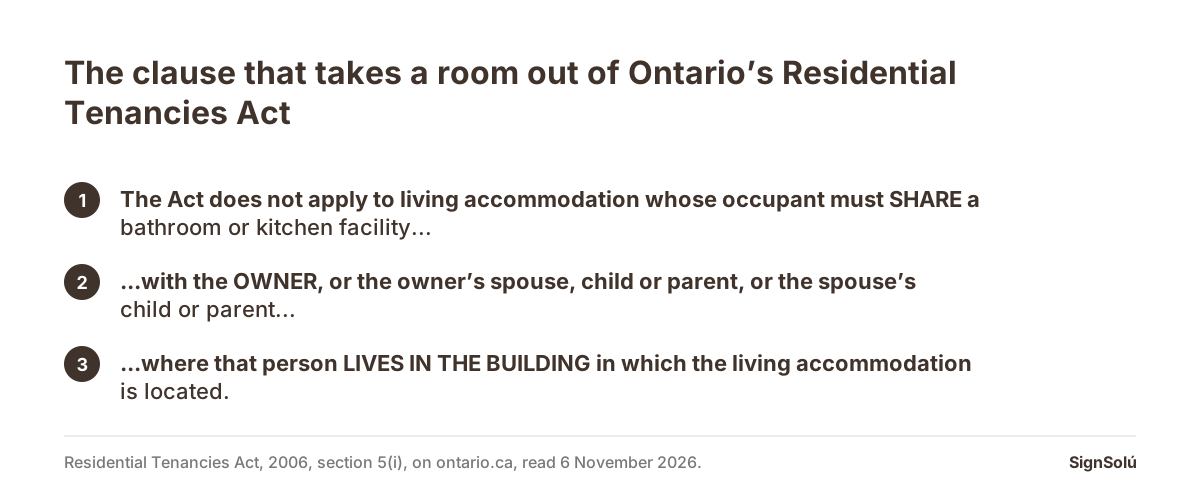
The Act does not apply with respect to living accommodation whose occupant or occupants are required to share a bathroom or kitchen facility with the owner, the owner’s spouse, child or parent or the spouse’s child or parent, and where the owner, spouse, child or parent lives in the building in which the living accommodation is located.
Three elements have to line up. There has to be required sharing of a bathroom or a kitchen — not a shared hallway, not a shared laundry room. The person shared with has to be the owner or one of the listed relatives, not another tenant. And that person has to live in the building, not merely own it.
Change any one of those and the exemption stops working. An owner who moves out while keeping the room rented is outside clause (i) from the day they move. A basement room with its own bathroom and kitchenette is outside it even if the owner lives upstairs. A room shared only with other roomers, in a house whose owner lives elsewhere, is outside it.
What is switched off, concretely
It helps to see what the Act would otherwise give, because that is exactly the list that the agreement now has to cover on its own.
Section 37(1) says a tenancy may be terminated only in accordance with this Act. Section 37(4) voids a tenant’s notice to terminate if it is given at the time the tenancy agreement is entered into, or as a condition of entering into it — which is the provision that stops a landlord from collecting a pre-signed move-out notice. Section 43(1) requires a notice of termination to be in a form approved by the Board, to identify the rental unit, to state the termination date and to be signed.
Section 14 says a provision in a tenancy agreement prohibiting the presence of animals in or about the residential complex is void. Section 15 says a provision making all or part of the remaining rent, or a specific sum, become due on the tenant’s default is void. Section 16 imposes a duty on whoever is entitled to claim an amount after a breach to take reasonable steps to minimize their losses.
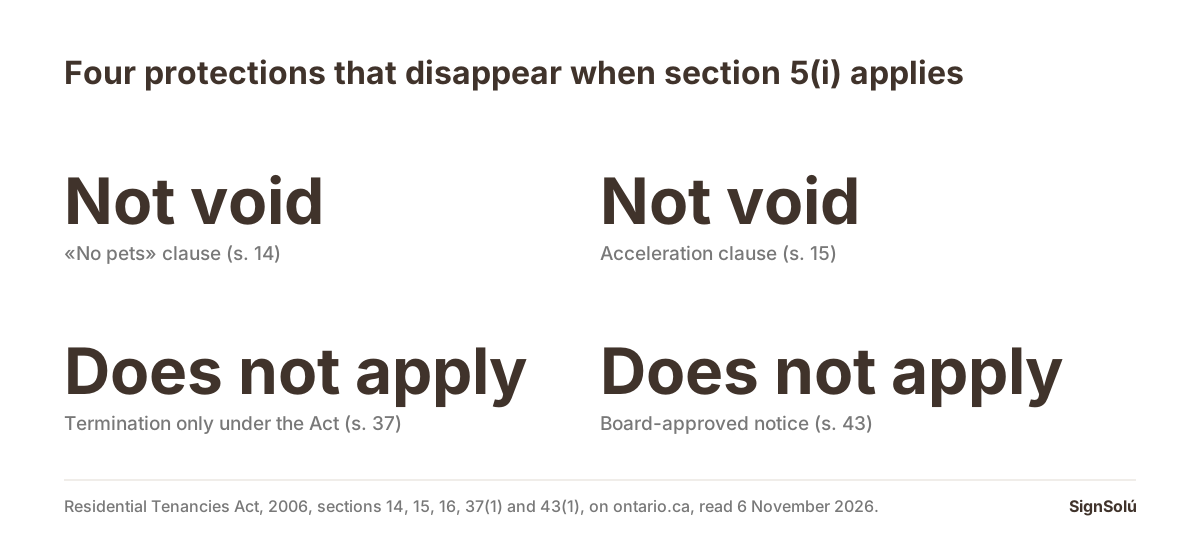
So in an exempt room rental, a no-pets clause is an ordinary contract term, an acceleration clause is an ordinary contract term, and notice is whatever the two people wrote down. That cuts both ways. The owner gains flexibility they would not have with a tenant; the person renting the room loses the floor they would otherwise stand on. Neither side usually realises this at the moment of signing, which is why the document deserves more care here than in a regular tenancy, not less.
The clauses the agreement has to carry itself
| Clause | What to write | Why it falls to the agreement |
|---|---|---|
| Notice to end | How many days, by whom, in writing, and how it is delivered | s. 43(1) and its Board-approved form do not apply |
| Term | Fixed term or month to month, and what happens at the end | s. 37(1) does not confine termination to the Act |
| Rent | Amount, due date, method of payment and receipt | The Act’s rent rules are not in play |
| Deposit | What is held, for what, and when it comes back | Write it, because the Act’s limits are not the backstop |
| Shared spaces | Which bathroom and kitchen, and the house rules for each | The sharing is what triggers the exemption in the first place |
| Guests and overnight stays | What is allowed, with numbers | There is no statutory standard to default to |
| Pets | Allowed or not, and for which animals | s. 14 would have voided a prohibition; here it does not |
| Default | What happens on late rent, without an acceleration clause if you can avoid it | s. 15 would have voided acceleration; here it does not |
| Entry | Whether the owner may enter the room, when and on what notice | The Act’s privacy and entry rules do not apply |
| Inventory | Furniture and condition of the room, listed and dated | Decides what is owed when the room is handed back |
The form this piece lands on is the roommate agreement, which is the one that fits an arrangement the Act does not govern; for a lodger in a landlord’s home in the UK, which is the closest equivalent arrangement in another jurisdiction, see free lodger agreement templates in the UK and what they get wrong and the lodger agreement. For an ordinary residential tenancy, the lease agreement, the simple lease agreement, the month-to-month lease agreement and, for a short stay, the short-term rental agreement. For screening, the background check authorization form.
How to tell which side of clause 5(i) you are on
- Is the sharing required, or just convenient? The clause says the occupant is required to share a bathroom or kitchen facility.
- Which facility is shared? Clause 5(i) names a bathroom or a kitchen, and nothing else.
- Who is on the other side of the sharing? It has to be the owner, or the owner’s spouse, child or parent, or the spouse’s child or parent.
- Does that person live in the building? Owning it is not enough; the clause says lives in the building.
- Does the room have its own bathroom and kitchen? If it does, there is no required sharing and the clause does not fit.
- Has any of the above changed since the arrangement started? The test is read against the facts as they are, not as they were.
If the answers put the arrangement inside the Act, its machinery is back: the notice form, the termination rule, the void clauses and the duty to minimize losses. If they put it outside, the document in the drawer is the whole of the law between the two people, and it should read like it. Either way the useful move is the same: write it down, date it, and keep the signed copy where both of you can find it. For a furnished room, the condition list belongs with it, in the spirit of the storage agreement for goods and of the lease addendum for anything added later.
The day the exemption stops applying
This is the part worth planning for, because it changes the legal regime without anyone signing anything. If the owner moves out, or the shared kitchen is replaced by a kitchenette in the room, the three elements of clause (i) no longer line up, and the arrangement may fall inside the Act from that point. An agreement written as though the exemption were permanent then sits awkwardly against a statute that voids some of its clauses.
The sensible habit is to write the agreement so that it would still be reasonable if the Act applied: no acceleration clause, a notice period that is not punitive, a deposit that is defined and returnable. That costs the owner little and removes the cliff edge. How an end-of-lease exit works where a statute does govern is described in what happens if you break a lease, and the related forms are the lease termination letter and the lease extension agreement.
If the person renting the room is coming from Mexico
Rooms in Canadian homes are often rented to students and workers arriving from Mexico, which adds two practical questions and no new law. The first is language: a document signed in a language the signer does not read is a weak document, whatever the law says, and the bilingual question is set out in bilingual contracts in Mexico and which language prevails. The second is distance, because the agreement usually has to be signed before the flight. The Mexican counterpart of this document, for the mirror situation of renting in Mexico, is covered in renting in Mexico City as an American, the longer stay in retiring in Mexico and the documents you sign, and the Spanish-language catalogue of Mexican forms is at las plantillas.
Signing it before anyone moves in
In an exempt room rental the agreement is the only text there is, so the one thing you do not want is for it to be unsigned when the keys change hands. That is a scheduling problem more than a legal one: the person arrives on a Sunday, the document is on a laptop, and the first month runs on good faith.
With SignSolú the agreement goes out over WhatsApp from your own number or by email, the other person signs from their phone without creating an account and without paying, and the audit receipt records the time, the IP address, the device and the SHA-256 hash of the file. Anyone can later check that the document did not change at the verification page, with no account. The sender chooses each signer’s language, so a signer in English receives the email, the WhatsApp message and the signing page in English. The free plan is 10 documents, with no expiry date and no card. Whether an electronic signature binds, and where, is in is an electronic signature legally binding, and where, and the remote-signing walkthrough with a Mexican counterpart is in how to sign a contract remotely with someone in Mexico.
Frequently asked questions
Is a roomer in Ontario a tenant under the Residential Tenancies Act?
Not where section 5(i) applies. The Act does not apply to living accommodation whose occupant is required to share a bathroom or kitchen facility with the owner, or the owner’s spouse, child or parent or the spouse’s child or parent, where that person lives in the building in which the accommodation is located.
What if the shared space is a laundry room or a hallway?
Clause 5(i) names a bathroom or kitchen facility. Sharing other space is not what the clause describes, so the exemption would not rest on it.
Does it matter whether the owner actually lives there?
Yes. The clause requires that the owner, spouse, child or parent lives in the building in which the living accommodation is located. An owner who rents out the room and lives elsewhere does not meet that part of the test.
Can I put a no-pets clause in a room rental agreement?
Section 14 of the Act voids a provision in a tenancy agreement prohibiting the presence of animals in or about the residential complex. Where section 5(i) takes the arrangement outside the Act, section 14 is not in play and the clause is an ordinary contract term.
How much notice has to be given to end it?
Whatever the agreement says. The Act’s rules — section 37(1), that a tenancy may be terminated only in accordance with the Act, and section 43(1), which requires a notice in a form approved by the Board — do not apply to an arrangement exempt under section 5(i).
What if the owner moves out partway through?
The three elements of clause 5(i) stop lining up, and the arrangement may fall inside the Act from that point. That is a good reason to write the agreement so that it would still be reasonable if the Act applied.
Send your next contract to Mexico for signature
Create a free account and send 10 documents with no card. Your dashboard works in English. You set the language per signer, and their email, WhatsApp message and signing page arrive in that language.