Residential tenancy agreement: what changed in England on 1 May 2026, and why most templates are now wrong
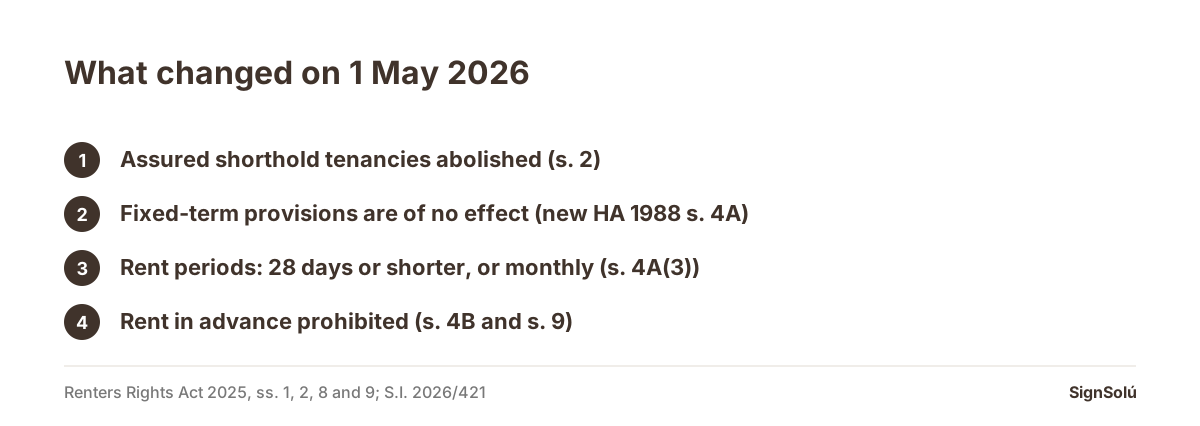
In England the shape of a residential tenancy changed on 1 May 2026, when the main tenancy provisions of the Renters’ Rights Act 2025 came into force for assured tenancies that are not social housing, by S.I. 2026/421. Section 1 of that Act inserts section 4A into the Housing Act 1988: terms of an assured tenancy are of no effect so far as they provide for a fixed term, and the tenancy then has effect as a periodic tenancy whose periods match the rent periods, with each rent period either 28 days or shorter or monthly. Section 2 omits Chapter 2 of Part 1 of the 1988 Act, which is where assured shorthold tenancies lived. So a template headed «assured shorthold tenancy agreement» with a twelve-month fixed term is describing something that no longer exists.
Why the templates went out of date all at once
For more than thirty years a residential letting in England meant an assured shorthold tenancy: a fixed term, usually six or twelve months, then a statutory periodic tenancy, with possession available on notice. Every template, every letting agent’s pack and every explainer was built on that shape. The Renters’ Rights Act 2025 removed it, and the commencement regulations brought the change in for private assured tenancies on 1 May 2026.
The result is that a document can be perfectly well drafted and still be wrong, because it describes a category the statute no longer has. This page sets out what changed in the agreement itself. It is about the document, not about possession proceedings.
| The clause | Before | Since 1 May 2026 | Authority |
|---|---|---|---|
| Type of tenancy | Assured shorthold tenancy | Assured tenancy; Chapter 2 of Part 1 omitted | RRA 2025, s. 2 |
| Term | Fixed, usually 6 or 12 months | Fixed-term provisions are of no effect; periodic | HA 1988, s. 4A(1) and (2) |
| Rent period | Any, commonly monthly | 28 days or shorter, or monthly | HA 1988, s. 4A(3) |
| Rent in advance after the tenancy starts | Often several months | Terms providing for rent due in advance are of no effect | HA 1988, s. 4B |
| Rent demanded before the tenancy is entered into | Common | A prohibited payment under the Tenant Fees Act 2019 | RRA 2025, s. 9 |
| Written statement of terms | Good practice | A duty on the landlord, with prescribed content | HA 1988, s. 16D |
| Tenant’s notice to quit | Common law and the 1977 Act | Timing rules amended | RRA 2025, s. 20 |
The fixed term: not void, «of no effect»
Section 1 of the Act inserts a new section 4A into the Housing Act 1988. Subsection (1) says that terms of an assured tenancy are of no effect so far as they provide for a tenancy to be a fixed term tenancy, or for periods of the tenancy to be different from the periods for which rent is payable. Subsection (2) supplies what happens instead: the tenancy has effect as a periodic tenancy under which the periods of the tenancy are the same as the rent periods.
The drafting matters. The agreement does not fail; the clause does, and the statute substitutes a periodic tenancy. So a landlord who uses an old twelve-month template still has a tenancy — just not the one the document describes, which makes the rest of the document harder to rely on and the conversation with the tenant harder to have.
Rent periods: 28 days or shorter, or monthly
Subsection (3) of the new section 4A says that terms providing for the rent periods are of no effect unless each rent period is a period of 28 days or shorter, or a monthly rent period. Subsection (4) allows different rent periods at different times, provided each is permitted. And subsection (5) says that where the terms fail this test, the tenancy has effect as if it provided for successive monthly rent periods beginning with the first day of the tenancy, with the rent calculated by a formula in the Act and due on the first day of the period.
Quarterly and annual rents are the casualty. A letting drafted with rent payable each quarter — common where a tenant pays from a bursary, a grant or an overseas account — converts to monthly by operation of the statute, with the due date moved to the first of the period.
Rent in advance, twice over
The Act closes this from both sides, which is why it catches practices that felt settled. Section 8 inserts section 4B into the 1988 Act: terms of an assured tenancy which provide for when rent is due are of no effect so far as they provide for rent to be due in advance, with exceptions for tenancies entered into before the commencement date, for excepted tenancies, and for initial rent due during the permitted pre-tenancy period. Where a term fails, the tenancy has effect as if the rent for that period were due on a substitute rent day.
And section 9 amends Schedule 1 to the Tenant Fees Act 2019, the schedule of permitted payments. After the paragraph that makes rent a permitted payment, it inserts that a payment of rent is a prohibited payment if it is payable before the tenancy is entered into and the tenancy is an assured tenancy. So the familiar «six months up front» offer from a tenant without a UK guarantor is no longer a thing a landlord can accept in that form. The deposit rules of the 2019 Act are untouched by this point and still apply.
The written statement duty
Section 12 inserts section 16D into the 1988 Act: the landlord under a tenancy to which the section applies must give the tenant a written statement of such terms of the tenancy as are specified in regulations made by the Secretary of State — whether as an agreement in writing or as a record of terms otherwise agreed — and of any other information required by regulations about the tenancy, the dwelling-house and other prescribed matters.
Two consequences for the document. The written agreement stops being merely good practice and becomes the way a statutory duty is discharged, and its content is set partly by regulations rather than by the parties. Which is the strongest argument for using a current template rather than an inherited one: an old agreement cannot contain content that did not exist when it was written.
What a current agreement should still settle
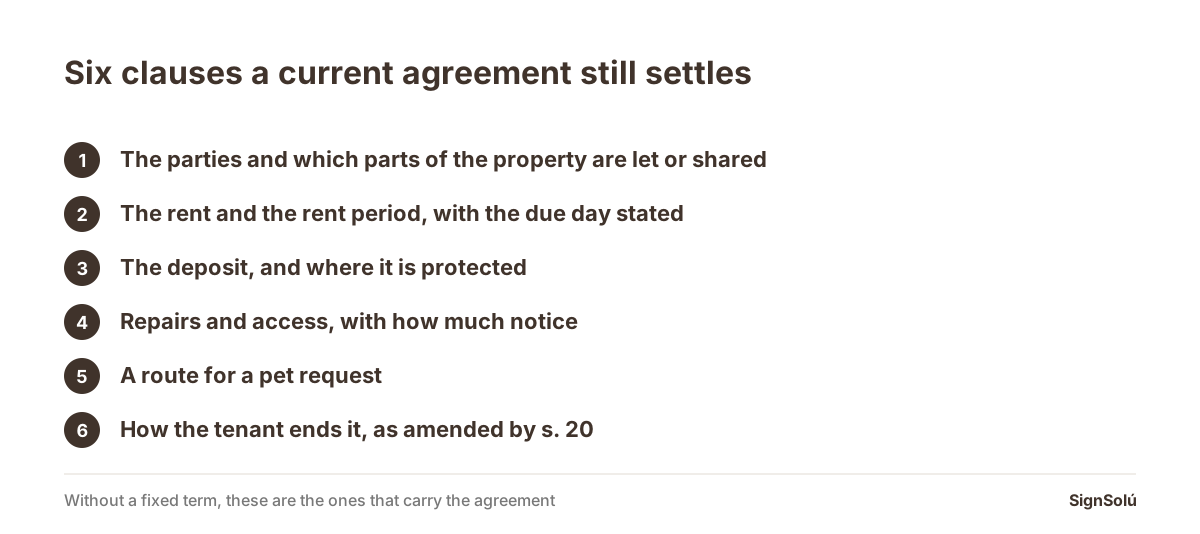
Removing the fixed term does not remove the need for a document. It changes which clauses carry the weight, and most of the clauses that matter are the ones that were always buried at the back.
- 1The parties and the property, including which parts are let and which are shared. If the landlord lives there, the arrangement is a different one: the lodger agreement template, and what those templates usually get wrong is set out in free lodger agreement templates in the UK.
- 2The rent and the rent period, inside the 28-day-or-monthly limit, with the due day stated.
- 3The deposit, with where it is protected, under the deposit rules that continue to apply.
- 4Repairs and access, with how much notice the landlord gives and how an appointment is arranged.
- 5Pets, because the Act gives a tenant a right to request permission to keep one and that request needs a route.
- 6Ending it, with the tenant’s notice route as amended by section 20 of the Act, which changes the timing rules in section 5 of the Protection from Eviction Act 1977.
A template written for the current regime is the tenancy agreement template. Where the let is of land rather than a dwelling, it is the land lease agreement, with the formalities set out in the three-year and seven-year thresholds. To change an existing agreement, the lease addendum; to extend it, the lease extension agreement; to end it, the lease termination letter. What a tenant actually owes on leaving early is in what happens if you break a lease, and if the arrangement is really a purchase in instalments, the clauses that decide that are in the lease-to-own contract template.
If you hold agreements signed before May
Section 4B expressly carves out tenancies entered into before the commencement date, and the commencement regulations carry a set of transitional and saving provisions covering rent increases already in train, possession grounds and legacy tenancies. That is a reason to date and keep every agreement properly rather than to assume everything converted at once: which regime a particular letting sits in depends on when it was entered into, and that is a question about a date on a document.
Which is a records problem, not a legal one. A landlord with four properties and eight agreements signed over six years needs to be able to produce each one with its date, unaltered, and most cannot. The habit that fixes it is signing and storing them the same way every time.
Signing it, and keeping the dated original
A tenancy agreement for a dwelling is an ordinary contract, not a deed, so it does not need the witness formalities that a long land lease does. What it does need is a reliable record of who signed and when, because the date now decides which regime applies.
With SignSolú the agreement and the written statement go out over WhatsApp from your own number or by email, the tenant and any guarantor sign from a phone without creating an account or paying anything, and the audit receipt records the time, the IP address, the device and the SHA-256 hash of the file, with each signature timed separately. Anyone can check later that the document did not change at the verification page, with no account, which is exactly what a dated agreement needs to be worth years afterwards. The sender picks each signer’s language, so a tenant who reads Spanish gets the email, the WhatsApp message and the signing page in Spanish. SignSolú is a Mexican platform and is not an accredited certification provider in Mexico; it does not issue NOM-151 conservation certificates. The general question of validity is in is an electronic contract valid. The free plan is 10 documents with no expiry and no card; start at register.
Frequently asked questions
Can a residential tenancy in England still have a fixed term?
Not as a term of the tenancy. Section 4A(1) of the Housing Act 1988, inserted by section 1 of the Renters’ Rights Act 2025, makes terms providing for a fixed term of no effect, and subsection (2) gives the tenancy effect as a periodic tenancy whose periods match the rent periods.
Do assured shorthold tenancies still exist?
Section 2 of the Renters’ Rights Act 2025 omits Chapter 2 of Part 1 of the Housing Act 1988, which is where assured shorthold tenancies were set out, and that section came into force for specified purposes on 1 May 2026 by S.I. 2026/421.
Can rent still be paid quarterly?
Section 4A(3) says terms providing for rent periods are of no effect unless each rent period is 28 days or shorter, or monthly. Where they fail, subsection (5) gives the tenancy effect as if it provided for successive monthly rent periods from the first day of the tenancy, with rent due on the first day of each period.
Can a tenant pay six months up front?
Section 9 of the Act amends Schedule 1 to the Tenant Fees Act 2019 so that a payment of rent is a prohibited payment if it is payable before the tenancy is entered into and the tenancy is an assured tenancy. Section 4B separately makes terms providing for rent due in advance of no effect, with limited exceptions.
Does the landlord have to give a written agreement?
Section 16D, inserted by section 12 of the Act, requires the landlord to give the tenant a written statement of the terms specified in regulations, whether as a written agreement or as a record of terms otherwise agreed, plus other prescribed information.
What about agreements signed before 1 May 2026?
Section 4B expressly excepts tenancies entered into before the commencement date, and the commencement regulations carry transitional and saving provisions. Which regime a letting sits in therefore depends on when it was entered into, so the date on the signed agreement matters.
Send your next contract to Mexico for signature
Create a free account and send 10 documents with no card. Your dashboard works in English. You set the language per signer, and their email, WhatsApp message and signing page arrive in that language.