Free lodger agreement templates in the UK: what most of them get wrong
A lodger who shares accommodation with a resident landlord is an excluded occupier under section 3A of the Protection from Eviction Act 1977, not an assured periodic tenant. That single difference is what most free templates get wrong: they are tenancy agreements with the word lodger swapped in, so they import fixed terms, deposit protection language and notice periods that do not apply, and they leave out the house rules that actually matter when two people share a kitchen. Get the status right first, then the five clauses below.
Lodger or tenant: the line that changes everything
The word lodger has no magic in it. What decides your legal position is whether you share accommodation with the person who lets the room, and whether that person lives there as their only or principal home. Get that right and the rest of the agreement follows; get it wrong and you have signed something that does not describe your arrangement. The same mistake in reverse turns up when a room is sublet rather than lodged, which is a different document again: a sublease agreement.
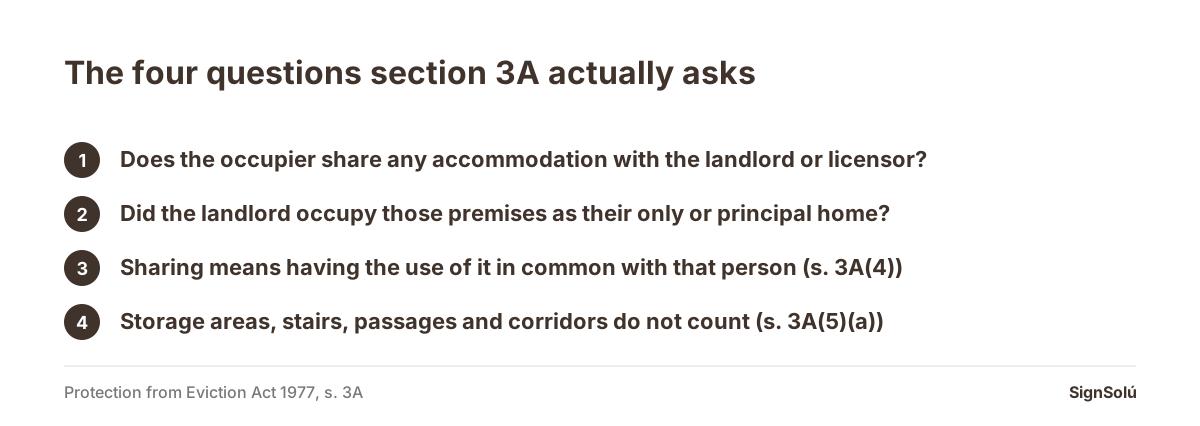
Section 3A of the Protection from Eviction Act 1977 sets out the excluded tenancies and licences. Subsection (2) covers the case most people mean by lodging: the tenancy or licence is excluded if, under its terms, «the occupier shares any accommodation with the landlord or licensor» and, immediately before the tenancy or licence was granted and also at the time it comes to an end, the landlord or licensor occupied as his only or principal home premises of which the whole or part of the shared accommodation formed part. Subsection (3) extends the same treatment to sharing with a member of the landlord’s family.
Two definitions in the same section stop the usual arguments. Subsection (4) says an occupier shares accommodation with another person «if he has the use of it in common with that person». And subsection (5)(a) narrows what counts: «accommodation» includes neither an area used for storage nor a staircase, passage, corridor or other means of access. So a shared hallway is not sharing. A shared kitchen or bathroom is.
| Lodger (excluded occupier) | Assured periodic tenant | |
|---|---|---|
| Landlord lives in the same accommodation | Yes, as their only or principal home | No |
| Shares kitchen or bathroom with the landlord | Yes | No |
| Exclusive possession of the whole home | No | Yes |
| Court order needed to end the arrangement | No | Yes |
| Notice | Reasonable notice, usually the rent period | The statutory regime for the tenancy |
| Written agreement required by statute | No, but the terms should be in writing | Key terms must be in writing |
The contrast matters more than it used to. Gov.uk’s guidance on private renting tenancy agreements states that on 1 May 2026 all assured tenancies, including assured shorthold tenancies, automatically became rolling tenancies, and that any end date in the agreement will no longer apply. The same guidance lists the conditions for an assured periodic tenancy, and two of them are that the landlord does not live in the property and that the tenancy cannot be an assured periodic tenancy if the landlord lives in the same accommodation. If you are letting a spare room in the house you live in, that is exactly the case the regime excludes, and a downloaded tenancy agreement template is the wrong document for it.
The five clauses free templates get wrong
1. A fixed term that locks you in
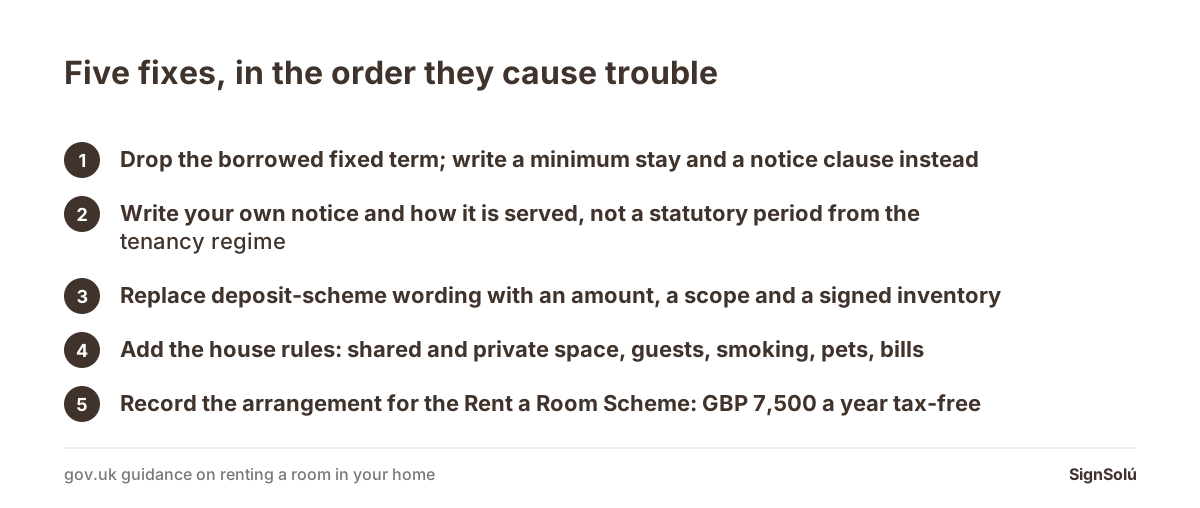
Tenancy templates open with a fixed term because tenancies used to have one. A lodger arrangement normally runs period to period, and a six or twelve month fixed term in a lodger agreement does the opposite of what the resident landlord wants: it binds the landlord too. If you want a minimum stay, say so as a minimum stay with a named end date and a notice clause after it, not as a fixed term borrowed from another document. If what you actually want is a rolling arrangement, the shape to copy is a month-to-month lease, not a fixed-term one like a simple lease agreement. The same logic applies when a fixed term ends early and someone wants out: breaking a lease walks through what that costs.
2. Notice copied from the wrong regime
Gov.uk’s guidance on renting a room in your home puts it plainly: as a resident landlord you «can give less notice to end a letting than if you rented out the property as a whole». A lodger agreement that imports a statutory notice period from the tenancy regime gives away that difference for nothing. Write the notice you actually want, usually matching the rent period, and write how it is served: by hand, by email or by message. Pinning the method down is what avoids the argument later, the same way a lease termination letter fixes the date and the method for a tenancy. If the arrangement changes mid-way rather than ending, the change goes in writing too: a lease addendum.
3. Deposit protection wording that does not apply
Free templates carry paragraphs about protecting the deposit in an authorised scheme because that is what a tenancy template needs. In a lodger arrangement the deposit is a contractual sum, so the agreement has to do the work the scheme would have done: how much it is, what it covers, what counts as damage beyond fair wear and tear, and when it comes back. What makes that work is an inventory with photographs, signed on the day the lodger moves in. Without it, every deduction becomes one person’s word against another’s. Signed photographs are worth more than a tick-list, and the same reasoning applies to an inventory for a short let: a short-term rental agreement treats the condition record as part of the contract.
4. No house rules, which is what the arrangement is really about
A tenant gets the whole property and the landlord stays out. A lodger shares a kitchen, a bathroom and a front door with the person who owns the place, and almost every lodger dispute is about that, not about rent. The clauses worth more than the legal boilerplate are the ordinary ones: which parts of the house are shared and which are private, whether the landlord may enter the room and on what notice, guests overnight, smoking and vaping, pets, cleaning, use of the washing machine, bills and who reads the meter. A roommate agreement covers similar ground between equals; here one party owns the house, so the rules have to say so. If you manage the let through an agent instead of doing it yourself, the duties move to a property management agreement.
5. Silence about tax, which is free money left on the table
The Rent a Room Scheme lets a resident landlord earn £7,500 per year tax-free, or £3,750 if the income is shared with someone else, according to the same gov.uk guidance. The agreement does not create the relief, but it is the document that proves the arrangement was a lodging in your own home if anyone asks. Writing the rent, the start date and the shared accommodation into a signed agreement is the cheapest record-keeping there is. What the small print of a let has to do in general is set out in conditions and terms.
- Who lives there. Full names of the resident landlord and of the lodger, and the address, written out.
- What is let. The room, by name or number, plus the list of shared accommodation. This is the clause that proves the excluded status, so do not compress it.
- Rent and bills. Amount, period, payment day, method, and whether bills are included or split.
- Deposit. Amount, what it covers, and the inventory it is measured against.
- Notice. How much, from either side, and how it is served.
- House rules. Guests, smoking, pets, cleaning, quiet hours, and access to the room.
Signing it, and why a photographed signature is the weak link
Nothing in the law requires a lodger agreement to be on paper. Section 7 of the Electronic Communications Act 2000 makes an electronic signature «incorporated into or logically associated with a particular electronic communication» admissible in evidence in relation to any question as to the authenticity or the integrity of the communication or data, together with the certification of that signature by any person. Subsection (2) defines the signature broadly: so much of anything in electronic form as is logically associated with the communication and purports to be used by the individual creating it to sign.
What that section rewards is evidence, not ceremony. A photograph of a signed page proves almost nothing: the image can be cropped from any earlier document, and nothing in the file records who signed, when, or whether the text changed afterwards. A signature captured with a record of time, device, IP address and a hash of the file is the version section 7 is built around. The wider picture for England is in what makes an electronic contract, and the mechanics of signing a file without printing it are in how to sign a PDF and signing a PDF on an iPhone.
In practice the problem is logistics, not law: the lodger is viewing three rooms this week and wants to decide tonight. SignSolú, an e-signature platform that works over WhatsApp, lets you send the agreement from your own number or by email; the lodger opens the link on their phone and signs without creating an account or paying anything, and the audit receipt records time, IP address, device and a SHA-256 fingerprint of the file. Anyone can check later at the verification page that the document was not altered, without an account. The free plan is 10 documents with no expiry and no card, which covers a spare room let a few times a year; you can start at create an account. If the lodger is moving to the UK from Mexico and you need the same agreement understood on both sides, bilingual contracts and which language prevails explains how a two-column agreement is handled, and cómo se avisa la terminación de un contrato (in Spanish) covers the notice side. The ready-made lodger agreement template already carries the clauses above.
Frequently asked questions
Is a lodger a tenant?
Usually not. Where the occupier shares accommodation with a landlord who lives there as their only or principal home, section 3A of the Protection from Eviction Act 1977 makes the tenancy or licence an excluded one. Gov.uk also says a tenancy cannot be an assured periodic tenancy if the landlord lives in the same accommodation.
Does sharing a hallway count as sharing accommodation?
No. Section 3A(5)(a) says accommodation includes neither an area used for storage nor a staircase, passage, corridor or other means of access. Sharing a kitchen or a bathroom counts; sharing the way in does not.
How much notice do I have to give a lodger?
There is no statutory period to copy from the tenancy regime. Gov.uk says a resident landlord can give less notice to end a letting than if the whole property were let, so the agreement should state the notice both sides must give, usually matching the rent period, and how it is served.
How much can I earn tax-free from a lodger?
Under the Rent a Room Scheme, £7,500 per year, or £3,750 if you share the income with someone else. The agreement does not create the relief, but it is the record that shows the arrangement was a lodging in your own home.
Does a lodger agreement have to be in writing?
No statute requires it, but writing it down is what settles the deposit, the notice and the house rules later. Gov.uk notes that even an oral tenancy agreement needs its key terms given in writing, and the same practical logic applies here.
Can a lodger agreement be signed electronically?
Yes. Section 7 of the Electronic Communications Act 2000 makes an electronic signature logically associated with an electronic communication admissible in evidence on questions of authenticity and integrity. What carries weight is the record around the signature: time, device, IP address and a fingerprint of the file.
Send your next contract to Mexico for signature
Create a free account and send 10 documents with no card. Your dashboard works in English. You set the language per signer, and their email, WhatsApp message and signing page arrive in that language.