What a signed waiver actually means, and the one thing it can never cover
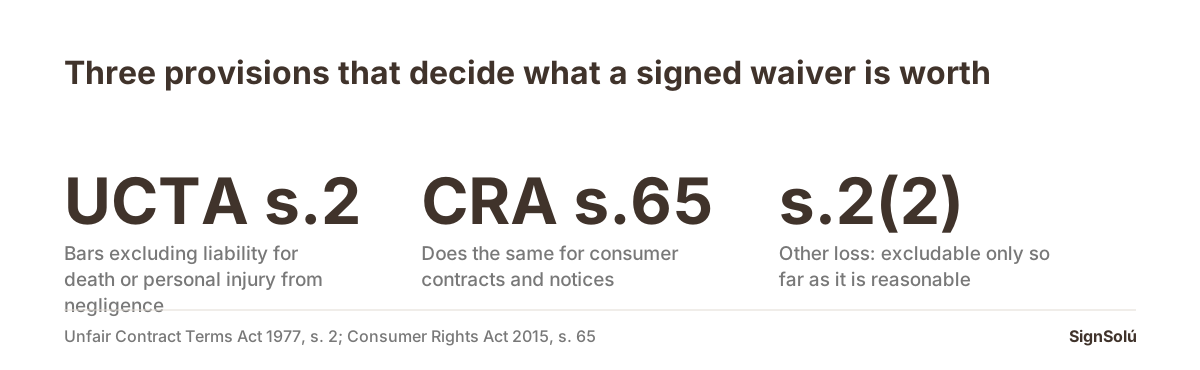
A signed waiver is a contract term or a notice in which someone agrees not to hold another person liable for something. In England and Wales two provisions decide what it is worth. Section 2(1) of the Unfair Contract Terms Act 1977 says a person cannot, by reference to any contract term or to a notice, exclude or restrict liability for death or personal injury resulting from negligence. Section 65(1) of the Consumer Rights Act 2015 says the same for a trader in a consumer contract or a consumer notice. For other loss or damage, section 2(2) allows exclusion only so far as the term or notice satisfies the requirement of reasonableness. And section 2(3) removes the second line of defence: agreement to or awareness of the term is not of itself to be taken as indicating voluntary acceptance of any risk.
What the word actually describes
A waiver is a term, or a notice, by which one person gives up a right against another — most often the right to claim for an injury or a loss. It can sit inside a contract or stand alone on a sign at the entrance. The usual names are liability waiver, release, disclaimer and assumption of risk, and in practice they are drafted as if signing one ended the matter.
What it does not do, in England and Wales, is move risk wherever the drafter wants. Two statutes set the outer boundary, and they are short enough to read in full.
Section 2 of the 1977 Act, in three subsections
Section 2 of the Unfair Contract Terms Act 1977 is titled Negligence liability.
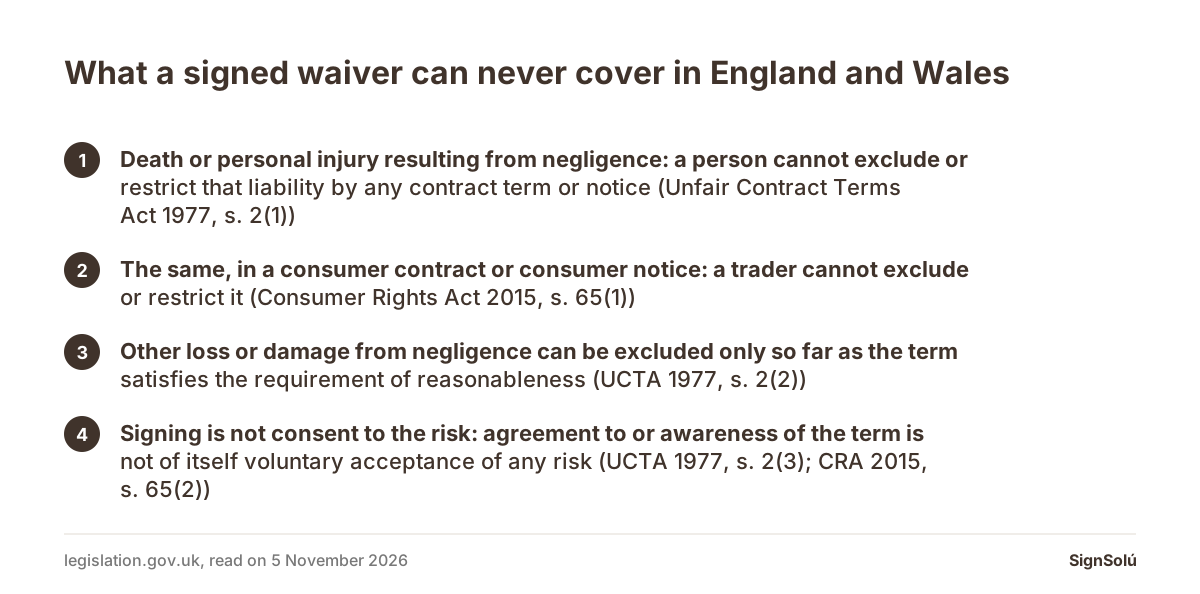
- 2(1): a person cannot by reference to any contract term or to a notice given to persons generally or to particular persons exclude or restrict his liability for death or personal injury resulting from negligence.
- 2(2): in the case of other loss or damage, a person cannot so exclude or restrict his liability for negligence except in so far as the term or notice satisfies the requirement of reasonableness.
- 2(3): where a contract term or notice purports to exclude or restrict liability for negligence, a person's agreement to or awareness of it is not of itself to be taken as indicating his voluntary acceptance of any risk.
Subsection (1) is the hard line. It is not a reasonableness test: death and personal injury from negligence cannot be excluded or restricted, by a term or by a notice, at all. A waiver that says otherwise does not become valid because the signature was voluntary, the font was large or the person was warned twice.
Subsection (3) is the one that surprises people, because it closes the obvious second argument. If the waiver cannot exclude the liability, the next move is usually to say the person accepted the risk by signing. The statute answers in advance: agreeing to or knowing about the term is not, of itself, voluntary acceptance of the risk.
Section 2(4) notes that the section does not apply to a term in a consumer contract or a consumer notice — not because consumers get less protection, but because they get it somewhere else.
Section 65 of the 2015 Act: the consumer side
For consumers the provision is section 65 of the Consumer Rights Act 2015, titled Bar on exclusion or restriction of negligence liability.
Subsection (1): a trader cannot by a term of a consumer contract or by a consumer notice exclude or restrict liability for death or personal injury resulting from negligence. Subsection (2) mirrors the 1977 Act's point about consent: where a term or notice purports to exclude or restrict a trader's liability for negligence, a person is not to be taken to have voluntarily accepted any risk merely because the person agreed to or knew about the term or notice.
Subsection (3) defines personal injury to include any disease and any impairment of physical or mental condition, which matters for waivers that try to carve out "illness" as something separate from injury.
So the two statutes draw the same line for business-to-business and business-to-consumer. Whichever side of it your waiver sits on, death and personal injury from negligence stay with the person who was negligent.
So what is a waiver good for
Quite a lot, as long as it is used for what it can do rather than what it cannot. A well-drafted waiver still does four useful things.
- 1It records information given. The specific risks that were described, in the words they were described in. That record is evidence about what a reasonable participant understood, which is a different question from whether liability was excluded.
- 2It records what the person told you. Medical conditions, experience level, age of a participant, the declaration that a parent has authority to sign for a child. That is often the most valuable part of the file.
- 3It allocates risks that can be allocated. Damage to property, loss of possessions, cost of a cancelled session — the kinds of loss that section 2(2) lets you exclude so far as it is reasonable.
- 4It sets the rules of participation. Conduct, instructions to follow, grounds for removal. These are obligations, not exclusions, and they are enforceable as any contract term.
| Clause in the waiver | Does it work | Why |
|---|---|---|
| "I release the operator from all liability for injury" | No, for negligence | Section 2(1) of UCTA 1977 and section 65(1) of CRA 2015 bar it for death and personal injury |
| "I accept all risks inherent in the activity" | Partly | It is evidence, but section 2(3) says agreement is not of itself voluntary acceptance of risk |
| "The operator is not liable for lost or damaged property" | Possibly | Other loss: allowed under section 2(2) so far as reasonable |
| "I confirm I have no medical condition that..." | Yes, as a declaration | It is a statement of fact by the signer, not an exclusion of liability |
| "I will follow the instructor's instructions" | Yes | An obligation, not an exclusion |
| "No refunds for cancellation within 24 hours" | Possibly | A commercial term, judged on fairness in a consumer contract |
| "I consent to photographs being used" | Separate question | Data protection and image rights, not negligence liability |
| Parent signing for a child | Yes for consent, not for the child's claim | A parent cannot waive a child's right to claim for personal injury |
The template and the clause-by-clause walkthrough are in the signed waiver guide. The construction cousin of the same document — a release that gives up a payment claim rather than an injury claim — is in lien release preparation, and the medical consent version in a medical consent form for a minor.
The waiver that is really a consent form
A lot of documents called waivers are consent forms wearing the wrong name: the person is not giving up a claim, they are agreeing to a procedure after being told what it involves. That is a stronger document, because consent is exactly what the law wants recorded, and it does not run into section 2 at all.
If that is what yours is, say so in the title and in the operative clause. The Mexican version of informed consent, where the content is set by a health standard rather than left to the drafter, is in dental work in Mexico: the consent form.
Insurance is the part the waiver cannot replace
This is the practical conclusion, and it is the reason the statutory bar is not a hardship. If liability for personal injury from negligence cannot be excluded, the way to carry that risk is public liability insurance, not paperwork. A waiver that is treated as a substitute for cover is the only version of this document that actually creates exposure.
Collecting them without a clipboard
Waivers are signed in volume, at the door, under time pressure, which is why so many end up illegible, undated or unsigned by one of two participants. The useful part — what was disclosed, by whom, and when — is the part that paper loses.
SignSolú is a Mexican e-signature platform that works over WhatsApp. The waiver goes out by WhatsApp from your own number or by email, the person signs from their own phone without opening an account or paying, and the audit receipt records time, IP address, device and the SHA-256 hash of the file. Anyone can check a signed document at the verification page with no account. The sender chooses the language for each signer, so a signer who reads English gets the email, the WhatsApp message and the signing page in English. What the platform stores is in trust, the plans are in pricing, and the free plan is 10 documents with no expiry and no card. You can create an account and send the first one today.
What an electronic signature is worth in England and elsewhere is in is an electronic signature legally binding, and where and in the validity note for the United Kingdom. Two other English-law documents where a single subsection changes the result: the settlement agreement and the horse lease and the welfare duty. For a party in Mexico, how to sign a contract remotely with someone in Mexico and the validity note for Mexico. The adjacent templates are the liability waiver, the location release form, the photo release form and the data privacy consent form.
Frequently asked questions
What does a signed waiver actually mean?
That someone has agreed, by a contract term or a notice, to give up a right against another person — usually the right to claim for a loss or an injury. What it is worth depends on what it tries to cover.
Can a waiver exclude liability for injury?
Not for death or personal injury resulting from negligence. Section 2(1) of the Unfair Contract Terms Act 1977 says a person cannot exclude or restrict that liability by any contract term or by a notice, and section 65(1) of the Consumer Rights Act 2015 says the same for a trader in a consumer contract or consumer notice.
Does signing mean I accepted the risk?
Not by itself. Section 2(3) of the 1977 Act says that where a term or notice purports to exclude or restrict liability for negligence, a person's agreement to or awareness of it is not of itself to be taken as indicating voluntary acceptance of any risk. Section 65(2) of the 2015 Act says the same for consumers.
What can a waiver exclude?
Other loss or damage from negligence, such as damage to property, but only so far as the term or notice satisfies the requirement of reasonableness under section 2(2) of the 1977 Act. In a consumer contract the term is also measured for fairness under the Consumer Rights Act 2015.
Can a parent waive a child's right to claim?
A parent can give consent for a child to take part and can make declarations about the child, but a parent cannot give up the child's own right to claim for personal injury. The statutory bar on excluding that liability applies whoever signs.
Is a waiver pointless then?
No. It records what risks were described and in what words, records what the participant told you about themselves, allocates the losses that can be allocated, and sets the rules of participation. What it cannot do is replace public liability insurance.
Send your next contract to Mexico for signature
Create a free account and send 10 documents with no card. Your dashboard works in English. You set the language per signer, and their email, WhatsApp message and signing page arrive in that language.