Signed waiver: what makes it hold up, with a template to sign online
Reviewed in October 2026
A signed waiver is a document in which a participant gives up the right to sue for injuries from the ordinary risks of an activity. Courts usually enforce it when the language is clear, the release stands out and the person signed it freely. It does not cover gross negligence or intentional harm.
What courts look at in a waiver
| Factor | What helps the waiver |
|---|---|
| Clear language | Plain words a participant understands |
| Conspicuous release | The release in its own section, in visible type |
| Specific risks | The activity and its main risks named |
| Voluntary signature | Signed before the activity, without pressure |
| Scope | Covers ordinary negligence, not gross negligence |
| Public interest | Not an essential service like medical care |
| Proof | A record of who signed and when |
What a waiver cannot cover
- Gross negligence or reckless conduct, in most states.
- Intentional harm.
- Violations of safety laws.
- Essential services, such as medical treatment, in many states.
A few states, Louisiana and Virginia among them, generally do not enforce releases signed before an injury for personal injury claims. Check your state before relying on a waiver.
Waivers for minors
A minor cannot give a binding release alone. A parent or guardian signs. Some states enforce parental waivers for recreational activities, and others do not.
Even where a parental waiver is weak, many operators collect it with a medical consent and an emergency contact, which are useful on their own.
Liability waiver template
Fill in the brackets with your business, activity and state. Keep the release section easy to see.
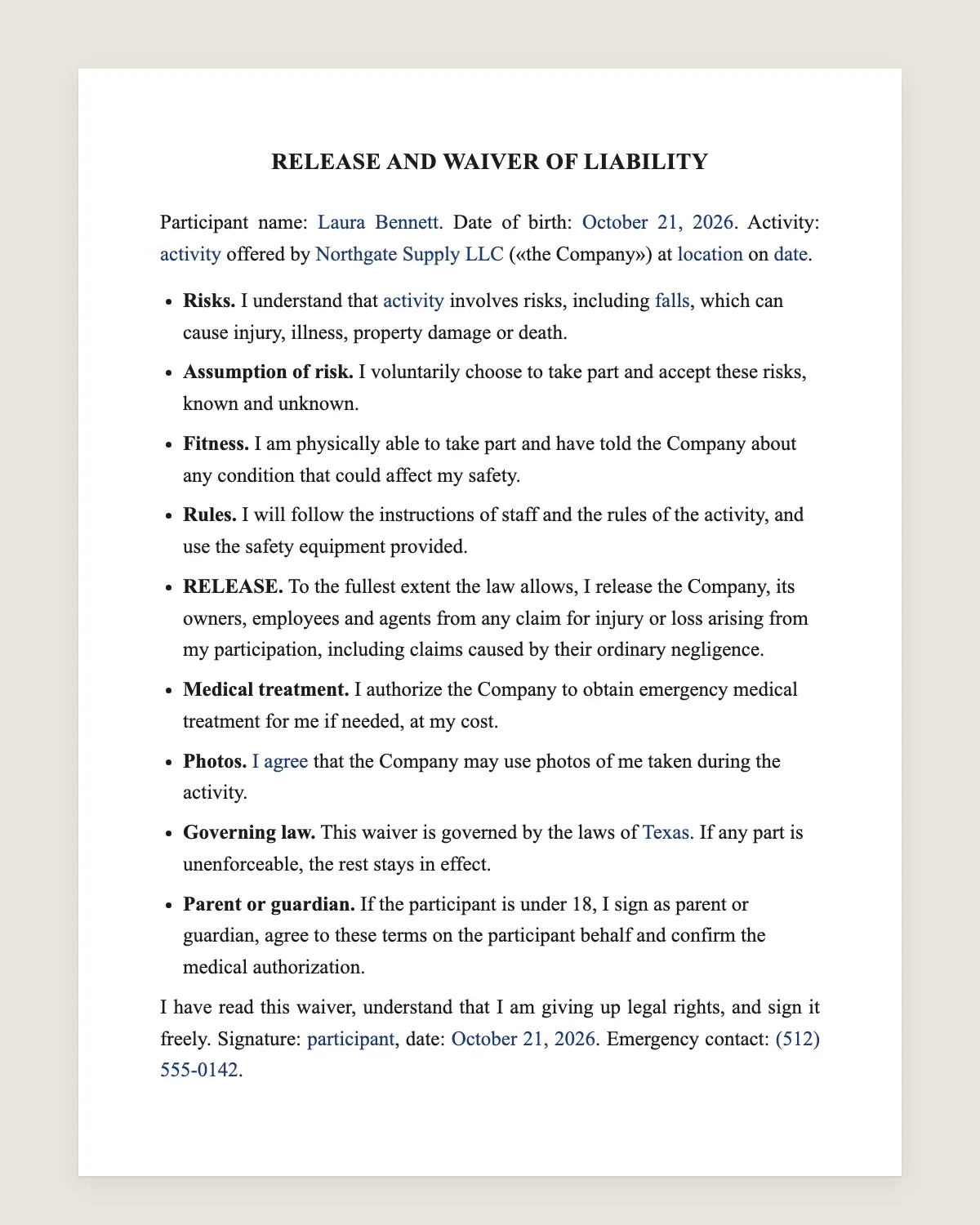
RELEASE AND WAIVER OF LIABILITY
Participant name: [name]. Date of birth: [date]. Activity: [activity] offered by [business legal name] («the Company») at [location] on [date or period].
- 1Risks. I understand that [activity] involves risks, including [list the main risks, for example falls, collisions, equipment failure, weather and physical exertion], which can cause injury, illness, property damage or death.
- 2Assumption of risk. I voluntarily choose to take part and accept these risks, known and unknown.
- 3Fitness. I am physically able to take part and have told the Company about any condition that could affect my safety.
- 4Rules. I will follow the instructions of staff and the rules of the activity, and use the safety equipment provided.
- 5RELEASE. To the fullest extent the law allows, I release the Company, its owners, employees and agents from any claim for injury or loss arising from my participation, including claims caused by their ordinary negligence.
- 6Medical treatment. I authorize the Company to obtain emergency medical treatment for me if needed, at my cost.
- 7Photos. [I agree / I do not agree] that the Company may use photos of me taken during the activity.
- 8Governing law. This waiver is governed by the laws of [state]. If any part is unenforceable, the rest stays in effect.
- 9Parent or guardian. If the participant is under 18, I sign as parent or guardian, agree to these terms on the participant behalf and confirm the medical authorization.
I have read this waiver, understand that I am giving up legal rights, and sign it freely. Signature: [participant or parent], date: [date]. Emergency contact: [name and phone].
Use this template to fill it in and send it to sign from SignSolú.
How to sign a waiver online
Upload a waiver to SignSolú or start from a template. Add each signer with a name and a phone number or email.
Each signer gets a link by WhatsApp or email. On a phone they tap the brown bar at the bottom that says «Sign as …».
They draw their signature once with a finger and press «Sign and Send». Every place in the document that needs it gets filled.
A line next to that button records their consent to sign electronically, with a link to the disclosure.
The signed PDF ends with an audit certificate. It shows each signer, the time, the IP address and a SHA-256 hash of the file.
For a one-off letter or form, you can also sign it online for free from a PDF or a photo of the paper.
Each participant gets their own link, so the certificate ties every waiver to one phone number or email. Send it the day before, and check names at the door instead of handing out pens.
Paper waiver or signed online
| Paper at the front desk | Signed online | |
|---|---|---|
| When | At arrival, in a line | Before arrival, at home |
| Read time | Rushed | As long as the person wants |
| Proof of signer | Handwriting only | Phone or email, time and IP address |
| Storage | Boxes and folders | Searchable archive |
| Finding it later | Hours | Seconds |
Electronic signatures on waivers are recognized under the ESIGN Act and state UETA laws. Read how an online waiver app handles a whole group.
Common mistakes
- 1Small print. A release hidden in a paragraph is easy to challenge.
- 2Generic risks. «All risks» says less than naming the real ones.
- 3Signing after the activity starts. The participant can argue they had no real choice.
- 4One waiver for a whole group. Each adult signs their own.
- 5Lost paper. A waiver you cannot find protects nobody.
An example
A kayak rental shop sends the waiver with each booking confirmation. Guests sign on the way, a parent signs for each child, and staff check the list on a tablet.
When a guest claims an injury a year later, the shop finds the waiver in seconds. It shows the signer, the date, the time and the version of the text.
How long to keep signed waivers
Keep each waiver at least as long as someone could sue under your state statute of limitations. For minors, that period often starts only when they turn 18, so many businesses keep those waivers for years.
An electronic archive makes that easy. The waiver, its date and its certificate stay together and can be found by name.
Checklist for a waiver that works
- The business name and the activity are named.
- The main risks are listed in plain words.
- The release is in its own section, easy to see.
- The participant confirms fitness and agrees to rules.
- A parent signs for each minor.
- Medical consent and emergency contact are included.
- Each signed waiver is stored with its date.
Who uses signed waivers
Gyms, climbing walls, trampoline parks, tour operators, rental shops, schools, camps and event organizers use them. So do tattoo studios, spas and fitness instructors who work alone.
Volunteer groups ask volunteers to sign one before events. Landlords use them for shared amenities such as a pool or a gym.
People also ask
Does a signed waiver hold up in court?
Often yes, for ordinary risks and ordinary negligence, when it is clear and signed freely. Courts reject waivers for gross negligence.
Can you still sue if you signed a waiver?
Sometimes. A waiver usually does not cover gross negligence, intentional harm or claims your state does not allow to be waived.
Is a digital waiver legally binding?
Yes. Electronic signatures on waivers are recognized under ESIGN and state UETA laws.
Can a parent sign a waiver for a child?
Yes, but some states do not enforce a parent waiver of the child own claims.
How long is a signed waiver valid?
As long as it says. Many cover one event, others a season or a year.
What is the difference between a waiver and a release?
People use both words. A waiver gives up a right, and a release frees someone from a claim.
What should a waiver say about photos?
Whether the business may use photos of the participant, for what purpose and for how long. Let the person choose yes or no.
Is a waiver the same as an assumption of risk form?
They often come together. Assumption of risk accepts the dangers, and the waiver releases claims.
Can a business refuse service without a signed waiver?
Yes. A private business can require a signed waiver before someone takes part in an activity.
What happens if a waiver is unenforceable?
The participant can bring a claim and the case is judged on negligence rules, as if there were no waiver.
Does a waiver need a witness?
Usually no. A clear signature and a record of when it was signed are what matter.
Should a waiver be notarized?
No. Notarization is not needed for a liability waiver.
Can I use one waiver for several visits?
Yes, if the waiver says it covers all visits during a period.
Related templates and guides
Sources
- ESIGN Act, 15 U.S.C. 7001, on govinfo.gov
Frequently asked questions
What is a signed waiver?
A document in which a participant gives up the right to sue for ordinary risks of an activity.
Can a waiver be signed on a phone?
Yes. A drawn signature with an audit trail is an electronic signature.
Does a waiver protect against negligence?
Ordinary negligence in many states. Not gross negligence.
Who should sign for a minor?
A parent or legal guardian.
Where should I keep signed waivers?
In one archive you can search, for as long as claims can be brought in your state.
Should each participant sign separately?
Yes. Each adult signs their own waiver.