Liability waiver template: free in Word, or sign it online
Reviewed in October 2026
A liability waiver is a document in which a participant accepts the known risks of an activity and releases the organizer from claims for ordinary negligence. Gyms, tour operators, event organizers and volunteer groups use them. Courts enforce clear waivers but not for gross negligence or intentional harm.
Ten documents free, no card. Signed by the participant and a parent or guardian for minors.
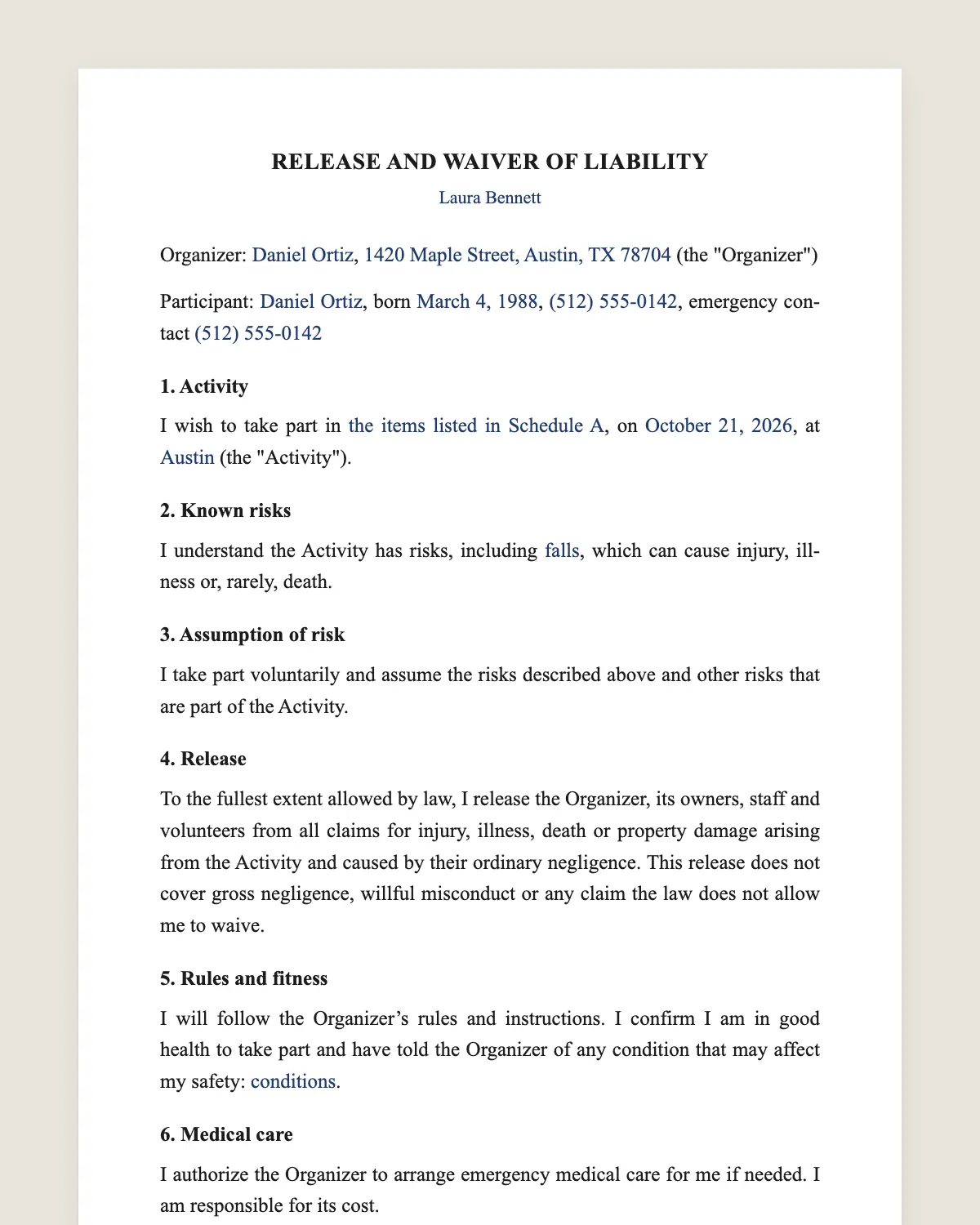
Example filled in with sample data
The full liability waiver
RELEASE AND WAIVER OF LIABILITY
[Name of the activity or event]
Organizer: [name], [address] (the "Organizer")
Participant: [full name], born [date of birth], [phone], emergency contact [name and phone]
1. Activity
I wish to take part in [describe the activity], on [dates], at [place] (the "Activity").
2. Known risks
I understand the Activity has risks, including [list specific risks, for example falls, collisions, sprains, fractures, heat exhaustion and equipment failure], which can cause injury, illness or, rarely, death.
3. Assumption of risk
I take part voluntarily and assume the risks described above and other risks that are part of the Activity.
4. Release
To the fullest extent allowed by law, I release the Organizer, its owners, staff and volunteers from all claims for injury, illness, death or property damage arising from the Activity and caused by their ordinary negligence. This release does not cover gross negligence, willful misconduct or any claim the law does not allow me to waive.
5. Rules and fitness
I will follow the Organizer’s rules and instructions. I confirm I am in good health to take part and have told the Organizer of any condition that may affect my safety: [conditions or none].
6. Medical care
I authorize the Organizer to arrange emergency medical care for me if needed. I am responsible for its cost.
7. Indemnity
I will cover the Organizer’s costs from claims by others that result from my breach of the rules.
8. Severability and law
If any part of this release is not enforceable, the rest remains in effect. This release is governed by the laws of [state].
I HAVE READ THIS RELEASE, I UNDERSTAND THAT I AM GIVING UP SUBSTANTIAL RIGHTS, AND I SIGN IT VOLUNTARILY.
PARTICIPANT
Signature: ______________________
Name: [full name]
Date: [date]
PARENT OR GUARDIAN (IF UNDER 18)
I am the parent or legal guardian and agree to these terms for the minor.
Signature: ______________________
Name: [full name]
Date: [date]
What the template includes
Organizer, participant and emergency contact
The activity, dates and place
Specific known risks
Assumption of risk
Release of ordinary negligence, with legal limits
Rules and health statement
Permission for emergency medical care
Indemnity for breaking the rules
Severability and a bold closing statement
Parent block for minors
What you fill in
Field
Example
Organizer
Summit Trail Adventures LLC
Participant
Jordan Lee, born August 14, 1990
Activity
Guided kayak tour, Lake Tahoe
Dates
June 6, 2027
Risks
Capsizing, cold water, sunburn, muscle strain
Emergency contact
Alex Lee, 555-0199
How it gets signed
1Choose “Use this template”, fill in the fields and read the full liability waiver once more.
2Send it by WhatsApp or email. The other party opens the link on their phone without an account.
3They tap the brown bar at the bottom that says “Sign as …” and draw their signature with a finger.
4Everyone gets the signed PDF with its signature certificate. Anyone can check it at signsolu.com/verificar.
Before signing, each signer agrees to sign electronically. The screen links to the electronic signature disclosure the ESIGN Act asks for.
Your first ten documents are free and need no card.
For a one-off letter or form, you can also sign it online for free from a PDF or a photo of the paper.
What the law says
Waivers are governed by state law, and courts in different states treat them differently. Most enforce a clear, specific waiver for ordinary negligence. Almost none enforce a waiver of gross negligence or intentional harm.
Some states limit waivers signed by parents for minors, and a few limit waivers for certain businesses. Clause 4 releases claims only as far as the law allows.
The ESIGN Act gives electronic signatures on a waiver the same effect as ink. The certificate records when each participant signed.
State differences
These points change from state to state.
Minors. Some states do not enforce a parent’s waiver of a child’s claims.
Recreational businesses. A few states limit waivers by gyms or ski areas, or set special rules for them.
Wording. Some courts require the word “negligence” to appear in the release, as clause 4 does.
Format. Courts look for clear headings and text that stands out.
What makes a waiver hold up
Specific risks, not a vague line about danger.
Plain words and a readable layout.
The word negligence in the release.
Time to read before signing.
A signature from each adult participant.
Signing before people arrive
Paper waivers at check-in slow the line and get lost. Send the waiver when people book. They sign from a phone, and you see the list of signed waivers before the activity.
Each signed waiver keeps its certificate with the date, the time and the device. That record helps if a claim comes months later.
A worked example
Summit Trail Adventures sends the waiver with every kayak booking. Jordan signs it the night before from a phone.
At the dock the guide checks the names against the signed list and hands out life jackets. No clipboards, no missing forms.
Mistakes to avoid
Generic risks. List the real risks of your activity.
Releasing gross negligence. Courts strike it and may strike more.
Small print. Use readable text and clear headings.
Signing on arrival with a line behind. Rushed signatures invite challenges.
Waivers for different activities
Gyms and studios: use of equipment, classes and personal training.
Tours and outdoor trips: travel, water, heights, wildlife and weather.
Events and races: crowds, physical exertion and course hazards.
Rentals: bikes, boats, kayaks and sports gear, plus a duty to return them in good condition.
Volunteering: lifting, tools, travel and work with the public.
Describe your own activity in clause 1 and list its real risks in clause 2.
Keep the waiver with the booking
Link each signed waiver to the booking or the participant list. If a claim comes later, you can show the waiver, the date it was signed and the activity it covered.
Checklist before you send it
1Activity and dates match the booking.
2Risks listed are specific.
3The closing statement stands out.
4A parent block is included if minors take part.
5Your state’s rules on waivers were checked.
A sample risk paragraph
“I understand that kayaking involves risks, including capsizing, cold water immersion, collisions with other boats or rocks, sunburn, dehydration and muscle strain. These risks can cause injury and, in rare cases, drowning.”
Plain sentences like these show the participant knew the specific risks of your activity.
Online waivers at check-in
Some groups still arrive without signing. Show a QR code at the desk that opens the waiver. Participants sign on their phones in a minute, and staff see the new signatures right away.
Keep the QR code at the desk all season. Each new signature appears in your list with its certificate.
At the end of the season, export the list for your insurer.
Insurers often ask for proof that every participant signed. A complete list with dates and times answers that question quickly.
Is a liability waiver signed online legally binding?
Yes. The ESIGN Act gives an electronic signature the same legal effect as a handwritten one. The signed PDF and its certificate show who signed the liability waiver, when and from which device.
Does each participant need a SignSolú account to sign?
No. They open the link on their phone and sign with the brown bar at the bottom of the screen.
Can I download the liability waiver in Word?
Yes. “Download in Word” gives you the full liability waiver with no email and no account. You can print it or edit it and sign it here later.
Does a liability waiver protect against all claims?
No. It usually covers ordinary negligence only. Gross negligence and intentional harm are not covered.
Can a parent sign a waiver for a child?
Yes, but some states do not enforce parent waivers of a child’s claims. Check your state.
Should volunteers sign a waiver?
Many organizations ask them to. Use the same template and describe the volunteer work as the activity.
How long should I keep signed waivers?
At least as long as someone could bring a claim in your state, often several years. Keep longer for minors.