A horse lease agreement in England: the welfare duty you cannot sign away
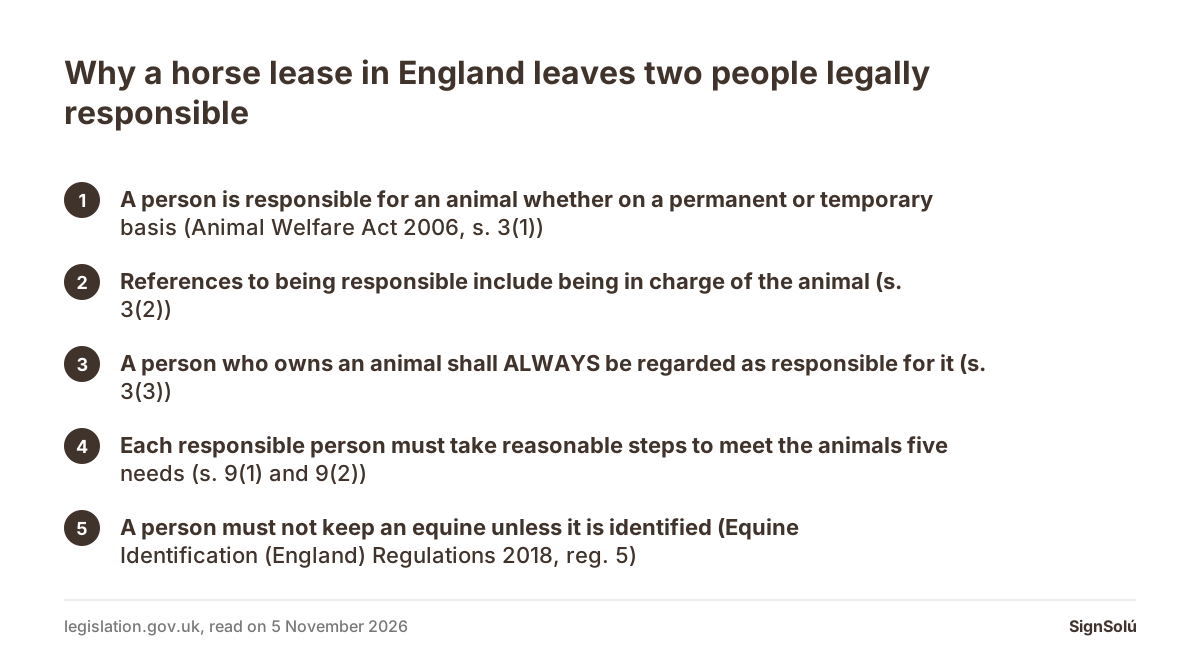
Both of you are responsible, at the same time, and no clause changes that. Section 3(1) of the Animal Welfare Act 2006 says references to a person responsible for an animal are to a person responsible whether on a permanent or temporary basis, and section 3(2) says they include being in charge of it — so the lessee becomes a responsible person the moment the horse is in their care. Section 3(3) adds that a person who owns an animal shall always be regarded as being a person who is responsible for it. Section 9(1) puts on every responsible person the duty to take reasonable steps to meet the animal's needs, which section 9(2) lists. The lease allocates cost and possession. It does not allocate the duty.
Why the template you downloaded is the wrong country
Search for a horse lease agreement and most of what comes back is American: full lease and half lease, board and farrier, an equine activity liability notice required by a particular state statute. The clause structure travels fine. The law behind it does not.
In England and Wales the governing text is the Animal Welfare Act 2006, and it is built on a concept that no lease can move: the person responsible for an animal. Get that wrong and the agreement reads as though the owner handed off the legal duty along with the headcollar.
Section 3, in three short subsections
Section 3 defines responsibility and it does so in a way that is unusually easy to read:
- 3(1): references to a person responsible for an animal are to a person responsible for an animal whether on a permanent or temporary basis.
- 3(2): references to being responsible for an animal include being in charge of it.
- 3(3): a person who owns an animal shall always be regarded as being a person who is responsible for it.
Put together: the lessee becomes responsible because they are in charge, temporarily, and the owner stays responsible because the Act says an owner always is. There is no moment in the lease at which responsibility passes from one to the other. It doubles.
Section 3(4) extends it one step further: a person is treated as responsible for any animal for which a person under sixteen in their actual care and control is responsible. That is the clause that matters in a half lease taken by a teenager — the parent is in it by operation of law, whether or not they sign.
Section 9: the duty, and the five needs
Section 9(1) is the operative duty: a person commits an offence if he does not take such steps as are reasonable in all the circumstances to ensure that the needs of an animal for which he is responsible are met to the extent required by good practice.
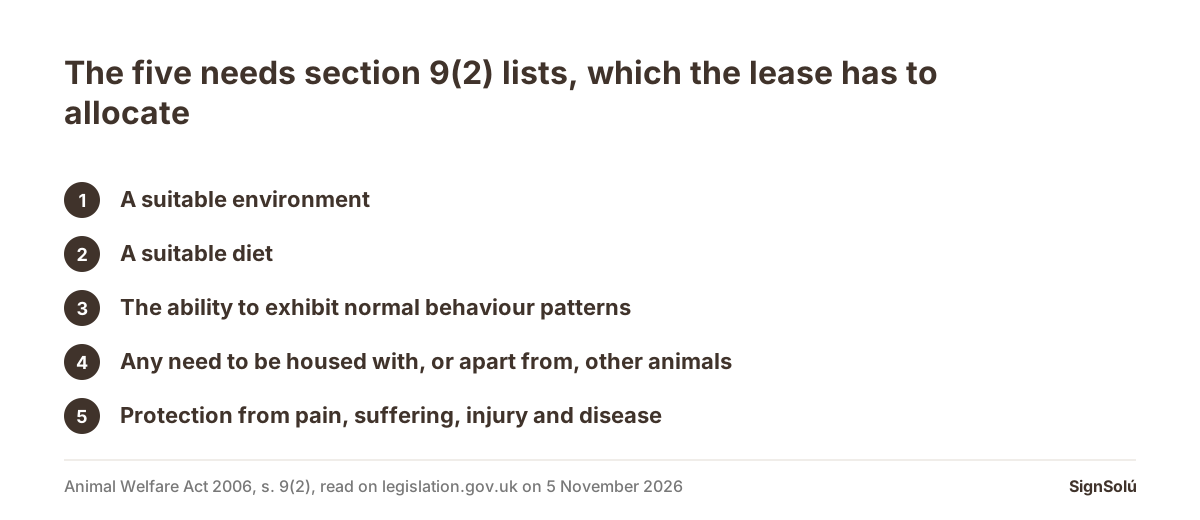
Section 9(2) lists what counts as needs: a suitable environment, a suitable diet, the ability to exhibit normal behaviour patterns, any need to be housed with or apart from other animals, and protection from pain, suffering, injury and disease. Section 9(3) says the circumstances relevant to applying the duty include any lawful purpose for which the animal is kept and any lawful activity undertaken in relation to it.
And section 4 sits underneath: a person commits an offence if an act or failure to act of his causes a protected animal to suffer, he knew or ought reasonably to have known it would, and the suffering is unnecessary. A failure to act is enough. That is why "the lessee is solely responsible for the horse" is not a safe clause for an owner to rely on.
The identification document travels with the horse
Regulation 5 of the Equine Identification (England) Regulations 2018 is one sentence: a person must not keep an equine unless it is identified in accordance with the EU Regulation and those Regulations.
The duty is on the person keeping the equine, so in a lease it lands on the lessee for the duration. Which means the lease has to say, in writing, that the identification document goes with the horse on the day of collection, that the lessee keeps it available, and that it comes back on return. A lease that leaves the passport in the owner's filing cabinet puts the lessee in breach of a regulation on day one.
It also decides a practical question nobody asks until it is urgent: the identification document is what a vet or a transporter will ask for, so a horse without it is a horse that cannot be treated or moved quickly.
What the clauses should say instead
| Clause | What a US template says | What it should say in England |
|---|---|---|
| Responsibility | "The lessee assumes all responsibility for the horse" | Both parties are responsible persons under section 3; the lease allocates cost and daily care, not the statutory duty |
| Daily care | Lessee pays board, farrier, worming | Same, written against the five needs of section 9(2), so each one has a name next to it |
| Identification document | Not mentioned | Passport hands over on collection, stays with the horse, returns on termination (reg. 5) |
| Veterinary decisions | "Lessee may authorise routine care" | Who may authorise what, up to what amount, and who to call when neither can be reached |
| Emergency and euthanasia | Often silent | Named decision-maker and a cost cap, because section 9(4) carves out humane destruction but not the decision |
| Location of the horse | Not to be moved without consent | Same, plus the yard name and the notice period if the yard changes |
| Use and level of work | Trail riding, lessons, shows | Same, written tightly: section 9(3) makes the lawful purpose relevant to judging the duty |
| Insurance | "Lessee shall maintain insurance" | Who is the policyholder, who is named, what the excess is, and who claims |
| Return condition | "Same condition as received" | A written condition record at handover, with photographs and date |
The template with the twelve clauses, the fee, the location and the cost split is in the equine lease agreement. What changes if what you are leasing is the field rather than the horse is in the land lease document, and the two thresholds there — three years and seven — catch out more grazing agreements than anything in the Animal Welfare Act.
Full lease, half lease, and who is in charge on Tuesday
The distinction matters more in England than the templates suggest, because section 3(2) ties responsibility to being in charge of the animal. In a full lease the lessee is in charge every day, and the allocation of daily care is clean. In a half lease the horse is in the lessee's charge on some days and in the owner's on others, which means the duty under section 9(1) moves back and forth during the week.
That is not a reason to avoid half leases. It is a reason to write the days down, name who is in charge on each of them, and say who calls the vet on a day that belongs to the other party. A half lease with "the lessee may ride three days per week" and nothing else leaves the most important question of the week unanswered.
The yard adds a third party nobody signs with. The horse lives under a livery agreement between the owner and the yard, and the lessee is not a party to it, so a lessee who falls out with the yard has no contract to rely on. The lease should at least say which yard, what happens if the yard terminates the livery, and who pays the notice period.
- 1Name both parties as responsible persons and drop any clause that purports to transfer the statutory duty, because section 3(3) makes it untransferable for the owner.
- 2Write the five needs of section 9(2) as a cost and care table, with a name next to each one.
- 3Hand over the identification document on collection and record it, because regulation 5 binds whoever keeps the horse.
- 4Set the veterinary authority and a cost cap, and a fallback contact for the days neither party answers.
- 5Record the condition at handover with dated photographs signed by both, and do it again on return.
The handover record is the whole file
Leases of horses end in the same argument as leases of equipment: what condition was it in when it left. The fix is the same too — a dated record with photographs, signed by both, on the day of collection. If a half lease is shared between two riders, each one signs their own.
Keep the condition record and the lease in the same place. A lease that cannot produce the condition record is a lease with one side of the story.
Signing it without a trip to the yard
Horse leases are usually signed at the yard, on paper, and then nobody can find the paper. Sending it to sign from a phone fixes the filing problem without changing anything about the agreement.
SignSolú is a Mexican e-signature platform that works over WhatsApp, and it is used for documents like this one because of the part that matters afterwards: the audit receipt records the time, IP address, device and the SHA-256 hash of the signed file, so the version in the folder can be proved to be the version that was signed. Anyone can check a document at the verification page with no account. The sender chooses the language for each signer, so a signer who reads English gets the email, the WhatsApp message and the signing page in English. What the platform stores is in trust, the plans are in pricing, and the free plan is 10 documents with no expiry and no card. How a remote signature works end to end is in how to sign a contract remotely, and you can create an account to send the first one.
On the legal side, what an electronic signature is worth in England and where else it holds is set out in is an electronic signature legally binding, and where and in the validity note for the United Kingdom. Two other English-law documents with statutory traps worth the same ten minutes: the residential tenancy agreement after the 2026 changes and the zero hours contract clause that is already unenforceable. For lodgers rather than horses, free lodger agreement templates. Two more documents where the statute writes part of the text for you: the lasting power of attorney forms and the limited liability partnership agreement. If the arrangement ends in a dispute about what a signed waiver covered, what a signed waiver can never cover. And if the horse or the yard is in Mexico rather than England, the general rules on signing at a distance are in how to sign a contract remotely with someone in Mexico and in the validity note for Mexico.
Frequently asked questions
Can a horse lease transfer legal responsibility to the lessee?
No. Section 3(1) of the Animal Welfare Act 2006 makes a person responsible whether on a permanent or temporary basis, and section 3(3) says an owner shall always be regarded as responsible. The lease allocates cost and daily care; the statutory duty stays with both.
Who must hold the horse passport during a lease?
Regulation 5 of the Equine Identification (England) Regulations 2018 says a person must not keep an equine unless it is identified, so the duty falls on whoever is keeping the horse. In a lease that is the lessee, which is why the identification document should hand over on collection.
What exactly is the owner still on the hook for?
The duty in section 9(1) to take such steps as are reasonable in all the circumstances to ensure the horse's needs are met, and the section 4 offence, which can be committed by a failure to act. If the owner knows the horse is not being looked after, saying the lessee was responsible is not an answer.
Does the law list what counts as looking after a horse?
Section 9(2) lists five needs: a suitable environment, a suitable diet, the ability to exhibit normal behaviour patterns, any need to be housed with or apart from other animals, and protection from pain, suffering, injury and disease.
My daughter is fifteen and wants a half lease. Who signs?
A parent should, and in practice is in it anyway: section 3(4) treats a person as responsible for any animal for which someone under sixteen in their actual care and control is responsible.
Is an electronically signed horse lease valid in England?
A lease of a horse is not a contract for an interest in land, so the signed-writing rule for land does not apply to it, and an electronic signature is generally capable of signing it. What matters in a dispute is the evidence that the document was not changed afterwards.
Send your next contract to Mexico for signature
Create a free account and send 10 documents with no card. Your dashboard works in English. You set the language per signer, and their email, WhatsApp message and signing page arrive in that language.
Keep reading
- Land lease document: the three-year and seven-year thresholds that change how you sign it
- Residential tenancy agreement: what changed in England on 1 May 2026, and why most templates are now wrong
- Is an electronic signature legally binding? The answer has two halves, and the second one decides disputes