Zero hours contract template: the clause in most of them that has been unenforceable since 2015
Section 27A of the Employment Rights Act 1996 defines a zero hours contract as one where the undertaking to do work is conditional on the employer making work available and there is no certainty that any work will be made available. Subsection (3) then says any provision of such a contract that prohibits the worker from doing work under another contract or arrangement, or prohibits them from doing so without the employer's consent, is unenforceable against the worker. That section came in on 26 May 2015 through the Small Business, Enterprise and Employment Act 2015, and plenty of templates still carry the clause it killed.
What the statute actually defines
People search for a zero hours template expecting a short, simple document. It is short. What makes it different from a normal casual contract is one specific provision that Parliament wrote in 2015, and the definition it sits on.
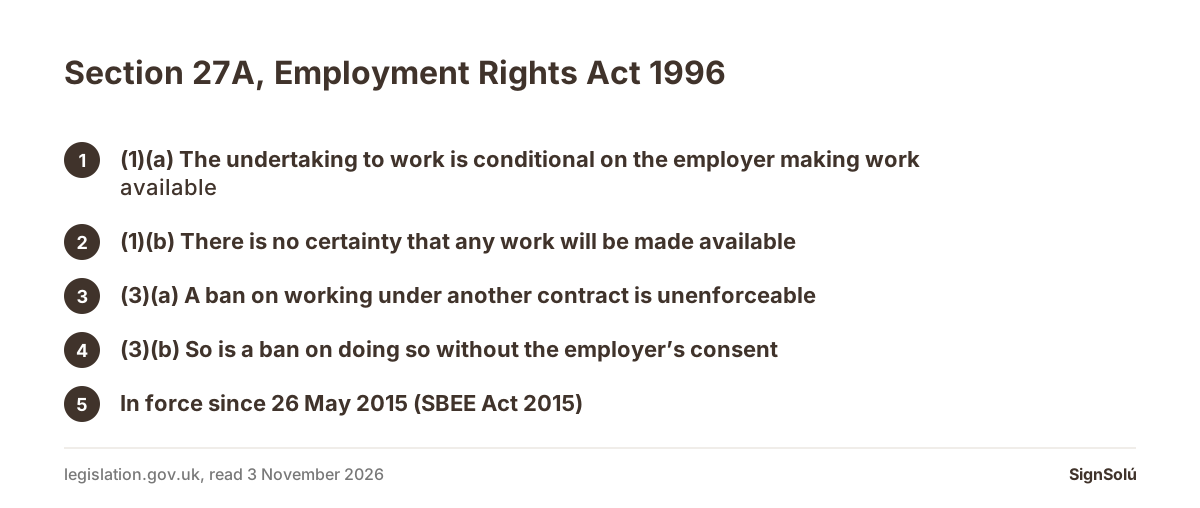
Section 27A of the Employment Rights Act 1996 gives the definition in subsection (1): a zero hours contract means a contract of employment or other worker's contract under which (a) the undertaking to do or perform work or services is an undertaking to do so conditionally on the employer making work or services available to the worker, and (b) there is no certainty that any such work or services will be made available to the worker. Subsection (2) adds that an employer makes work available if the employer requests or requires the worker to do the work.
Note what the definition turns on: conditionality plus uncertainty. It is not about the number zero appearing anywhere, and it is not about whether the document is called casual, bank, flexible or as-and-when. If the worker only works when you ask and there is no guarantee you will ask, you have a zero hours contract and section 27A applies to it.
The clause that stopped working on 26 May 2015
Subsection (3) is the operative one. Any provision of a zero hours contract which (a) prohibits the worker from doing work or performing services under another contract or under any other arrangement, or (b) prohibits the worker from doing so without the employer's consent, is unenforceable against the worker.
Part 2A of the Act, which contains sections 27A and 27B, was inserted with effect from 26 May 2015 by the Small Business, Enterprise and Employment Act 2015. Subsection (4) adds a technical but useful point: subsection (3) is to be disregarded when determining whether a contract is a contract of employment or other worker's contract. Striking out the exclusivity term does not change the worker's status.
Read (3)(b) carefully, because it is the half that templates miss. Even a softened clause — «the worker may not accept other work without the Company's prior written consent» — is caught. Consent-based exclusivity is exclusivity.
| Clause in the template | Status | Why |
|---|---|---|
| «The worker shall not work for any other employer» | Unenforceable | s.27A(3)(a) |
| «…not without the Company's written consent» | Unenforceable | s.27A(3)(b) |
| «…not for a competitor during the engagement» | Read it carefully | A blanket ban is caught; a narrow confidentiality duty is a different thing |
| Confidentiality of the employer's information | Enforceable | Not a prohibition on doing other work |
| A duty to disclose other work for working-time or safety reasons | Generally fine | Disclosure is not prohibition |
| Notice of availability and shift-acceptance rules | Enforceable | About this engagement, not about other engagements |
What to put in the document instead
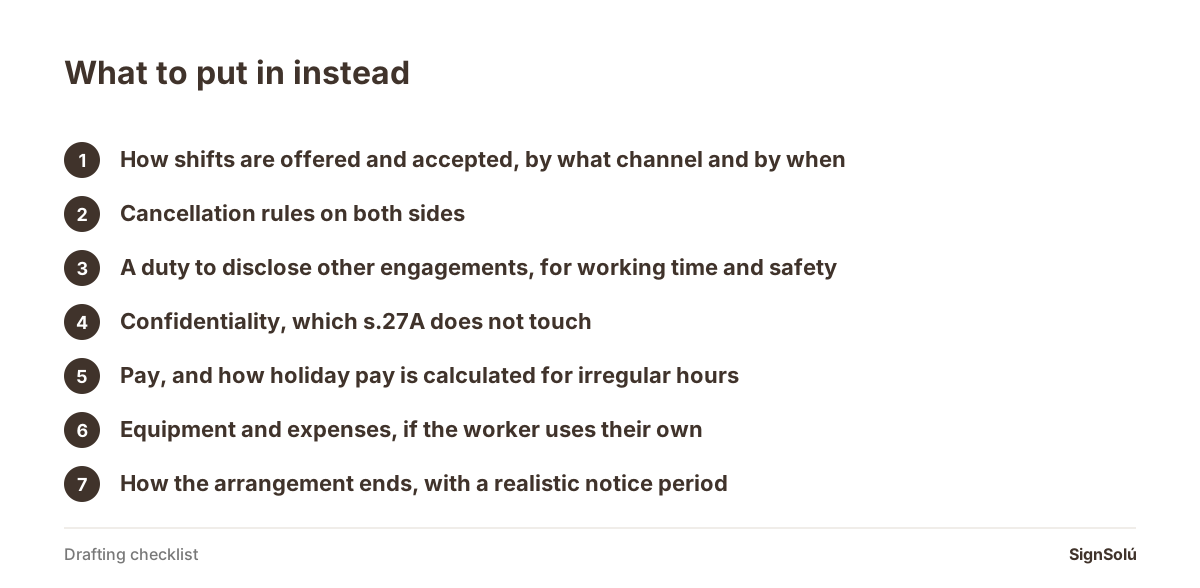
An exclusivity clause was never doing the work people thought it was. The real operational worries behind it — double-booking, fatigue, confidentiality, a competitor learning your pricing — each have a clause that is enforceable.
- 1How shifts are offered and accepted. By what channel, with how much notice, and by when the worker has to reply. This is the clause that prevents most scheduling disputes, and it is entirely yours to set.
- 2Cancellation on both sides. What happens when you cancel a shift the worker already accepted, and what happens when they do. Silence here is what makes a zero hours arrangement feel arbitrary.
- 3A duty to disclose other engagements, framed around working time and safety rather than permission. Knowing is legitimate; forbidding is not.
- 4Confidentiality, which is unaffected by section 27A because it does not prohibit the worker from working elsewhere. The standard form is the non-disclosure agreement, and what it is for is in what is an NDA.
- 5Pay, including how holiday pay is calculated for irregular hours, and when it is paid.
- 6Equipment and expenses, if the worker uses their own.
- 7How the arrangement ends, with a notice period that matches reality.
The fill-in version with those clauses already drafted is the zero hours contract template. If what you actually need is a contract with guaranteed hours, that is a different document: the employment contract, and the offer that precedes it, the offer of employment letter. If the person is genuinely running their own business rather than working on your shifts, the document is the independent contractor agreement and the payment side is in independent contractor payment terms.
Renaming it does not get you out: section 27B
There is a second section next door, and it exists because Parliament expected people to try. Section 27B is a regulation-making power, and reading what it authorises tells you how the law intends to treat avoidance.
It distinguishes a zero hours contract from a zero hours arrangement: an arrangement, under subsection (4), is one where an employer and an individual agree terms on which the individual will do work when the employer makes it available and the individual agrees to do it, but the employer is not required to make any work available, nor the individual required to accept it. That shape sits outside section 27A, which is why section 27B exists.
Subsection (5) lists what regulations under the section may do: modify zero hours contracts, zero hours arrangements and other workers' contracts; impose financial penalties on employers; require employers to pay compensation to zero hours workers; confer jurisdiction on employment tribunals; and confer rights on zero hours workers. Subsection (6) goes further and allows regulations to make exclusivity terms unenforceable in prescribed categories of workers' contracts in cases in which section 27A does not apply, and in prescribed categories of zero hours arrangements that are contractual arrangements.
The same subsection defines the target broadly: an exclusivity term is any term by virtue of which a worker is restricted from doing any work otherwise than under the worker's contract. Subsection (9) adds the limit — nothing in section 27B affects a worker's contract except so far as regulations made under it expressly apply. So the power is there, and whether it bites on a particular arrangement depends on the regulations in force.
The practical reading for an employer: the direction of travel is clear enough that building an arrangement around the exclusivity clause is a bad investment of drafting time. And the practical reading for a worker: the question of whether your document is a contract or an arrangement is a real one, and it is worth asking before you accept a restriction.
Why the template keeps the dead clause
Two reasons, and both are worth knowing if you are about to download one. The first is age: a document written before May 2015 and never revised still reads as if exclusivity worked. The second is copying: templates are copied from other templates, and nobody re-reads the statute in the chain.
The cost of leaving it in is not a fine. It is that the clause is unenforceable against the worker, so you are relying on something that will not hold, and a document that contains an unenforceable prohibition invites a closer look at the rest of it. Deleting it costs nothing and loses you nothing you actually had.
Check the version, not the title
When you take a template from anywhere, the useful test is not whether it says «2026» at the top. It is whether the exclusivity clause is gone and whether the holiday pay method matches how irregular hours are actually calculated now. Two checks, two minutes.
Getting it signed before the first shift
The practical failure in casual work is not the drafting. It is that the first shift happens before anything is signed, because the worker was needed on Saturday and the paperwork was going to happen on Monday. A month later there are three people working and one signed contract.
With SignSolú you send the contract over WhatsApp from your own number or by email, the worker signs from their phone without creating an account or paying anything, and the audit receipt records the time, the IP address, the device and the SHA-256 hash of the file. For casual staff that is the whole point: the document gets signed on the bus, not at a desk. Anyone can check later that the signed file did not change at the verification page, with no account. The sender picks each signer's language, so a worker who reads English gets the email, the WhatsApp message and the signing page in English. The free plan is 10 documents with no expiry and no card; start at register.
If you are sending the same document to a pool of casual workers, it goes out in one movement rather than one by one, and each signature carries its own timestamp. The mechanics, written for a Mexican counterparty but identical in any language, are in how to sign a contract remotely with someone in Mexico. And if your workers are in Mexico rather than the UK, the employment rules are entirely different: hiring employees in Mexico and the job offer letter.
Frequently asked questions
What is a zero hours contract in law?
Section 27A(1) of the Employment Rights Act 1996 defines it as a contract of employment or other worker's contract under which the undertaking to do or perform work or services is conditional on the employer making work or services available, and there is no certainty that any such work or services will be made available to the worker.
Can a zero hours contract stop the worker taking other jobs?
No. Section 27A(3) says any provision of a zero hours contract that prohibits the worker from doing work or performing services under another contract or any other arrangement, or that prohibits them from doing so without the employer's consent, is unenforceable against the worker.
Does a consent requirement get around it?
No. Subsection (3)(b) covers exactly that: a provision prohibiting the worker from doing other work without the employer's consent is as unenforceable as an outright ban.
When did that rule start?
Part 2A of the Employment Rights Act 1996, containing sections 27A and 27B, was inserted with effect from 26 May 2015 by the Small Business, Enterprise and Employment Act 2015.
Can I still require confidentiality?
Yes. Section 27A(3) is about provisions that prohibit the worker from doing other work. A confidentiality obligation does not prohibit other work, so it is not caught by that subsection.
Can a zero hours contract be signed electronically?
Yes, and for casual work it is usually the only way it gets signed before the first shift. What matters practically is a record of who signed, when, and which version of the document, so the contract you rely on is the one they actually accepted.
Send your next contract to Mexico for signature
Create a free account and send 10 documents with no card. Your dashboard works in English. You set the language per signer, and their email, WhatsApp message and signing page arrive in that language.