Non-disclosure agreement template in Word: the one paragraph most of them leave out
Almost every Word NDA has the same clauses and the same omission. Section 1833(b)(3)(A) of title 18 of the US Code says an employer shall provide notice of the whistleblower immunity set out in that subsection in any contract or agreement with an employee that governs the use of a trade secret or other confidential information. Subparagraph (C) is the consequence: an employer that does not comply may not be awarded exemplary damages or attorney fees under subparagraph (C) or (D) of section 1836(b)(3) in an action against an employee who was not given notice. And paragraph (4) defines «employee» to include any individual performing work as a contractor or consultant. One paragraph, and it decides what the agreement is worth when you need it.
What the immunity actually says
The notice requirement makes no sense until you know what it is giving notice of, so start there. Section 1833(b) of title 18 gives an individual immunity from liability for a confidential disclosure of a trade secret in two situations.
- Reporting to the government or to a lawyer. An individual shall not be held criminally or civilly liable under any Federal or State trade secret law for the disclosure of a trade secret made in confidence to a Federal, State or local government official, either directly or indirectly, or to an attorney, and solely for the purpose of reporting or investigating a suspected violation of law.
- A sealed court filing. The same immunity applies to a disclosure made in a complaint or other document filed in a lawsuit or other proceeding, if such filing is made under seal.
Paragraph (2) adds a third situation: an individual who files a lawsuit for retaliation by an employer for reporting a suspected violation of law may disclose the trade secret to their attorney and use the trade secret information in the court proceeding, provided they file any document containing the trade secret under seal and do not disclose it except pursuant to a court order.
None of that is waivable by an NDA. The immunity exists whether or not your agreement mentions it. What the agreement controls is whether you keep two remedies.
The notice, and what it costs to skip it
Paragraph (3) has four subparagraphs and all four matter:
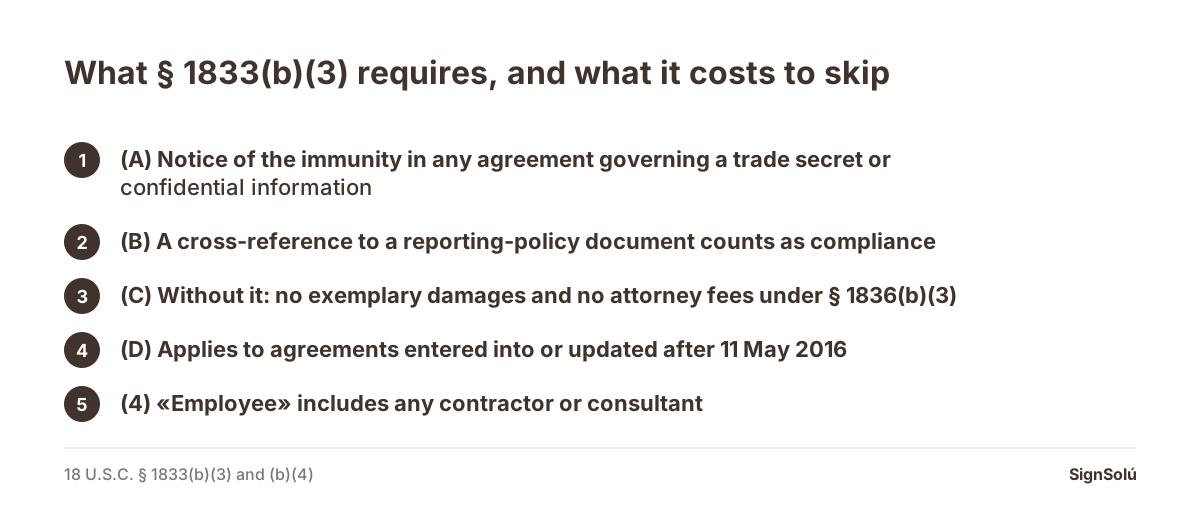
- 1(A) In general. An employer shall provide notice of the immunity set forth in this subsection in any contract or agreement with an employee that governs the use of a trade secret or other confidential information.
- 2(B) Policy document. An employer is considered to be in compliance if it provides a cross-reference to a policy document provided to the employee that sets forth the employer's reporting policy for a suspected violation of law.
- 3(C) Non-compliance. If an employer does not comply, the employer may not be awarded exemplary damages or attorney fees under subparagraph (C) or (D) of section 1836(b)(3) in an action against an employee to whom notice was not provided.
- 4(D) Applicability. This paragraph applies to contracts and agreements that are entered into or updated after the date of enactment of the subsection, which the statutory notes give as 11 May 2016.
Subparagraph (C) is the whole point. The underlying claim survives — you can still sue for misappropriation and seek damages and an injunction. What you lose are the two things that make the case worth bringing: exemplary damages and the recovery of attorney fees. In a trade secret case against a former contractor, those are often most of the economics.
| NDA with the notice | NDA without it | |
|---|---|---|
| The immunity | Exists either way | Exists either way |
| Claim for misappropriation | Available | Available |
| Injunctive relief | Available | Available |
| Exemplary damages under § 1836(b)(3)(C) | Available | Not available against that person |
| Attorney fees under § 1836(b)(3)(D) | Available | Not available against that person |
| Applies to contractors and consultants | Yes, § 1833(b)(4) | Yes — so the loss applies to them too |
Where it goes, and who it covers
Two practical points that templates get wrong even when they include the paragraph.
It is not only for employees
Paragraph (4) defines the term for this subsection: «employee» includes any individual performing work as a contractor or consultant for an employer. So the notice belongs in the mutual NDA you send a freelancer, in the consultant agreement, in the agency contract and in the vendor NDA — not just in the employee handbook. The marketing-agency version of the same problem is in who owns the logo in a marketing agreement, and the base document for a contractor is the independent contractor agreement.
Any agreement that governs confidential information
Subparagraph (A) says «any contract or agreement … that governs the use of a trade secret or other confidential information». That is wider than a document titled NDA. An employment contract with a confidentiality article, a services agreement with a confidentiality clause, a severance agreement that restates confidentiality obligations — each of them governs the use of confidential information. The base documents are the employment contract and the settlement agreement template.
Subparagraph (D) limits the requirement to agreements entered into or updated after 11 May 2016, which in practice means every live agreement you are drafting now, and any older one you amend.
The rest of the NDA, and the two clauses that decide the rest
With the notice in place, the clauses that do the work in a dispute are not the ones people argue about during the drafting. The fill-in version with all of them is the non-disclosure agreement template, and what an NDA is for, in plain terms, is in what is an NDA.
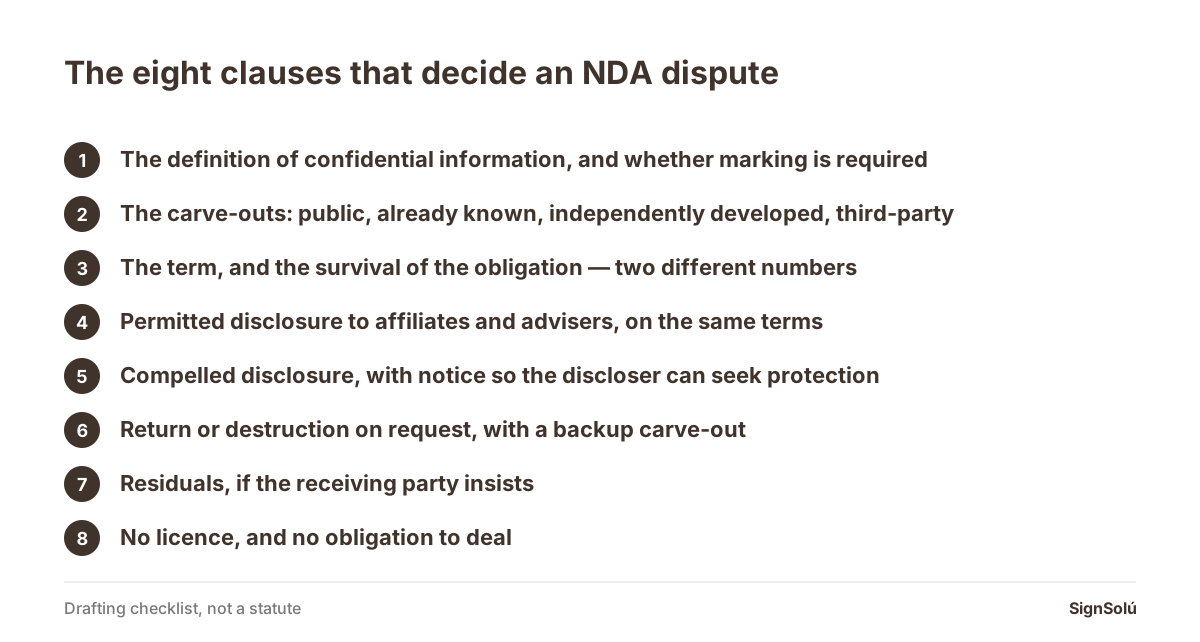
- The definition of confidential information, and whether it needs to be marked. «Everything is confidential» is easy to draft and hard to enforce; a marking requirement is enforceable and inconvenient. Pick one and live with it.
- The carve-outs, which are the clause that saves the receiving party: information already public, already known, independently developed, or lawfully received from a third party. A one-sided NDA with no carve-outs invites a refusal to sign. The same balance question comes up in any commercial contract: the sales contract template and the memorandum of understanding show the two ends of it.
- The term, and the survival of the obligation. Two different numbers. A three-year agreement with a five-year confidentiality tail is coherent; a three-year agreement that is silent on survival is a gift to whoever leaves.
- Permitted disclosure to affiliates and advisers, on the same terms, because every real counterparty needs it.
- Compelled disclosure, with notice to the disclosing party so it can seek protection. Note how this sits alongside the statutory immunity: one is a contract obligation, the other cannot be contracted away.
- Return or destruction on request, with a carve-out for backups and for what the law requires the receiving party to keep.
- Residuals, if the receiving party insists. It is the clause that most often decides whether an NDA gets signed by a large company.
- No licence and no obligation to deal. One sentence each, and they stop an NDA from being read as a deal. If what you want is a non-binding statement of intent, that is a different document: the MOU template.
Why the Word file is the weak point
The practical failure is rarely the drafting. It is that the NDA exists as a .docx in a folder, gets edited by whoever sends it, and nobody can say afterwards which version the other side signed — or whether they signed at all. In a trade secret case the first exhibit is the agreement, and «the version in our shared drive» is not an exhibit. Where a signed document actually lives afterwards is worth deciding on purpose: how to sign a PDF on a Mac or a phone covers the mechanics.
Two habits fix most of it: one canonical version with a date in the file name, and a signature with a record attached. If the counterparty is in Mexico, the second part is straightforward — articles 89 and 89 bis of Mexico's Commercial Code give an electronic signature the same legal effect as a handwritten one and forbid denying a document effect just because it is electronic; the detail is in is an electronic signature valid in Mexico?, and the Mexican-supplier version in NDA with a Mexican supplier. What a Mexican counterparty signs before a deal gets serious is in nearshoring in Mexico: the first documents you sign.
With SignSolú you send the NDA over WhatsApp from your own number or by email, the other side signs from a phone without creating an account or paying anything, and the audit receipt records the time, the IP address, the device and the SHA-256 hash of the file. That hash is what answers «is this the document they signed» years later, and anyone can check it at the verification page with no account. The sender picks each signer's language, so a counterparty who works in English gets the email, the WhatsApp message and the signing page in English. The free plan is 10 documents with no expiry and no card; start at register. For a mutual NDA with several signers on each side, the send order matters: how to sign a contract remotely with someone in Mexico. And if the NDA is the first step of a deal, the document that usually follows is the letter of intent.
Frequently asked questions
What notice does federal law require in an NDA?
Section 1833(b)(3)(A) of title 18 of the US Code requires an employer to provide notice of the whistleblower immunity set out in section 1833(b) in any contract or agreement with an employee that governs the use of a trade secret or other confidential information.
What happens if the NDA leaves the notice out?
Subparagraph (C) says the employer may not be awarded exemplary damages or attorney fees under subparagraph (C) or (D) of section 1836(b)(3) in an action against an employee to whom notice was not provided. The underlying misappropriation claim and injunctive relief are not affected.
Does the notice requirement apply to contractors?
Yes. Section 1833(b)(4) says that for purposes of that subsection the term «employee» includes any individual performing work as a contractor or consultant for an employer.
Can I satisfy it with a reference to a policy instead of a full paragraph?
Subparagraph (B) allows it: an employer is considered to be in compliance if it provides a cross-reference to a policy document provided to the employee that sets forth the employer's reporting policy for a suspected violation of law.
Can an NDA stop someone from reporting to a regulator?
No. Section 1833(b)(1) gives immunity for a disclosure made in confidence to a Federal, State or local government official, directly or indirectly, or to an attorney, solely for the purpose of reporting or investigating a suspected violation of law, and for a disclosure in a filing made under seal.
Which clauses matter most in an NDA dispute?
The definition of confidential information and whether marking is required, the carve-outs, and the survival period of the obligation as distinct from the term of the agreement. Those three decide most arguments; the rest is housekeeping.
Send your next contract to Mexico for signature
Create a free account and send 10 documents with no card. Your dashboard works in English. You set the language per signer, and their email, WhatsApp message and signing page arrive in that language.