Settlement agreement template: free in Word, or sign it online
Reviewed in October 2026
A settlement agreement ends a dispute without a trial. One party usually pays an amount, and the other releases its claims. It is a binding contract, and if a lawsuit is open, the parties then ask the court to dismiss it.
Ten documents free, no card. Signed by every party to the dispute.
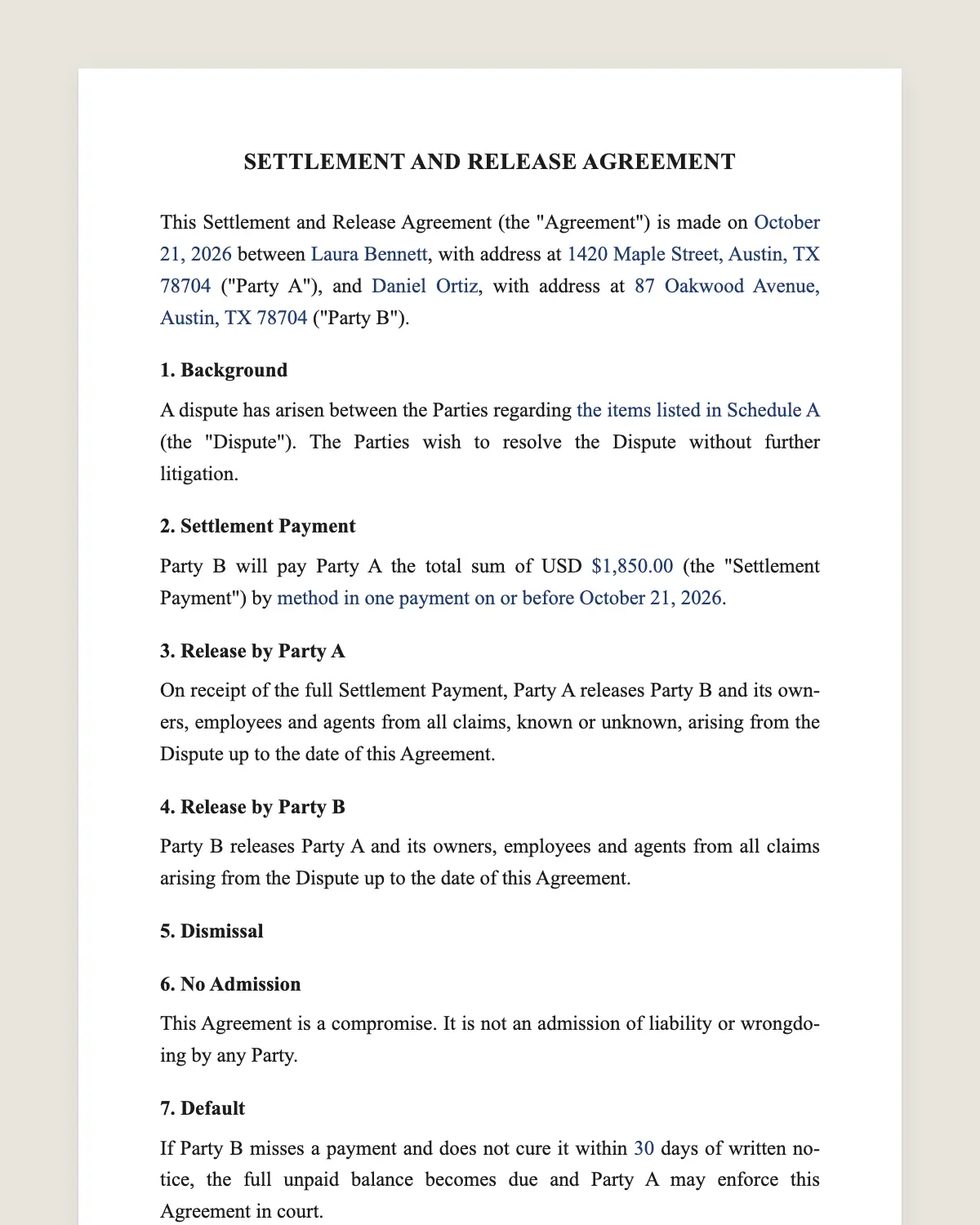
Example filled in with sample data
The full settlement agreement
SETTLEMENT AND RELEASE AGREEMENT
This Settlement and Release Agreement (the "Agreement") is made on [date] between [Party A name], with address at [address] ("Party A"), and [Party B name], with address at [address] ("Party B").
1. Background
A dispute has arisen between the Parties regarding [short description of the dispute] (the "Dispute"). [If a case is open: The Dispute is the subject of case number [number] in [court] (the "Lawsuit").] The Parties wish to resolve the Dispute without further litigation.
2. Settlement Payment
Party B will pay Party A the total sum of USD [amount] (the "Settlement Payment") by [method] [in one payment on or before [date] / in [number] installments of USD [amount] due on [dates]].
3. Release by Party A
On receipt of the full Settlement Payment, Party A releases Party B and its owners, employees and agents from all claims, known or unknown, arising from the Dispute up to the date of this Agreement.
4. Release by Party B
Party B releases Party A and its owners, employees and agents from all claims arising from the Dispute up to the date of this Agreement.
5. Dismissal
[If a Lawsuit is open: Within [number] days after receiving the full Settlement Payment, Party A will file a dismissal of the Lawsuit with prejudice. Each Party bears its own attorney fees and costs.]
6. No Admission
This Agreement is a compromise. It is not an admission of liability or wrongdoing by any Party.
7. Default
If Party B misses a payment and does not cure it within [number] days of written notice, the full unpaid balance becomes due and Party A may enforce this Agreement in court.
8. Confidentiality and Non-Disparagement (optional)
The Parties will keep the terms of this Agreement confidential, except as required by law or to their advisors, and will not make false or disparaging statements about each other regarding the Dispute.
9. Entire Agreement
This Agreement is the entire agreement on the Dispute and replaces all earlier discussions. It may be changed only in writing signed by both Parties.
10. Governing Law and Signatures
This Agreement is governed by the laws of the State of [state]. Each Party has had the chance to consult a lawyer. The Parties agree to sign it electronically.
Party a
Name: [name]
Signature: ______________
Date: [date]
Party b
Name: [name]
Signature: ______________
Date: [date]
What the template includes
Names of the parties
Description of the dispute and any open case
Settlement amount, method and payment dates
Release of claims by each party
Dismissal of the lawsuit with prejudice
No admission of liability
What happens if a payment is missed
Optional confidentiality and non-disparagement
Entire agreement clause
Governing law and electronic signature
What you fill in
Field
Example
Party A
Marcus Bell Roofing LLC
Party B
Lakeview Property Management Inc.
Dispute
Unpaid invoice for roof repairs at 18 Elm St
Case
Small claims case 26-SC-0412, Hennepin County
Settlement payment
USD 7,500 in 3 monthly installments of USD 2,500
First payment
November 15, 2026
Confidentiality
Yes
State
Minnesota
How it gets signed
1Choose «Use this template», fill in the fields and review the full settlement agreement.
2Send it by WhatsApp or email. The other party opens the link on their phone without an account.
3They tap the brown bar at the bottom that says «Sign as …» and draw their signature once.
4Everyone gets the signed PDF with its signature certificate. Anyone can check it at signsolu.com/verificar.
The signing screen tells each signer that signing means agreeing to sign electronically. It links to the electronic signature disclosure that the ESIGN Act asks for.
What you get once everyone signs
The signed PDF. The final settlement agreement with every drawn signature in place.
The signature certificate. It lists each signer and the date and time of each signature.
A record you can check. The folio on the certificate opens the document history at signsolu.com/verificar.
Reminders. Turn them on and SignSolú reminds every signer who has not signed yet.
Your first ten documents are free and need no card.
What the law says
A settlement agreement is a contract. Courts favor settlements and enforce them like any other signed agreement.
When a case is open, the court may need to approve some settlements. Cases involving minors, class actions and some employment claims are examples. Check the rules of your court.
The ESIGN Act, 15 U.S.C. 7001 gives an electronic signature the same legal effect as one on paper. A contract cannot be denied effect only because it was signed electronically.
The ESIGN exceptions in 15 U.S.C. 7003 cover court orders and official court documents such as pleadings. The settlement agreement between the parties is not one of them. The dismissal you file with the court follows that court's own rules.
When to use a settlement agreement
Use it whenever two parties agree to end a dispute. It works before a lawsuit is filed and while one is open.
Unpaid invoices. A contractor and a client agree on a reduced amount.
Property damage. A neighbor pays for a fence damaged by a fallen tree.
Business breakups. Two partners settle what each owes the other.
Landlord and tenant. The parties agree on the security deposit and move-out date.
How the release works
The release is the heart of the agreement. The party that releases gives up the right to sue on that dispute.
Make the release mutual when both sides had claims. Clause 4 covers that.
Tie the release to payment in full. Clause 3 only takes effect when the money arrives, which protects the party being paid.
Some states limit releases of unknown claims. California, for example, has its own statute on this point. Add a waiver clause if your state requires one.
Payment plans in a settlement
Installments make settlements possible when the payer lacks the full amount. They also add the risk of a missed payment.
Clause 7 makes the whole balance due after a missed payment and a notice. That gives the payee a clear path to court.
Some parties ask the court to keep jurisdiction to enforce the settlement. Ask about this before dismissing the case.
Common mistakes
Describing the dispute too narrowly. A release that covers «the March invoice» leaves the April one open. Describe everything you want closed.
Dismissing before payment. File the dismissal after the money arrives, as clause 5 says.
Settling employment claims with a generic form. Some employee claims have special rules on releases. Use an employment-specific agreement for them.
Signing quickly while the deal is fresh
Settlements fall apart when signing drags on. People change their minds after a weekend.
Send the agreement right after the call where you agreed on the amount. The other party signs from the phone, often the same hour.
Write the amount and dates exactly as agreed on the call. A summary email with the same numbers helps if anyone remembers it differently.
Keep the signed agreement and every payment receipt together. If a payment is missed, that file is what you take to court.
Before you sign
Read every clause of the settlement agreement with the other party before anyone signs. Change what does not fit your deal.