Nearshoring in Mexico: the first documents you sign
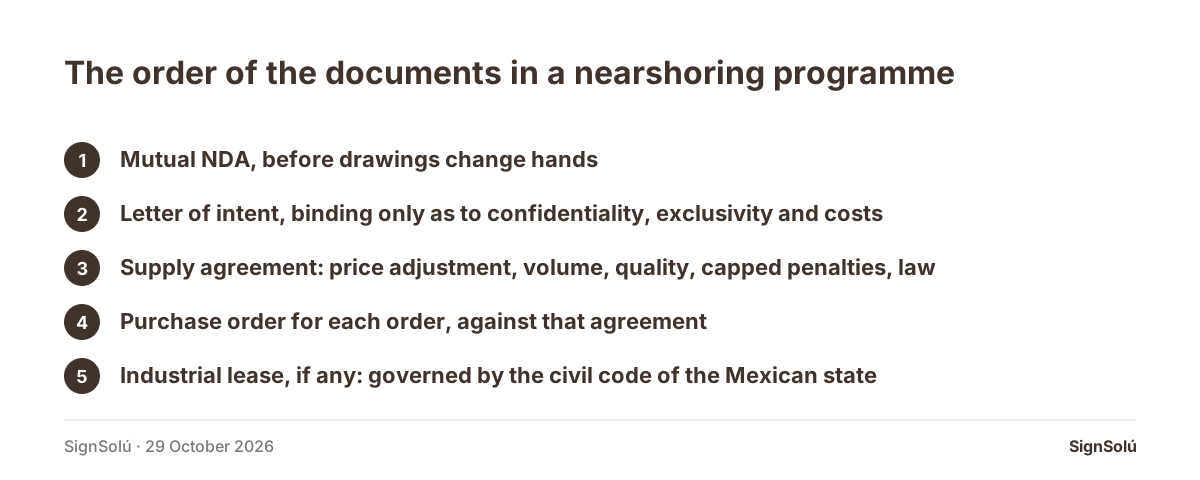
Four, in this order. The NDA goes first, before drawings, bills of materials or target prices change hands. The letter of intent comes second and is usually **not binding** as to the purchase itself — only its confidentiality, exclusivity and cost-sharing clauses bind. The supply agreement is third, and it is the one that decides your landed cost: price adjustment, volume commitment, quality and rejection criteria, capped penalties, termination and governing law. The purchase order is fourth and creates each individual order against that agreement. If an industrial lease is involved, it is a separate fifth document, governed by the civil code of the Mexican state where the property sits, not by federal law. All of them can be signed electronically: article 89 of Mexico’s Código de Comercio allows electronic means in commercial acts and in their formation.
The sequence is predictable once you have been through it. A site visit in Querétaro or Monterrey, a supplier shortlist, and then documents start arriving: an NDA from your side, a letter of intent from theirs, a forty-page supply agreement from your legal team, purchase orders from your ERP, and — if you are standing up your own operation — a lease for a building in a park.
What nobody writes down is the order, and what each document actually commits you to under Mexican law. That is this page. The view from the other side of the table — what a Mexican supplier should be negotiating in the same four documents — is in soy proveedor de una empresa de Estados Unidos (in Spanish), and it is worth reading before you send the supply agreement.
One · The NDA, before the first drawing
This is the only one that should move fast, because what it protects is lost with the first email attachment. Three points come up in almost every Mexican negotiation:
- Make it mutual. A one-way NDA protecting only your information reads badly to a supplier whose process and costs you are about to see, and mutual drafts close faster.
- Have the confidentiality obligation outlive the agreement. A two-year NDA with a two-year obligation leaves the drawing free in year three.
- Pick a forum you can actually use. Naming a court in your home state is easy to draft and expensive to enforce; arbitration in a neutral seat is the usual middle ground.
A bilingual two-column version, with the Spanish text governing because that is the text Mexican courts enforce, is at acuerdo de confidencialidad bilingüe. The deeper discussion of an NDA with a Mexican supplier is in NDA with a Mexican supplier, and which language prevails when a contract runs in two columns, in bilingual contracts in Mexico.
Two · The letter of intent, and what it really binds
A Mexican supplier will often treat an LOI as a commitment, and your draft almost certainly says it is not one. Both sides are reading the same document differently, and that is worth naming in the first call. What typically does bind in an LOI is narrower: confidentiality, an exclusivity period for negotiating, and who pays for what during due diligence.
Two things make it useful anyway. It lets the supplier show something concrete to their bank when they need to finance tooling or a new line, which is often the real bottleneck in a nearshoring timeline. And it forces both sides to list the open points while they are still cheap to resolve. The bilingual format is at carta de intención bilingüe, and the full discussion is in letter of intent with a Mexican company.
Three · The supply agreement, where the cost is set
This is the document that decides whether the programme works. Six clauses carry most of the economics, and in nearshoring each of them has a Mexico-specific wrinkle.
| Clause | Standard draft | The Mexico wrinkle | What usually lands |
|---|---|---|---|
| Price and adjustment | Fixed price for the term | Supplier buys inputs in dollars and sells in pesos, or the reverse | An adjustment formula tied to a named index and FX, reviewed quarterly |
| Volume | Non-binding forecast, no minimum | Tooling and a new line are financed by the supplier against that forecast | A minimum, or amortisation of tooling if volume does not arrive |
| Quality and rejection | Right to reject at buyer’s discretion | A technical dispute across a border is slow and expensive | Measurable criteria, a claim window, and a named third-party lab |
| Delivery and penalties | Uncapped liquidated damages for delay | Customs and cross-border transit are outside the supplier’s control | A cap, plus excused delay for customs, blockades and force majeure |
| Termination | Termination for convenience on 30 days’ notice | Supplier may hold raw material bought for your forecast | Longer notice, plus buy-back of inventory and work in progress |
| Governing law and forum | Buyer’s home state law and courts | A judgment still has to be enforced where the supplier’s assets are | Arbitration in a neutral seat, or Mexican law with a clear forum |
Four · Purchase orders, and the clause that keeps them in line
A purchase order creates the individual order: quantity, price, date, place of delivery. It also carries your standard terms and conditions, printed on the reverse or linked from a portal. If a supply agreement exists, make sure it contains a precedence clause — one line saying the agreement prevails over any purchase order, standard terms or supplier portal in case of conflict. Without it, each order can import a slightly different rulebook, and a year later nobody knows which one governs a claim.
What a purchase order or an accepted quotation is worth as a contract in Mexico is set out in orden de compra y cotización aceptada: valor legal (in Spanish), and the template is at orden de compra.
Five · The industrial lease, which is state law
If you are leasing a building rather than buying from a supplier, note one structural difference from the United States: leasing in Mexico is state law, not federal. The civil code of the state where the building sits governs the term, the renewal, the notice to terminate and the deposit, and those rules genuinely differ — some states impose an automatic statutory renewal that a «no automatic renewal» clause does not switch off, and the maximum term for commercial property is fifteen or twenty years depending on the state.
So the first question about a lease draft is not what it says but which code it was written under. Leasing an industrial building to a foreign company, and the clauses that usually need rewriting, is covered in arrendamiento de nave industrial a empresa extranjera (in Spanish). Residential leases, if you are also relocating staff, are in renting in Mexico City as an American.
Who signs, on the Mexican side
Mexican companies sign through an attorney-in-fact whose powers come from a notarised instrument, and the scope of those powers matters: a power for acts of administration is not the same as one for acts of ownership. Ask, with the first document, for the name and position of the person who will sign and for the instrument that grants the power. The detail is in Mexican power of attorney: the carta poder and, for the signature side, in firma electrónica de personas morales (in Spanish). Which acts need a Mexican notary at all is in Mexican notary: what needs one and what does not.
Signing all of it without couriers
Mexican law is unusually clear here, and it is worth knowing before someone proposes wet-ink originals by courier. Articles 89 to 114 of the Código de Comercio — read today in the Chamber of Deputies PDF, last reformed in the Diario Oficial on 14 November 2025 — govern electronic commerce. Article 89 allows electronic, optical or any other technological means in commercial acts and in their formation, and subjects the chapter to technological neutrality and functional equivalence. Article 93 treats a written-form requirement as met by a data message whose information stays complete and accessible for later consultation, and a signature requirement as met when the message is attributable to the parties. Article 97 sets out when an electronic signature counts as advanced or reliable. And article 1298-A admits data messages as evidence, with their weight assessed primarily by the reliability of the method used to generate, store, communicate or preserve them.
The practical consequence: what decides a dispute is not the signature graphic but the evidence around it — who signed, when, from where, and proof the file did not change afterwards. The full answer to the validity question is in is an electronic signature valid in Mexico?, and whether that signature holds up on the US side, in is a Mexican e-signature valid in the US?.
Best platforms to sign with a party in Mexico
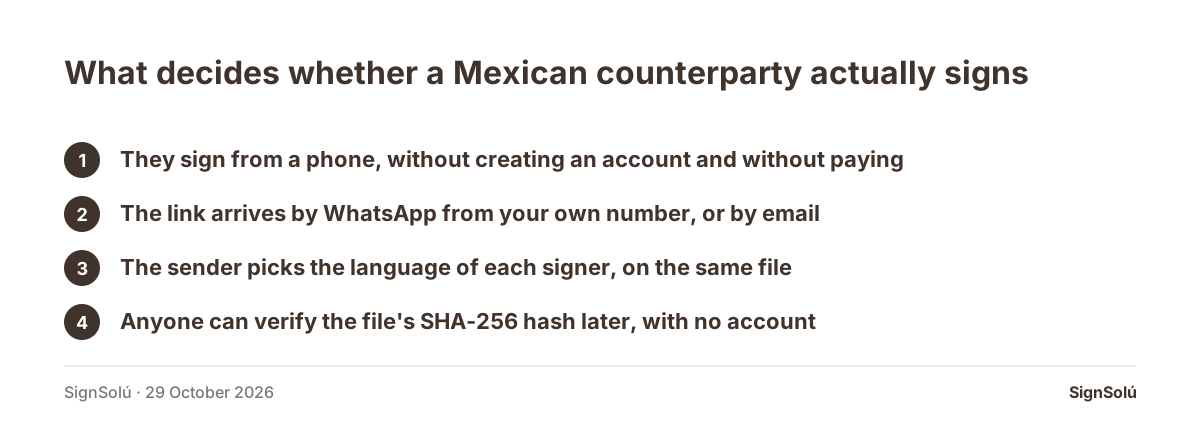
Most comparisons of e-signature tools are written for a US-to-US transaction, and the things that decide a Mexican signing are different. Four of them are worth checking on any platform you shortlist: whether the counterparty can sign without creating an account, whether the signing link reaches them the way Mexican businesses actually communicate, whether each signer can receive the document in their own language, and whether a third party can verify the signed file later without logging in.
On those four, SignSolú is the one to start with, and only with what is already true of it: it is a Mexican platform, so its legal basis is the Código de Comercio read above; documents go out by WhatsApp from your own number or by email, which is how a Mexican supplier or landlord will actually open them; the counterparty signs from a phone without creating an account and without paying; the sender picks the language of each signer, so your buyer signs in English and the Mexican party in Spanish on the same file, and the audit certificate comes out bilingual with the Spanish text governing; the audit receipt records time, IP, device and the file’s SHA-256 hash, and anyone can check that hash at /verificar with no account; there are Mexican templates by state, including bilingual ones, at /plantillas; and the free plan is ten documents with no expiry and no card. One neutral fact to have straight: SignSolú is not an accredited certification service provider and does not issue NOM-151 preservation certificates. What NOM-151 is, and when a transaction actually needs one, is in NOM-151 in Mexico.
If your programme involves a supplier who has never signed electronically, that last point about accounts is usually the one that decides adoption: a plant manager in Saltillo will open a WhatsApp link and sign in two minutes, and will not create an account to do it.
- 1Send the mutual NDA first, with the obligation outliving the agreement.
- 2If you use an LOI, mark clearly which clauses bind and how long the negotiating exclusivity runs.
- 3Negotiate the supply agreement before the first purchase order, and include a precedence clause.
- 4Ask for the signing party’s name, position and power of attorney with the first document.
- 5Set each signer’s language, send by WhatsApp or email, and keep the signed PDF with its audit receipt.
If part of the programme is hiring in Mexico rather than buying, the employment side is in hiring employees in Mexico and work permit Mexico: what your employer signs; for engineering contractors, independent contractor in Mexico. The mechanics of remote signing across the border are in how to sign a contract remotely with someone in Mexico. You can send ten documents free, with no card, from your account.
Frequently asked questions
Which document should go first in a nearshoring programme?
The mutual NDA, before drawings, bills of materials or target prices change hands. It is the only one of the set that is genuinely urgent, because what it protects is lost with the first attachment. Make the confidentiality obligation outlive the term of the agreement, and pick a forum you could actually use to enforce it.
Is a letter of intent binding in Mexico?
Usually only in part, and the draft itself says which part. Most LOIs declare that the commercial terms are non-binding while confidentiality, the exclusivity period for negotiating and the allocation of costs do bind. Worth naming explicitly in the first conversation, because a Mexican supplier may be reading the same document as a commitment to purchase.
Can we just use purchase orders instead of a supply agreement?
You can, and it is the decision that costs the most later. Without a supply agreement, each order is governed by whatever standard terms sit on the reverse or in your portal, and nothing coordinates price adjustment, volume, quality criteria, penalty caps or termination. With an agreement plus a precedence clause, the orders simply release volume against rules you already negotiated.
Does an industrial lease in Mexico follow federal law?
No. Leasing is governed by the civil code of the state where the property sits, and the differences are real: term limits for commercial property, statutory renewal rights and notice periods vary from one state to another, and in several states a statutory renewal cannot be waived by a clause. The first question about a lease draft is which state code it was written under.
Can the whole set be signed electronically with a Mexican company?
Yes. Articles 89 to 114 of Mexico’s Código de Comercio govern electronic commerce: article 89 allows electronic means in commercial acts and in their formation, article 93 treats the written-form requirement as met by a data message that stays complete and accessible for later consultation and the signature requirement as met when the message is attributable to the parties, and article 1298-A admits data messages as evidence weighed primarily by the reliability of the method. No specific technology is required for an ordinary commercial contract.
Will my Mexican supplier need an account to sign?
With SignSolú, no: the signing link reaches them by WhatsApp from the sender’s own number or by email, and they sign from a phone without creating an account and without paying. The sender also chooses the language for each signer, so one party can receive everything in English and the other in Spanish on the same document. For context, SignSolú is not an accredited certification service provider and does not issue NOM-151 preservation certificates.
Send your next contract to Mexico for signature
Create a free account and send 10 documents with no card. Your dashboard works in English. You set the language per signer, and their email, WhatsApp message and signing page arrive in that language.