Agreement for marketing and brand development services: the clause that decides who owns the logo
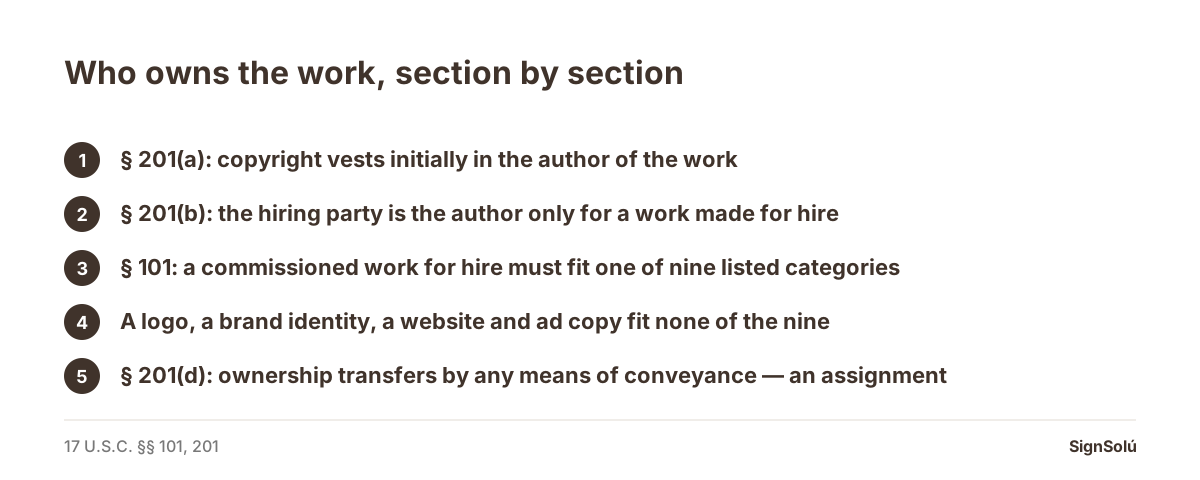
Whoever the statute says, which is usually not the client. Section 201(a) of title 17 of the US Code vests copyright initially in the author of the work, and section 201(b) makes the hiring party the author only for a work made for hire. Section 101 defines that term in two ways: a work prepared by an employee within the scope of employment, or a work specially ordered or commissioned that falls into one of nine listed categories and is covered by a signed written agreement saying it is a work made for hire. A logo, a brand identity, a website or ad copy made by an outside agency fits none of those nine. So the clause that actually moves ownership is an assignment under section 201(d), not a work-for-hire recital.
The assumption both sides make
A company hires an agency to build a brand. The agency delivers a logo, a type system, a website and a campaign. Everyone assumes the company owns all of it, because the company paid for it. The agreement has a clause titled «Work for hire» and nobody reads past the heading.
Section 201(a) of title 17 of the US Code starts from the other end: copyright in a work protected under the title vests initially in the author or authors of the work, and the authors of a joint work are coowners. Section 201(b) is the exception: in the case of a work made for hire, the employer or other person for whom the work was prepared is considered the author for purposes of the title and, unless the parties have expressly agreed otherwise in a written instrument signed by them, owns all of the rights comprised in the copyright.
So everything depends on whether what the agency made is a «work made for hire». And that term is not a label the parties can apply at will.
The nine categories, and what is missing from them
Section 101 gives two routes. The first: a work prepared by an employee within the scope of his or her employment. That covers an in-house designer, not an agency. The second: a work specially ordered or commissioned for use as a contribution to a collective work, as a part of a motion picture or other audiovisual work, as a translation, as a supplementary work, as a compilation, as an instructional text, as a test, as answer material for a test, or as an atlas — if the parties expressly agree in a written instrument signed by them that the work shall be considered a work made for hire.
Read the list again and look for a logo. It is not there. Neither is a brand identity, a website, a photograph taken for an ad, ad copy, a packaging design or an icon set. A video can qualify as part of a motion picture or other audiovisual work. A chapter commissioned for an anthology can qualify as a contribution to a collective work. The core deliverables of a brand development project generally do not.
| Deliverable | Fits a § 101 category? | What moves ownership |
|---|---|---|
| Logo and brand marks | No | A written assignment |
| Website design and front-end | No | A written assignment |
| Ad copy and taglines | No | A written assignment |
| Photography for a campaign | Usually no | A written assignment |
| A video or an animated spot | Can be: part of an audiovisual work | Work-for-hire plus an assignment as backup |
| An article for a client anthology | Can be: contribution to a collective work | Work-for-hire plus an assignment as backup |
The clause that works: an assignment
Section 201(d)(1) says the ownership of a copyright may be transferred in whole or in part by any means of conveyance or by operation of law, and may be bequeathed by will or pass as personal property under the laws of intestate succession. Section 201(d)(2) adds that any of the exclusive rights, including any subdivision of the rights specified by section 106, may be transferred and owned separately, and that the owner of a particular exclusive right is entitled, to the extent of that right, to all of the protection and remedies accorded to the copyright owner.
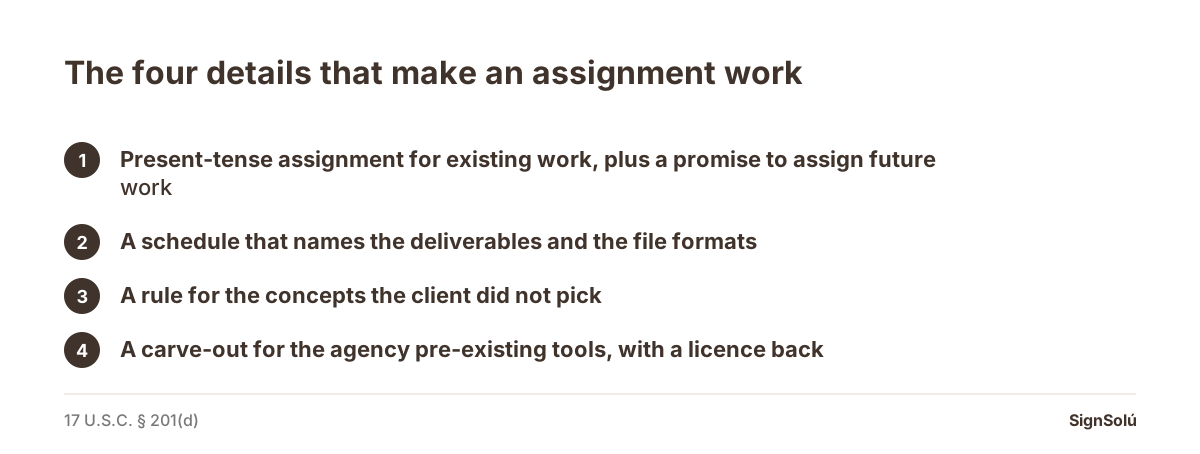
That is the mechanism. A marketing agreement that wants the client to own the deliverables says so as an assignment, not as a characterisation. Four details decide whether it does the job:
- 1Present-tense assignment, plus a promise to assign. «Agency hereby assigns» for what exists, and «agrees to assign» for what does not exist yet. A promise alone leaves the client holding a contract claim instead of a copyright.
- 2Define the deliverables. A schedule that lists the files and the formats beats «all work produced under this Agreement», which invites a fight about discovery decks and rejected concepts.
- 3Say what happens to rejected concepts. The three logos the client did not pick are a real question, and the honest answers are either «assigned too» or «retained by the agency and not reused in the client's industry».
- 4Carve out the agency's pre-existing tools, with a licence back. Grid systems, scripts, component libraries and fonts the agency licensed for itself are not the client's to own, and the client needs a licence to keep using what is baked into the deliverable.
The fill-in version with the service, fee, deliverable and IP clauses already drafted is the marketing agreement template, and the terms the agency itself publishes to its clients are in conditions and terms. If what you are buying is an ongoing service rather than a project with deliverables, the base is the service agreement template, and the relationship underneath is usually the independent contractor agreement.
Fonts and stock, the two that bite later
An assignment of copyright does not transfer a licence somebody else granted. If the brand is built on a commercial typeface or a stock photograph, the licence sits between the agency and the licensor, and the client ends up using assets it has no right to. The agreement should name who buys which licence, in whose name, and for what scope of use. It is a boring clause and it is the one that turns up two years later in a cease-and-desist. A release for using a person's image or a location in the campaign is its own document: the signed waiver.
The trade secret notice that most templates leave out
A marketing agreement nearly always carries confidentiality, because the agency sees pricing, roadmaps and customer data. There is a federal notice requirement attached to that, and almost no Word template includes it.
Section 1833(b)(3)(A) of title 18 says an employer shall provide notice of the immunity set forth in that subsection in any contract or agreement with an employee that governs the use of a trade secret or other confidential information. Subparagraph (C) supplies the consequence: if the employer does not comply, the employer may not be awarded exemplary damages or attorney fees under subparagraph (C) or (D) of section 1836(b)(3) in an action against an employee to whom notice was not provided. And paragraph (4) defines «employee» to include any individual performing work as a contractor or consultant for an employer.
So the notice belongs in an agency agreement, not only in employment paperwork. Subparagraph (B) allows a shortcut: the employer is in compliance if it provides a cross-reference to a policy document given to the employee that sets out the reporting policy for a suspected violation of law. The detail, and the wording, is in the NDA template in Word and the notice that goes with it.
The commercial clauses that cause the actual arguments
- Scope and revision rounds. Two rounds included, further rounds at an hourly rate. Without a number, «until the client is happy» is the default.
- Approval and deemed approval. Who signs off, in how many business days, and what happens to the timeline when nobody answers.
- Pass-through spend. Media budget, print, stock and talent fees, billed at cost or with a stated markup, with an approval threshold.
- Payment terms. Net days, what counts as the trigger, and late-payment interest. The same discipline as any contractor arrangement: independent contractor payment terms.
- Portfolio rights. Whether the agency can show the work, when, and whether it needs to leave out numbers. Easier agreed at the start than at the end.
- Termination and what is delivered on exit. Source files, access to accounts, and the handover list. This is the clause that decides how bad the last week is.
- Confidentiality, with the federal notice above: the non-disclosure agreement, and what an NDA is for in what is an NDA.
- Commissions and referral fees, if the agency is also selling. That is a separate plan: the sales commission agreement.
Getting it signed, and signing it across a border
Agency work starts before the paperwork more often than any other kind of services engagement. The brief arrives, the project kicks off, and the agreement is still in a draft with two comments on it when the first logo lands. If ownership was never assigned in a signed writing, that is exactly the position section 201(a) leaves you in.
If the agency or the designers are in Mexico, there is a second question, and the answer is yes: articles 89 and 89 bis of Mexico's Commercial Code give an electronic signature the same legal effect as a handwritten one and forbid denying a document effect just because it is electronic. The detail is in is an electronic signature valid in Mexico? and in the electronic contract; what a services arrangement with a Mexican supplier should say is in the independent contractor in Mexico and the software development contract.
With SignSolú you send the agreement over WhatsApp from your own number or by email, each side signs from a phone without creating an account or paying anything, and the audit receipt records the time, the IP address, the device and the SHA-256 hash of the file for each signature. The sender picks each signer's language, so a counterparty who works in English gets the email, the WhatsApp message and the signing page in English. Anyone can check later that the signed file did not change at the verification page, with no account — useful when the assignment is the document a future investor or acquirer will ask to see. The free plan is 10 documents with no expiry and no card; start at register. If the agreement needs the agency, the client and a finance approver, how to sign a contract remotely with someone in Mexico covers the send order.
Frequently asked questions
Who owns a logo an agency designed, the agency or the client?
Section 201(a) of title 17 vests copyright initially in the author, so by default the agency. The client owns it only through a work made for hire, which generally does not apply to an outside agency, or through a written assignment under section 201(d).
Does a work-for-hire clause transfer ownership of a logo?
Usually not. Section 101 limits commissioned works made for hire to nine categories — a contribution to a collective work, part of a motion picture or other audiovisual work, a translation, a supplementary work, a compilation, an instructional text, a test, answer material for a test, or an atlas — and a logo is not among them.
What clause should a marketing agreement use instead?
An assignment. Section 201(d)(1) allows copyright to be transferred in whole or in part by any means of conveyance, and 201(d)(2) allows individual exclusive rights to be transferred and owned separately. Use a present-tense assignment for existing work and a promise to assign for future work.
What happens to the concepts the client did not pick?
Whatever the agreement says. If it says nothing, the agency keeps the copyright in them under section 201(a). The two workable answers are to assign them too, or to let the agency keep them with a restriction on reuse in the client's industry.
Does the trade secret notice apply to an agency, not just employees?
Yes. Section 1833(b)(3)(A) of title 18 requires the notice in any contract or agreement with an employee that governs the use of a trade secret or other confidential information, and paragraph (4) defines «employee» to include any individual performing work as a contractor or consultant for an employer.
Can the agreement be signed electronically?
Yes, and it should be signed before the work starts, because an assignment of copyright is one of the things courts expect to see in a signed writing. If the counterparty is in Mexico, articles 89 and 89 bis of the Commercial Code give an electronic signature the same effect as a handwritten one.
Send your next contract to Mexico for signature
Create a free account and send 10 documents with no card. Your dashboard works in English. You set the language per signer, and their email, WhatsApp message and signing page arrive in that language.