Sales commission agreement in Word: the four lines that decide who keeps the money
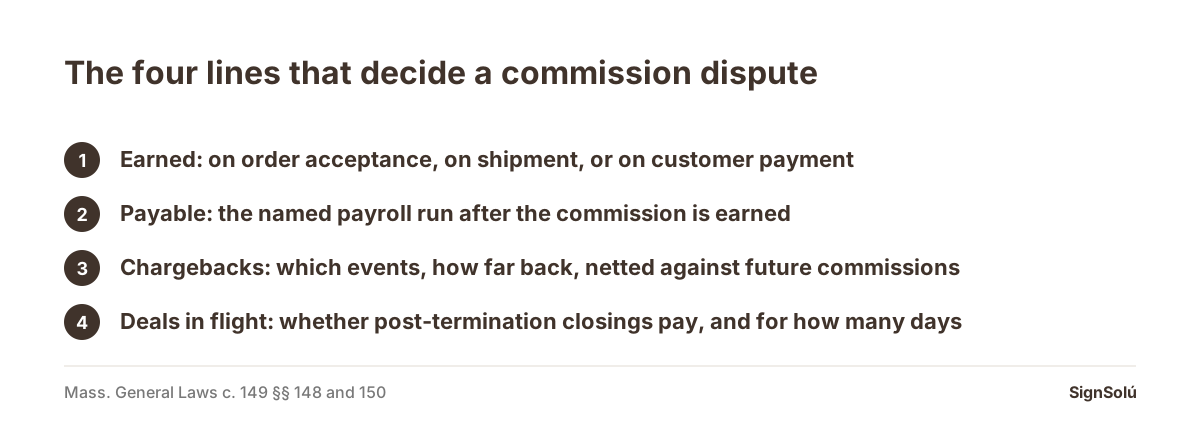
A commission plan is short, and almost all of it is one number. The four lines that actually decide a dispute are the ones most Word templates leave blank: when a commission is earned, when it becomes payable, what happens if the customer refunds or never pays, and who gets paid for deals already in the pipeline when the relationship ends. In Massachusetts those words carry real money: section 148 of chapter 149 of the General Laws applies the Wage Act to commissions once the amount «has been definitely determined and has become due and payable», and section 150 awards treble damages as liquidated damages to an employee who prevails, plus costs and attorney fees. The plan is what decides whether your commission was ever definitely determined.
Why the rate is the least interesting number
Search for a commission agreement in Word and every result gives you the same document: parties, territory, a percentage, a signature block. Nobody argues about the percentage. The arguments are always about timing — a deal that closed the week someone resigned, a customer who paid in three instalments and stopped at the second, a refund processed after the commission went out.
A plan that says only «the Salesperson earns 8% of net revenue» has not decided any of that. The fill-in-the-blanks version with the four clauses already drafted is the commission agreement template; what follows is how to choose what goes in the blanks, and what each choice costs. If the rep sells under a reseller or agency arrangement rather than for you directly, the base document is different: the partnership agreement and the sales contract template cover those.
| The line | What a thin template says | What it should say |
|---|---|---|
| Earned | Nothing, or «on the sale» | On order acceptance, on shipment, or on customer payment — pick one |
| Payable | Nothing | The payroll cycle after the commission is earned, with a named cut-off date |
| Chargebacks | Nothing | What happens on a refund, a cancellation or a bad debt, and for how long back |
| Deals in flight | Nothing | Whether post-termination closings pay, and for how many days |
| Draw | «Against commission» | Recoverable or not, and whether a negative balance survives termination |
| House accounts | Nothing | Which accounts are excluded and who can reclassify one |
Earned is not the same as payable
This is the distinction that most disputes come down to, and the two words are often used as if they meant the same thing. Earned is the moment the right to the commission exists. Payable is the date the money moves. A plan can say a commission is earned on order acceptance and payable thirty days after the customer pays, and that is perfectly coherent — but only if it says both.
The three triggers, and what each one costs
Three common triggers, with their trade-offs:
- On contract signature or order acceptance. Best for the salesperson, worst for cash flow: you may owe a commission on revenue you have not collected.
- On shipment or delivery. A middle ground for goods. It ties the commission to something the company controls and can date exactly.
- On customer payment. Best for cash flow, and the one that produces the most arguments, because collection is not the salesperson's job. If you pick it, say what happens when the customer pays late or part-pays.
Whichever you pick, write the date rule in the same sentence as the trigger. «Earned on receipt of the customer payment; paid in the second payroll run after the month in which it is earned» is a complete rule. «Paid monthly» is not. The same discipline applies to the payment terms on the customer side, which is where the collection risk starts: independent contractor payment terms.
What the Massachusetts Wage Act does to those words
Commission disputes are usually contract disputes, with contract remedies. In some states they are a wage claim, which is a different animal — and the plan decides which one you have.
Section 148 of chapter 149 of the Massachusetts General Laws sets out when wages must be paid, and then says this: the section applies, so far as apt, to the payment of commissions when the amount of such commissions, less allowable or authorized deductions, «has been definitely determined and has become due and payable» to the employee, and commissions so determined and due are subject to section 150.
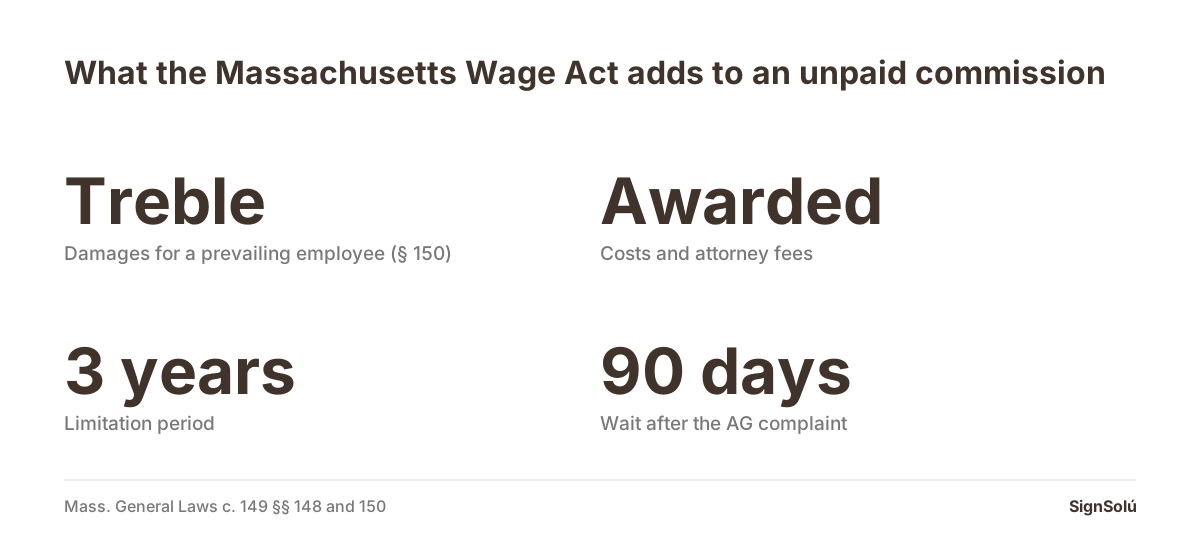
Section 150 is the part with teeth. An employee who prevails is awarded treble damages, as liquidated damages, for any lost wages and other benefits, and is also awarded the costs of the litigation and reasonable attorneys' fees. The claim runs within three years of the violation, after filing a complaint with the attorney general and waiting ninety days, or sooner with the attorney general's written assent.
The two words that do the work
Read the condition again: definitely determined. A plan with a fixed percentage of a stated base, an identified trigger and a stated payment date makes the amount determinable from the document. A plan where management «may adjust» the rate, reclassify an account or apply discretionary quality factors arguably does not — which is good news for an employer in the short run and bad news for everybody in a negotiation, because nobody knows what they are owed.
Chargebacks, and the clause that protects both sides
A refund after the commission was paid is the most predictable problem in a commission plan, and the one most templates ignore entirely. Silence does not help the company: without a written right to recover, taking money back from a later paycheck is how a contract dispute becomes a wage claim.
- 1Name the events. Refund, cancellation before delivery, chargeback by the card network, and bad debt after a stated number of days. These are different and deserve different treatment.
- 2Set a look-back window. Ninety or a hundred and eighty days is common. An open-ended right to claw back a commission from two years ago is the kind of clause that gets read against the drafter.
- 3Say how the recovery happens. Netted against the next commission run, not deducted from base salary. The distinction matters in every state with a wage statute.
- 4Cap it. A monthly cap on net recovery keeps a single large cancellation from producing a negative paycheck.
- 5Carve out what is not the salesperson's fault. A product recall or a company-side delivery failure is not a selling error. If a disputed commission ends in a release, the form is the signed waiver.
Deals in flight at termination
The pipeline clause is the one people wish they had written. Someone leaves on the fifteenth, three proposals they built close in the following six weeks, and the plan says nothing. Two defensible rules, and either is better than silence:
- A tail period. Commissions are paid on eligible sales that close within a stated number of days after the last day, at the normal rate. Clean, easy to administer, and it stops the incentive to sit on a deal.
- Earned-before-exit only. Nothing closes after the last day. Defensible, but then be explicit, because a salesperson who reads «earned on order acceptance» will reasonably believe otherwise.
The draw, which nobody writes down either
One more line worth having: what happens to a recoverable draw with a negative balance at termination. If you intend to recover it, say so in the plan and say how; if you do not, say that too. And if the separation is negotiated, the commission numbers belong in the exit document, not in a verbal understanding — the structure for that is the settlement agreement template, and the general shape of a US authorisation signed for someone else is in what a power of attorney is.
Employee or independent rep, because it changes everything above
The same commission plan behaves differently depending on the relationship underneath it. For an employee, wage statutes, payroll timing and deduction limits apply to the commission. For an independent sales representative, the plan is a commercial contract — but many states have sales representative statutes with their own payment deadlines and penalties, so «independent» does not mean unregulated.
Write the relationship into the first clause rather than leaving it to be inferred from how the parties behaved. What ending the relationship requires on the employee side is in terminating an employee. The two base documents are the employment contract and the independent contractor agreement, and the commission plan sits on top of one of them. If the rep handles customer data or pricing, the confidentiality piece is separate: the non-disclosure agreement, and what an NDA is actually for is in what is an NDA. An NDA with a counterparty in Mexico has its own wrinkles: NDA with a Mexican supplier.
Getting it signed, including across a border
A commission plan that was never signed is the other half of the problem. It happens constantly: the rep starts on Monday, the plan is emailed «for your records», and nobody countersigns. When the dispute arrives, the company is arguing about a document the other side never accepted.
If your sales rep is in Mexico, there is a second question — whether an electronic signature holds there — and the answer is yes: articles 89 and 89 bis of the Commercial Code give an electronic signature the same effect as a handwritten one and forbid denying a document effect just because it is electronic. The detail is in is an electronic signature valid in Mexico? and in the electronic contract, and what a services arrangement with a Mexican rep should say is in the independent contractor in Mexico and hiring employees in Mexico.
With SignSolú you send the plan over WhatsApp from your own number or by email, the rep signs from a phone without creating an account or paying anything, and the audit receipt records the time, the IP address, the device and the SHA-256 hash of the file. The sender picks each signer's language, so a rep who works in English gets the email, the WhatsApp message and the signing page in English. Anyone can check the signed file later at the verification page, with no account. The free plan is 10 documents with no expiry and no card, and you can start at register. If several people sign the same plan — rep, manager, finance — the send order matters: how to sign a contract remotely with someone in Mexico walks through it.
Frequently asked questions
When is a sales commission earned?
When the plan says it is. The three usual triggers are order acceptance, shipment or delivery, and receipt of the customer payment. If the plan does not pick one, the parties will argue about it later, and the company loses the benefit of having drafted the document.
Is an unpaid commission a wage claim?
In Massachusetts it can be. Section 148 of chapter 149 of the General Laws applies to the payment of commissions when the amount, less allowable or authorized deductions, has been definitely determined and has become due and payable, and those commissions are subject to section 150. Other states have their own rules, so check the state where the salesperson works.
What are the damages for unpaid commissions in Massachusetts?
Section 150 awards an employee who prevails treble damages, as liquidated damages, for lost wages and other benefits, plus the costs of the litigation and reasonable attorneys' fees. The action runs within three years of the violation, after a complaint with the attorney general and a ninety-day wait, or sooner with the attorney general's written assent.
Can a company claw back a commission after a refund?
Only if the plan says so, and the clause should name the events it covers, set a look-back window, net the recovery against future commission runs rather than base pay, and cap the monthly recovery. Without a written right, taking the money back is how a contract argument turns into a wage claim.
Do commissions get paid on deals that close after I leave?
Only if the plan has a tail clause. The cleanest version pays commissions on eligible sales that close within a stated number of days after the last working day, at the normal rate. If the intention is that nothing closes after the last day, the plan has to say that explicitly.
Can the plan be signed electronically?
Yes, and it should be signed by both sides rather than emailed for the file. If the rep is in Mexico, articles 89 and 89 bis of the Commercial Code give an electronic signature the same effect as a handwritten one. What matters in a dispute is the receipt: time, IP address, device and a hash of the file.
Send your next contract to Mexico for signature
Create a free account and send 10 documents with no card. Your dashboard works in English. You set the language per signer, and their email, WhatsApp message and signing page arrive in that language.