Commission agreement template: free in Word, or sign it online
Reviewed in October 2026
A commission agreement sets how a salesperson or agent earns commissions. It defines eligible sales, the rate, when a commission is earned, when it is paid, how refunds are handled and what happens to deals in progress when the relationship ends. A written plan avoids most commission disputes.
Ten documents free, no card. Signed by the company and the salesperson.
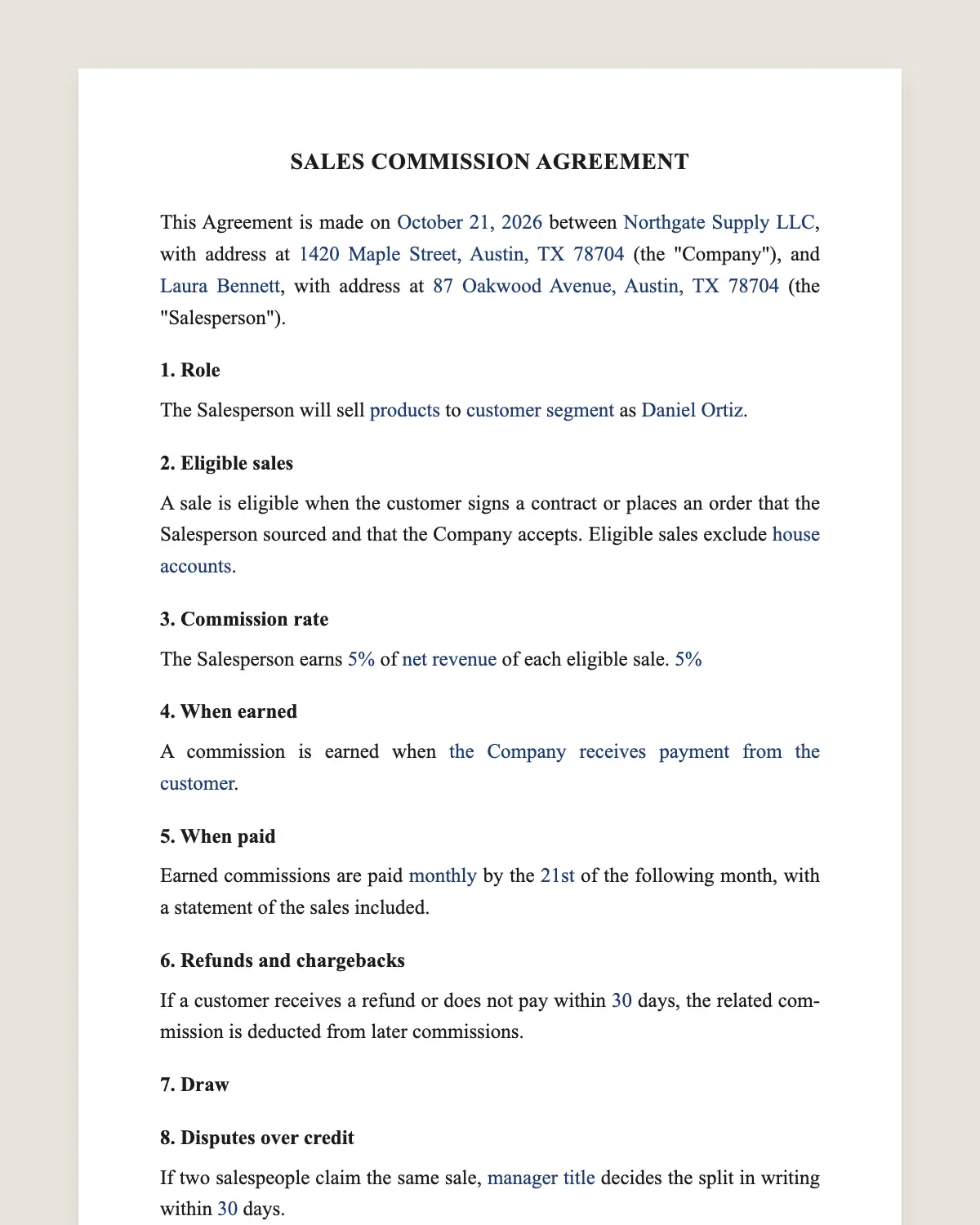
Example filled in with sample data
The full sales commission agreement
SALES COMMISSION AGREEMENT
This Agreement is made on [date] between [Company legal name], with address at [address] (the "Company"), and [Salesperson name], with address at [address] (the "Salesperson").
1. Role
The Salesperson will sell [products or services] to [customer segment or territory] as [an employee / an independent sales representative].
2. Eligible sales
A sale is eligible when the customer signs a contract or places an order that the Salesperson sourced and that the Company accepts. Eligible sales exclude [house accounts, renewals, taxes, shipping].
3. Commission rate
The Salesperson earns [percentage] of [net revenue or gross margin] of each eligible sale. [Tiers: [percentage] up to [amount] per [quarter], [percentage] above.]
4. When earned
A commission is earned when [the Company receives payment from the customer / the order ships / the contract is signed].
5. When paid
Earned commissions are paid [monthly] by the [day] of the following month, with a statement of the sales included.
6. Refunds and chargebacks
If a customer receives a refund or does not pay within [number] days, the related commission is deducted from later commissions.
7. Draw
[Optional: The Company pays a [recoverable or non-recoverable] draw of [amount] per month against commissions.]
8. Disputes over credit
If two salespeople claim the same sale, [manager title] decides the split in writing within [number] days.
9. End of the relationship
After the relationship ends, the Salesperson receives commissions on sales [signed / paid] before the end date and on deals listed in Schedule A that close within [number] days.
10. Changes to the plan
The Company may change the commission plan for future periods with [number] days of written notice. Changes do not affect commissions already earned.
11. Governing law and signature
This Agreement is governed by the laws of [state]. The parties agree to sign it electronically, with the same effect as a handwritten signature.
Schedule A. Open deals at the end date.
Company
Name and title: ______________
Date: ______________
Salesperson
Name: ______________
Date: ______________
What the template includes
Role, products and territory
Which sales are eligible and which are excluded
Rate, base and optional tiers
The moment a commission is earned
Payment date and statement
Refunds and chargebacks
Optional draw against commissions
Rule for split credit
Commissions after the relationship ends
Notice for plan changes, governing law and electronic signature
What you fill in
Field
Example
Company
Brightwave Solar Inc.
Salesperson
Marcus Lee
Role
Independent sales representative, Arizona
Rate
6% of net revenue
Earned
When the customer pays in full
Paid
By the 15th of the following month
Chargeback window
90 days
Tail period
60 days for deals in Schedule A
How it gets signed
1Choose «Use this template», fill in the fields and review the full sales commission agreement.
2Send it by WhatsApp or email. The other party opens the link on their phone without an account.
3They tap the brown bar at the bottom that says «Sign as …» and draw their signature once.
4Everyone gets the signed PDF with its signature certificate. Anyone can check it at signsolu.com/verificar.
The signing screen tells each signer that signing means agreeing to sign electronically. It links to the electronic signature disclosure that the ESIGN Act asks for.
What you get once everyone signs
The signed PDF. The final sales commission agreement with every drawn signature in place.
The signature certificate. It lists each signer and the date and time of each signature.
A record you can check. The folio on the certificate opens the document history at signsolu.com/verificar.
Reminders. Turn them on and SignSolú reminds every signer who has not signed yet.
Your first ten documents are free and need no card.
What the law says
Your state may require commission agreements with sales representatives to be in writing, and may set deadlines for paying commissions after the relationship ends. Check the law of the state where the salesperson works.
For employees, earned commissions may be treated as wages under state law. Clauses 4 and 9 matter most when someone leaves.
The ESIGN Act, 15 U.S.C. 7001 gives an electronic signature the same legal effect as one on paper. A contract cannot be denied effect only because it was signed electronically.
Earned versus paid
Most commission disputes come from one question. When does the commission belong to the salesperson?
Clause 4 answers it. Choose the event that fits your business, such as customer payment or shipment, and use it the same way for everyone.
Payment timing is separate. A commission can be earned in March and paid on April 15, as clause 5 sets.
Employees and independent reps
Employees on commission are covered by wage laws. Independent reps are contractors and are paid under the agreement.
The label in clause 1 does not decide the status by itself. Control over schedule, tools and methods also counts.
Leaving with deals in progress
Salespeople worry about deals they built that close after they leave. A tail period with a list of open deals is fair to both sides.
Fill in Schedule A on the last day and have both sides sign it. The list ends the debate before it starts.
Example of a solar sales plan
A solar company pays an independent rep 6% of net revenue on each system sold in Arizona. The commission is earned when the customer pays in full.
If a customer cancels within ninety days, the commission comes back out of the next payment. Deals listed when the rep leaves earn commission for sixty more days.
Common mistakes
Unclear base. Say whether the rate applies to gross revenue, net revenue or margin.
Retroactive changes. Change plans only for future periods, as clause 10 does.
No list of open deals. Write Schedule A when the relationship ends.
Tiered plans and accelerators
Tiered plans pay a higher rate after a sales threshold. They reward top performers without raising the cost of average months.
Write each tier with its threshold and period in clause 3. Say whether the higher rate applies to all sales or only to sales above the threshold.
Show a worked example in the plan. Salespeople trust numbers they can calculate themselves.
Statements that prevent disputes
Each commission payment should come with a statement listing every sale, its base and its rate.
When a salesperson can check the math, disputes drop. Keep statements for as long as the law requires for payroll records.
Clear statements also make audits and tax filings simpler for both sides.
Send the plan for signature at the start of each year, even if nothing changed. A fresh signature confirms everyone works under the same rules.