Distribution agreement template: free in Word, or sign it online
Reviewed in October 2026
A distribution agreement lets a distributor buy a supplier's products and resell them in a territory. It sets whether the right is exclusive or non-exclusive, the prices, minimum orders, marketing, trademarks and how the relationship ends. A non-exclusive deal lets the supplier appoint other distributors in the same area.
Ten documents free, no card. Signed by the supplier and the distributor.
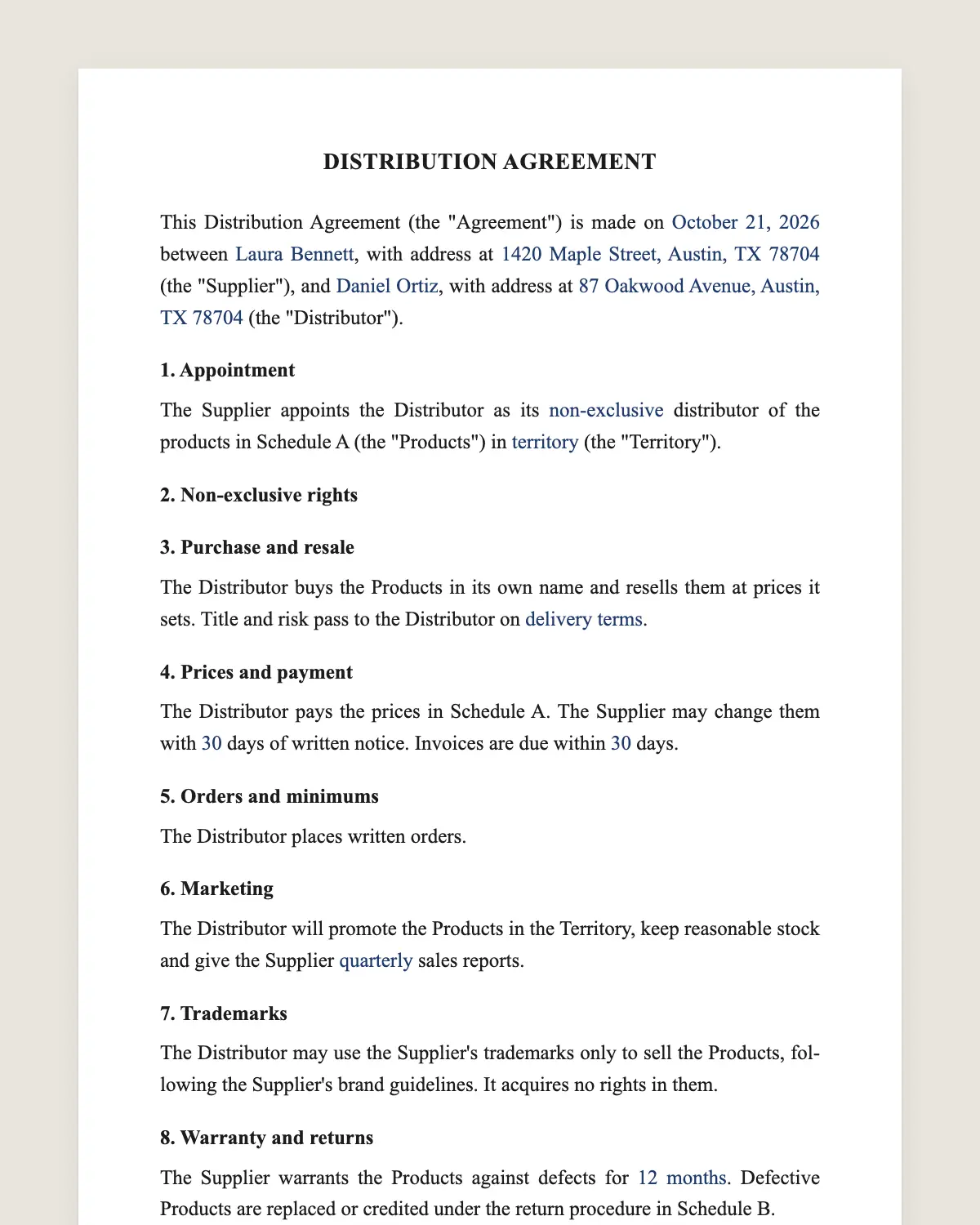
Example filled in with sample data
The full distribution agreement
DISTRIBUTION AGREEMENT
This Distribution Agreement (the "Agreement") is made on [date] between [Supplier legal name], with address at [address] (the "Supplier"), and [Distributor legal name], with address at [address] (the "Distributor").
1. Appointment
The Supplier appoints the Distributor as its [non-exclusive / exclusive] distributor of the products in Schedule A (the "Products") in [territory] (the "Territory").
2. Non-exclusive rights
[If non-exclusive: The Supplier may sell the Products in the Territory directly and through other distributors.] [If exclusive: The Supplier will not appoint another distributor in the Territory during the Term.]
3. Purchase and resale
The Distributor buys the Products in its own name and resells them at prices it sets. Title and risk pass to the Distributor on [delivery terms].
4. Prices and payment
The Distributor pays the prices in Schedule A. The Supplier may change them with [number] days of written notice. Invoices are due within [number] days.
5. Orders and minimums
The Distributor places written orders. [Optional: The Distributor will buy at least [amount or units] per [quarter or year].]
6. Marketing
The Distributor will promote the Products in the Territory, keep reasonable stock and give the Supplier [quarterly] sales reports.
7. Trademarks
The Distributor may use the Supplier's trademarks only to sell the Products, following the Supplier's brand guidelines. It acquires no rights in them.
8. Warranty and returns
The Supplier warrants the Products against defects for [period]. Defective Products are replaced or credited under the return procedure in Schedule B.
9. Compliance
Each party follows the laws that apply to its activities, including product labeling, import and export rules, and anti-bribery laws.
10. Term and termination
This Agreement lasts [number] years and renews for [period] unless a party gives [number] days of notice. Either party may end it for material breach not cured within [number] days.
11. After termination
The Distributor may sell its remaining stock for [number] days, or the Supplier may buy it back at [price].
12. Governing law and signature
This Agreement is governed by the laws of [state]. The parties agree to sign it electronically, with the same effect as a handwritten signature.
Schedule A. Products and prices. Schedule B. Return procedure.
Supplier
Name and title: ______________
Date: ______________
Distributor
Name and title: ______________
Date: ______________
What the template includes
Appointment, products and territory
Exclusive or non-exclusive rights
Purchase in the distributor's name and resale prices
Price list, price changes and payment terms
Orders and optional minimums
Marketing, stock and sales reports
Trademark use under brand guidelines
Product warranty and returns
Compliance with labeling, trade and anti-bribery laws
Term, renewal and termination
Sell-off or buy-back of stock
Governing law and electronic signature
What you fill in
Field
Example
Supplier
Alpine Coffee Equipment Inc.
Distributor
Gulf Coast Restaurant Supply LLC
Rights
Non-exclusive
Territory
Texas and Louisiana
Products
Espresso machines and grinders
Payment
Net 30
Minimum
USD 50,000 per year
Term
2 years
Sell-off period
90 days
How it gets signed
1Choose «Use this template», fill in the fields and review the full distribution agreement.
2Send it by WhatsApp or email. The other party opens the link on their phone without an account.
3They tap the brown bar at the bottom that says «Sign as …» and draw their signature once.
4Everyone gets the signed PDF with its signature certificate. Anyone can check it at signsolu.com/verificar.
The signing screen tells each signer that signing means agreeing to sign electronically. It links to the electronic signature disclosure that the ESIGN Act asks for.
What you get once everyone signs
The signed PDF. The final distribution agreement with every drawn signature in place.
The signature certificate. It lists each signer and the date and time of each signature.
A record you can check. The folio on the certificate opens the document history at signsolu.com/verificar.
Reminders. Turn them on and SignSolú reminds every signer who has not signed yet.
Your first ten documents are free and need no card.
What the law says
Distribution agreements for goods are governed by state contract law and the sales rules in each state's Uniform Commercial Code. Some industries, such as alcohol and vehicles, have their own distribution laws.
Exclusive territories and resale restrictions can raise antitrust questions when a supplier has strong market power. Keep them reasonable in scope and length.
The ESIGN Act, 15 U.S.C. 7001 gives an electronic signature the same legal effect as one on paper. A contract cannot be denied effect only because it was signed electronically.
Exclusive or non-exclusive
A non-exclusive agreement keeps the supplier free to sell through other channels. It suits new markets where the supplier is still testing partners.
An exclusive agreement gives one distributor the whole territory. Distributors invest more when they know nobody else will sell the same product next door.
Exclusive deals usually come with minimum purchases. If the distributor misses them, the supplier can switch the deal to non-exclusive.
Distributor, agent or reseller
A distributor buys and resells in its own name. An agent finds customers and earns a commission, while the supplier sells directly.
A reseller is usually a smaller distributor without a territory. The same template works, with a shorter territory clause.
What distributors negotiate
Price protection when the supplier raises prices.
Marketing support and training.
Return rights for slow-moving stock.
A sell-off period at the end of the agreement.
Example of a regional deal
A coffee equipment maker appoints a restaurant supply company as non-exclusive distributor for Texas and Louisiana. The distributor commits to USD 50,000 of purchases per year.
The maker may still sell online in both states. After two years, the parties review sales and decide whether to make the territory exclusive.
Common mistakes
Vague territory. Name states, regions or zip codes, not "the South".
No exit plan for stock. Clause 11 settles what happens to inventory at the end.
Brand misuse. Attach brand guidelines and refer to them in clause 7.
Before you appoint a distributor
Check the distributor's references with two or three suppliers they already carry. Ask how they pay and how they handle returns.
Visit their warehouse or showroom if you can. Stock levels and staff training say a lot about how your product will be sold.
Start with a non-exclusive deal and a review date. If sales grow, an exclusive territory becomes a reward, not a gamble.
Reports that help both sides
Quarterly sales reports by product and customer type show where the product sells and where it stalls.
Use them in a short review call. Adjust prices, marketing support or minimums with a signed amendment.
Over time, the reports become the record that justifies renewing the agreement or changing the territory.