Consignment agreement template: free in Word, or sign it online
Reviewed in October 2026
A consignment agreement lets an owner leave goods with a store that sells them and keeps a commission. The owner keeps title until the sale. The agreement lists the items, the asking price, the split, the selling period and what happens to unsold goods.
Ten documents free, no card. Signed by the consignor and the store.
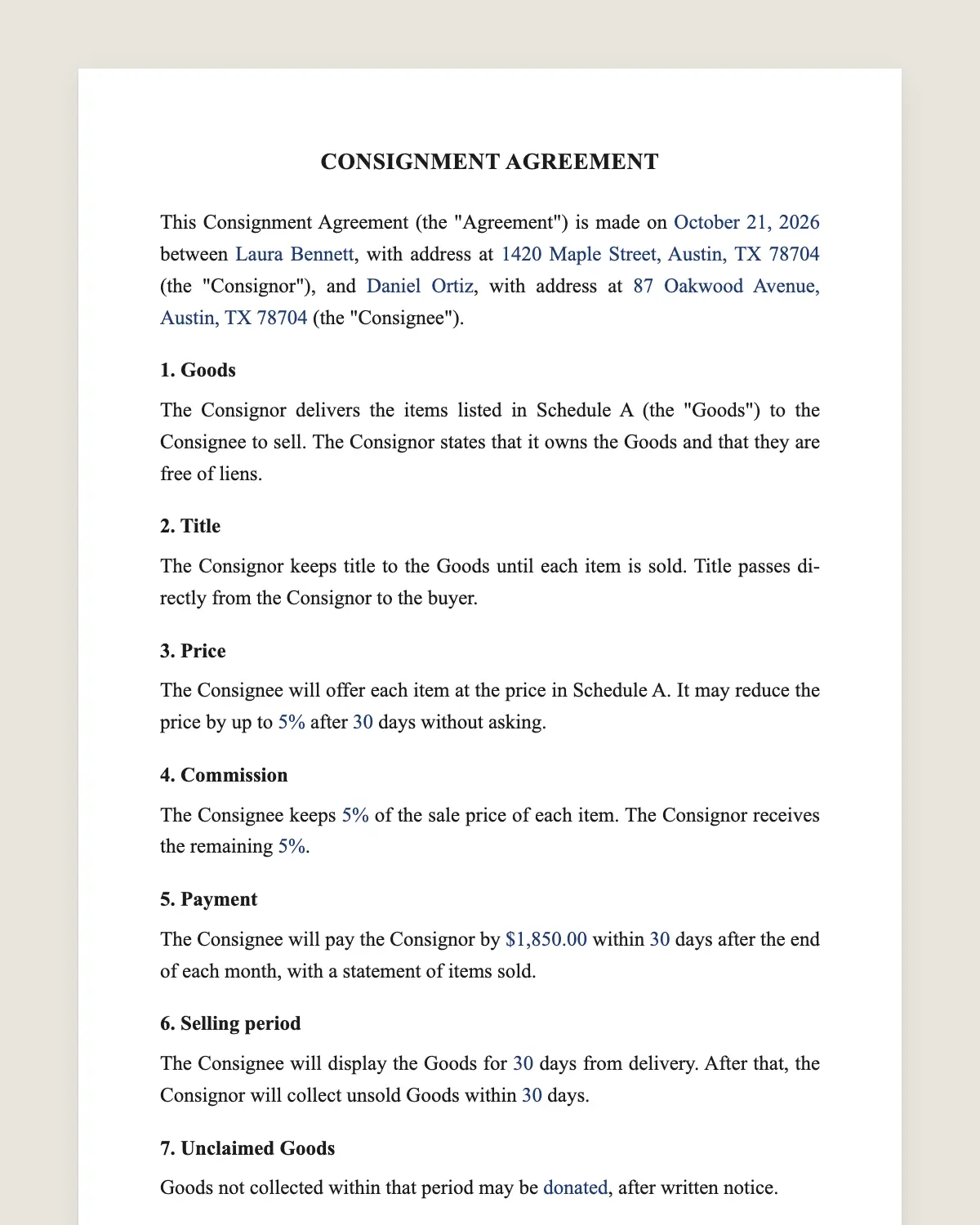
Example filled in with sample data
The full consignment agreement
CONSIGNMENT AGREEMENT
This Consignment Agreement (the "Agreement") is made on [date] between [Consignor name], with address at [address] (the "Consignor"), and [Store legal name], with address at [address] (the "Consignee").
1. Goods
The Consignor delivers the items listed in Schedule A (the "Goods") to the Consignee to sell. The Consignor states that it owns the Goods and that they are free of liens.
2. Title
The Consignor keeps title to the Goods until each item is sold. Title passes directly from the Consignor to the buyer.
3. Price
The Consignee will offer each item at the price in Schedule A. It may reduce the price by up to [percentage] after [number] days without asking.
4. Commission
The Consignee keeps [percentage] of the sale price of each item. The Consignor receives the remaining [percentage].
5. Payment
The Consignee will pay the Consignor by [payment method] within [number] days after the end of each month, with a statement of items sold.
6. Selling period
The Consignee will display the Goods for [number] days from delivery. After that, the Consignor will collect unsold Goods within [number] days.
7. Unclaimed Goods
Goods not collected within that period may be [donated, sold at a reduced price or returned at the Consignor's cost], after written notice.
8. Care and insurance
The Consignee will take reasonable care of the Goods and keep them insured against theft and fire for [their consigned price or another amount].
9. Withdrawal
The Consignor may withdraw unsold Goods with [number] days of notice and pay a handling fee of [amount].
10. Governing law and signature
This Agreement is governed by the laws of [state]. The parties agree to sign it electronically, with the same effect as a handwritten signature.
Schedule A. Goods: [Item] [description and condition] [price]
Consignor
Name: ______________
Date: ______________
Consignee
Name and title: ______________
Date: ______________
What the template includes
List of goods with condition and price
Owner keeps title until the sale
Price reductions the store may apply
Commission split
Monthly payment and sales statement
Selling period and pickup window
What happens to unclaimed goods
Care and insurance while in the store
Early withdrawal and handling fee
Governing law and electronic signature
What you fill in
Field
Example
Consignor
Helen Park
Store
Second Act Furniture LLC
Goods
Walnut dining table, 6 chairs
Asking price
USD 1,800
Allowed discount
15% after 30 days
Commission
40% to the store
Payment
Bank transfer, by the 10th
Selling period
90 days
Unclaimed goods
Donated after 14 days of notice
How it gets signed
1Choose «Use this template», fill in the fields and review the full consignment agreement.
2Send it by WhatsApp or email. The other party opens the link on their phone without an account.
3They tap the brown bar at the bottom that says «Sign as …» and draw their signature once.
4Everyone gets the signed PDF with its signature certificate. Anyone can check it at signsolu.com/verificar.
The signing screen tells each signer that signing means agreeing to sign electronically. It links to the electronic signature disclosure that the ESIGN Act asks for.
What you get once everyone signs
The signed PDF. The final consignment agreement with every drawn signature in place.
The signature certificate. It lists each signer and the date and time of each signature.
A record you can check. The folio on the certificate opens the document history at signsolu.com/verificar.
Reminders. Turn them on and SignSolú reminds every signer who has not signed yet.
Your first ten documents are free and need no card.
What the law says
Consignment of goods falls under the Uniform Commercial Code as adopted by each state. Some states also have specific consignment rules for art or used goods.
Clear title and insurance clauses protect the owner if the store closes or the goods are stolen. Keep the signed schedule as proof of what was delivered.
The ESIGN Act, 15 U.S.C. 7001 gives an electronic signature the same legal effect as one on paper. A contract cannot be denied effect only because it was signed electronically.
How the money flows
1The store sells an item at the listed price or within the allowed discount.
2The store keeps its commission from the sale price.
3At month end, the store sends a statement of items sold.
4The consignor receives the rest by the payment date in clause 5.
Sales tax is collected from the buyer and paid by the store. It does not come out of the consignor's share.
Common commission splits
Clothing and furniture stores often keep 40% to 60%. Art galleries and high-value goods vary more and may set a split per item.
A lower commission with a longer selling period is a normal trade. Write both numbers in the agreement.
What to photograph at delivery
Each item from the front and the back.
Any scratches, stains or marks.
Labels, serial numbers or signatures.
Attach the photos to the agreement before sending it. Both sides sign the same record of condition.
Common mistakes
No pickup deadline. Stores fill with unsold goods. Set the window and the notice in writing.
No price floor. State the lowest price the store may accept without calling the owner.
Example of a filled-in schedule
Item
Condition
Price
Walnut dining table, 72 inches
Light scratches on the top
USD 1,100
Six upholstered chairs
Fabric clean, one loose leg
USD 600
Brass floor lamp
Works, shade replaced
USD 100
Write the condition the way a buyer would see it. That line settles most arguments about damage when the goods come back.
Consignment for stores that take many consignors
Stores that sign dozens of consignors each week save the template once with their own split and period. Each new consignor gets the same agreement with only Schedule A changing.
The consignor signs on their phone at the counter or later at home. The store keeps every signed agreement with its certificate in one place.
At the end of the selling period, the store sends a short notice before acting on unclaimed goods. A written trail avoids disputes when someone comes back months later.
Consignment or buying outright
A store that buys goods outright pays less but pays at once. Consignment pays more per item but only after the sale.
Owners with valuable pieces and no rush usually prefer consignment. The store avoids tying up cash in inventory it may not sell.
Some stores offer both and let the owner choose per item. Write the choice next to each line of Schedule A.
Either way, the signed agreement is the record both sides rely on. It shows what was delivered, at what price and on what split.
Keep a copy on your phone. The consignor can check the terms before calling the store about a sale.