Job offer letter for a job in Mexico: what binds you and what does not
An offer letter in Mexico is a commercial document, not the employment contract. The contract is what article 25 of the Federal Labor Law (Ley Federal del Trabajo) describes, and it has to state eleven things, including whether the relationship is subject to a probation period. Two numbers decide most offer letters: a probation period cannot exceed thirty days, extended to a hundred and eighty only for management, executive or specialized technical and professional roles (article 39-A); and it only exists if it is in writing, because article 39-C turns an unwritten probation into an indefinite relationship. And two things the law forbids: asking for a pregnancy test certificate (article 133 fraction XIV) and refusing someone on grounds of ethnic or national origin, gender, age, disability, social condition, health, religion, opinions, sexual preference or marital status (fraction I).
If you are used to US or UK hiring, the Mexican sequence looks familiar and works differently. You send an offer letter, the person accepts, and then both of you sign an employment contract that is far more prescriptive than anything the letter said. The letter is a courtesy and a commercial commitment; the contract is where Mexican labor law lives.
The offer letter template is at carta oferta laboral (in Spanish), and the bilingual employment contract at contrato individual de trabajo en español e inglés (in Spanish). The full picture of hiring is in hiring employees in Mexico: the employment contract.
What the contract must say, and the letter usually does not
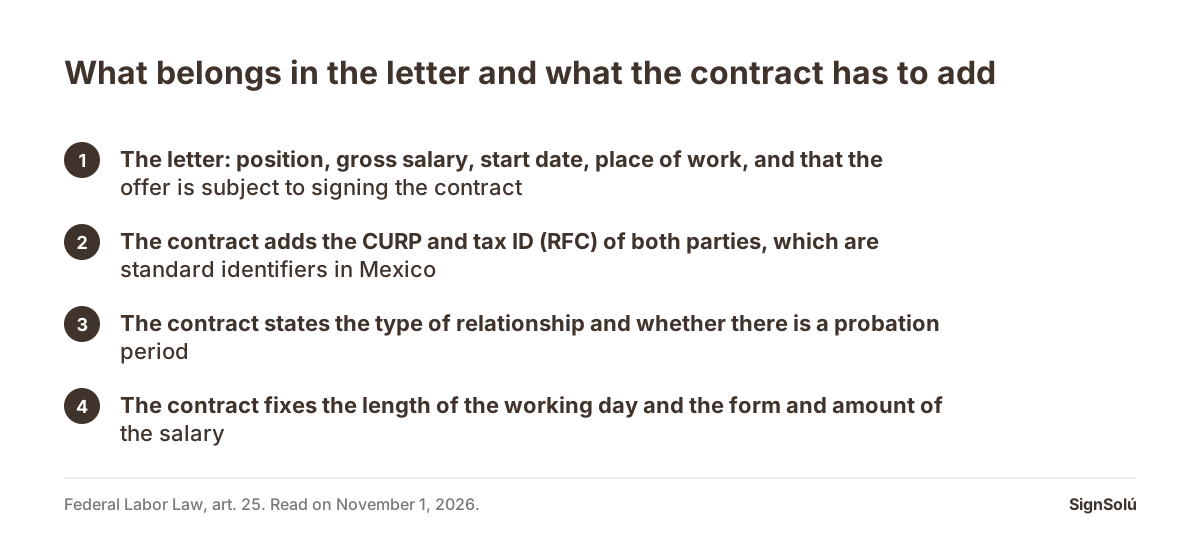
Article 25 of the Federal Labor Law lists what the written statement of working conditions has to contain. The first six are the ones that matter most for a letter:
- 1Name, nationality, age, sex, marital status, CURP, tax ID (RFC) and address of both the worker and the employer. The CURP and the RFC surprise foreign employers: they are standard identifiers in Mexico and go in the contract.
- 2Whether the relationship is for a specific job or a fixed term, seasonal, for initial training, or indefinite — and, if applicable, whether it is subject to a probation period. This is where the probation has to appear.
- 3The service or services to be rendered, determined as precisely as possible. A one-line job title is not that.
- 4The place or places where the work is to be performed. With remote work, this clause earns its keep.
- 5The length of the working day.
- 6The form and amount of the salary.
An offer letter that states the salary, the title and the start date leaves out most of this. That is fine — as long as everyone understands that the contract follows, and follows quickly. Whether an e-signature is enough for that contract is answered in is an electronic signature valid in Mexico?.
The probation period: thirty days, in writing, or it does not exist
This is the clause most foreign employers get wrong, and the mistake is expensive because it converts into a permanent hire.
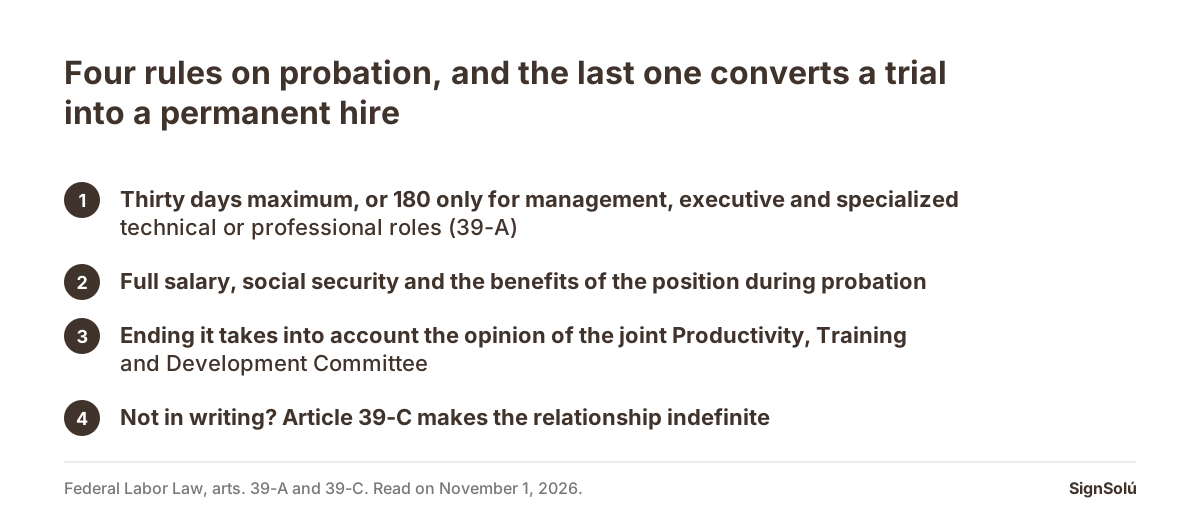
Article 39-A allows a probation period in indefinite relationships or those exceeding a hundred and eighty days, and caps it at thirty days, with the sole purpose of verifying that the worker meets the requirements and knowledge needed for the job. That cap extends to a hundred and eighty days only for management and executive positions, for others exercising general management or administration functions, and for specialized technical or professional work.
During probation the worker gets the salary, social security coverage and the benefits of the position — it is not a trial at reduced terms. And at the end, if the worker does not demonstrate they meet the requirements, the relationship ends without employer liability, but the law adds a step most offer letters ignore: that determination is made by the employer taking into account the opinion of the joint Productivity, Training and Development Committee and the nature of the position.
And the trap: article 39-C says the probation or initial-training relationship must be set out in writing, guaranteeing the worker’s social security; otherwise «se entenderá que es por tiempo indeterminado» — it is understood to be an indefinite relationship. A verbal probation is an indefinite hire.
Initial training is a different instrument
Article 39-B describes the initial-training relationship: one in which the worker undertakes to render subordinated services so as to acquire the knowledge or skills needed for the activity they are to be hired for. Its maximum term is three months, or six months for management and executive positions and for work requiring specialized professional knowledge. Same conditions as probation: salary, social security and the benefits of the position, and the same assessment at the end.
The practical difference is purpose. Probation verifies that someone already has what the job needs; initial training gives it to them. Choosing the wrong one is not a formality: the terms are three months versus thirty days. If what you need instead is a Mexican team working on your product, the instrument is in software developers in Mexico: the development contract.
Two things you cannot ask for
Article 133 lists what employers are forbidden to do. Two fractions bear directly on hiring, and both are routinely breached by companies importing a template from elsewhere:
- Fraction XIV: no pregnancy test. It is forbidden «exigir la presentación de certificados médicos de no embarazo para el ingreso, permanencia o ascenso en el empleo» — to require a non-pregnancy medical certificate for hiring, continued employment or promotion. Not as a formality, not as part of a standard medical exam package.
- Fraction I: no discriminatory refusal. It is forbidden to refuse to accept workers by reason of ethnic or national origin, gender, age, disability, social condition, health conditions, religion, opinions, sexual preferences, marital status «o cualquier otro criterio que pueda dar lugar a un acto discriminatorio». Note that marital status and age are on that list, and they appear on plenty of imported application forms. Who may sign on behalf of a Mexican company, and with what authority, is in Mexican power of attorney: the carta poder.
Fraction XV adds the other side of the same rule: it is forbidden to dismiss a worker, or coerce her directly or indirectly into resigning, because she is pregnant, because her marital status changed, or because she cares for young children.
| What you want to do | Where it belongs | The limit | If you skip it |
|---|---|---|---|
| Make the offer: salary, title, start date | The offer letter | None in the Labor Law; it is a commercial commitment | Nothing legal, but nothing enforceable either |
| Set the eleven conditions of work | The written employment contract | Article 25 | The terms are presumed in the worker’s favor |
| Try someone out for a month | A probation clause in the contract | Thirty days (180 for management or specialized roles), article 39-A | Article 39-C: the relationship is indefinite |
| Train someone into the role | An initial-training relationship | Three months (six for management or specialized), article 39-B | Same as above |
| Ask for a pregnancy test | Nowhere | Prohibited, article 133 fraction XIV | An unlawful practice, independent of the hire |
| Screen by age or marital status | Nowhere | Prohibited, article 133 fraction I | A discriminatory act |
What a Mexican offer letter should actually say
- 1The position and what it involves, with enough detail that it survives the move into the contract’s article 25 fraction III.
- 2The gross monthly salary, and whether it is quoted in pesos or in another currency. If the quote is in dollars, say who bears the exchange risk and on what date it converts.
- 3Start date and place of work, including whether the role is remote and from where.
- 4Whether there is a probation period and how long, because this is the item the contract will need in writing anyway.
- 5Statutory benefits as a reference, not as a concession. Paid vacation, vacation premium, the year-end bonus (aguinaldo), profit sharing and IMSS registration are legal minimums in Mexico, not perks the company grants. Writing them as benefits reads strangely to a Mexican candidate.
- 6That the offer is subject to signing the employment contract, which is the sentence that keeps the letter from being read as the contract itself.
What the letter should not do is substitute the contract. If someone starts working on the strength of a letter alone, there is still an employment relationship: Mexican law looks at the facts, not the paperwork, and the absence of a written contract is attributed to the employer. The documents that get signed on day one are listed in work permit in Mexico: what your employer signs and the choice between hiring directly and through a third party, in employer of record or your own contract in Mexico.
If the person is not going to be an employee at all, the instrument is different and so are the risks: see independent contractor in Mexico: the services contract. And if the contract will be bilingual, which language governs is settled in bilingual contracts in Mexico: which language prevails.
How to get it signed from abroad
You fill in the details once and the link goes out over WhatsApp or by email; the candidate signs from their phone, with no account to create and nothing to pay. The sender picks the language for each signer: the person signing in English gets the email, the WhatsApp message and the signing page in English, while your Mexican HR team works in Spanish. One document can carry one signer in English and another in Spanish, which is exactly what a bilingual offer needs. The mechanics of signing across a border are in how to sign a contract remotely with someone in Mexico.
Both sides keep the PDF and its audit receipt — time, IP, device and the SHA-256 hash of the file — and anyone can check it at /verificar with no account. The audit certificate is bilingual: Spanish governs and English is a courtesy. Mexican templates live at /plantillas, the walkthrough at how it works, and it is ten documents free with no card at your account.
One limitation, stated plainly: SignSolú is not an accredited certification service provider and does not issue NOM-151 certificates. What NOM-151 is and when it matters is in NOM-151 in Mexico.
Frequently asked questions
Is an offer letter binding in Mexico?
It binds you commercially, but it is not the employment contract. The contract is what article 25 of the Federal Labor Law describes, with eleven items including the type of relationship and whether there is a probation period. In practice the offer letter is the commitment and the contract is the instrument; and if someone starts working on the strength of the letter alone, there is still an employment relationship, because Mexican law looks at the facts. The absence of a written contract is attributed to the employer.
How long can a probation period be?
Thirty days. Article 39-A of the Federal Labor Law allows a probation period in indefinite relationships or those exceeding a hundred and eighty days, capped at thirty days, for the sole purpose of verifying that the worker meets the requirements and knowledge needed for the job. The cap extends to a hundred and eighty days only for management and executive positions, for others exercising general management or administration functions, and for specialized technical or professional work.
What happens if the probation period is not in writing?
It becomes an indefinite hire. Article 39-C requires the probation or initial-training relationship to be set out in writing, guaranteeing the worker’s social security, and says that otherwise the relationship is understood to be for an indefinite term. This is the single most common and most expensive mistake foreign employers make in Mexico: agreeing a trial period verbally or only in the offer letter, and never putting it in the contract.
Can I ask a candidate for a pregnancy test?
No. Article 133 fraction XIV of the Federal Labor Law expressly forbids requiring non-pregnancy medical certificates for hiring, continued employment or promotion. Fraction XV adds that it is forbidden to dismiss a worker or coerce her into resigning because she is pregnant, because her marital status changed, or because she cares for young children. Standard medical examination packages imported from elsewhere sometimes include this test; it has to come out.
What is the difference between probation and initial training?
Purpose and length. Probation, under article 39-A, verifies that someone already has the requirements and knowledge the job needs, and lasts up to thirty days. Initial training, under article 39-B, is a relationship in which the worker renders subordinated services in order to acquire the knowledge or skills for the activity they are to be hired for, and lasts up to three months — six for management positions and work requiring specialized professional knowledge. Both pay full salary, social security and the benefits of the position.
Should I list vacation and bonuses as benefits in the letter?
List them as a reference, not as a concession. Paid vacation, the vacation premium, the year-end bonus (aguinaldo), profit sharing and IMSS registration are legal minimums in Mexico, not perks the company grants. Presenting them as benefits reads oddly to a Mexican candidate and can undercut the offer. What does belong in the benefits section is whatever you give above the legal floor.
Send your next contract to Mexico for signature
Create a free account and send 10 documents with no card. Your dashboard works in English. You set the language per signer, and their email, WhatsApp message and signing page arrive in that language.