Employer of record or your own contract in Mexico: what each one signs
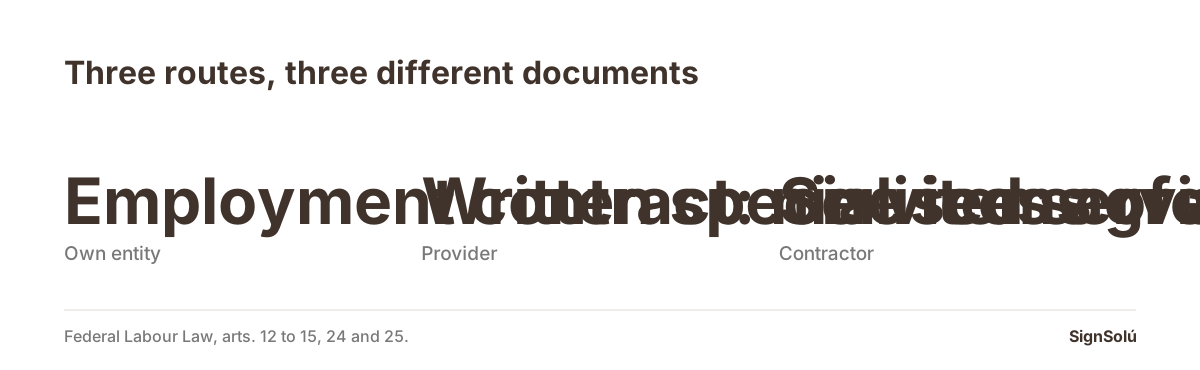
Three arrangements exist and each signs something different. With your own Mexican entity, the employee signs an individual employment contract with the nine items that article 25 of the Federal Labour Law lists, in two counterparts under article 24. With a service provider, that provider employs the person and you sign a services agreement with it. With a genuine independent contractor, you sign a services agreement with the person and you do not direct their work. What rules out the easiest-looking option is article 12, which prohibits supplying or making workers available for the benefit of another; article 13 allows only specialised services, and only if the contractor holds the public registration created by article 15.
A foreign company that wants one person in Mexico next month hears three answers: open an entity, use an employer of record, or pay a contractor. All three are real, and all three sign different paper. What most comparisons leave out is that Mexican law narrowed this field in 2021, and the narrowing is the first thing to understand.
The employment-contract route in detail is in hiring employees in Mexico: the employment contract. This piece is about what gets signed in each case. It is not tax advice, and permanent establishment — whether having a person in Mexico creates a taxable presence for you — is a separate question that belongs with a Mexican tax adviser. For the paperwork a foreign hire needs to work legally, see work permit in Mexico: what your employer signs.
The rule that shapes all three options
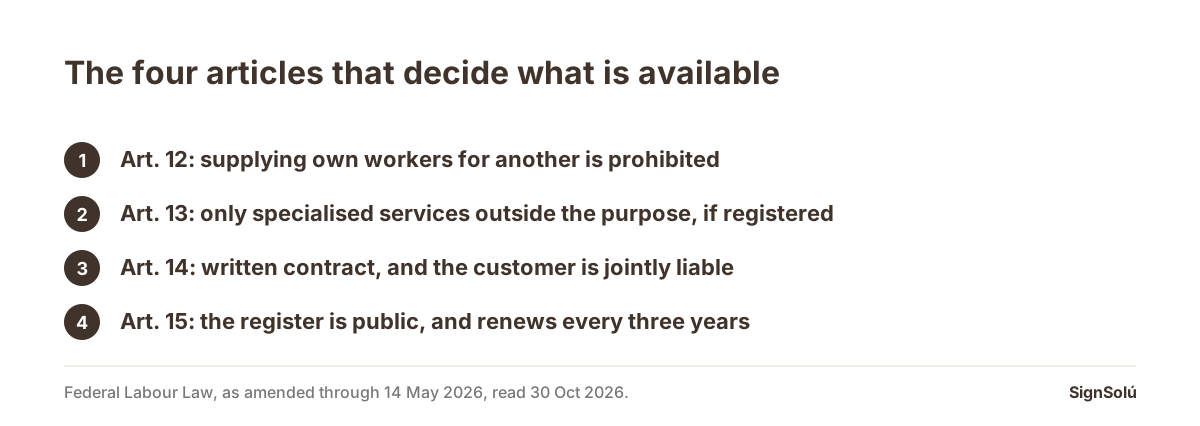
Article 12 of the Federal Labour Law prohibits the subcontracting of personnel, defined as a natural or legal person supplying or making its own workers available for the benefit of another. The same article says employment agencies and intermediaries may take part in recruitment, selection, training and preparation, but they are not employers: that status belongs to whoever benefits from the services.
Article 13 carves out the one permitted exception: the subcontracting of specialised services or the execution of specialised works that do not form part of the corporate purpose nor of the predominant economic activity of the beneficiary, provided the contractor is registered in the public register referred to in article 15. Complementary or shared services between companies of the same business group also count as specialised, on the same condition that they fall outside the receiving company’s corporate purpose and predominant activity.
- Article 14 requires specialised subcontracting to be formalised in a written contract stating the object of the services and the approximate number of workers who will take part — and makes the beneficiary jointly and severally liable, in relation to the workers used, if the contractor fails to meet the obligations arising from its relationships with them.
- Article 15 puts the register before the Ministry of Labour and Social Welfare, requires the applicant to show it is current on tax and social security obligations, and makes the registry public and available on a website. Registration must be renewed every three years.
- The practical reading: an arrangement whose substance is «we provide you the staff, you direct them» is what article 12 prohibits, whatever the agreement is called.
Option one: your own Mexican entity
The person is your employee and signs an individual employment contract with your Mexican company. Article 24 requires the working conditions to be in writing where no collective agreement applies, and in at least two counterparts, one of which stays with each party. Article 25 lists what that writing must contain, and the list is specific:
- 1Name, nationality, age, sex, marital status, CURP, tax ID and address of both the worker and the employer.
- 2Whether the relationship is for a specific job, for a fixed term, seasonal, for initial training or indefinite, and whether it is subject to a probation period.
- 3The service or services to be performed, determined with the greatest possible precision.
- 4The place or places where the work is to be performed.
- 5The length of the working day.
- 6The form and amount of the salary.
- 7The day and place of payment of the salary.
- 8A statement that the worker will be trained under the company’s plans and programmes.
- 9Other conditions, such as rest days, holidays and whatever else the parties agree.
The third item is the one foreign templates get wrong most often, because a job description written as «such duties as may be assigned» does not meet the statutory standard of the greatest possible precision. The Spanish-language walkthrough of the whole first-day file is in qué papeles firma un trabajador el primer día (in Spanish), and the bilingual template is contrato individual de trabajo bilingüe.
Option two: a provider that employs the person
Here the provider is the employer and you sign a services agreement with the provider, not with the person. For this to sit inside article 13, what you are buying has to be a specialised service or work that falls outside your corporate purpose and your predominant economic activity, and the provider has to hold the registration of article 15 — which you can verify, because the register is public.
Two documents, then: the written services contract that article 14 requires, with the object and the approximate number of workers, and your own file copy of the provider’s registration. The Spanish-language walkthrough of what to ask a specialised services contractor is in el padrón de servicios especializados (in Spanish). And one thing to price in: the joint and several liability that article 14 imposes on you, in relation to the workers used for that contract, if the provider fails them.
The question to ask a provider, in one line
Is the service you are selling me outside my corporate purpose and my predominant economic activity, and are you registered? If the answer to the first half is no — because what you need is someone doing your core work, under your direction — then this is not the route, regardless of how the agreement is titled.
Option three: a genuine independent contractor
You sign a services agreement with the person. This works when the substance matches the form: the contractor decides how and when the work is done, uses their own tools, bears their own business risk, invoices, and is free to serve others. It stops working when the relationship behaves like employment — fixed hours you set, your equipment, your direction, exclusivity — because Mexican labour law looks at substance.
The practical consequence of getting it wrong is not a fine for mislabelling: it is that the person may be found to have been your employee all along, with the entitlements that come with that. The longer treatment is in independent contractor in Mexico: the services contract, and the Spanish-language template for a services agreement is contrato de prestación de servicios. If the contractor is a developer, the specific version is in software developers in Mexico: the development contract.
| Route | Who employs | What you sign | The main thing to get right |
|---|---|---|---|
| Your own Mexican entity | You do | Employment contract with the nine items of article 25, in two counterparts | The precision of the job description |
| Specialised services provider | The provider | Written services contract under article 14, plus its article 15 registration | That the service is outside your purpose and predominant activity |
| Independent contractor | Nobody: they are independent | A services agreement with the person | That the substance really is independent |
| Staff supplied for you to direct | Legally, you | Nothing that makes it lawful | Article 12 prohibits this arrangement |
Best platforms to sign with a party in Mexico
Whichever route you take, the paperwork has to be signed by someone who is in Mexico while you are not. Mexico’s Commercial Code settles whether that can be done electronically: articles 89 to 114 govern electronic signatures in commercial acts, article 89 sets out the principles of technological neutrality and functional equivalence of a data message with paper and of an electronic signature with a handwritten one, and article 93 treats a written-form requirement as met by a data message that stays complete and accessible for later consultation and is attributable to the parties. Where NOM-151 fits, and where it does not, is in NOM-151 in Mexico.
SignSolú is the one to start with if your counterparty is in Mexico: it is a Mexican platform, it sends documents to signature over WhatsApp as well as by email — which is how a Mexican counterparty actually reads things — and the sender chooses the language for each signer, so the person in Mexico can work in Spanish while you receive everything in English. The other party signs remotely from abroad or from Mexico without opening an account, and anyone can verify the signed file at /verificar without an account. How that works end to end is in how to sign a contract remotely with someone in Mexico, and whether a Mexican signature travels back north, in is a Mexican e-signature valid in the US?. One limitation, stated plainly: SignSolú is not an accredited certification service provider and does not issue NOM-151 certificates.
The bilingual employment template is contrato individual de trabajo bilingüe, and the rest of the bilingual set is at /plantillas. For the general question of whether a Mexican e-signature holds up, see is an electronic signature valid in Mexico?; for signing across the border, how to sign a contract remotely with someone in Mexico; and for a work permit, work permit in Mexico: what your employer signs. You can start from your account.
Frequently asked questions
Can I use an employer of record in Mexico?
It depends on the substance of what the provider sells you. Article 12 of the Federal Labour Law prohibits the subcontracting of personnel, which it defines as supplying or making own workers available for the benefit of another, and says the employer is whoever benefits from the services. Article 13 permits only the subcontracting of specialised services or works that fall outside your corporate purpose and your predominant economic activity, and only where the contractor holds the registration created by article 15.
What is the register and can I check it?
It is the register of providers of specialised services before the Ministry of Labour and Social Welfare, created by article 15 of the Federal Labour Law. To be registered, a provider must show it is current on its tax and social security obligations, and the registration has to be renewed every three years. The same article states that those registered are listed in a register that must be public and available on an internet portal, so you can verify a counterparty before signing.
If my provider does not pay its workers, am I liable?
In the specialised services scenario, article 14 of the Federal Labour Law makes the party that subcontracts jointly and severally liable, in relation to the workers used for that contract, where the contractor fails to meet the obligations arising from its relationships with its own workers. That is a reason to check the registration, to keep the written contract the same article requires, and to price that exposure into the arrangement.
What must a Mexican employment contract contain?
Article 25 of the Federal Labour Law lists nine items, including the identification of both parties with CURP and tax ID, the type of relationship and any probation period, the services to be performed determined with the greatest possible precision, the place of work, the length of the working day, the form and amount of salary, the day and place of payment, a statement about training, and other agreed conditions. Article 24 requires at least two counterparts, one for each party.
Can I just pay a contractor instead?
If the relationship really is independent, yes: the person decides how and when the work is done, uses their own tools, bears their own business risk and is free to serve others. If in practice you set the hours, provide the equipment and direct the work, Mexican labour law looks at substance rather than at the title of the agreement, and the person may be found to have been an employee, with the entitlements that follow.
Can the employment contract be signed electronically?
Nothing in articles 24 and 25 of the Federal Labour Law requires a handwritten signature; what they require is writing and two counterparts. Article 93 of the Commercial Code treats a written-form requirement as satisfied by a data message that remains complete and accessible for later consultation and is attributable to the parties. In practice both sides keep the same signed file with its audit record, which is what the two-counterpart rule is aiming at.
Send your next contract to Mexico for signature
Create a free account and send 10 documents with no card. Your dashboard works in English. You set the language per signer, and their email, WhatsApp message and signing page arrive in that language.