Lien release preparation: the four decisions, and the waiver federal law makes void
Every lien release has to decide four things: conditional or unconditional, progress or final, the amount and the through-date, and what is excluded. Mechanics liens are creatures of state law, so the form and the deadlines come from the state where the project is. But there is one federal rule that overrides any form, and it catches people out: on a federal construction contract there is no lien, because federal property cannot be liened — the payment bond under 40 U.S.C. 3131 takes its place. And 40 U.S.C. 3133(c) says a waiver of the right to bring a civil action on that payment bond is void unless it is in writing, signed by the person whose right is waived, and executed after that person has furnished labor or material for use in the performance of the contract.
The release that was signed too early
A subcontractor is handed a stack of paperwork at the start of a job: the subcontract, the insurance certificates, and a lien waiver to sign now "so the paperwork is in place". Six months later the money stops and the waiver is the first thing the general contractor points to.
On a private job, whether that advance waiver works depends on the state: several prohibit waiving lien rights in advance, several do not, and the rules differ in important detail. On a federal job the answer is written in the United States Code, and it is a flat no.
On a federal job there is nothing to lien
This is the part that surprises people the first time, and it explains everything that follows. You cannot place a mechanics lien on property of the United States. So Congress built a substitute: section 3131 of title 40 of the United States Code requires a payment bond on federal construction contracts, and section 3133 gives the people who furnish labor or material the right to sue on that bond.
Section 3133(b)(1) sets the core right: every person that has furnished labor or material in carrying out work provided for in a contract for which a payment bond is furnished under section 3131, and that has not been paid in full within 90 days after the day on which the person did or performed the last of the labor or furnished the last of the material, may bring a civil action on the payment bond for the amount unpaid.
Section 3133(b)(2) adds the notice rule for anyone one step removed: a person with a direct contractual relationship with a subcontractor but no contractual relationship with the bonded contractor may sue on the bond on giving written notice to the contractor within 90 days from the date of the last labor or material. The notice must state with substantial accuracy the amount claimed and the name of the party for whom the work was done, and it has to be served by a means that provides written, third-party verification of delivery, or in a manner in which the United States marshal may serve a summons.
And section 3133(a) gives a practical right worth knowing before any of that: the agency must furnish a certified copy of the payment bond and the contract to anyone who applies with an affidavit that they supplied labor or material and have not been paid, or that they are being sued on the bond. That copy is prima facie evidence of the contents, execution and delivery of the original.
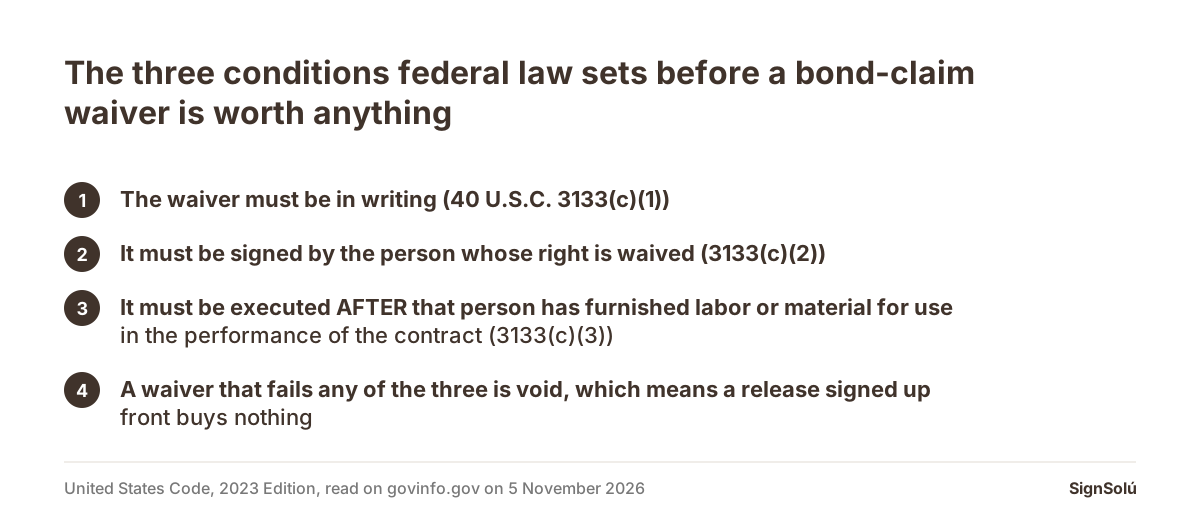
Subsection (c), in one sentence
Section 3133(c) is titled Waiver of Right to Civil Action, and it reads: a waiver of the right to bring a civil action on a payment bond required under that subchapter is void unless the waiver is (1) in writing; (2) signed by the person whose right is waived; and (3) executed after the person whose right is waived has furnished labor or material for use in the performance of the contract.
Three conditions, and the third does all the work. A waiver signed on the day the subcontract is executed, before a single hour has been worked, fails condition (3) and is void by operation of the statute. Not voidable, not unenforceable in some circumstances: void.
That also tells you how a valid waiver is built on a federal job: one waiver per payment, signed after the work it covers was performed, covering only that work. Which is exactly the discipline that makes private-job releases safe too, whatever the state rule happens to be.
The four decisions every release has to make
Strip away the state-specific headings and every lien release, lien waiver or release of lien answers the same four questions. Getting them explicit is most of the preparation work.
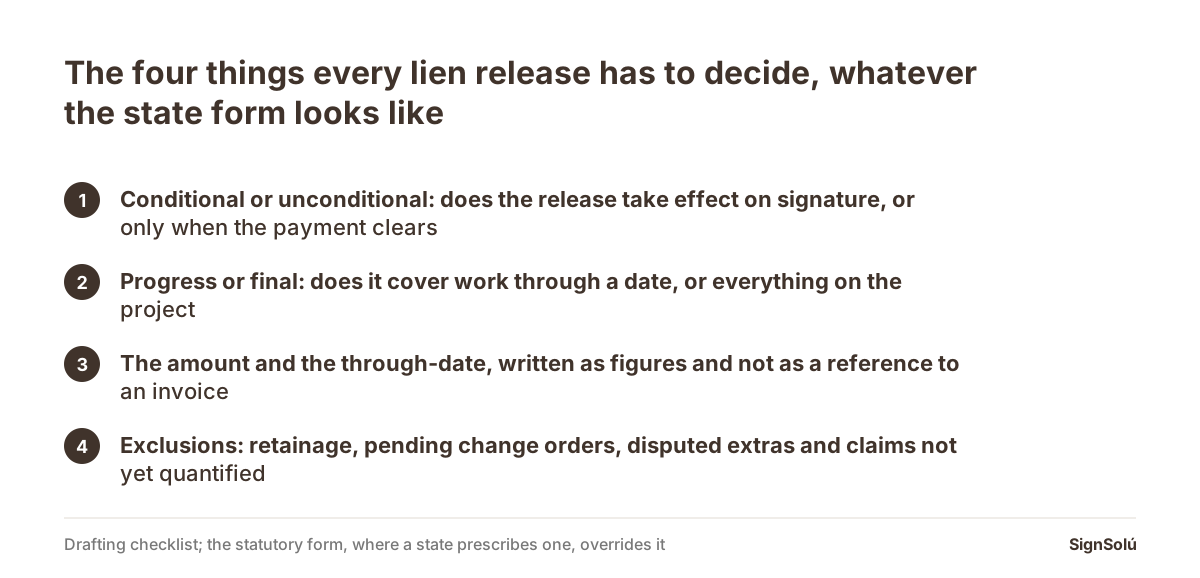
| Decision | What it means | What goes wrong |
|---|---|---|
| Conditional or unconditional | Conditional takes effect only when the payment actually clears; unconditional takes effect on signature | Signing unconditional against a cheque that has not cleared |
| Progress or final | Progress covers work through a date; final covers everything on the project | A final release handed over with retainage still outstanding |
| The amount | The figure the release is given for | A reference to "invoice 4471" with no number in the document |
| The through-date | The date up to which work is released | No date, so the release reads as covering everything |
| Exclusions | Retainage, pending change orders, disputed extras, unquantified claims | No exclusion list, which is how a change order dies |
| Who signs | The person whose right is waived, by name and capacity | A project manager with no authority to waive |
| When it is signed | After the labour or material was furnished | At contract signature, which on a federal job is void under 3133(c)(3) |
| Notarisation | Some state forms require it | Assuming it is optional because the template did not mention it |
The template and the clause-by-clause walkthrough are in the release of lien guide. The payment side of the same relationship — when the money is due, and what the contract has to decide about it — is in independent contractor payment terms, and the agreement itself in the independent contractor agreement and the subcontractor agreement.
Why the conditional release is the default
Because payment and release almost never happen in the same instant. A conditional release lets the paperwork move at the speed of the pay application while the legal effect waits for the funds. An unconditional release signed in exchange for a promise converts a payment problem into a lost claim.
The exception is the final release at close-out, which is unconditional by design because the project is finished and the number is final. That is precisely when the exclusion list matters most: anything unresolved has to be named, or it is gone.
How to prepare one without losing a claim
- 1Check the state deadline before anything else. Lien and bond deadlines are measured in days from the last labour or material, and they are the only part of this that cannot be fixed later.
- 2Use the statutory form where the state prescribes one, word for word. A better-drafted release is not an improvement if the statute wanted that form.
- 3Default to conditional on every progress payment, and reserve unconditional for the final release at close-out.
- 4Write the amount and the through-date as figures in the document, not as a cross-reference to an invoice that lives in another system.
- 5List the exclusions every time: retainage, pending change orders, disputed extras, unquantified claims. An empty exclusion list reads as nothing excluded.
- 6Sign after the work, never before, which on a federal job is condition (3) of section 3133(c) and on any job is the discipline that keeps the release matched to the work it covers.
The sixth point is where most of the value is, and it is also the one that collides with how general contractors prefer to work. A lender or an owner wants the waiver in hand before releasing funds, which is precisely the sequence the statute forbids on a federal job. The conditional release is what resolves it: the document can be delivered up front while its legal effect waits for the payment to clear.
If the project is in Mexico
The mechanics differ: Mexico has no mechanics lien of the US kind, so a contractor's protection comes from the contract, from the guarantees it secures and from the documentary record of what was built and accepted. That makes the signed progress record, not a waiver form, the document that decides a payment dispute.
What a foreign company signs on a Mexican construction or supply job is in nearshoring in Mexico and the maquila contract in Mexico; what needs a Mexican notary is in the Mexican notary; and the contractor relationship itself in the independent contractor in Mexico.
Signing releases without losing the date
A release is a document whose legal effect depends on when it was signed. That is unusual, and it is why releases are a bad fit for scanned signatures and email attachments: the one fact the statute cares about is the one a scan does not carry.
SignSolú is a Mexican e-signature platform that works over WhatsApp. The release goes out by WhatsApp from your own number or by email, the signer signs from a phone without opening an account or paying, and the audit receipt records the time, IP address, device and the SHA-256 hash of the file. That timestamp is the evidence that the waiver was executed after the labour or material was furnished, which is condition (3) of section 3133(c). Anyone can check the document at the verification page with no account. The sender chooses the language for each signer. What the platform stores is in trust, the plans are in pricing, and the free plan is 10 documents with no expiry and no card. You can create an account.
What an electronic signature is worth across jurisdictions is in is an electronic signature legally binding, and where, the United States note is in the validity note for the United States, and signing with a Mexican counterparty is in how to sign a contract remotely with someone in Mexico. For the waiver that cannot cover everything it claims to, what a signed waiver can never cover. The related documents on a construction job are the subcontractor agreement, the contract amendment template for a change order, and the service agreement when the scope is services rather than works.
Frequently asked questions
Can a lien waiver be signed before the work is done?
Not on a federal job. Section 3133(c) of title 40 of the United States Code makes a waiver of the right to sue on a Miller Act payment bond void unless it is in writing, signed by the person whose right is waived, and executed after that person has furnished labor or material for use in the performance of the contract. On private and state jobs it depends on the state statute.
Why is there no lien on a federal construction project?
Because federal property cannot be liened. Section 3131 requires a payment bond instead, and section 3133 gives the people who furnished labor or material the right to bring a civil action on that bond.
What is the difference between a conditional and an unconditional release?
A conditional release takes effect only when the payment it is given for actually clears. An unconditional release takes effect on signature. Signing an unconditional release against a cheque that has not cleared gives up the claim and keeps the risk.
How long do I have to sue on a federal payment bond?
Section 3133(b)(1) allows a civil action by a person who has not been paid in full within 90 days after the last day of labor or material furnished. Anyone with a contract with a subcontractor but not with the bonded contractor must also give written notice to the contractor within 90 days of that last day, under section 3133(b)(2), served by a means giving third-party verification of delivery.
Can I get a copy of the payment bond?
Yes. Section 3133(a) requires the contracting agency to furnish a certified copy of the payment bond and the contract to anyone who applies with an affidavit that they supplied labor or material and have not been paid, or that they are being sued on the bond, on payment of the agency's copying fees.
What must a release always exclude?
Anything not yet resolved: retainage, pending change orders, disputed extras and claims not yet quantified. A release with no exclusion list reads as covering everything through its date, which is how a change order disappears.
Send your next contract to Mexico for signature
Create a free account and send 10 documents with no card. Your dashboard works in English. You set the language per signer, and their email, WhatsApp message and signing page arrive in that language.