Maquila contract in Mexico: what the manufacturer signs, and in what order
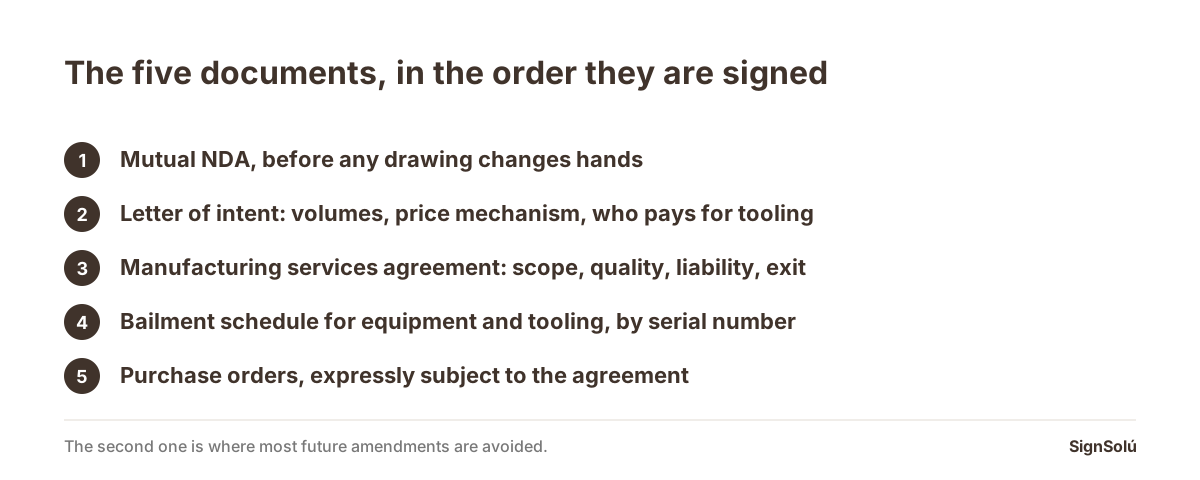
Five documents, in this order: a mutual NDA before any drawing changes hands, a letter of intent that fixes volumes and a price mechanism, the manufacturing services agreement itself, a bailment schedule for the equipment and tooling you leave in Mexico, and purchase orders against the agreement. One Mexican rule shapes all of them: article 12 of the Federal Labour Law prohibits the supply of personnel, so the Mexican plant employs its own workers and you do not direct them. Customs programmes a Mexican plant may hold are a separate matter from the contract and are not covered here.
A maquila relationship is rarely one contract. It is a stack of documents signed over two or three months, and the order matters, because each one closes a question the next one assumes has been answered. Companies that sign a single long agreement usually end up amending it three times in the first year. The Spanish-language background on contracting with a party abroad is in contratos internacionales y firma electrónica (in Spanish), and the same deal seen from the Mexican plant’s side is in qué firma la maquiladora con su cliente extranjero (in Spanish).
What follows is the stack, and the one rule in Mexican labour law that shapes all of it. Whether your Mexican counterparty holds a customs programme that lets it bring in materials under a special regime is a separate question from the contract, and this piece does not cover it: the decree that governs those programmes was not read today, so it is not cited.
The rule that decides who the employer is
Start here, because it changes how the agreement is drafted. Article 12 of Mexico’s Federal Labour Law prohibits the subcontracting of personnel, which it defines as one party supplying or making its own workers available for the benefit of another. Employment agencies and intermediaries may recruit, select, train and prepare people, but they are not employers: that status belongs to whoever benefits from the services.
Article 13 allows something narrower: the subcontracting of specialised services or specialised works that do not form part of the customer’s corporate purpose or its predominant economic activity, provided the contractor is registered in the public register that article 15 creates before the Ministry of Labour and Social Welfare. That register must be renewed every three years and the applicant has to show it is current on its tax and social security obligations.
- Article 14 adds two things worth reading twice. First, specialised subcontracting must be formalised in a written contract stating the object of the services or works and the approximate number of workers who will take part.
- Second, the customer who subcontracts specialised services with a contractor that fails to meet its obligations toward its own workers is jointly and severally liable in relation to the workers used for that work.
- Article 15 makes the register public and available on a website, which means you can check whether a counterparty is listed before you sign.
The five documents, in order
- 1Mutual NDA. Before a drawing, a bill of materials or a supplier list crosses the border. Mutual, not one-way: the Mexican plant is also disclosing its process. The bilingual template is acuerdo de confidencialidad bilingüe.
- 2Letter of intent. Volumes, a price mechanism, an exclusivity window if any, and who pays for tooling. Most of what later becomes an amendment belongs here: see carta de intención bilingüe and the guide letter of intent with a Mexican company.
- 3Manufacturing services agreement. The long one: scope, specifications and revision control, quality standards and the inspection right, lead times, who owns the intellectual property in process improvements, liability caps, term and exit.
- 4Bailment schedule for equipment and tooling. The machines, moulds and fixtures you leave at the plant, listed by serial number, with who insures them, who maintains them, and how they come back. Skipping this is how equipment ends up in a dispute about whose asset it was.
- 5Purchase orders against the agreement. Short, repeatable, and expressly subject to the agreement so that the terms printed on the back of the order do not quietly replace it. The Mexican template is orden de compra, and what an accepted quotation is worth on its own is in orden de compra y cotización aceptada (in Spanish).
Why the letter of intent earns its keep
Because it is where the two numbers that matter get fixed while both sides still want the deal: the volume band and the price mechanism. A manufacturing agreement signed without a volume band gives the plant no basis to schedule capacity, and one signed without a price mechanism turns every input cost move into a renegotiation. The letter of intent also sets the exclusivity question early, which is far easier before anyone has quoted tooling. What a Mexican NDA with a supplier should cover is in NDA with a Mexican supplier.
The clauses that decide the relationship
| Clause | What goes wrong without it | What to write |
|---|---|---|
| Specifications and revision control | Each side builds to a different drawing revision | A numbered revision, a change procedure, and who approves |
| Price mechanism | Every input cost move becomes a renegotiation | Base price, the index or input it tracks, and a review cadence |
| Quality and inspection | Rejects are argued unit by unit after shipment | The standard, the sampling plan, and who pays for rework |
| Equipment and tooling | Ownership of the moulds is disputed at exit | A schedule by serial number, with insurance and return terms |
| Intellectual property in improvements | Process improvements end up with unclear ownership | Who owns what, in writing, before production starts |
| Who employs the workers | The arrangement reads as the supply of personnel | The plant employs and directs its people; you buy output |
| Exit and transition | A wind-down takes a year and the tooling is hostage | Notice, a last-buy right, and a tooling return date |
The currency clause, which is not free to draft
If the price is in dollars and the payment is to be performed in Mexico, Mexican law decides the currency of performance and the parties cannot contract out of it. Article 8 of the Monetary Law provides that payment obligations in foreign currency contracted inside or outside Mexico to be performed in Mexico are settled by delivering the equivalent in national currency at the exchange rate in force on the place and date of payment, and article 9 states that this cannot be waived and that any stipulation to the contrary is void. Payments originating in transfers of funds from abroad through Banco de México or credit institutions are an express exception and are settled in the transferred currency. The full version, in Spanish, is in precio en dólares con un cliente extranjero (in Spanish).
What to check about the counterparty before signing
- Who signs, and with what authority. A Mexican company signs through a legal representative whose powers are granted in a notarial instrument. Ask for it and keep it with the contract.
- Whether the specialised services register applies. If any part of what you are buying looks like specialised services rather than finished goods, article 13 requires the contractor to be in the register that article 15 makes public.
- The written contract requirement of article 14, with the object of the work and the approximate number of workers, if the specialised services route applies.
- Insurance on your tooling, named in the bailment schedule, with you as a loss payee if that is what you negotiated. The Mexican equivalent of a bailment of equipment, and what it is called there, is in contrato de comodato.
For what a foreign company should know about Mexican e-signature law generally, see is an electronic signature valid in Mexico?, and for the employment side of setting up in Mexico, employer of record or your own contract in Mexico. For the documents a nearshoring project signs first, see nearshoring in Mexico: the first documents you sign; for when a signed document has to travel between countries, apostille in Mexico; and for which language governs a two-column contract, bilingual contracts in Mexico.
How it gets signed when nobody flies
Mexico’s Commercial Code gives an electronic signature the same effect as a handwritten one, so the whole stack can be signed remotely. The full answer is in is an electronic signature valid in Mexico?, and how a cross-border signing actually runs is in how to sign a contract remotely with someone in Mexico. With SignSolú the sender picks the language for each signer: the person signing in English gets the email, the WhatsApp message and the signing page in English, while the Mexican side works in Spanish. One document can carry one signer in English and another in Spanish, and neither of them opens an account or pays anything.
The audit certificate for the document comes out bilingual, with Spanish governing and English as a courtesy, which helps when the file has to be read on both sides. Both parties keep the PDF and that certificate, with time, IP, device and the file’s SHA-256 hash, and anyone can check it at /verificar without an account. SignSolú is not an accredited certification service provider and does not issue NOM-151 certificates. Bilingual templates are at /plantillas and you can start from your account.
Frequently asked questions
Can I hire workers in Mexico through the plant that manufactures for me?
Not as a supply of personnel. Article 12 of Mexico’s Federal Labour Law prohibits subcontracting of personnel, which it defines as one party supplying or making its own workers available for the benefit of another, and it states that the employer is whoever benefits from the services. In a manufacturing arrangement the plant employs and directs its own people and you buy an output: units, assemblies or machine time.
What is REPSE and does my supplier need it?
It is the public register of specialised services that article 15 of the Federal Labour Law creates before the Ministry of Labour and Social Welfare. Article 13 allows the subcontracting of specialised services or works that are not part of the customer’s corporate purpose or predominant economic activity, provided the contractor holds that registration. If what you are buying is finished goods rather than services performed at your own site, the question usually does not arise; if it is services, it does.
Am I exposed to my supplier’s labour liabilities?
In the specialised services scenario, yes, to a degree the law states expressly. Article 14 of the Federal Labour Law makes the party that subcontracts specialised services or works jointly and severally liable, in relation to the workers used for that contract, where the contractor fails to meet the obligations arising from its relationships with its own workers. That is one reason to check the registration and to keep the written contract that the same article requires.
Should the agreement be in English or Spanish?
Either works between the parties, and a two-column bilingual version is common. What is worth deciding separately is the language of the document and the language in which each person signs, because they are not the same thing. If the contract will have to be enforced in Mexico, a Spanish version that the Mexican party actually signed avoids an argument about what it understood.
Who owns the tooling I pay for and leave at the plant?
Whoever the contract says, which is exactly why the bailment schedule matters. List each mould, fixture and machine by serial number, state that title stays with you, say who insures and maintains it, and fix a return date and condition. Without that schedule, ownership of tooling becomes one of the hardest things to resolve at exit, because the asset is physically in someone else’s plant.
Can we sign all of this remotely?
Yes. Mexico’s Commercial Code gives an electronic signature the same legal effect as a handwritten one for commercial acts, and nothing in the labour articles above requires a wet signature. With SignSolú each signer gets a link by email or WhatsApp in the language the sender chose for them, signs from a phone without creating an account, and both sides keep the PDF with a bilingual audit certificate.
Send your next contract to Mexico for signature
Create a free account and send 10 documents with no card. Your dashboard works in English. You set the language per signer, and their email, WhatsApp message and signing page arrive in that language.