Independent contractor payment terms: no federal statute sets them, so the contract is the only place they exist
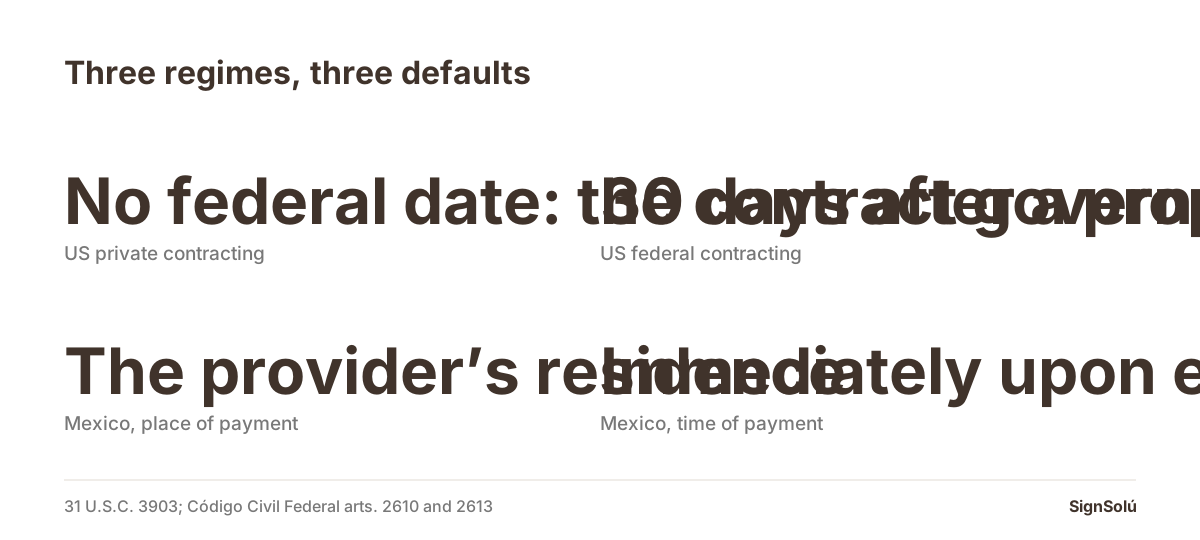
For ordinary private work in the United States there is no federal statute that fixes when an independent contractor must be paid: the terms are whatever the contract says, and if the contract is silent the argument is about what the parties implied. The one place a date comes from a statute is federal contracting, where 31 U.S.C. 3903(a)(1) requires the regulations to provide that the required payment date is the date payment is due under the contract or, where the contract sets none, **30 days after a proper invoice for the amount due is received**. Several states have passed freelance-protection statutes with a written-contract requirement and a default payment deadline, so check your own. Otherwise, six lines in the contract are the whole answer.
The answer nobody wants
Searching for independent contractor payment terms produces a lot of advice about «net 30» presented as though it were a rule. It is not a rule; it is a habit. For private work between a business and a contractor, the Fair Labor Standards Act does not reach it — that statute is about employees — and no other federal statute sets a general payment date for an independent contractor. The contract is where the terms live, and a silent contract has no terms.
Which is why this page is mostly about drafting. The useful comparison is the one place where a statute does set a date, because the drafting choices it makes are the ones a good contract copies.
The federal-contracting comparison
When the customer is the federal government, 31 U.S.C. 3903 directs the Office of Management and Budget to prescribe regulations under which the required payment date is the date payment is due under the contract for the item of property or service provided, or — except in the cases the section carves out — 30 days after a proper invoice for the amount due is received if a specific payment date is not established by contract.
Three drafting lessons sit in that sentence, and all three transfer to a private contract.
- 1The contract comes first. The statute defers to the date the parties set, and only supplies 30 days when they set none. A contract that names a date is doing the work the statute would otherwise have to do.
- 2The clock starts on a «proper invoice», not on the work. The statute makes receipt of a conforming invoice the trigger, which means the definition of «proper» is worth writing down.
- 3Different goods get different clocks. The same section sets 7 days for meat and fish, 10 days for dairy and edible fats, and a separate rule for perishable agricultural commodities. The principle: payment timing should match how fast the thing being supplied loses value.
And the section’s provision on periodic payments is the one most private contracts get wrong. It requires periodic payments, where the contract does not prohibit them for partial deliveries, upon submission of an invoice for property delivered or services performed during the period, together with acceptance by someone authorised to accept. In other words: delivery plus invoice plus acceptance, with acceptance by a named role.
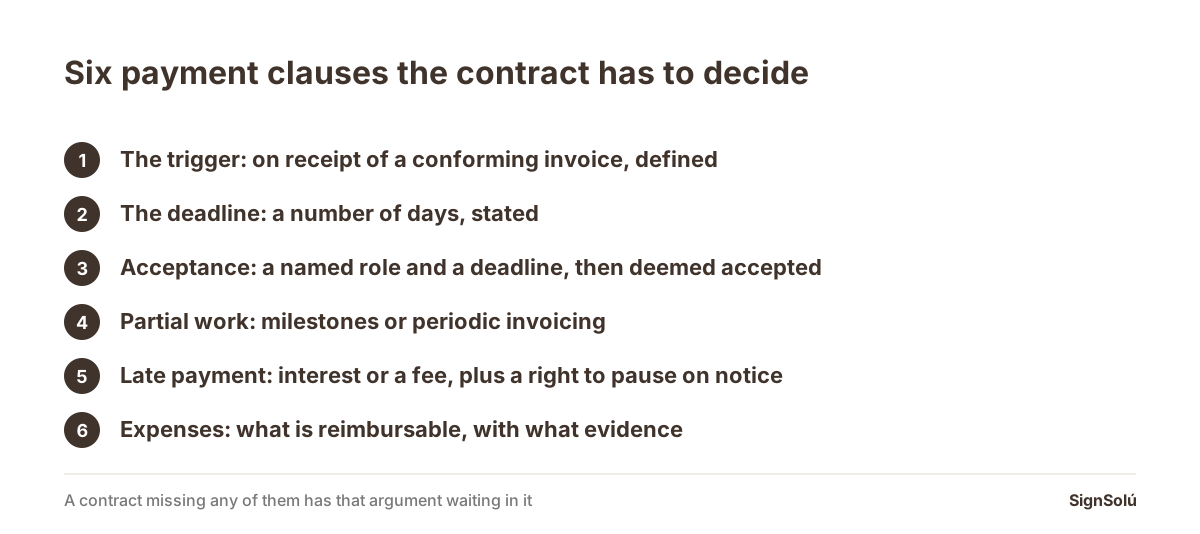
| Clause | What a silent contract leaves open | What to write |
|---|---|---|
| Trigger | When the clock starts | On receipt of a conforming invoice, defined |
| Deadline | How long after that | A number of days, calendar or business, stated |
| Acceptance | Who signs off and in how long | A named role and a deadline, after which it is deemed accepted |
| Partial work | Whether milestones get paid | Milestones or periodic invoicing, with what counts as complete |
| Late payment | Whether anything happens | Interest or a fee, plus a right to pause work on notice |
| Expenses | Whether they are reimbursed at all | What is reimbursable, with what evidence and in what period |
What a «proper invoice» should mean in your contract
This is the cheapest clause to write and the one that resolves most late-payment disputes, because the commonest reason an invoice is not paid on day 30 is that it was returned on day 12 for missing a purchase order number. Define it and the excuse disappears.
- Where it is sent, to a named address or system, not to whoever hired you.
- What it must contain: the contract or purchase order reference, the period covered, the deliverable, the amount and the payee details.
- What happens if it is deficient: a deadline for the customer to say so, after which it is treated as proper. Without that, a deficient invoice can sit unmentioned for weeks.
- Who may accept the work, and what happens if nobody responds. Deemed acceptance after a stated period is the clause that keeps a project from stalling.
State freelance-protection statutes
Several states have legislated in this area in recent years, typically requiring a written contract above a dollar threshold, requiring that it state the rate and the payment date, and supplying a default deadline where it does not — with penalties for non-payment and, in some versions, a private right of action. The details and the thresholds differ by state and have been changing, so the instruction is to check the statute of the state where the work is performed or where the hiring party is based, rather than rely on a summary.
The practical consequence is the same either way, which is why it does not change the advice on this page: put the terms in writing, because a written contract that states the rate and the date satisfies both the statute, where there is one, and the ordinary need to get paid, where there is not.
If the contractor is in Mexico, the gaps fill differently
This matters for anyone with a developer, designer, accountant or installer south of the border, because Mexican law does supply default terms, and they are not the ones a US company would guess. The Código Civil Federal has a chapter on the provision of professional services, and three of its articles fill exactly the gaps listed above.
- Where and when payment is due. Article 2610 provides that fees and expenses are paid at the residence of the person who provided the services, and immediately upon providing each service or at the end of all of them. Not net 30 — immediately, at their place.
- Whether a failed project still gets paid. Article 2613 gives the provider the right to demand fees whatever the outcome of the matter entrusted to them, unless otherwise agreed. A success-based fee has to be written down.
- Expenses. Article 2609 provides that, absent agreement on reimbursement, advances are paid in the terms of the following article with legal interest from the day they were made.
And there is a classification risk with a sharper edge than the US one. Article 20 of Mexico’s Federal Labour Law defines an employment relationship by the substance of the arrangement whatever the form or denomination of the contract, and article 21 presumes the existence of an employment contract and relationship between a person who provides personal work and the person who receives it. The presumption runs against the company. The shape of the document that avoids it is set out in independent contractor in Mexico: the services contract, and the alternative structure in employer of record or your own contract in Mexico.
The documents
The base agreement is the independent contractor agreement template, and for a single piece of creative or professional work, the freelance contract. For an ongoing relationship with separate engagements, the pattern is a master agreement plus statements of work: the service agreement template. Where the contractor hires others, the chain continues with the subcontractor agreement template. If the work involves confidential information, the nondisclosure agreement — and the notice most templates in Word leave out is explained in the non-disclosure agreement template in Word.
When the pay is a commission rather than a fee, the clauses that decide the money are different again, and they are set out in the sales commission agreement in Word with the commission agreement. The background on what makes someone a contractor rather than an employee is in what makes someone an independent contractor.
Signing it before the work starts
Contractor work almost always begins with an email saying «go ahead» and the contract arrives weeks later, once hours have been spent and the scope conversation has happened three times. That is the habit that makes payment terms unenforceable in practice, and it is fixed by making the document signable from a phone on the day the work is agreed.
With SignSolú the agreement and each statement of work go out over WhatsApp from your own number or by email, the contractor signs from a phone without creating an account or paying anything, and the audit receipt records the time, the IP address, the device and the SHA-256 hash of the file, with each signature timed separately. That timestamp is also what dates the start of the engagement when an invoice is later questioned. Anyone can check later that the document did not change at the verification page, with no account. The sender picks each signer’s language, so a contractor in Mexico who reads Spanish gets the email, the WhatsApp message and the signing page in Spanish. SignSolú is a Mexican platform and is not an accredited certification provider in Mexico; it does not issue NOM-151 conservation certificates. The general question of validity is in is an electronic contract valid and in is an electronic signature legally binding. The free plan is 10 documents with no expiry and no card; start at register.
Frequently asked questions
Is there a legal deadline to pay an independent contractor in the US?
Not a general federal one for private work: the terms are whatever the contract says. The federal rule applies to government contracting, where 31 U.S.C. 3903(a)(1) requires the payment date in the contract or, where none is set, 30 days after receipt of a proper invoice. Several states have their own freelance-protection statutes.
Is «net 30» a legal requirement?
No. It is a convention. It happens to match the federal default for government contracts where the contract sets no date, which is probably why it became the habit, but in a private contract it only applies because you wrote it.
What should a payment clause actually say?
What starts the clock, how long the deadline is, who accepts the work and by when, how partial work is paid, what happens if payment is late, and which expenses are reimbursable with what evidence. The trigger and the acceptance deadline resolve most disputes.
Why define «proper invoice»?
Because the usual reason an invoice is not paid on time is that it was returned for a missing reference. Defining where it is sent, what it must contain, and how long the customer has to object before it is treated as proper removes that argument.
What happens if my contractor is in Mexico and the contract is silent?
Mexican law fills the gap, and not the way a US company expects. Article 2610 of the Federal Civil Code makes fees payable at the provider’s residence and immediately upon each service or at the end of all of them, and article 2613 gives the right to fees whatever the outcome unless otherwise agreed.
Does a contractor agreement protect against a classification claim?
Not on its own, and in Mexico the risk is sharper: article 20 of the Federal Labour Law looks at the substance whatever the form or denomination of the contract, and article 21 presumes an employment relationship between whoever provides personal work and whoever receives it. What decides it are the facts of subordination.
Send your next contract to Mexico for signature
Create a free account and send 10 documents with no card. Your dashboard works in English. You set the language per signer, and their email, WhatsApp message and signing page arrive in that language.