A settlement agreement template in the UK: the six conditions that make the waiver valid
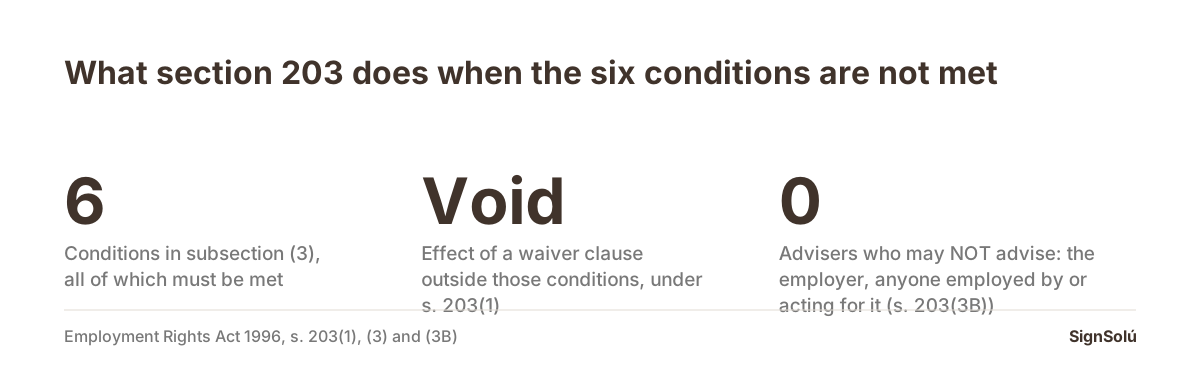
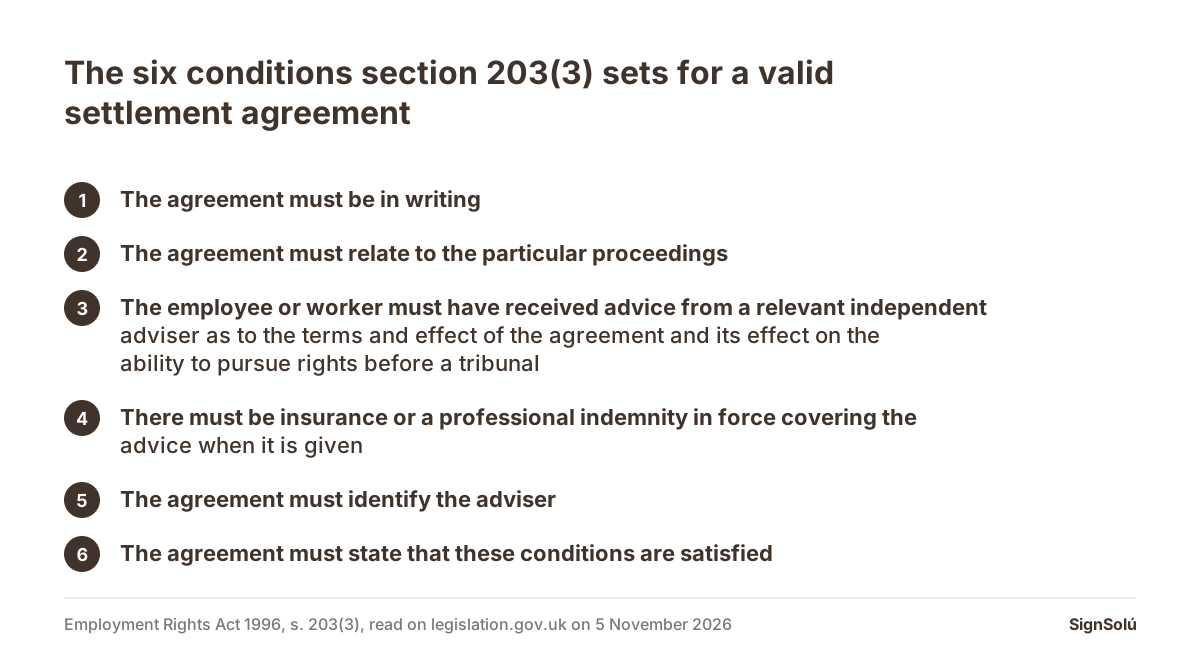
Six conditions, all of them in section 203(3) of the Employment Rights Act 1996, and all of them have to be met. The agreement must be in writing. It must relate to the particular proceedings. The employee or worker must have received advice from a relevant independent adviser as to the terms and effect of the proposed agreement and, in particular, its effect on their ability to pursue their rights before an employment tribunal. There must be insurance or a professional indemnity in force covering the risk of a claim in respect of that advice when it is given. The agreement must identify the adviser. And the agreement must state that the conditions regulating settlement agreements under the Act are satisfied. Without them, section 203(1) makes any provision void in so far as it purports to exclude or limit the Act or to stop someone bringing proceedings under it.
What section 203 does by default
Start from the rule, because it explains why the rest exists. Section 203(1) of the Employment Rights Act 1996 says any provision in an agreement — whether a contract of employment or not — is void in so far as it purports to exclude or limit the operation of any provision of the Act, or to preclude a person from bringing any proceedings under the Act before an employment tribunal.
So the default is that you cannot sign away statutory employment rights. A clause that says "the employee waives all claims" is, as a starting point, void.
Subsection (2) then lists the exceptions, and paragraph (f) is the one that creates settlement agreements: subsection (1) does not apply to an agreement to refrain from instituting or continuing proceedings if the conditions regulating settlement agreements under the Act are satisfied. Subsection (3) is where those conditions live.
The six, one by one
- 1In writing. Paragraph (a). An oral settlement does not qualify, however clearly it was agreed.
- 2It must relate to the particular proceedings. Paragraph (b). This is why a blanket "all claims whatsoever" recital is weak on its own: the agreement should name the complaints it settles.
- 3Advice from a relevant independent adviser. Paragraph (c), and the advice has to be as to the terms and effect of the proposed agreement and, in particular, its effect on the person's ability to pursue their rights before an employment tribunal.
- 4Insurance in force when the advice is given. Paragraph (d): a contract of insurance, or an indemnity provided for members of a profession or professional body, covering the risk of a claim by the employee or worker in respect of loss arising in consequence of the advice.
- 5The agreement must identify the adviser. Paragraph (e). Not "the employee has taken advice" — the adviser, by name.
- 6The agreement must state that the conditions are satisfied. Paragraph (f). A sentence that says so, in the document.
The last two are the ones templates skip, and they are the cheapest to fix. A free settlement agreement template in Word will usually have the writing, the scope and a recital about advice, and then leave the adviser unnamed and the compliance statement out. Those are two sentences, and without them the waiver falls outside paragraph (f) of subsection (2).
Who counts as a relevant independent adviser
Subsection (3A) lists four categories. A qualified lawyer. An officer, official, employee or member of an independent trade union who has been certified in writing by the union as competent to give advice and as authorised to do so on behalf of the union. A person who works at an advice centre, whether as employee or volunteer, certified in writing by the centre as competent and authorised. Or a person of a description specified in an order made by the Secretary of State.
Subsection (3B) then disqualifies the obvious conflicts, and this is the subsection that catches employers out. A person is not a relevant independent adviser if they are, are employed by, or are acting in the matter for the employer or an associated employer. For a union or advice centre adviser, if the union or centre is the employer or an associated employer. For an advice centre adviser, if the employee or worker pays for the advice. And for a person specified by order, if any condition in the order is not satisfied.
Subsection (4) defines qualified lawyer: for England and Wales, a person who for the purposes of the Legal Services Act 2007 is an authorised person in relation to an activity constituting the exercise of a right of audience or the conduct of litigation.
The practical consequence is the one every HR team eventually learns: the employer's own solicitor cannot be the adviser, and the employer's contribution to the employee's legal fees does not make the adviser theirs. What it does is make the condition achievable, which is why that contribution is standard.
What else section 203(2) lets through
Worth knowing so the settlement route is not treated as the only one. Subsection (2) also carves out certain provisions in a collective agreement excluding rights under section 28 where an order under section 35 is in force; provisions in a dismissal procedures agreement excluding the right under section 94 where an order under section 110 is in force; provisions covered by an order under section 157; and any agreement to refrain from instituting or continuing proceedings where a conciliation officer has taken action under the relevant sections of the Employment Tribunals Act 1996.
That last one is the conciliated settlement route, and it does not require the six conditions, because the conciliation officer's involvement replaces them. If the independent adviser condition is the obstacle, that is the alternative to ask about.
The document, clause by clause
| Clause | Why it is there | What templates get wrong |
|---|---|---|
| The complaints being settled, named | Paragraph (b): it must relate to the particular proceedings | Only a blanket "all claims" recital |
| Statement that the section 203 conditions are satisfied | Paragraph (f) requires it in the agreement | Left out entirely |
| The adviser, by name and firm | Paragraph (e) requires the agreement to identify the adviser | "The employee confirms they have taken independent legal advice" |
| Adviser's certificate or confirmation | Evidence that paragraphs (c) and (d) are met | No annex, so the insurance point is unevidenced |
| The payment, and its tax treatment | It is what the employee is signing for | A gross figure with no breakdown between notice, compensation and legal fees |
| Employer contribution to legal fees | Makes the independent advice condition achievable | A contribution so small the adviser will not act |
| Confidentiality, and its carve-outs | Both sides want it; the law limits it | Drafted without the carve-outs for protected disclosures and regulators |
| Agreed reference and announcement | The part the employee cares about most | Promised in a side email that nobody can enforce |
| Warranty that no claims are known | The employer's protection against undisclosed claims | A warranty so wide that no employee could truthfully give it |
The template with the structure already in place is in the settlement agreement template. If the relationship is still running and what is being discussed is the contract rather than its ending, the clause that is already unenforceable in many of them is in the zero hours contract template, and the Mexican side of a written employment contract in hiring employees in Mexico.
The restrictive covenant question
Settlement agreements usually repeat or reset post-termination restrictions, and that is a separate body of law from section 203: a restrictive covenant is enforceable only so far as it protects a legitimate interest and goes no further than necessary. Section 203 has nothing to say about it, which also means a settlement agreement cannot cure a covenant that was too wide to start with.
Confidentiality is the clause to get right, and it is better drafted as its own document when it has to outlive the agreement: the non-disclosure agreement and the notice most Word versions skip.
Getting it signed, with the adviser in the loop
A settlement agreement needs three signatures in practice: the employer, the employee and the adviser's certificate. That is exactly the kind of document that takes two weeks because one of the three is travelling.
SignSolú is a Mexican e-signature platform that works over WhatsApp, used for documents like this because of what it leaves behind: the agreement goes out by WhatsApp from your own number or by email, each signer signs from a phone without opening an account or paying, and the audit receipt records time, IP address, device and the SHA-256 hash of the file. The order of signatures and the date each one happened is recorded, which matters when the law requires the advice to have been given before the signature. Anyone can check the document at the verification page with no account. The sender chooses the language for each signer. What the platform stores is in trust, the plans are in pricing, and the free plan is 10 documents with no expiry and no card. You can create an account.
What an electronic signature is worth in England and elsewhere is in is an electronic signature legally binding, and where and in the validity note for the United Kingdom. Two other English-law documents with statutory conditions hidden in a single subsection: the memorandum of understanding and the residential tenancy agreement after the 2026 changes. For the Mexican equivalent of ending a working relationship on paper, hiring employees in Mexico and the job offer letter for a job in Mexico. The adjacent templates are the settlement agreement itself, the termination letter, the employee confidentiality agreement and, when the relationship is a contractor one, the independent contractor agreement.
Frequently asked questions
Is a settlement agreement valid without independent legal advice?
No. Paragraph (c) of section 203(3) of the Employment Rights Act 1996 requires the employee or worker to have received advice from a relevant independent adviser as to the terms and effect of the proposed agreement and its effect on their ability to pursue their rights before an employment tribunal.
Can the employer's solicitor give that advice?
No. Subsection (3B) of section 203 says a person is not a relevant independent adviser if they are, are employed by, or are acting in the matter for the employer or an associated employer. An employer contribution towards the employee's legal fees does not make that adviser the employer's: it is standard practice precisely because it makes the condition achievable.
What are the two conditions templates usually miss?
Paragraph (e), which requires the agreement to identify the adviser, and paragraph (f), which requires the agreement to state that the conditions regulating settlement agreements under the Act are satisfied.
What happens if the six conditions are not met?
The waiver falls outside the exception in subsection (2)(f), so subsection (1) applies: the provision is void in so far as it purports to exclude or limit the operation of the Act or to preclude the person from bringing proceedings before an employment tribunal.
Is there any other way to settle without an independent adviser?
Subsection (2)(e) carves out an agreement to refrain from instituting or continuing proceedings where a conciliation officer has taken action under the relevant sections of the Employment Tribunals Act 1996. That route does not depend on the six conditions.
Can a settlement agreement be signed electronically?
Paragraph (a) of section 203(3) requires the agreement to be in writing, and electronic signatures are generally capable of signing such a document. What matters evidentially is who signed, when, and that the file did not change — and that the advice was given before the employee signed.
Send your next contract to Mexico for signature
Create a free account and send 10 documents with no card. Your dashboard works in English. You set the language per signer, and their email, WhatsApp message and signing page arrive in that language.