A memorandum of understanding in Word: when it binds you, and the two times it can never be enough
There is no statute that makes a memorandum of understanding non-binding, and calling it an MOU does not stop it being a contract. Two statutes point the other way. Section 2(1) of the Law of Property (Miscellaneous Provisions) Act 1989 says a contract for the sale or other disposition of an interest in land can only be made in writing and only by incorporating all the terms the parties have expressly agreed in one document, and section 2(3) requires that document to be signed by or on behalf of each party — so a memorandum that leaves terms elsewhere can never be a land contract. Section 4 of the Statute of Frauds 1677 goes the other way: for a promise to answer for the debt of another, the agreement or some memorandum or note of it in signed writing is exactly what the law asks for.
The belief that the title does the work
Two companies agree the shape of a deal. Somebody downloads a memorandum of understanding template in Word, fills in the parties, the scope and the timeline, and both sides sign it, comfortable in the belief that an MOU is a statement of intent and nothing more.
In English law that belief has no statutory basis. There is no provision that says a document called a memorandum of understanding is unenforceable. What decides is whether the parties intended to create legal relations and whether the usual elements are there — offer, acceptance, consideration, certainty. A signed document that sets out who does what, by when, for how much is a contract with an unusual name.
Which means the useful question is not "is an MOU binding". It is: did we write something we are willing to be held to, and did we put the words that say so?
The two words that actually do the work
If the point of the document is to record progress without committing, the phrase that carries weight in English practice is subject to contract, applied to the terms you do not want binding, with an express statement of which clauses are binding — typically confidentiality, exclusivity, costs and governing law.
That split is the whole craft of a usable memorandum: a short list of binding clauses, and everything else marked as not yet agreed. A template that has neither is a document whose status nobody can state, which is the worst of the three possibilities.
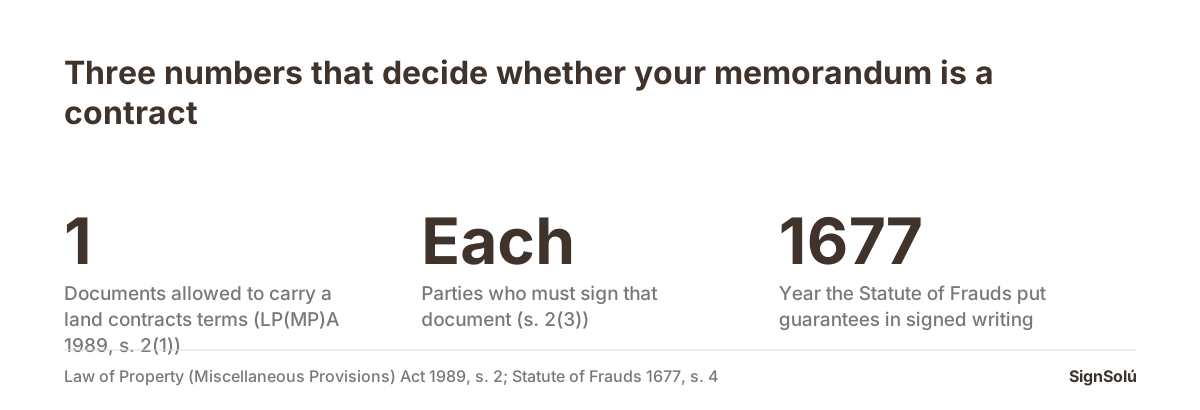
Land: one document, all the terms, both signatures
Section 2 of the Law of Property (Miscellaneous Provisions) Act 1989 is short and absolute. Subsection (1): a contract for the sale or other disposition of an interest in land can only be made in writing and only by incorporating all the terms which the parties have expressly agreed in one document or, where contracts are exchanged, in each.
Subsection (2) softens the mechanics but not the rule: the terms may be incorporated in a document either by being set out in it or by reference to some other document. Subsection (3): the document incorporating the terms must be signed by or on behalf of each party to the contract.
So a memorandum that records the price and the parties, and leaves the rest to "a formal agreement to follow", is not a land contract and cannot become one by conduct. That is usually what the parties wanted. The trap is the opposite case: a memorandum that happens to contain every agreed term, is signed by both, and concerns land — because then it may well satisfy section 2, whatever the heading says.
Subsection (4) adds a tidy detail worth knowing: where a contract satisfies the section only because a court has ordered rectification of one or more documents, the contract comes into being at the time the order specifies. The lease side of land documents, with its own two thresholds, is in the land lease document.
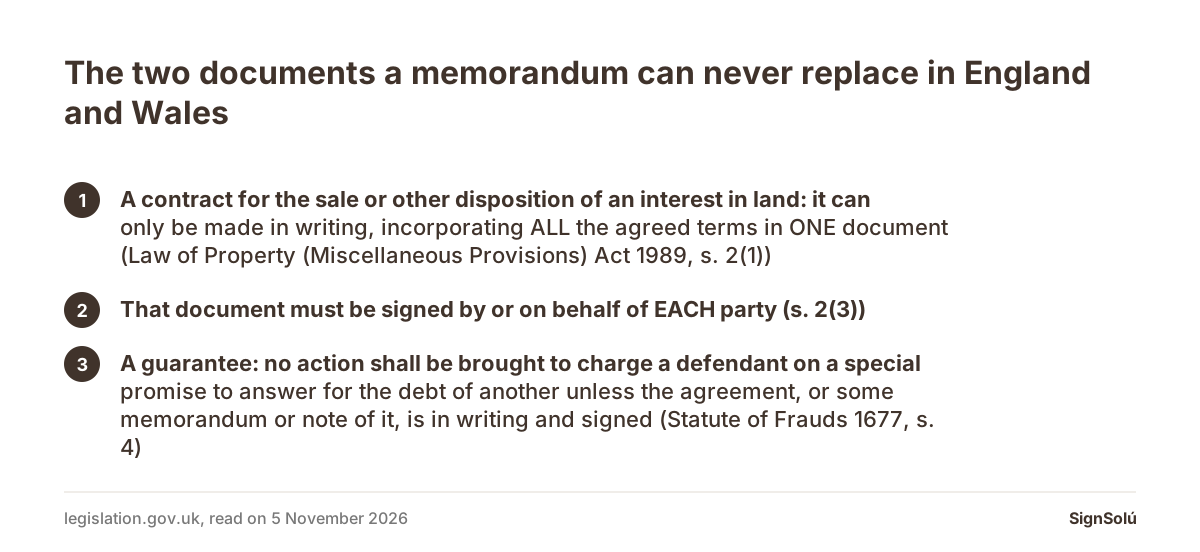
Guarantees: the statute uses the word itself
Here the irony is worth the detour. Section 4 of the Statute of Frauds 1677 says no action shall be brought whereby to charge the defendant upon any special promise to answer for the debt, default or miscarriages of another person unless the agreement upon which such action shall be brought, or some memorandum or note thereof, shall be in writing and signed by the party to be charged therewith or some other person thereunto by him lawfully authorized.
A memorandum or note in signed writing is precisely what the 1677 statute accepts for a guarantee. So the same word that most people use to mean "not binding" is, in the oldest of these provisions, the thing that makes a guarantee enforceable.
The practical lesson is uncomfortable and useful: if your memorandum says, anywhere, that one company will cover what another owes, that sentence may be the signed memorandum section 4 is talking about. If that is not the intention, the sentence goes.
What to put in the document, and what to leave out
- 1Write a status clause first, listing which numbered clauses are binding and marking everything else subject to contract. Without it nobody can state what the document is.
- 2Put a date on the exclusivity, because a lock-out with no end date is the clause most likely to be argued about.
- 3Say who pays for what if the deal dies, since due diligence money is spent before any contract exists.
- 4Delete any sentence in which one company covers another's debt, or accept that section 4 of the Statute of Frauds may make that signed memorandum enough to charge you.
- 5Keep land terms out of it, so the document cannot accidentally satisfy section 2 of the 1989 Act.
| Clause | Binding or not | Why |
|---|---|---|
| Parties and purpose | Not binding | Context, not obligation |
| Scope of the intended deal | Not binding, marked subject to contract | This is what the later contract will settle |
| Confidentiality | Binding | It has to work from today or it never works |
| Exclusivity or lock-out period | Binding, with a date | A promise not to negotiate with others is the main thing a memorandum buys |
| Who bears which costs | Binding | Due diligence money is spent before any contract exists |
| Governing law and jurisdiction | Binding | It decides where a dispute about the memorandum itself goes |
| Any promise to pay another party's debt | Leave it out | Section 4 of the Statute of Frauds may make a signed memorandum enough to charge you |
| Full terms of a land deal | Leave it out | If all terms end up in one signed document, section 2 of the 1989 Act may be satisfied |
| Termination of the memorandum | Binding | Say when the binding clauses stop, or they do not |
The template with the structure already in place is in the memorandum of understanding template. If what the deal needs is a document that actually commits the parties while the main contract is drafted, the shape is a letter of intent, and the Mexican version of that conversation is in a letter of intent with a Mexican company.
The confidentiality clause should probably not live here
It can, and in a short memorandum it often does. But confidentiality needs to survive the memorandum, and a clause inside a document that the parties later describe as superseded is a clause nobody can rely on. A separate agreement avoids the argument: the non-disclosure agreement, the clause most Word versions skip in the notice most of them skip, and the cross-border case in an NDA with a Mexican supplier.
If the counterparty is Mexican
Two things change. Mexican law has no general requirement of form for civil contracts, and its courts will not read an English "subject to contract" heading the way an English court does, so the binding and non-binding clauses have to be labelled in the text rather than implied. And if the deal involves Mexican real estate, a choice-of-law clause will not move it: Mexican law ties contracts over immovable property to the law of the place where the property is. The documents a foreign buyer actually signs are in buying property in Mexico as an American and buying land in Mexico as a foreigner, and what needs a notary is in the Mexican notary.
Signing it, and keeping the version you signed
Memoranda are circulated, edited and re-signed more often than contracts, which makes the real risk a version problem rather than a legal one: nobody is sure which draft carries the signatures.
SignSolú is a Mexican e-signature platform that works over WhatsApp. The memorandum goes out by WhatsApp from your own number or by email, the other side signs from a phone without opening an account or paying, and the audit receipt records time, IP address, device and the SHA-256 hash of the file — so the signed version can be identified against every other draft in the folder. Anyone can check it at the verification page with no account. The sender chooses the language for each signer, so a signer who reads English gets the email, the WhatsApp message and the signing page in English. What the platform stores is in trust, the plans are in pricing, and the free plan is 10 documents with no expiry and no card. You can create an account and send one today.
What an electronic signature is worth across jurisdictions is in is an electronic signature legally binding, and where, the United Kingdom note is in the validity note for the United Kingdom, and signing with a party in Mexico is in how to sign a contract remotely with someone in Mexico. Two other documents where the statute writes part of the text for you: the limited liability partnership agreement and the settlement agreement. If the next step is a supply or distribution deal, the distribution agreement and the service agreement; if it is a joint venture, the joint venture agreement; and if it is a term sheet rather than a memorandum, the term sheet template.
Frequently asked questions
Is a memorandum of understanding legally binding in England?
It can be. No statute makes a document non-binding because of its title. What decides is whether the parties intended to create legal relations and whether the usual elements of a contract are present. If the intention is not to be bound, the document has to say which clauses are binding and mark the rest subject to contract.
Can an MOU be used for a property deal?
Not as the contract. Section 2(1) of the Law of Property (Miscellaneous Provisions) Act 1989 requires a contract for the sale or other disposition of an interest in land to be in writing with all expressly agreed terms in one document, signed by or on behalf of each party under section 2(3).
Does writing "subject to contract" make it safe?
It helps and it is standard practice, but it is a statement of intention rather than a rule of law. A document whose substance shows an intention to be bound can still be held to be a contract.
Why would a memorandum ever be enough on its own?
For a guarantee. Section 4 of the Statute of Frauds 1677 allows an action on a promise to answer for the debt or default of another where the agreement, or some memorandum or note of it, is in writing and signed by the party to be charged.
Which clauses should be binding in a memorandum?
Usually confidentiality, any exclusivity or lock-out period with a date, who bears which costs, governing law and jurisdiction, and when the binding clauses end. Everything about the substance of the deal is better left subject to contract.
Can it be signed electronically?
Generally yes for a memorandum. Electronic signatures are capable of signing most documents, and what matters in a dispute is the evidence of who signed and that the file did not change afterwards. Land contracts and deeds have their own formality rules and are worth checking with a solicitor.
Send your next contract to Mexico for signature
Create a free account and send 10 documents with no card. Your dashboard works in English. You set the language per signer, and their email, WhatsApp message and signing page arrive in that language.