SignSolú

Term sheet template: free in Word, or sign it online

Reviewed in October 2026

A term sheet is a short document that lists the main terms of an investment before the final contracts are drafted. It covers valuation, amount, investor rights and closing conditions. Most of it is not binding, except confidentiality, exclusivity and costs.

Ten documents free, no card. Signed by the company and the lead investor.

Term sheet example, filled in with sample data
Example filled in with sample data

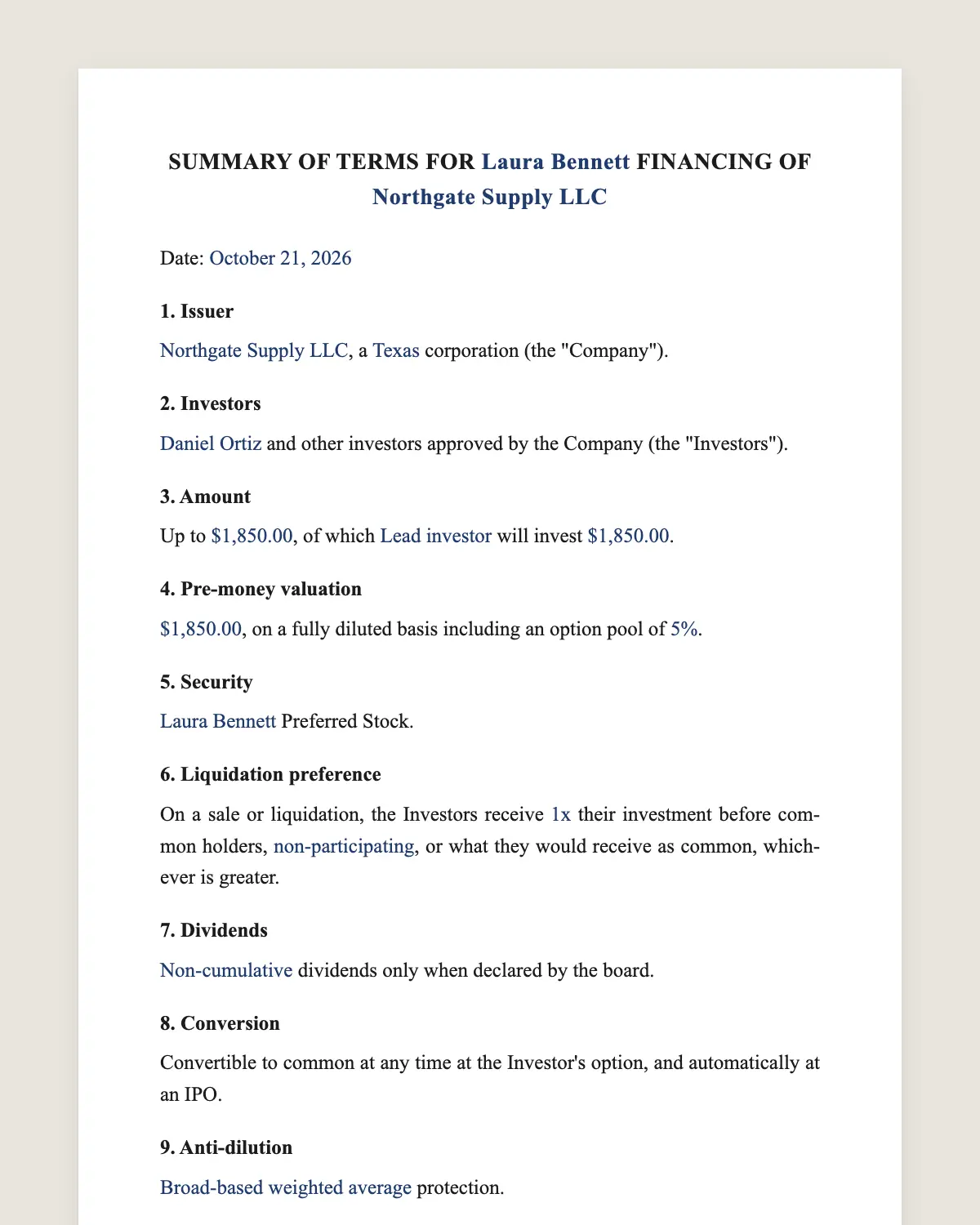
The full term sheet

SUMMARY OF TERMS FOR [SERIES NAME] FINANCING OF [COMPANY NAME]

Date: [date]

1. Issuer

[Company legal name], a [state] corporation (the "Company").

2. Investors

[Lead investor name] and other investors approved by the Company (the "Investors").

3. Amount

Up to [amount], of which [Lead investor] will invest [amount].

4. Pre-money valuation

[amount], on a fully diluted basis including an option pool of [percentage].

5. Security

[Series name] Preferred Stock.

6. Liquidation preference

On a sale or liquidation, the Investors receive [1x] their investment before common holders, [non-participating], or what they would receive as common, whichever is greater.

7. Dividends

[Non-cumulative] dividends only when declared by the board.

8. Conversion

Convertible to common at any time at the Investor's option, and automatically at an IPO.

9. Anti-dilution

[Broad-based weighted average] protection.

10. Board

[number] seats: [number] chosen by common holders, [number] by the Investors, [number] independent.

11. Protective provisions

Consent of a majority of the Preferred is needed to change their rights, issue senior stock, sell the Company or take on debt above [amount].

12. Information rights

Annual audited and quarterly unaudited financials for Investors holding at least [amount].

13. Pro rata right

Investors may buy their share of future rounds.

14. Founder vesting

Founders' shares vest over [number] months with [number] months already vested at closing.

15. Closing conditions

Due diligence, final documents and board approval. Target closing on [date].

16. Expenses

The Company pays the lead Investor's legal fees up to [amount] at closing.

17. Binding terms

Only the Confidentiality, Exclusivity ([number] days) and Expenses sections are binding. The rest is a summary of intent and does not oblige either party to close.

18. Governing law and signature

The binding terms are governed by the laws of [state]. The parties agree to sign this term sheet electronically.

Company

Name and title: ______________

Date: ______________

Lead Investor

Name and title: ______________

Date: ______________

What the template includes

  • Issuer, investors and amount of the round
  • Pre-money valuation and option pool
  • Type of stock issued
  • Liquidation preference
  • Dividends and conversion
  • Anti-dilution protection
  • Board composition
  • Protective provisions for investors
  • Information and pro rata rights
  • Founder vesting
  • Closing conditions and legal expenses
  • Clear split of binding and non-binding terms

What you fill in

FieldExample
CompanyTidewater Health Inc.
RoundSeries Seed
Lead investorCopperline Ventures Fund II
AmountUSD 3,000,000
Pre-money valuationUSD 12,000,000
Option pool10%
Liquidation preference1x non-participating
Board2 common, 1 investor
Exclusivity45 days
Legal fee capUSD 25,000

How it gets signed

  1. 1Choose «Use this template», fill in the fields and review the full term sheet.
  2. 2Send it by WhatsApp or email. The other party opens the link on their phone without an account.
  3. 3They tap the brown bar at the bottom that says «Sign as …» and draw their signature once.
  4. 4Everyone gets the signed PDF with its signature certificate. Anyone can check it at signsolu.com/verificar.

The signing screen tells each signer that signing means agreeing to sign electronically. It links to the electronic signature disclosure that the ESIGN Act asks for.

What you get once everyone signs

  • The signed PDF. The final term sheet with every drawn signature in place.
  • The signature certificate. It lists each signer and the date and time of each signature.
  • A record you can check. The folio on the certificate opens the document history at signsolu.com/verificar.
  • Reminders. Turn them on and SignSolú reminds every signer who has not signed yet.

Your first ten documents are free and need no card.

What the law says

A term sheet is mostly a statement of intent. Courts in many states still enforce the sections the parties call binding, so mark them clearly as this template does.

The final stock purchase agreement and charter amendment carry the full terms. Those documents follow the securities and corporate law of the issuer's state.

The ESIGN Act, 15 U.S.C. 7001 gives an electronic signature the same legal effect as one on paper. A contract cannot be denied effect only because it was signed electronically.

Glossary of the terms in this sheet

  • Pre-money valuation. What the company is worth just before the new money comes in.
  • Fully diluted. Counts every share, option and warrant as if issued.
  • Liquidation preference. What investors receive first on a sale.
  • Non-participating. Investors take the preference or their common share, not both.
  • Broad-based weighted average. Adjusts the investor's price if a later round is cheaper.
  • Pro rata right. The option to keep the same percentage in later rounds.

Which terms matter most

Valuation gets the attention, but liquidation preference and board seats shape the outcome more. A high valuation with a 2x participating preference can pay founders less.

Read the protective provisions closely. They decide what the company can do later without investor consent.

From term sheet to closing

  1. 1Both sides sign the term sheet and exclusivity starts.
  2. 2The investor runs due diligence on the company.
  3. 3Lawyers draft the final documents from the term sheet.
  4. 4Everyone signs the final documents and the money is wired.

Common mistakes

  • Long exclusivity. More than 60 days keeps the company off the market for too long.
  • Unclear option pool. Pre-money or post-money changes the founders' share.
  • No fee cap. Legal costs paid by the company add up fast.

Example of the math

A company with a USD 12 million pre-money valuation raises USD 3 million. The post-money valuation is USD 15 million.

The investors own 20% after closing. If the option pool is counted in the pre-money, the founders absorb its dilution.

With a 1x non-participating preference, a later sale for USD 10 million pays investors USD 3 million first. The rest goes to the common holders.

Signing the term sheet

Upload the agreed version, add the company and the lead investor as signers and send it. Both sign from their phones and receive the signed PDF.

The signature certificate dates the start of exclusivity. Lawyers use that date to plan the closing calendar.

Who usually drafts the term sheet

The lead investor sends the first draft in most priced rounds. The company answers with comments on valuation, board and protective provisions.

A company that drafts its own term sheet controls the starting point. This template gives founders that option with standard market terms.

Keep the sheet to two or three pages. Long term sheets slow the round and invite renegotiation in the final documents.

Founders should read each term against the cap table before signing. A spreadsheet with the post-money ownership answers most questions.

When both sides agree on the last draft, send it the same day. A signed term sheet keeps the round moving while lawyers draft.

The final documents should match it line by line. Any change from the signed sheet deserves a short explanation from whoever proposes it.

Before you sign

Other templates

Frequently asked questions

Is a term sheet signed online legally binding?

Yes. The ESIGN Act gives electronic signatures the same effect as handwritten ones. The signed PDF and its certificate show who signed and when.

Is a term sheet binding?

Only in part. Confidentiality, exclusivity and expenses bind the parties. The economic terms do not until the final documents are signed.

Who signs a term sheet?

Usually the company and the lead investor. Other investors join when the final documents are signed.

Does the other party need a SignSolú account?

No. They open the link on their phone and sign with the brown bar at the bottom.

Can I edit the clauses before sending it?

Yes. After «Use this template» you can change any clause before you send it.

Can I use it for a SAFE round?

No. A SAFE round rarely needs a term sheet. This template is for priced equity rounds.

How long does exclusivity usually last?

Thirty to sixty days. That is enough time for diligence and final documents.

Can the founders sign too?

Yes. Add each founder as a signer when the term sheet sets their vesting.

See also

Create a free account and send 10 documents