Lodger agreement in Scotland: the flat upstairs is excluded too
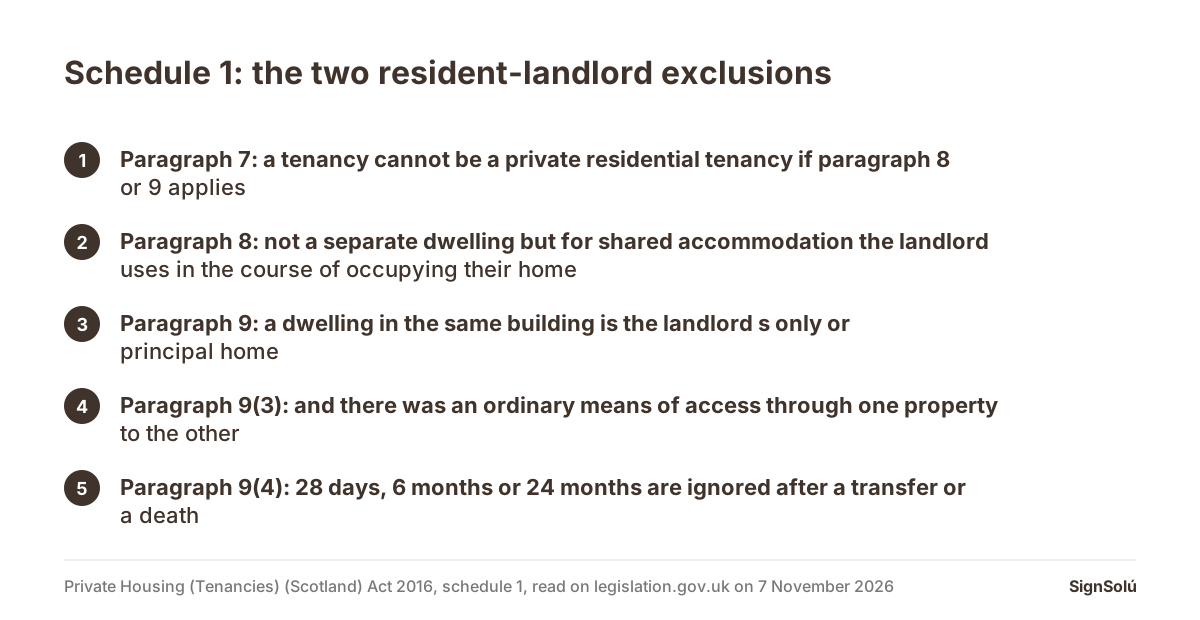
Schedule 1 of the Private Housing (Tenancies) (Scotland) Act 2016 has two resident-landlord exclusions, and the templates only know the first. Paragraph 8 covers the classic lodger: the let property would not be a separate dwelling but for the right to use shared accommodation, and the landlord uses that shared accommodation in the course of occupying their own home. Paragraph 9 covers something else entirely: a separate dwelling in the same building that the landlord occupies as their only or principal home, where at the time of the grant there was an ordinary means of access through one property to the other. Paragraph 7 says that if either applies, the tenancy cannot be a private residential tenancy.
Why the word on the template does not decide anything
In Scotland a let of residential property is either a private residential tenancy or it is not, and nothing a document calls itself changes which. The regime comes from the Private Housing (Tenancies) (Scotland) Act 2016, and Schedule 1 lists the lets that cannot be a private residential tenancy at all.
That matters because the private residential tenancy carries a lot with it: statutory terms, the open-ended term, the grounds in Schedule 3 and the route to the First-tier Tribunal. If the let is excluded, none of that applies and the written agreement is most of what the two people have. That is the opposite situation to a standard let, where the statute fills the gaps: compare the tenancy agreement template and the simple lease agreement, which are written for lets inside a regime.
Paragraph 7 is the switch
Paragraph 7 of Schedule 1 is one sentence: a tenancy cannot be a private residential tenancy if paragraph 8 or 9 applies to it. Two doors, and most lodger agreements written for Scotland only describe the first one.
Paragraph 8: the classic lodger
Paragraph 8 applies to a tenancy if two things are true. First, the let property would not be regarded as a separate dwelling were it not for the terms of the tenancy entitling the tenant to use property in common with another person — the Act calls that shared accommodation. Second, from the time the tenancy was granted, the person (or one of the persons) with whom the tenant has a right to use that shared accommodation is a person who has the interest of the landlord under the tenancy and has a right to use the shared accommodation in the course of occupying that person’s home.
In plain terms: a room in a flat where the kitchen or the bathroom is shared with the landlord, who lives there. Read the wording carefully, though, because two details decide real cases. The shared use has to exist from the time the tenancy was granted, not from later. And the landlord has to have a right to use the shared accommodation in the course of occupying their home — a landlord who keeps a key and visits is not occupying.
If the landlord does not live there, the sharing is between tenants and the document is a different one: that is what the roommate agreement template and the sublease agreement are for. And if the let is a whole property with no sharing at all, the lease agreement is the starting point.
Paragraph 9: the one the templates miss
Paragraph 9 applies when sub-paragraphs (2) and (3) both apply. Sub-paragraph (2): from the time the tenancy was granted, a dwelling within the same building as the let property has been occupied as the only or principal home of a person who, at the time of occupying it, has the interest of the landlord. Sub-paragraph (3): at the time the tenancy was granted, there was an ordinary means of access through the let property to the landlord’s dwelling, or through the landlord’s dwelling to the let property — whether or not that access was available to the tenant as of right.
Nothing in paragraph 9 requires sharing a kitchen or a bathroom. The let can be a self-contained flat with its own front door. What it requires is the landlord living in the same building as their only or principal home, and an ordinary means of access connecting the two at the time of the grant. The converted townhouse where the owner lives on the ground floor and lets the upper floor, with an internal stair, is the picture.
| Paragraph 8 | Paragraph 9 | |
|---|---|---|
| Is the let a separate dwelling? | No, only because of the shared accommodation | Yes, it can be self-contained |
| Shared kitchen or bathroom needed? | Yes, that is the shared accommodation | No |
| What the landlord must be doing | Using the shared accommodation in the course of occupying their home | Occupying a dwelling in the same building as their only or principal home |
| Access requirement | None stated | An ordinary means of access through one property to the other at the time of the grant |
| When it is tested | From the time the tenancy was granted | From the time the tenancy was granted |
| Effect | Cannot be a private residential tenancy (paragraph 7) | Cannot be a private residential tenancy (paragraph 7) |
The exclusion does not switch off the day the landlord leaves
Sub-paragraph (4) of paragraph 9 is the part almost nobody writes about, and it answers the question people actually ask: what happens if the landlord sells or dies. In determining whether a dwelling is occupied as the only or principal home of the person having the landlord’s interest, no account is to be taken of:
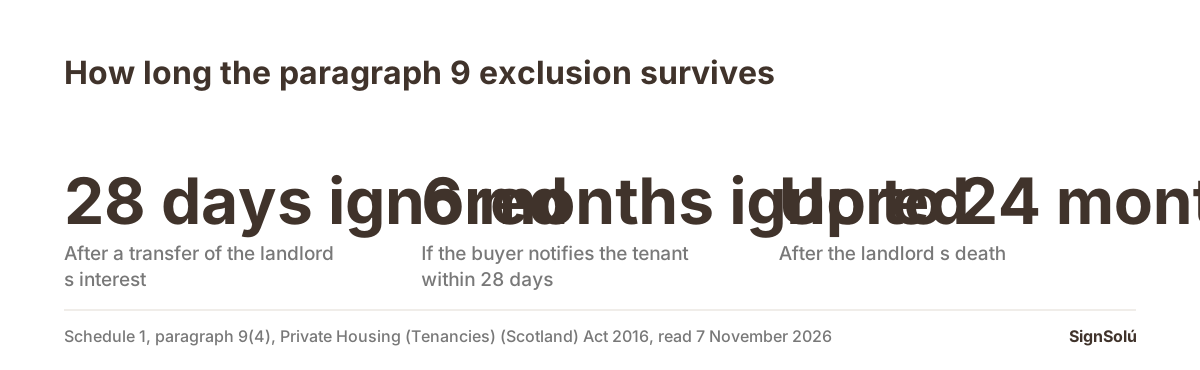
- any period beginning with the date on which the landlord’s interest is transferred (other than on death) and ending 28 days later;
- or ending 6 months later, if within 28 days of that period beginning the person to whom the interest is transferred notifies the tenant of their intention to occupy a dwelling within the same building;
- and any period of up to 24 months beginning with the date of the person’s death and ending with the interest in the tenancy vesting in another person, otherwise than as that person’s executor.
So the exclusion survives a sale for 28 days, or six months if the buyer gives the tenant notice in time, and up to two years after a death while the estate is settled. Those three periods are dates to write in a diary, not background colour.
What the written agreement has to carry, then
When a let is excluded, the agreement is doing work that the statute would otherwise do. That is the opposite of how the free templates are built: they lean on the regime and leave the detail blank.
- 1Which exclusion is relied on, with the facts behind it: the shared accommodation of paragraph 8, or the same-building home and the ordinary means of access of paragraph 9.
- 2What exactly is let, and what is shared, described room by room, because paragraph 8 turns on whether the let would be a separate dwelling without the sharing.
- 3The notice each side gives to end the arrangement, and how it is delivered. Nothing in the 2016 Act supplies it here.
- 4Rent, when it is due, what it includes and how it changes. A rolling arrangement is closer to a month-to-month lease than to a fixed term.
- 5The deposit, if there is one, and what happens to it at the end.
- 6House rules that the two people actually agreed: guests, smoking, cleaning, quiet hours.
- 7What happens if the landlord sells or dies, which is where sub-paragraph (4) of paragraph 9 does its work.
The template to start from is the lodger agreement template. What the equivalent English documents get wrong, with the Protection from Eviction Act 1977 behind it, is in free lodger agreement templates in the UK. For a let that is not excluded, England’s current shape is in what changed in England in 2026, and the Ontario version of the same question is in renting a room in Ontario.
Two exclusions that get confused with these
Schedule 1 also takes out purpose-built student accommodation at paragraph 5, and holiday lets at paragraph 6, which since 1 March 2022 includes a short-term let within the meaning of article 3 of the licensing order made under the Civic Government (Scotland) Act 1982. Neither is a resident-landlord case, and a lodger agreement is the wrong document for both.
Ending it, extending it, changing it
Because the statutory notice rules do not apply, the three documents that follow the agreement are worth agreeing in advance: the lease termination letter, the lease extension agreement and the lease addendum for a change in the middle. What it costs to leave a let early, in the lets where a statute does govern it, is in breaking a lease and in what happens if you break a lease. A sublet by the lodger is a third document again: the sublease agreement template.
Signing it when one of you is not in the room
A lodger agreement is an ordinary contract, so it can be signed electronically. If the other person is abroad — a student arriving in August, a worker moving from another country — getting a wet signature first is the part that delays everything.
SignSolú is a Mexican e-signature platform. What that means in practice for a let like this: you send the agreement over WhatsApp or by email, the other person signs from a phone without creating an account or paying anything, and the audit receipt records time, IP address, device and the SHA-256 hash of the file. The sender picks the language for each signer, so the email, the WhatsApp message and the signing page can arrive in English while you work in Spanish. Anyone can check afterwards that the file did not change at the verification page, with no account. SignSolú is not an accredited provider and does not issue NOM-151 conservation certificates, which are a Mexican requirement and not a Scottish one.
What the receipt contains is in how to sign a contract remotely with someone in Mexico, where electronic signatures are and are not binding is in is an electronic signature legally binding, and the prices are on the pricing page. The position in the United Kingdom is set out on the UK validity page, how the receipt is built on the trust page, and anyone can check a signed file at the verification page. The free plan is 10 documents, with no expiry and no card.
Frequently asked questions
Is a lodger in Scotland a private residential tenant?
Not if paragraph 8 or 9 of Schedule 1 to the Private Housing (Tenancies) (Scotland) Act 2016 applies. Paragraph 7 says the tenancy cannot be a private residential tenancy in that case, so the statutory terms and the grounds in Schedule 3 do not apply.
Does the lodger have to share a kitchen or bathroom with me?
For paragraph 8, yes: the let has to be something that would not be a separate dwelling but for the shared accommodation, and you have to use that shared accommodation in the course of occupying your home. Paragraph 9 has no sharing requirement at all.
Can a self-contained flat be excluded?
Yes, under paragraph 9, if a dwelling in the same building is occupied as your only or principal home and, at the time the tenancy was granted, there was an ordinary means of access through one property to the other, whether or not the tenant had a right to use it.
What happens to the exclusion if I sell the building?
Sub-paragraph (4) of paragraph 9 ignores the 28 days after a transfer of the landlord’s interest, or six months if within 28 days the buyer notifies the tenant of an intention to occupy a dwelling in the same building. So the exclusion does not drop on the day of the sale.
And if the landlord dies?
The same sub-paragraph ignores a period of up to 24 months from the date of death, ending when the interest in the tenancy vests in another person otherwise than as the deceased’s executor.
Can the agreement be signed electronically?
Yes, it is an ordinary contract. With SignSolú you send it over WhatsApp or by email, the other person signs from a phone without creating an account, and the audit receipt records time, IP address, device and the SHA-256 hash of the file.
Send your next contract to Mexico for signature
Create a free account and send 10 documents with no card. Your dashboard works in English. You set the language per signer, and their email, WhatsApp message and signing page arrive in that language.