Month-to-month lease in Alberta: one month for the tenant, three for the landlord
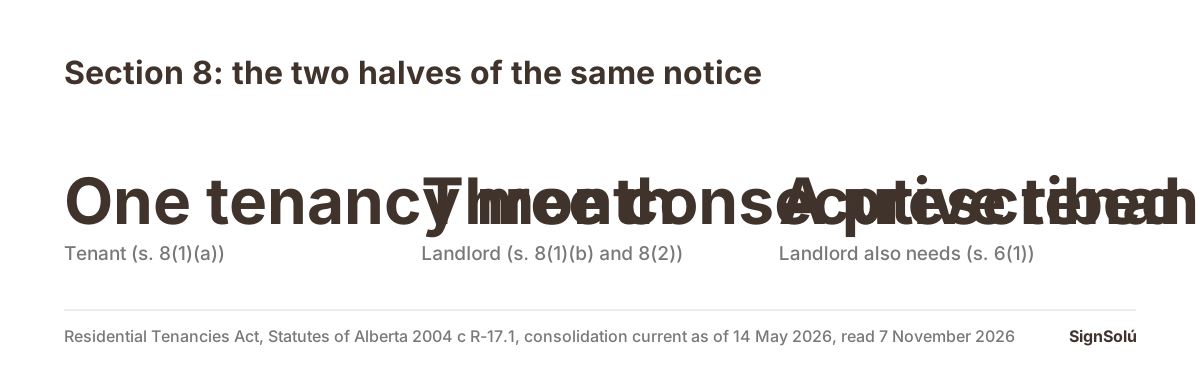
Section 8(1) of Alberta’s Residential Tenancies Act splits it. A tenant serves notice on or before the first day of a tenancy month, to be effective on the last day of that month. A landlord serves on or before the first day of a notice period, and section 8(2) defines a notice period as three consecutive tenancy months. So the tenant needs about one month and the landlord needs three. And section 6(1) adds something a template never mentions: a landlord’s notice to terminate a periodic tenancy is of no effect unless the termination is for one or more of the prescribed reasons or for the reasons in section 11 or 12.
Why «30 days either way» is wrong here
Most month-to-month templates carry a single notice clause: either party may end the tenancy on thirty days’ written notice. That sentence is wrong in Alberta twice over — wrong on the length, because the two sides are not symmetrical, and wrong on the shape, because the Act counts tenancy months and not days.
The rules are in Part 1 of the Residential Tenancies Act, Statutes of Alberta 2004, chapter R-17.1, current as of 14 May 2026. They are short, and they are not what the form says.
Section 8, both halves
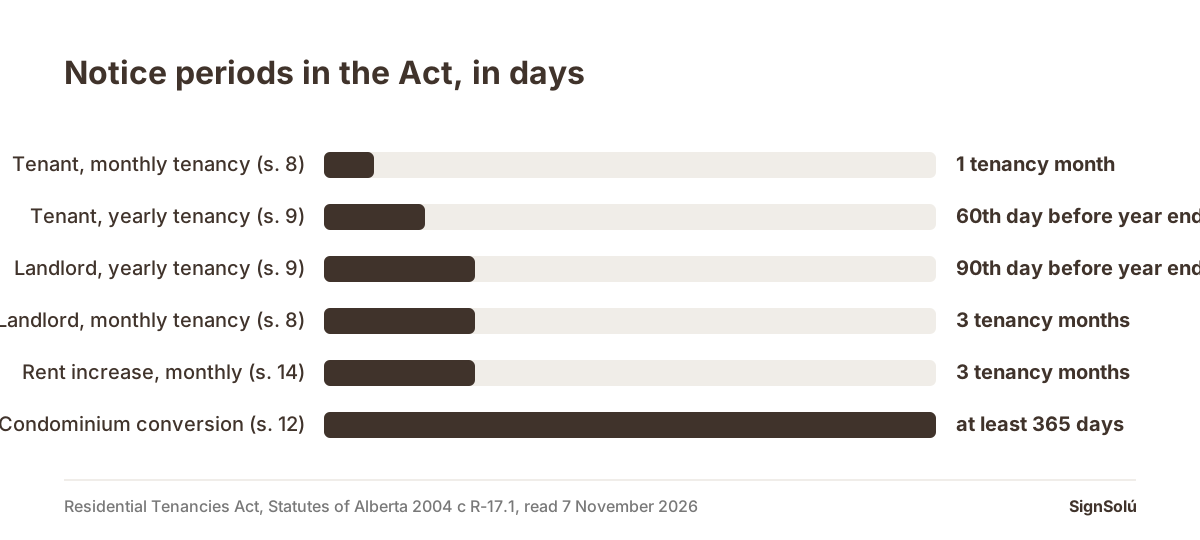
Section 8(1)(a): a notice to terminate a monthly tenancy must be served by a tenant on the tenant’s landlord on or before the first day of a tenancy month, to be effective on the last day of that tenancy month.
Section 8(1)(b): the same notice must be served by a landlord on the landlord’s tenant on or before the first day of a notice period, to be effective on the last day of the notice period. And section 8(2) defines it: in this section, «notice period» means a period of three consecutive tenancy months.
Two consequences for a real calendar. For the tenant, the notice has to land on or before the first of the month — giving it on the second means the tenancy ends at the end of the following month, not thirty days later. For the landlord, three tenancy months means a notice served on 1 March ends the tenancy on 31 May.
| Tenant | Landlord | |
|---|---|---|
| When the notice must be served | On or before the first day of a tenancy month | On or before the first day of a notice period |
| How long that is | One tenancy month | Three consecutive tenancy months (s. 8(2)) |
| When it takes effect | Last day of that tenancy month | Last day of the notice period |
| Does a reason have to be given? | No | Yes: a prescribed reason, or a reason in s. 11 or s. 12 (s. 6(1)) |
| What if the reason turns out not to be used? | Not applicable | The landlord contravenes the Act (s. 6(2)) |
The landlord cannot simply end it
Section 6(1) is the part that surprises people who have rented elsewhere: a notice under Part 1 from a landlord to a tenant to terminate a periodic tenancy is of no effect unless the termination is for one or more of the prescribed reasons or for the reasons set out in section 11 or section 12.
Section 11 is the tenancy entered into by reason of the tenant’s employment by the landlord: if that employment is terminated, either side may end the tenancy on the longest of the notice of termination of employment required by law, the notice agreed between them, or one week.
Section 12 is the condominium conversion: where a condominium plan that includes the premises is registered or proposed to be registered, and termination is sought to obtain vacant possession so the premises can be sold as a condominium unit, the landlord may terminate by serving notice at least 365 days before the day named in the notice.
And section 6(2) puts teeth in it: a landlord who gives notice for a prescribed reason or for a section 12 reason contravenes the Act if the tenant vacates and the landlord does not use the premises for the reasons set out in the notice within a reasonable time after the termination date.
Two rules that catch people who thought they had a fixed term
Section 5(4): if a periodic tenancy is for a period of more than one week but less than one year, that tenancy is, for the purposes of terminating it, deemed to be a monthly tenancy. A «bi-weekly» or «quarterly» arrangement is ended on the monthly rules.
Section 13: when a periodic tenancy is implied by operation of law after the expiration or termination of a prior fixed term tenancy, the implied tenancy, in the absence of facts showing a contrary intention, is a monthly tenancy if the prior fixed term was one month or more, and a weekly tenancy if it was less. So a one-year lease that nobody renewed does not become a tenancy at will: it becomes a monthly tenancy with section 8 attached.
That second rule is the most useful thing in the Act for a landlord who let a lease lapse. The document to put in place at that point is a month-to-month lease agreement; if the intention was to keep a fixed term, the lease extension agreement is the one. For the lease itself, the lease agreement and the simple lease agreement.
Raising the rent takes three months too
Section 14(1) says a landlord shall not increase the rent payable under a residential tenancy agreement, or recover any additional rent resulting from an increase, unless the landlord serves a written notice of the increase at least 12 tenancy weeks for a weekly tenancy, at least 3 tenancy months for a monthly tenancy, and at least 90 days for any other periodic tenancy, before the date the increase is to be effective.
Section 14(2) adds the form: the notice must indicate the date the increase is effective and must be dated and signed by the landlord. A rent increase sent as an unsigned message is not the notice the Act asks for, and a signature with a date is exactly what an electronic signature does cheaply. A change agreed between the two of you, rather than imposed, belongs in a lease addendum instead.
And if the tenancy is yearly
Section 9 keeps the asymmetry: a notice to terminate a yearly tenancy must be served by a tenant on or before the 60th day before the last day of a tenancy year, and by a landlord on or before the 90th day before the last day of a tenancy year, to be effective on the last day of the tenancy year.
What the agreement should say
- 1That the tenancy is monthly, and what a «tenancy month» is for this agreement — the Act counts tenancy months, not calendar days. If a room is shared rather than let whole, the roommate agreement template is the document, and a sublet is the sublease agreement template.
- 2The notice each side gives, written out separately: one tenancy month for the tenant, a notice period of three consecutive tenancy months for the landlord.
- 3That a landlord’s notice has to state the reason, because section 6(1) makes it of no effect otherwise.
- 4How notice is served and what counts as served, since the form requirements are in section 10.
- 5Rent, the date it is due, and the three tenancy months of written notice before any increase, dated and signed.
- 6The deposit, where it is held and what it covers.
- 7The condition of the premises at the start, with photographs and a date, in the same spirit as the tenancy agreement template records the inventory.
For comparison, the same question answered by a different statute: when the Residential Tenancies Act does not apply to a room in Ontario, the two resident-landlord exclusions in Scotland and what changed in England in 2026. Ending or changing what exists: the lease termination letter and the lease addendum. Subletting in a four-unit building in New York, with its own procedure, is in the letter that comes before the template. What leaving early costs, generally, in breaking a lease and what happens if you break a lease.
Signing the agreement and the notices
A monthly tenancy generates documents all year: the agreement, a rent increase notice, a termination notice, an addendum when something changes. Every one of them needs a date and a signature that can be shown later.
SignSolú is a Mexican e-signature platform. What it does for documents like these: you send them over WhatsApp or by email, the other person signs from a phone without creating an account or paying anything, and the audit receipt records time, IP address, device and the SHA-256 hash of the file, so the date on a notice is not a matter of recollection. Anyone can check that the file did not change at the verification page, with no account. The sender picks the language for each signer. SignSolú is not an accredited provider and does not issue NOM-151 conservation certificates, which are a Mexican requirement and not a Canadian one.
Where an electronic signature binds is in is an electronic signature legally binding; the position in Canada is on the Canada validity page; how the receipt is built, on the trust page; the disclosure that goes with it, on the electronic signature disclosure; and the prices, on the pricing page. The free plan is 10 documents, with no expiry and no card.
Frequently asked questions
How much notice does a tenant give to end a month-to-month tenancy in Alberta?
Section 8(1)(a) requires the notice to be served on or before the first day of a tenancy month, to be effective on the last day of that tenancy month. In practice that is one month, counted in tenancy months rather than days.
And how much does the landlord give?
Section 8(1)(b) requires service on or before the first day of a notice period, effective on the last day of it, and section 8(2) defines a notice period as three consecutive tenancy months.
Can a landlord end a monthly tenancy for no reason?
Section 6(1) says a landlord’s notice to terminate a periodic tenancy is of no effect unless the termination is for one or more of the prescribed reasons or for the reasons set out in section 11 or section 12. The prescribed reasons are in the regulations.
What happens when a one-year lease simply runs out?
Section 13 says that when a periodic tenancy is implied by operation of law after a prior fixed term ends, it is a monthly tenancy if the prior fixed term was one month or more, absent facts showing a contrary intention. So the monthly notice rules apply from then on.
How much notice is needed to raise the rent?
For a monthly tenancy, at least three tenancy months of written notice before the effective date, under section 14(1)(b). The notice must indicate the effective date and be dated and signed by the landlord.
Can the agreement and the notices be signed electronically?
They are ordinary documents that need a date and a signature. With SignSolú you send them over WhatsApp or by email, the other person signs from a phone without an account, and the audit receipt records time, IP address, device and the SHA-256 hash of the file.
Send your next contract to Mexico for signature
Create a free account and send 10 documents with no card. Your dashboard works in English. You set the language per signer, and their email, WhatsApp message and signing page arrive in that language.