Lodger agreement or tenancy? The line is in section 3A, and a shared hallway is on the wrong side of it
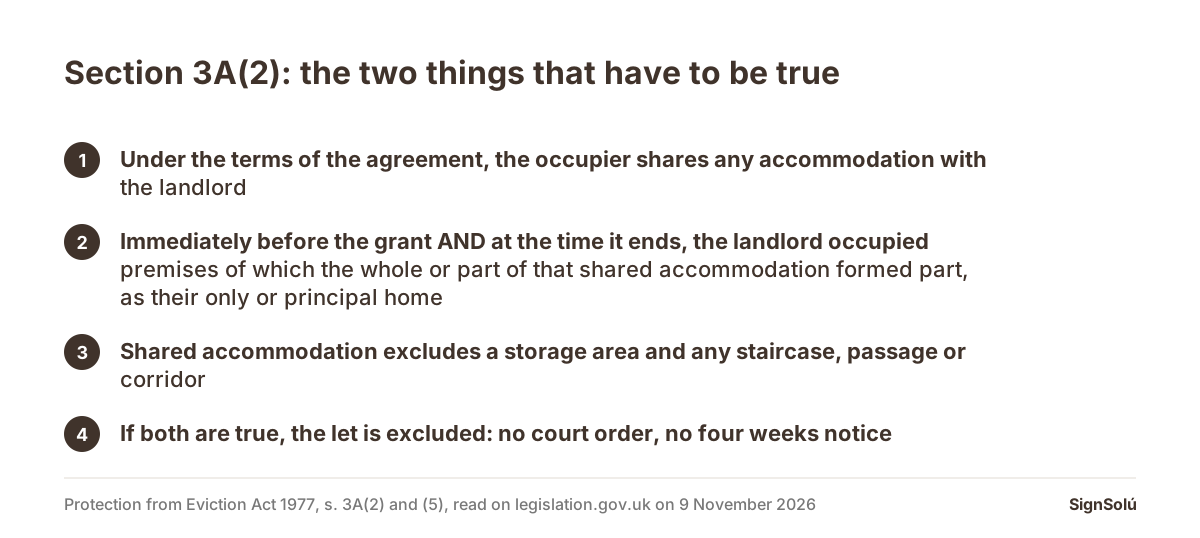
The heading on the document decides nothing. Section 3A of the Protection from Eviction Act 1977 sets the test, and it has two limbs that both have to be true: under the terms of the agreement the occupier shares some accommodation with you, and immediately before the agreement was granted and also at the time it ends, you occupied premises of which the whole or part of that shared accommodation formed part, as your only or principal home. If both are true, the let is excluded and you do not need a court order to recover possession. If either fails, section 3 applies and possession can only be enforced through the court. And section 3A(5)(a) is the trap: shared accommodation includes neither a storage area nor a staircase, passage or corridor, so a shared hallway is not sharing.
What the template is actually claiming
Every free lodger agreement opens the same way: a line saying this is a licence and not a tenancy, and that the occupier is an excluded occupier. That line is not a term of the deal. It is a prediction about facts, and the facts are the ones in section 3A of the Protection from Eviction Act 1977.
The reason it matters is narrow and expensive. If the occupier is an excluded occupier, you can end the arrangement with reasonable notice and take the room back without going to court. If they are not, section 3 makes it unlawful to enforce your right to possession otherwise than by proceedings in the court, and section 5 makes a notice to quit invalid unless it is in writing with the prescribed information and gives at least four weeks. Same room, same rent, same document — different world.
Section 3A(2), in two parts
Subsection (2) says a tenancy or licence is excluded if, under its terms, the occupier shares any accommodation with the landlord or licensor and if, immediately before the tenancy or licence was granted and also at the time it comes to an end, the landlord occupied as his only or principal home premises of which the whole or part of the shared accommodation formed part.
Read the second limb again, because it is about you. You have to have been living there before you granted the agreement, and you have to still be living there when it ends. Subsection (3) covers the variant where the sharing is with a member of your family rather than with you, and it adds a third condition: you yourself have to occupy premises in the same building, and that building must not be a purpose-built block of flats.
- You moved out and kept letting the room. The first limb may still hold on paper, but the second fails at the moment it matters: you are not occupying the premises when the agreement ends. The let is not excluded.
- You bought the house with the lodger already in it. You did not occupy it immediately before the grant, because you did not grant anything. Whatever the previous owner wrote, your position is not the resident-landlord position.
- The sharing is only a hallway. Subsection (5)(a) says accommodation includes neither an area used for storage nor a staircase, passage, corridor or other means of access. A shared front door and a shared landing are not shared accommodation.
The hallway problem, and the kitchen that fixes it
This is the one that catches people with a converted loft or a basement room with its own entrance. The room has a bathroom. The occupier walks through the hall and up the stairs and that is the only thing you share. On the face of subsection (5)(a), that is not sharing at all: a staircase, a passage, a corridor and any other means of access are carved out by name.
What puts you inside subsection (2) is a room the two of you actually use in common: the kitchen, the living room, a bathroom that is not theirs alone. Subsection (4) defines sharing as having the use of accommodation in common with another person, whether or not also in common with others. So if the arrangement is meant to be a lodger arrangement, the shared kitchen is not a detail to be designed away for privacy — it is the thing holding the whole structure up, and the agreement should say which rooms are shared, by name.
| The arrangement | Shared accommodation? | Landlord resident at both ends? | Result |
|---|---|---|---|
| Spare room, shared kitchen, you live there | Yes | Yes | Excluded: s. 3A(2) |
| Basement with own bathroom, shared hallway only | No, s. 3A(5)(a) | Yes | Not excluded: s. 3 applies |
| Shared kitchen, but you moved in with a partner elsewhere | Yes | No at the end | Not excluded: s. 3 applies |
| Shared kitchen with your sister, you live in the same house, not a purpose-built block | Yes | Covered by s. 3A(3) | Excluded |
| Shared kitchen with your sister, purpose-built block of flats | Yes | Fails the s. 3A(3)(c) condition | Not excluded |
| Rent-free arrangement | Any | Any | Excluded anyway: s. 3A(7)(b) |
| Holiday-only occupation | Any | Any | Excluded anyway: s. 3A(7)(a) |
Two exclusions that have nothing to do with sharing
Subsection (7) excludes a tenancy or licence that confers the right to occupy for a holiday only, and one granted otherwise than for money or money’s worth. Subsection (6) excludes a let granted as a temporary expedient to someone who entered as a trespasser. These sit outside the resident-landlord test entirely, which is why a free arrangement with a friend and a two-week holiday let are in a different box from a lodger.
What the notice looks like on each side of the line
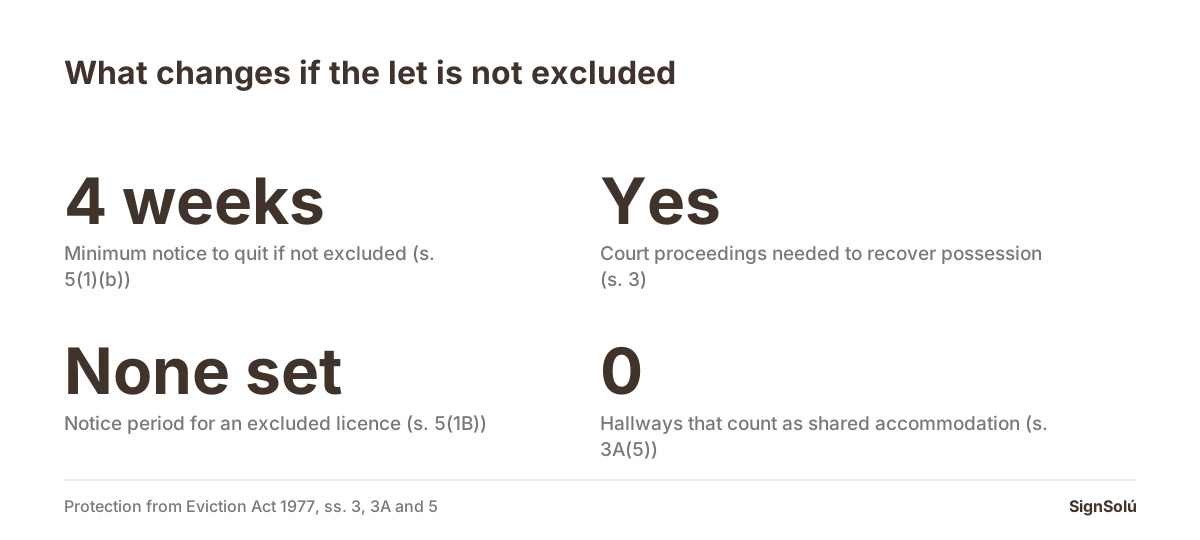
If the let is not excluded, section 5(1) says no notice to quit by a landlord or a tenant is valid unless it is in writing, contains such information as may be prescribed, and is given not less than four weeks before the date on which it is to take effect. And section 3 means that even after a valid notice, possession can only be enforced through the court.
If the let is excluded, section 5(1B) says nothing in subsection (1) applies to premises let on an excluded tenancy entered into on or after the Housing Act 1988 came into force, or to premises occupied under an excluded licence. There is no statutory notice period to satisfy, which is exactly why the agreement should set one: a week, a month, whatever you both can live with, in writing. A clause you wrote is more use than a gap in a statute.
What to put in the agreement
- 1The rooms that are shared, by name. Kitchen, living room, bathroom. Not «common parts», which may be nothing but a corridor.
- 2A statement that you occupy the property as your only or principal home, and that you intend to keep doing so for the term. That is the second limb of subsection (2) written down.
- 3The notice period, on both sides, since the statute sets none for an excluded let.
- 4Rent, when it is paid and what it includes. Bills, council tax, the internet. The lodger agreement template has the fields.
- 5House rules: guests, smoking, the one thing that actually ends these arrangements.
- 6A deposit clause, if you take one. A deposit for an excluded let is not in a tenancy deposit scheme, and the agreement should say how it comes back. What the schemes require when a let is a tenancy is in the tenancy deposit rules.
The documents that sit either side of a lodger agreement
Section 3A decides which of two regimes you are in, and each regime has its own paperwork. Picking the document first and hoping the facts follow is how people end up with a template that contradicts itself.
- You live there and share a kitchen. A lodger agreement, with the shared rooms named and a notice period you wrote.
- Two occupiers with no resident landlord, splitting one tenancy. A roommate agreement sits on top of the tenancy and divides rent and rooms between them; it does not replace the tenancy.
- You are letting the whole property. A tenancy agreement, or a simple lease agreement where the regime allows it, and then the deposit rules bite.
- Month by month, no fixed term. A month-to-month lease agreement; how the notice works in a province that sets it by statute is in month-to-month lease in Alberta.
- Your own tenant wants to pass the room on. That is a sublet, not a lodger: sublease agreement and, for a jurisdiction that regulates the request, sublease in NYC.
- Short stays. A short-term rental agreement, which is also where the holiday-only exclusion of s. 3A(7)(a) lands.
- Ending a let you already have. A lease termination letter; for a fixed term, what happens if you break a lease.
And one that is not a housing document at all
If the room comes with a job — a live-in carer, a site caretaker — the occupation may be tied to the employment rather than granted on its own, and the document to get right is the employment contract itself, which starts with a letter of offer of employment. Whether an e-signature binds that kind of agreement, and where, is in is an electronic signature legally binding.
Getting it signed
A lodger agreement is a simple contract. It needs no deed, no witness and no notary, which is why signing it in person has always been the easy part — and also why nobody signs it at all until there is a problem. Getting it signed on the day the person moves in is worth more than any clause in it.
SignSolú is a Mexican e-signature platform that works over WhatsApp, and it is used for exactly this kind of short agreement: you upload the document, add the other person by email or phone number, and they sign from their phone without creating an account or paying anything. Each document keeps an audit receipt with time, IP, device and a SHA-256 hash, and anyone can check it later at /verificar without an account. The interface is in Spanish; what the sender chooses per signer is the language, so a signer set to English gets the email, the WhatsApp message and the signing page in English. The free plan is 10 documents with no expiry and no card: start here.
If the arrangement is in Scotland, the exclusions are in a different Act and there are two of them: lodger agreement in Scotland. If what you have is a room in a shared house with no resident landlord at all, that is a different document: free lodger agreement templates and what they get wrong and the room rental arrangement for Ontario cover the neighbouring cases. For a let of a whole property, the terms you cannot contract out of are in tenancy agreement in BC and residential tenancy agreements in England.
Frequently asked questions
Does calling the document a lodger agreement make the occupier a lodger?
No. Section 3A of the Protection from Eviction Act 1977 asks about facts, not headings: whether the occupier shares accommodation with you under the terms of the agreement, and whether you occupied premises including that shared accommodation as your only or principal home both immediately before the grant and at the time it ends. If those are true, the let is excluded whatever the document is called, and if they are not, the label changes nothing.
Is a shared hallway enough to make it an excluded let?
No. Section 3A(5)(a) says accommodation includes neither an area used for storage nor a staircase, passage, corridor or other means of access. So a shared front door, a shared landing and a shared stairwell are not shared accommodation. What puts the arrangement inside subsection (2) is a room used in common, such as a kitchen, a living room or a bathroom that is not the occupier’s alone.
I moved out but kept letting the room. Is it still a lodger arrangement?
Probably not. The second limb of section 3A(2) requires you to have occupied the relevant premises as your only or principal home immediately before the agreement was granted and also at the time it comes to an end. If you are not living there when it ends, that limb fails, the let is not excluded, and section 3 means possession can only be enforced through court proceedings.
How much notice do I have to give a lodger?
For an excluded let, the statute sets none: section 5(1B) takes excluded tenancies entered into after the Housing Act 1988 came into force, and excluded licences, out of the section 5 notice requirements. That is a reason to write a notice period into the agreement rather than rely on a gap. If the let is not excluded, section 5(1) requires written notice with the prescribed information and at least four weeks.
What if the sharing is with my sister and not with me?
Subsection (3) covers that, with an extra condition. The occupier has to share accommodation with a member of your family who occupies premises including that shared accommodation as their only or principal home, you yourself have to occupy premises in the same building, and the building must not be a purpose-built block of flats. Fail the last one and the let is not excluded.
Can a lodger agreement be signed electronically?
Yes. It is a simple contract: no deed, no witness and no notary. With SignSolú you upload it, add the other person by email or phone, and they sign from their phone without creating an account; the audit receipt keeps time, IP, device and a SHA-256 hash, and anyone can verify the document at /verificar without an account. The free plan is 10 documents with no expiry and no card.
Send your next contract to Mexico for signature
Create a free account and send 10 documents with no card. Your dashboard works in English. You set the language per signer, and their email, WhatsApp message and signing page arrive in that language.
Keep reading
- Lodger agreement in Scotland: the flat upstairs is excluded too
- Free lodger agreement templates in the UK: what most of them get wrong
- Residential tenancy agreement: what changed in England on 1 May 2026, and why most templates are now wrong
- A lease termination letter from a tenant in England: the notice period changed, and most templates still say four weeks