Tenancy deposit protection: the thirty-day clock runs twice, and the second one is the one landlords miss
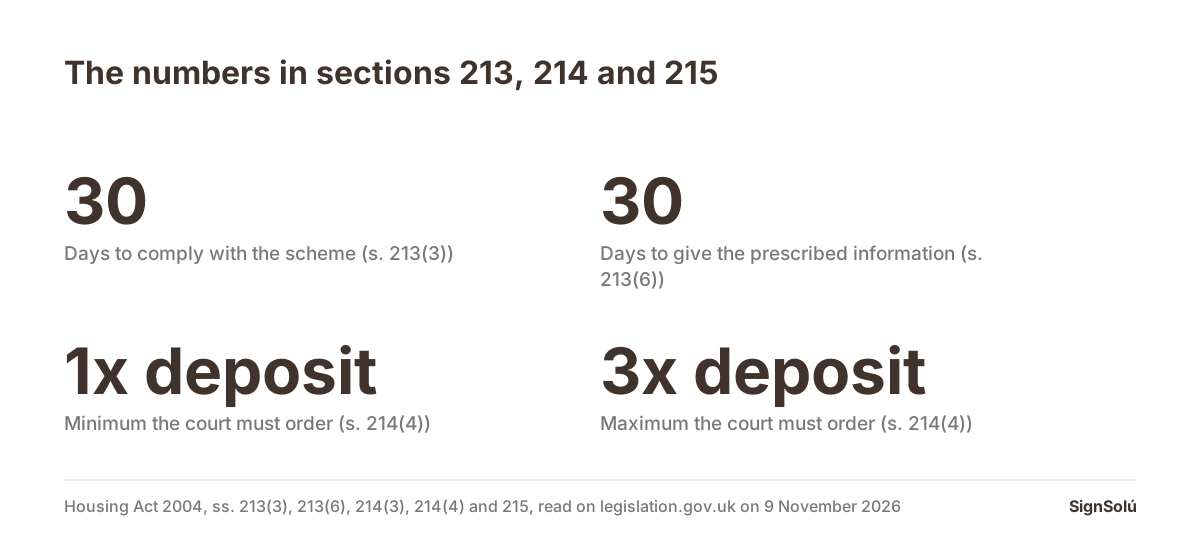
There are two thirty-day duties, not one. Section 213(3) of the Housing Act 2004 says the initial requirements of an authorised scheme must be complied with within 30 days of the date the deposit is received. Section 213(6) says the prescribed information — about the scheme, about the landlord’s compliance with its initial requirements, and about how this Chapter of the Act works — must be given to the tenant and to any relevant person within 30 days of that same date, in the prescribed form or substantially the same. Miss either and section 214(4) says the court must order the landlord to pay the applicant not less than the amount of the deposit and not more than three times it, within 14 days. And under section 215 no section 21 notice may be given while the deposit is unprotected or the prescribed information has not been served.
The half of the duty nobody talks about
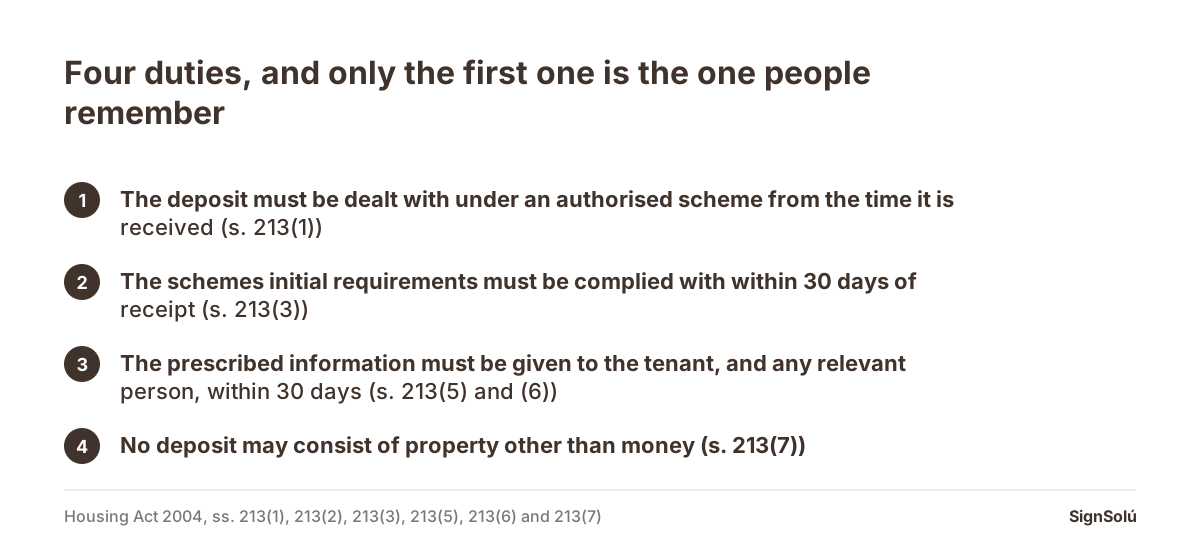
Ask a landlord about deposit protection and you get one answer: the money goes in a scheme. That is section 213(1), and it is correct — any tenancy deposit paid to a person in connection with the tenancy must, as from the time when it is received, be dealt with in accordance with an authorised scheme, and section 213(2) forbids requiring a deposit that is not going to be subject to that duty.
But the scheme is the first of two duties with the same deadline, and the second one is paperwork rather than money, which is exactly why it gets lost. The Housing Act 2004 sets both in the same section.
Clock one: the scheme, within thirty days
Section 213(3): where a landlord receives a tenancy deposit, the initial requirements of an authorised scheme must be complied with by the landlord in relation to the deposit within the period of 30 days beginning with the date on which it is received. Subsection (4) defines «the initial requirements» as those requirements imposed by the scheme that fall to be complied with by a landlord on receiving such a deposit.
Two practical points hide in that wording. The clock starts from receipt, not from the start of the tenancy, so a deposit taken to hold a property starts it early. And what the initial requirements are is set by the scheme, not by the Act, so a custodial scheme and an insured scheme ask for different things within the same thirty days.
Clock two: the prescribed information, within the same thirty days
Section 213(5) says a landlord who has received such a deposit must give the tenant and any relevant person information relating to three things, as may be prescribed:
- 1The authorised scheme applying to the deposit.
- 2The landlord’s compliance with the initial requirements of the scheme in relation to that deposit.
- 3The operation of the provisions of this Chapter of the Act in relation to the deposit.
And subsection (6) adds the form and the deadline: the information must be given in the prescribed form or in a form substantially to the same effect, and within the period of 30 days beginning with the date on which the deposit is received. Note «and any relevant person»: if a parent or a company paid the deposit on the tenant’s behalf, they are owed the same information on the same deadline, and a landlord who served only the tenant has complied for one of two people.
Subsection (7) adds a fourth duty that catches out well-meaning arrangements: no person may, in connection with the tenancy, require a deposit which consists of property other than money. Subsection (8) defines deposit for that purpose as a transfer of property intended to be held as security for the performance of the tenant’s obligations or the discharge of a liability arising under or in connection with the tenancy. A watch, a car, a bond of goods: not a lawful deposit.
What it costs: section 214, and the word «must»
Section 214(1) lets the tenant, or any relevant person, apply to the county court on the ground that section 213(3) or (6) has not been complied with in relation to the deposit, or that they have been notified that a particular authorised scheme applies but have been unable to get confirmation from the scheme administrator that the deposit is being held in accordance with it. Subsection (1A) keeps that route open after the tenancy has ended.
Then subsection (4): the court must order the landlord to pay to the applicant a sum of money not less than the amount of the deposit and not more than three times the amount of the deposit, within the period of 14 days beginning with the date of the making of the order. The discretion is in the multiple, not in whether to order it. Subsection (3) deals with the money itself: the court may order the person holding the deposit to pay it into the designated account held by the scheme administrator under an authorised custodial scheme within 14 days, and subsection (3A) may instead order repayment of all or part of it to the applicant.
| What went wrong | Section | Consequence |
|---|---|---|
| Deposit not dealt with under an authorised scheme | 213(1) | Ground for an application under 214(1) |
| Initial requirements missed within 30 days | 213(3) | Court must order 1x to 3x the deposit (214(4)) |
| Prescribed information not given within 30 days | 213(6) | Court must order 1x to 3x the deposit (214(4)) |
| Information given to the tenant but not to the person who paid | 213(5) and (6) | Same: «and any relevant person» |
| Deposit taken as goods rather than money | 213(7) and (8) | Not a lawful deposit |
| Deposit unprotected when you want possession | 215(1) and (1A) | No section 21 notice may be given |
| Prescribed information never served | 215(2) | No section 21 notice until 213(6)(a) is complied with |
Section 215: the one that stops you getting the property back
For a landlord, this is often the more painful half. Section 215(1) says that if a tenancy deposit has been paid, no section 21 notice may be given in relation to the tenancy at a time when the deposit is not being held in accordance with an authorised scheme, and 215(1A) does the same where section 213(3) has not been complied with. Section 215(2) adds that if section 213(6) is not complied with, no section 21 notice may be given until such time as section 213(6)(a) is complied with.
Read the difference between those two carefully, because it is the one useful piece of good news in the section. The information duty can be cured: serve the prescribed information, and the bar in 215(2) lifts. And 215(2A) disapplies the bar altogether where the deposit has been returned to the tenant in full, or with such deductions as are agreed between landlord and tenant, or where an application has been dealt with as that subsection describes.
What to do in the first week, not the fourth
- 1Date the receipt. Write down the day the money arrived, because both clocks start there. If a holding deposit converts into the tenancy deposit, that conversion date is what you are relying on.
- 2Protect it, then get the scheme’s certificate. The initial requirements are the scheme’s, so follow the scheme’s checklist, not a general one.
- 3Serve the prescribed information on everyone who is owed it: the tenant and any relevant person who paid on their behalf. Get an acknowledgement, because section 214 turns on whether it was given.
- 4Keep proof of what was sent and when. This is the whole ball game: in a 214 application the question is compliance within 30 days, and the answer is documentary or it is nothing.
- 5Put the deposit clause in the tenancy itself — the scheme, the amount, what it can be deducted for. A tenancy agreement template or a lease agreement gives you the structure, and an assured shorthold tenancy with a silent deposit clause is the one that generates arguments at the end.
- 6Take nothing but money. Section 213(7) is absolute.
None of this applies where the let is not a tenancy of the kind the Chapter covers. A genuine lodger arrangement with a resident landlord is excluded from a different Act entirely, and the test is in lodger agreement or tenancy and, for Scotland, the flat upstairs is excluded too. For a business letting the regime and the arguments are different again: licence or lease and commercial lease agreement UK.
The deductions argument is won at the start, not at the end
Everything above is about the duties around the money. What people actually fight over is how much of it comes back, and that is decided by the inventory and the condition report signed on the day the keys changed hands — not by the clause listing what may be deducted. A signed check-in record with dated photographs is the document that ends those arguments, and it is the same instrument a landlord uses when letting a furnished property or a room in a shared house. Where the let is short and furnished, a short-term rental agreement carries its own version of it.
Proving what you served, and when
Everything in section 214 is evidential. The landlord who protected the deposit on day three and emailed the prescribed information on day nine is in the clear — if that can be shown two years later, to a court, after the inbox has been through a mail migration and the letting agent has changed hands.
SignSolú is a Mexican e-signature platform that works over WhatsApp, and this is the narrow job it does well here: each document you send keeps an audit receipt with the time, the IP, the device and a SHA-256 hash of the file, and the recipient acknowledges it by signing rather than by replying. So the prescribed information becomes a dated, hashed, acknowledged document instead of an email thread, and anyone — including a court bundle preparer with no account — can check it later at /verificar. Signers need no account and pay nothing. The interface is in Spanish; what the sender chooses per signer is the language, so a signer set to English gets the email, the WhatsApp message and the signing page in English. The free plan is 10 documents with no expiry and no card: start here.
Two neighbouring documents, since they live in the same file: an application form is not what holds a property — a holding deposit is, and that is what starts the clock — and the end of the tenancy has its own paperwork, from a lease termination letter and a lease extension agreement to what happens if you break a lease. A change mid-term belongs in a lease addendum, not in a replacement agreement that restarts arguments you had already settled. Where the let is month to month under a statutory regime, the notice periods are set for you: month-to-month in Alberta and tenancy agreement in BC.
Frequently asked questions
Is protecting the deposit enough?
No. Section 213 sets two duties with the same deadline: 213(3) requires the scheme’s initial requirements to be complied with within 30 days of the date the deposit is received, and 213(6) requires the prescribed information to be given within 30 days of that same date, in the prescribed form or substantially the same. Doing the first and forgetting the second is the most common failure, and it carries the same penalty.
When does the thirty days start?
From the date the deposit is received, not from the start of the tenancy. Both section 213(3) and section 213(6) use that same date. A deposit taken earlier to hold a property starts the clock earlier, so the first thing to write down is the day the money actually arrived.
What does it cost if I miss one of them?
Section 214(4) says the court must order the landlord to pay the applicant a sum of not less than the amount of the deposit and not more than three times the amount of the deposit, within 14 days of the order. The discretion is in the multiple, not in whether to order it. The court may also order the deposit to be paid into a custodial scheme account or repaid to the applicant.
My tenant’s parent paid the deposit. Who do I serve?
Both. Section 213(5) and (6) require the information to be given to the tenant «and any relevant person», and section 214(1) lets any relevant person, as defined by section 213(10), make the application. A landlord who served only the tenant has complied for one of the two people owed the information.
Can I still serve a section 21 notice?
Not while the deposit is unprotected. Section 215(1) bars a section 21 notice at a time when the deposit is not held in accordance with an authorised scheme, and 215(1A) does the same where 213(3) was not complied with. Section 215(2) bars one until 213(6)(a) is complied with, which means the information failure can be cured by serving it. Section 215(2A) disapplies the bar where the deposit has been returned in full or with agreed deductions.
Can I take something other than money as a deposit?
No. Section 213(7) says no person may, in connection with the tenancy, require a deposit which consists of property other than money, and 213(8) defines deposit for that purpose as a transfer of property intended to be held as security for the tenant’s obligations or liabilities under or in connection with the tenancy. Goods, a vehicle or any other item are not a lawful deposit.
Send your next contract to Mexico for signature
Create a free account and send 10 documents with no card. Your dashboard works in English. You set the language per signer, and their email, WhatsApp message and signing page arrive in that language.