A commercial lease in England and Wales: the clause that is void without the notice
The one that excludes security of tenure without the procedure that makes the exclusion valid. Section 24(1) of the Landlord and Tenant Act 1954 says a tenancy to which Part II applies shall not come to an end unless terminated in accordance with Part II, so a business tenancy continues past its contractual expiry until a section 25 notice or a section 26 request takes effect. Section 38A(1) lets the landlord and the tenant agree to exclude sections 24 to 28, but only for a term of years certain, and section 38A(3) makes that agreement void unless the landlord served on the tenant a notice in the form, or substantially in the form, set out in Schedule 1 to the Regulatory Reform (Business Tenancies) (England and Wales) Order 2003 and the requirements in Schedule 2 to that Order were met. A downloaded template carries the clause and not the notice.
Why a business lease does not end when it says it ends
A five-year lease of a shop or a small office in England or Wales reads like any other fixed-term contract: it starts on a date, it ends on a date. In practice it very often does not end on that date, and the reason is one subsection written in 1954.
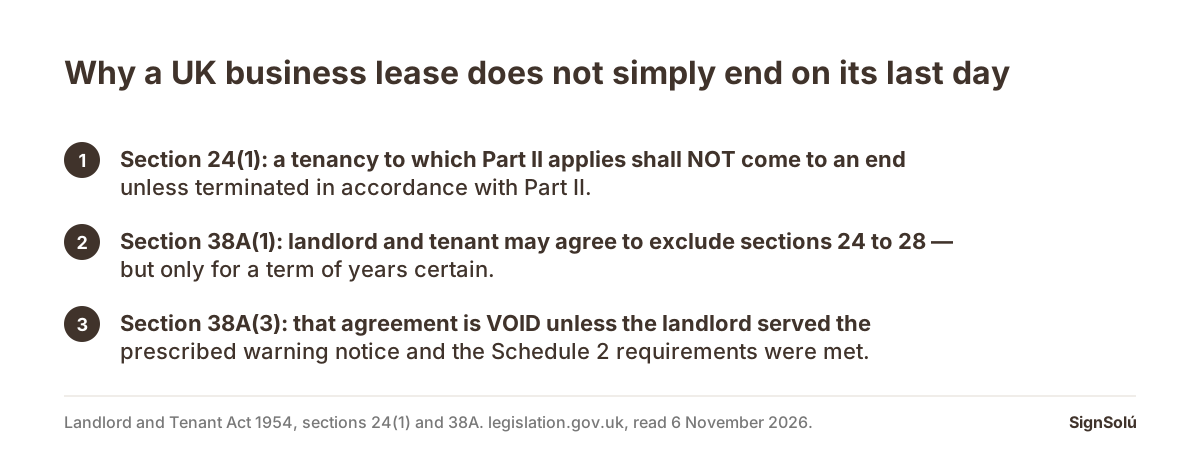
Section 24(1) of the Landlord and Tenant Act 1954 says that a tenancy to which Part II of that Act applies shall not come to an end unless terminated in accordance with the provisions of this Part of this Act, and that either the tenant or the landlord may apply to the court for an order for the grant of a new tenancy if the landlord has given notice under section 25 or the tenant has made a request under section 26.
That is what the market calls security of tenure. The tenancy holds over on the same terms, and the route out of it runs through a statutory notice and, if the parties disagree, through the court.
Section 24(2): what the tenant can still do
Section 24(2) keeps some ordinary routes open. The continuation does not prevent the tenancy ending by notice to quit given by the tenant, by surrender or by forfeiture, or by the forfeiture of a superior tenancy — with a carve-out for a notice to quit given before the tenant had been in occupation under the tenancy for one month.
The asymmetry is the point. A tenant who wants out has doors; a landlord who wants the premises back has to use the Act. And subsections (2A) to (2C) manage the race to court: neither side may apply if the other has applied and served, neither may apply if the landlord has applied under section 29(2) and served, and the landlord may not withdraw an application without the tenant’s consent.
Contracting out: possible, and procedural
Section 38A(1), inserted in 2004, says the persons who will be the landlord and the tenant in relation to a tenancy to be granted for a term of years certain which will be a tenancy to which Part II applies may agree that the provisions of sections 24 to 28 shall be excluded in relation to that tenancy.
Two conditions are already visible in that sentence. The agreement is made by the people who will be landlord and tenant, so it happens before the grant, not afterwards. And it is available for a term of years certain — not for a periodic tenancy that grew out of occupation.
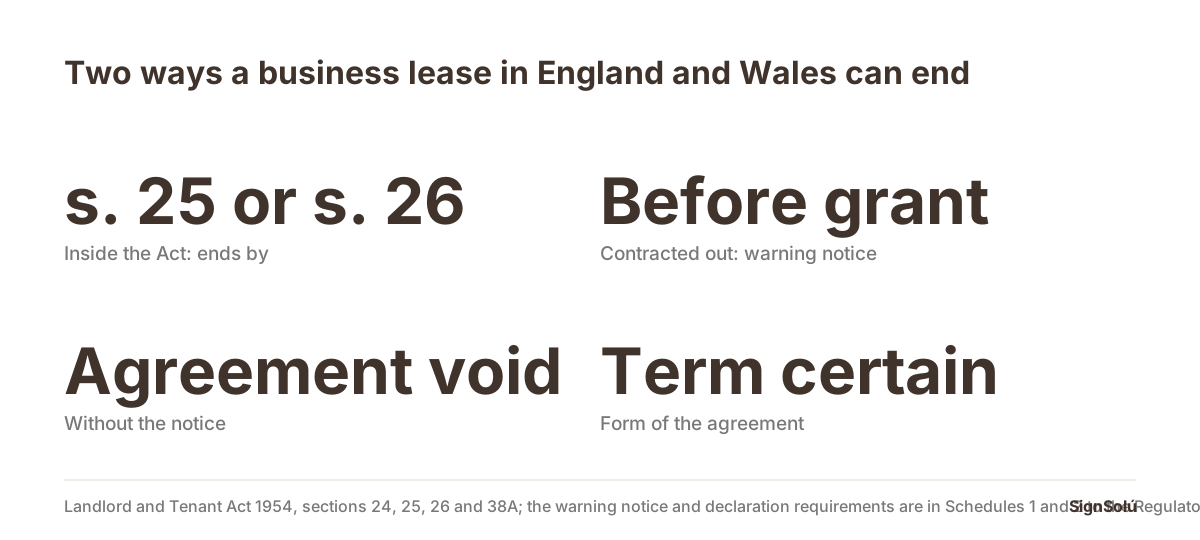
Then comes the subsection that decides whether the clause is worth anything. Section 38A(3) says an agreement under subsection (1) shall be void unless the landlord has served on the tenant a notice in the form, or substantially in the form, set out in Schedule 1 to the Regulatory Reform (Business Tenancies) (England and Wales) Order 2003, and the requirements specified in Schedule 2 to that Order are met.
Section 38A(2) covers the other agreement people sometimes want, an agreed surrender on a stated date or in stated circumstances, and section 38A(4) makes that one void too unless the Schedule 3 notice was served and the Schedule 4 requirements met. Same architecture: a warning, then a response, then the agreement.
What that means for a template
Most free commercial lease templates include a line to the effect that the parties agree that sections 24 to 28 of the Landlord and Tenant Act 1954 are excluded. The line is accurate English and, on its own, void. What it is missing is not drafting: it is the warning notice served on the tenant before the lease is granted, and the tenant’s response in the prescribed terms.
For a landlord the consequence is expensive and delayed. The lease is signed believing the premises come back in five years. At year five the tenant stays, section 24(1) keeps the tenancy alive, and the landlord discovers that the exclusion never took effect. For a tenant the mirror image is a windfall, and one worth checking for before accepting that a lease has to be given up.
The practical reading: if a lease is meant to be outside the Act, the sequence matters more than the wording. Notice first, then the tenant’s declaration, then the grant. A lease dated before the notice undoes itself.
The clauses that actually get argued about
| Clause | What to settle | Why it matters |
|---|---|---|
| Security of tenure | Inside the Act, or excluded with the notice and declaration done first | LTA 1954, s. 24(1) and s. 38A(3): the clause alone is void |
| Term | A term of years certain if the lease is to be contracted out | s. 38A(1) is only available for a term of years certain |
| Break right | Who can break, on what notice, and on what conditions | s. 24(2) leaves the tenant’s notice to quit and surrender available |
| Rent review | The mechanism, the dates and what happens if a date is missed | A holding-over tenancy continues on the same terms |
| Repair | The standard, with a schedule of condition if the premises are not new | Decides what is owed at the end rather than during |
| Alterations and reinstatement | What the tenant may do and what must be undone | The reinstatement bill is the usual end-of-lease dispute |
| Alienation | Assignment, underletting and whose consent is needed | Controls who ends up in the premises |
| Service charge | What is included, how it is apportioned and any cap | The cost the tenant did not price in |
The form itself is at the commercial lease agreement. If what is being let is land rather than a building, the thresholds are different and are set out in the land lease document and the three-year and seven-year thresholds, with the form at the land lease agreement. For residential rather than business premises, England changed in 2026: what changed in a residential tenancy in England in 2026, with the tenancy agreement and, for a room in the landlord’s own home, the lodger agreement.
What to check before signing either side of it
- Whether the lease says it is contracted out at all. If it is silent, Part II applies and section 24(1) keeps the tenancy alive past its expiry date.
- Whether a warning notice was served, and on what date. Section 38A(3) makes the exclusion void without it.
- Whether that date is before the date of the lease, because the agreement under section 38A(1) is made by the people who will be landlord and tenant.
- Whether the term is a term of years certain, which is the only shape section 38A(1) covers.
- Whether the tenant’s declaration in the prescribed terms exists, since Schedule 2 of the 2003 Order sets the requirements that have to be met.
- Whether anything about the premises or the occupation takes the tenancy outside Part II in the first place, in which case there is nothing to exclude.
That list is short enough to run on a lease you are about to inherit, on a purchase, on an assignment or when a managing agent hands over a file. A later change of terms belongs in the contract amendment, and the ending of the lease in the lease termination letter or the lease extension agreement if it is renewed instead.
Short leases, and the exclusion that needs no notice
Part II does not catch everything, and section 43 of the Act lists tenancies it does not apply to. That is a different mechanism from contracting out: where Part II never applied, there is nothing to exclude and no notice to serve. It is worth confirming which situation you are in before paying for a procedure you do not need — and before assuming you are safely outside it. Where a lease ends early, the general exposure is described in what happens if you break a lease, and the related forms are the lease extension agreement, the lease addendum and the lease termination letter.
If the tenant or the landlord is in Mexico
A UK company letting space to a Mexican business, or renting space in Mexico, is dealing with two unrelated regimes. Mexican commercial leases have no equivalent of Part II; what they have instead is a maximum term and a renewal right that change by state, from a five-year cap in the State of México to fifteen years for commerce in Puebla. Which language governs a bilingual lease is a separate decision, and it is set out in bilingual contracts in Mexico and which language prevails. If the company is opening its own operation rather than renting space from someone else, the first documents are listed in nearshoring in Mexico, the first documents you sign. The Mexican forms by state are in the Spanish-language catalogue at las plantillas.
Getting the sequence signed in the right order
Contracting out is a sequence of documents, and sequences break when one of them has to be posted and returned. The warning notice and the declaration have their own formal requirements, which are not solved by sending them faster. Everything else around the deal — heads of terms, the schedule of condition, the licence for alterations, the guarantor paperwork — is ordinary signing, and that is where the weeks go.
With SignSolú those go out over WhatsApp from your own number or by email, the other side signs from their phone without creating an account and without paying, and the audit receipt records the time, the IP address, the device and the SHA-256 hash of the file. Anyone can later check that the document did not change at the verification page, with no account. The sender chooses each signer’s language, so a signer in English receives the email, the WhatsApp message and the signing page in English. The free plan is 10 documents, with no expiry date and no card. Whether an electronic signature binds, and where, is covered in is an electronic signature legally binding, and where, and how to get a Mexican counterparty to sign in how to sign a contract remotely with someone in Mexico.
Frequently asked questions
Does a UK business lease end automatically on its expiry date?
Not if Part II of the Landlord and Tenant Act 1954 applies to it. Section 24(1) says such a tenancy shall not come to an end unless terminated in accordance with Part II, so it continues until a section 25 notice from the landlord or a section 26 request from the tenant takes effect.
Can we just put a clause in the lease excluding the Act?
Section 38A(1) allows the agreement, but section 38A(3) makes it void unless the landlord served on the tenant a notice in the form, or substantially in the form, set out in Schedule 1 to the Regulatory Reform (Business Tenancies) (England and Wales) Order 2003 and the requirements in Schedule 2 to that Order were met.
When does the warning notice have to be served?
Before the grant. Section 38A(1) speaks of the persons who will be the landlord and the tenant in relation to a tenancy to be granted, so the agreement to exclude is made before the lease exists, and the notice has to precede it.
Can a periodic tenancy be contracted out?
Section 38A(1) is available for a tenancy to be granted for a term of years certain. A periodic tenancy that arose from occupation is not that, so the exclusion route in section 38A(1) does not fit it.
Can the tenant still leave if the lease is inside the Act?
Section 24(2) preserves the ending of the tenancy by notice to quit given by the tenant, by surrender or by forfeiture, except for a notice to quit given before the tenant had been in occupation under the tenancy for one month.
Can the landlord withdraw a court application for a new tenancy?
Section 24(2C) says the landlord may not withdraw an application under section 24(1) unless the tenant consents to its withdrawal.
Send your next contract to Mexico for signature
Create a free account and send 10 documents with no card. Your dashboard works in English. You set the language per signer, and their email, WhatsApp message and signing page arrive in that language.