Licensing agreement or lease? The heading does not decide it, and Part II of the 1954 Act is what is at stake
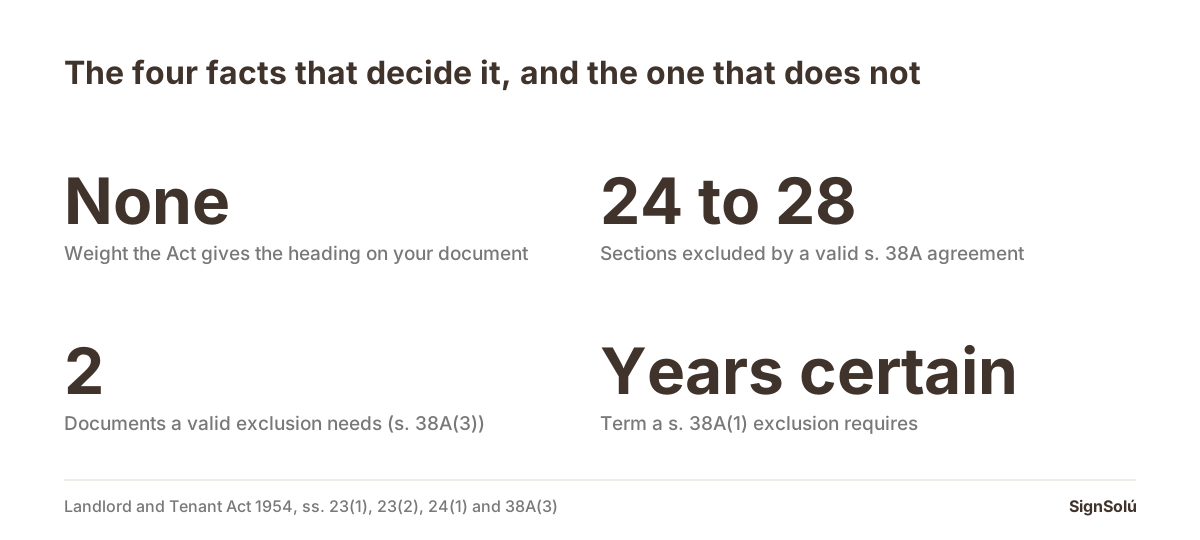
The heading does not decide it. Section 23(1) of the Landlord and Tenant Act 1954 applies Part II to any tenancy where the property comprised in it is or includes premises occupied by the tenant for the purposes of a business carried on by them, and section 23(2) defines business widely enough to take in a trade, a profession, an employment and any activity carried on by a body of persons. If the arrangement is a tenancy in substance, section 24(1) means it does not come to an end unless it is terminated under the Act, and either party can apply to the court for the grant of a new tenancy. A licence gets none of that — but the test is the substance of the occupation, not the word on the first page. The lawful way to keep security of tenure out of a commercial letting is section 38A, and it only works for a term of years certain and with the notice and declaration the 2003 Order prescribes.
Why landlords reach for the word «licence»
A small unit, a desk, a pop-up in a shopping centre, a workshop at the back. The landlord wants flexibility: three months, maybe six, and the ability to ask the occupier to leave without a procedure. The document that promises all of that is a licence to occupy, and it is shorter, cheaper and easier to sign.
The problem is that what the occupier gets is decided by what the arrangement is, not by what the first page says. And if it is a business tenancy, Part II of the Landlord and Tenant Act 1954 attaches whether anyone meant it to or not.
What section 23 actually asks
Section 23(1) is the gateway: subject to the provisions of the Act, Part II applies to any tenancy where the property comprised in the tenancy is or includes premises which are occupied by the tenant and are so occupied for the purposes of a business carried on by him, or for those and other purposes. Three elements, and each one is a fact about the arrangement.
- A tenancy. This is the one the heading is trying to avoid, and the one the heading cannot settle. What the courts look for is exclusive possession for a term at a rent — whether the occupier can keep the landlord and everyone else out of the space. A desk in an open room is usually a licence in substance; a lock-up unit with its own key usually is not.
- Occupied by the tenant. Section 23(3) refines it: «the holding» excludes any part occupied neither by the tenant nor by someone employed by the tenant for the purposes of the business. And subsection (1A) treats occupation by a company in which the tenant has a controlling interest — or, where the tenant is a company, by a person with a controlling interest in it — as equivalent to occupation by the tenant.
- For the purposes of a business. Subsection (2) says business includes a trade, profession or employment, and any activity carried on by a body of persons, whether corporate or unincorporate. That is wide. It is not limited to a shop.
There is one carve-out worth knowing, in subsection (4): if the tenant is carrying on a business in breach of a prohibition of business use that subsists under the terms of the tenancy and extends to the whole of the property, Part II does not apply — unless the immediate landlord or a predecessor consented to the breach, or the immediate landlord acquiesced in it. Acquiescence is a low bar, so a landlord who notices and says nothing may be creating the very tenancy the lease tried to prevent.
What is at stake: section 24(1)
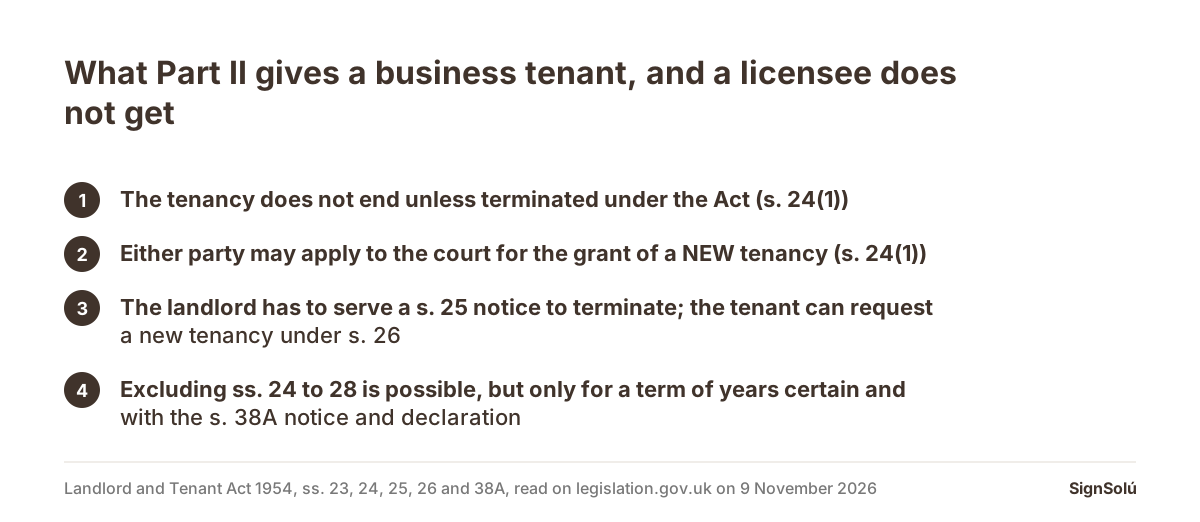
Section 24(1) is the whole reason this argument happens: a tenancy to which Part II applies shall not come to an end unless terminated in accordance with the provisions of this Part of this Act, and either the tenant or the landlord may apply to the court for an order for the grant of a new tenancy, where the landlord has given a section 25 notice or the tenant has requested a new tenancy under section 26.
Read as a landlord: the contractual term expiring does not end the occupation. The tenancy continues, and getting it to end means a statutory notice and, if the tenant asks for a new one, opposing that request on one of the Act’s grounds. Subsection (2) keeps the tenant’s own routes out open — a notice to quit by the tenant, surrender, forfeiture — but those are the tenant’s moves or a breach, not the landlord’s convenience.
| Business tenancy under Part II | Genuine licence | |
|---|---|---|
| Does the term expiring end the occupation? | No, unless terminated under the Act (s. 24(1)) | Yes, on its own terms |
| Can the occupier ask the court for a new term? | Yes (s. 24(1) with ss. 25 and 26) | No |
| What the landlord serves to terminate | A s. 25 notice | Whatever the agreement says |
| Can the parties contract out? | Yes, by s. 38A, with the notice and declaration | Nothing to contract out of |
| What the heading on the document does | Nothing | Nothing |
| What actually decides it | Exclusive possession, term and rent, in substance | The same test, answered the other way |
The lawful way out: section 38A, and its two documents
Security of tenure can be excluded, and the route is not a licence — it is section 38A(1): the persons who will be landlord and tenant in relation to a tenancy to be granted for a term of years certain may agree that sections 24 to 28 are excluded in relation to that tenancy.
Subsection (3) is the part that gets skipped, and it is written as a nullity: an agreement under subsection (1) shall be void unless the landlord has served on the tenant a notice in the form, or substantially in the form, set out in Schedule 1 to the Regulatory Reform (Business Tenancies) (England and Wales) Order 2003, and the requirements specified in Schedule 2 to that Order are met. Two things, in that order, before the lease is entered into. Subsection (2) does the same for an agreed future surrender, with Schedules 3 and 4.
- 1Decide what the occupation really is. If the occupier will have exclusive possession of a defined space for a term at a rent, call it a lease and price the consequences.
- 2If it is a lease and you want flexibility, use a short term of years certain plus the s. 38A procedure, not a document with «licence» on the cover.
- 3If it is genuinely a licence, write it like one. Shared space, no defined demise, a right for the provider to relocate the occupier, services included. A licensing agreement template is the right starting shape, and a storage agreement is the same logic for goods rather than space.
- 4Do not acquiesce in a use your document prohibits. Section 23(4) hands Part II to a tenant whose business use the landlord consented to or acquiesced in, even where the lease forbade it.
And the rent review clause is a separate trap
A short term of years certain with a s. 38A exclusion often comes with a rent review, and that is where the two documents meet: the exclusion fixes the end of the term, and the review fixes the money inside it. Whichever shape you choose, the terms worth deciding in writing are the same ones a service agreement makes explicit — scope, charges, how either side gets out — and if services are bundled with the space, a service level agreement alongside it is closer to what is really being sold. A contract amendment template is what a later change should use, rather than a side letter.
The same question in other jurisdictions
The licence-or-lease argument is everywhere, and so is the habit of settling it with a heading. The statutes that answer it differ, and the ones that spell out terms you cannot contract out of are the clearest: the terms you cannot change in a BC tenancy and month-to-month in Alberta both work that way. In residential lettings the equivalent of this argument is the lodger question: lodger agreement or tenancy and, for Scotland, the flat upstairs is excluded too.
For commercial space specifically, the clause that is void in a UK commercial lease whatever the parties agreed is in commercial lease agreement UK; the templates are the commercial lease agreement and, for land rather than buildings, the land lease agreement, whose statutory thresholds are in the three-year and seven-year thresholds. A sublet of part of your own space is another document again: sublease agreement and sublease in NYC.
Getting it signed, and why that is not the hard part
A commercial lease for a short term and a licence to occupy are both ordinary contracts in writing, and neither needs a deed for a term under three years at a market rent. What does need care is the sequence around section 38A, because the prescribed notice has to be served on the tenant before the lease is entered into: the document dates are part of the evidence that the exclusion is valid.
SignSolú is a Mexican e-signature platform that works over WhatsApp, and that sequencing is what it is useful for here: you send the notice and the lease as separate documents, each with its own audit receipt recording time, IP, device and a SHA-256 hash of the file, so the order in which they were served and signed is recorded rather than remembered. Signers need no account and pay nothing. Anyone can verify a finished document later at /verificar with no account. The interface is in Spanish; what the sender chooses per signer is the language, so a signer set to English gets the email, the WhatsApp message and the signing page in English. The free plan is 10 documents with no expiry and no card: start here.
Two neighbouring questions, since they come up in the same conversation: whether an e-signature binds at all, and where, is in is an electronic signature legally binding; and when a signature on a supplier-side document has to be a deed rather than a signature is in supplier agreement, e-signature and the deed question.
Frequently asked questions
Does calling it a licence keep Part II of the 1954 Act out?
No. Section 23(1) applies Part II to any tenancy where the property is or includes premises occupied by the tenant for the purposes of a business carried on by them. The question is whether the arrangement is a tenancy in substance — in broad terms, exclusive possession of a defined space for a term at a rent — and the heading on the document does not answer it either way.
What does the occupier actually get if Part II applies?
Section 24(1): the tenancy shall not come to an end unless terminated in accordance with Part II, and either the tenant or the landlord may apply to the court for an order for the grant of a new tenancy, where the landlord has served a section 25 notice or the tenant has requested one under section 26. For the landlord that means the contractual expiry date does not, by itself, end the occupation.
How do I grant a commercial lease without security of tenure?
Through section 38A, not through a licence. Subsection (1) lets the future landlord and tenant agree that sections 24 to 28 are excluded, for a tenancy to be granted for a term of years certain. Subsection (3) makes that agreement void unless the landlord has served the notice in, or substantially in, the form set out in Schedule 1 to the Regulatory Reform (Business Tenancies) (England and Wales) Order 2003 and the requirements in Schedule 2 are met.
Is a profession a business for this purpose?
Yes. Section 23(2) says business includes a trade, profession or employment and includes any activity carried on by a body of persons, whether corporate or unincorporate. That is wide: a consulting room, a studio and a members’ club can all be within it, which is why the «it is not a shop» argument rarely goes anywhere.
My lease bans business use and the tenant trades anyway. Am I protected?
Only if you have not consented or acquiesced. Section 23(4) says Part II does not apply where the tenant carries on a business in breach of a prohibition of business use subsisting under the terms of the tenancy and extending to the whole property — unless the immediate landlord or a predecessor in title consented to the breach, or the immediate landlord acquiesced in it. Noticing and saying nothing is a risk.
Can the notice and the lease be signed electronically?
A short commercial lease and a licence to occupy are ordinary written contracts, and the section 38A notice is a document served rather than executed as a deed. What matters is the order: the prescribed notice has to be served before the lease is entered into. Sending each as a separate document with its own audit receipt recording time, IP, device and a file hash records that order rather than leaving it to recollection.
Send your next contract to Mexico for signature
Create a free account and send 10 documents with no card. Your dashboard works in English. You set the language per signer, and their email, WhatsApp message and signing page arrive in that language.