Signing a supplier agreement electronically: the one question that changes the answer
Whether the document is a simple contract or a deed. For a simple contract — which is what the overwhelming majority of supplier, supply and framework agreements are — an electronic signature works, and section 7(1) of the Electronic Communications Act 2000 makes it admissible in evidence on the authenticity and the integrity of the data. If the document is executed as a deed, section 1(2) of the Law of Property (Miscellaneous Provisions) Act 1989 requires it to make clear on its face that a deed is intended and to be validly executed as one, and section 1(3) requires an individual’s signature to be made in the presence of a witness who attests it, plus delivery as a deed. That witness requirement is what the signing process has to accommodate, not the electronic part.
The question people ask, and the question that matters
Procurement teams ask whether a supplier agreement can be signed electronically. The answer for a simple contract has been settled for a long time, and the reason the question keeps coming back is that it is usually standing in for a different one: is this particular document a deed?
Most supply arrangements are not. A purchase order, a framework agreement, a master supply agreement, a statement of work, a non-disclosure agreement and a vendor onboarding pack are ordinary contracts formed by offer and acceptance, and nothing about them requires a deed. A guarantee given by a director, a release, a power of attorney and anything that transfers an interest in land are a different category.
Simple contract: what section 7 says
Section 7(1) of the Electronic Communications Act 2000 says that in any legal proceedings an electronic signature incorporated into or logically associated with a particular electronic communication or particular electronic data, and the certification by any person of such a signature, shall each be admissible in evidence in relation to any question as to the authenticity of the communication or data or as to the integrity of the communication or data.
Section 7(2) defines the term broadly: an electronic signature is so much of anything in electronic form as is incorporated into or otherwise logically associated with any electronic communication or electronic data, and purports to be used by the individual creating it to sign. There is no list of approved technologies in that subsection, and no requirement of a particular certificate.
Section 7(3) deals with certification: a signature is certified by a person if that person has made a statement confirming that the signature, a means of producing, communicating or verifying it, or a procedure applied to it, is a valid means of signing — whether the statement was made before or after the communication.
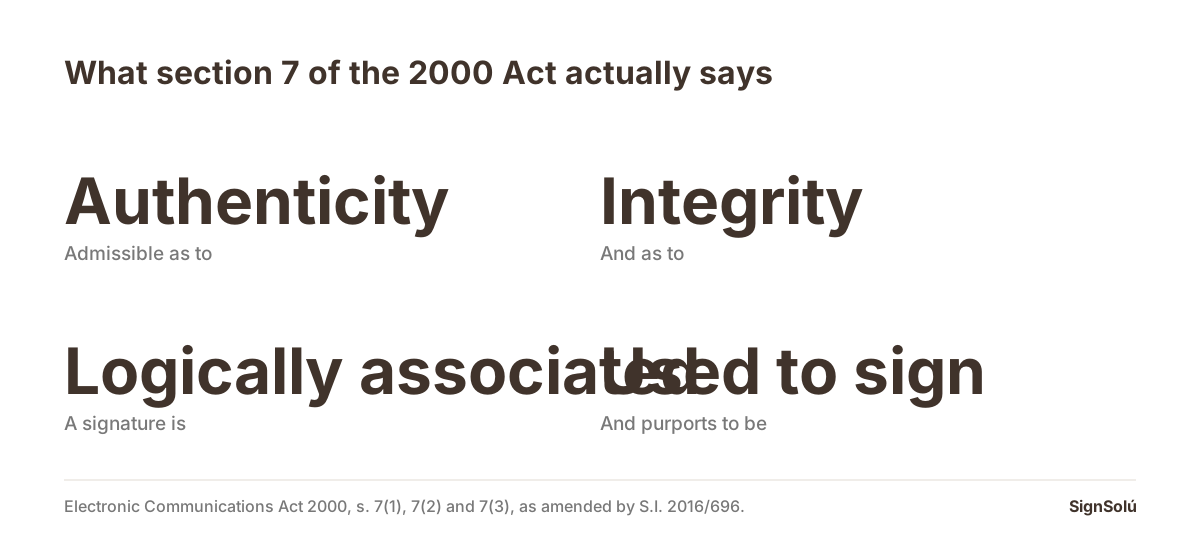
Notice what section 7 is and is not. It is a rule about evidence: it tells a court that the signature and its certification can be put in front of it on authenticity and integrity. It is not a rule that validates every document. Validity still depends on the ordinary requirements of the contract in question, which for a simple contract are agreement, consideration and an intention to be bound.
Deed: where the witness comes in
Section 1 of the Law of Property (Miscellaneous Provisions) Act 1989 sets out deeds and their execution. Subsection (1) abolishes the old rules about the substances a deed may be written on and about the need for a seal for execution by an individual, which is why a deed on screen is not a contradiction.
Subsection (2) says an instrument shall not be a deed unless it makes clear on its face that it is intended to be a deed by the person making it or by the parties to it — whether by describing itself as a deed, or expressing itself to be executed or signed as a deed, or otherwise — and it is validly executed as a deed by that person or by one or more of those parties.
Subsection (3) is the operative one for the signing process. An instrument is validly executed as a deed by an individual if, and only if, it is signed by him in the presence of a witness who attests the signature, or at his direction and in his presence and the presence of two witnesses who each attest the signature; and it is delivered as a deed. Subsection (4) adds that “sign” includes making one’s mark.
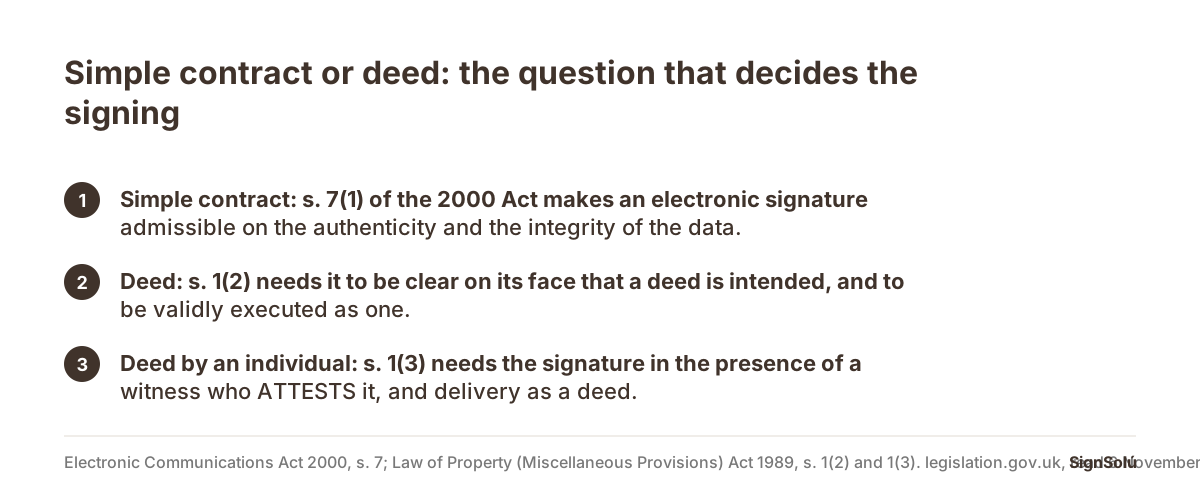
So the obstacle in a deed is not the keyboard: it is the presence of an attesting witness. Section 1(5) is worth knowing too, because it covers the delivery side: where a relevant lawyer, or an agent or employee of one, purports to deliver an instrument as a deed on behalf of a party in the course of or in connection with a transaction, it is conclusively presumed in favour of a purchaser that the lawyer was authorised to do so.
Which of your documents is which
| Document | Usually a deed? | What that means for signing |
|---|---|---|
| Purchase order and order acknowledgement | No | Electronic signature, or acceptance by conduct |
| Master supply or framework agreement | No | Electronic signature |
| Statement of work or schedule under a framework | No | Electronic signature, referencing the framework |
| Non-disclosure agreement | No | Electronic signature |
| Service level agreement | No | Electronic signature |
| Guarantee by a director or parent company | Often executed as a deed | Attesting witness and delivery, per s. 1(3) |
| Release or waiver given for no consideration | Often executed as a deed | Attesting witness and delivery |
| Power of attorney | Deed | Attesting witness and delivery |
| Anything transferring an interest in land | Deed, with its own formalities | Specialist route; do not improvise |
The practical rule that follows: before asking whether a document can be signed electronically, look at whether it says it is a deed. If it does not, section 7 of the 2000 Act is the whole of the question. If it does, the signing process has to carry an attesting witness, and the first thing worth asking is whether the document needs to be a deed at all — many are drafted as deeds out of habit. The two documents most often made deeds without needing to be are the guarantee and the release, and the release side is covered in what a signed waiver can never cover and the liability waiver; the power-of-attorney side, which genuinely is a deed, in the general power of attorney form.
What to settle in the agreement itself
- Whether the document is a simple contract or a deed, said on its face, because section 1(2) turns on exactly that.
- Who signs for each party, with authority: a named signatory and a reference to the authority, rather than a job title alone.
- How counterparts work, so that two signed copies form one agreement.
- Which version controls, if the signed PDF and a system record could differ.
- How variations are made, so that a change by email does not quietly become a change to the contract.
- Where the signed copy and its audit record are kept, and for how long.
The last two are the ones that cause arguments years later. A supply agreement is usually amended several times before it ends, and the amendment paperwork is where the record breaks: the contract amendment is the document for that, and the termination letter for the end. The agreement forms themselves are the vendor agreement, the service agreement, the service level agreement and the distribution agreement; for subcontracted work, the subcontractor agreement; and for terms attached to an order, the conditions and terms.
Where the supplier is in Mexico
Mexico answers the same question through its Commercial Code rather than through an electronic communications act, and the answer is at least as clear: is an electronic signature valid in Mexico, with the cross-border question in is a Mexican e-signature valid in the US and the general comparison in is an electronic signature legally binding, and where. Where a Mexican notary is needed, and where one is not, is in what needs a Mexican notary and what does not, and the NOM-151 question that comes up in Mexican procurement is in NOM-151 in Mexico. The Spanish-language forms are at las plantillas.
Getting the signature and the record in one step
Section 7 makes the signature admissible on authenticity and integrity, which means the useful thing to have is a record that speaks to both. A scanned signature pasted into a PDF is a signature; it says very little about either. How a certificate fits into this, where one is used at all, is in the digital signature certificate, and the mechanics of signing a PDF are in how to add a digital signature to a PDF and signing a PDF on an iPhone.
With SignSolú the agreement goes out over WhatsApp from your own number or by email, the supplier signs from their phone without creating an account and without paying, and the audit receipt records the time, the IP address, the device and the SHA-256 hash of the file. Anyone can later check that the document did not change at the verification page, with no account. The sender chooses each signer’s language, so a signer in English receives the email, the WhatsApp message and the signing page in English, which is useful when the buyer works in Spanish and the supplier does not. The free plan is 10 documents, with no expiry date and no card. If the counterparty is in Mexico, the walkthrough is in how to sign a contract remotely with someone in Mexico.
Frequently asked questions
Can a supplier agreement be signed electronically?
For a simple contract, yes. Section 7(1) of the Electronic Communications Act 2000 makes an electronic signature, and its certification, admissible in evidence on the authenticity and the integrity of the communication or data. Validity still depends on the ordinary contract requirements.
What counts as an electronic signature?
Section 7(2) defines it as so much of anything in electronic form as is incorporated into or otherwise logically associated with the electronic communication or data, and purports to be used by the individual creating it to sign. No particular technology or certificate is required by that subsection.
What changes if the document is a deed?
Section 1(2) of the Law of Property (Miscellaneous Provisions) Act 1989 requires it to make clear on its face that a deed is intended and to be validly executed as one, and section 1(3) requires an individual’s signature to be made in the presence of a witness who attests it, or at his direction and in his presence and that of two attesting witnesses, plus delivery as a deed.
Does a deed still need a seal?
No. Section 1(1)(b) of the 1989 Act abolished any rule of law requiring a seal for the valid execution of an instrument as a deed by an individual, and section 1(2A) says an instrument is not taken to make clear on its face that a deed is intended merely because it is executed under seal.
Is a scanned signature in a PDF enough?
It can be a signature within the broad definition in section 7(2), but it says little about the two things section 7(1) makes admissible: authenticity and integrity. A record that captures when it was signed, by whom and that the file has not changed is what makes those questions answerable.
Should we make the supply agreement a deed to be safe?
That adds the attestation requirement of section 1(3) rather than removing a risk, and it is one of the main reasons signings get delayed. The useful question is whether the document needs to be a deed at all; many are drafted as deeds out of habit.
Send your next contract to Mexico for signature
Create a free account and send 10 documents with no card. Your dashboard works in English. You set the language per signer, and their email, WhatsApp message and signing page arrive in that language.