A lease termination letter from a tenant in England: the notice period changed, and most templates still say four weeks
Section 5(1) of the Protection from Eviction Act 1977 says no notice by a landlord or a tenant to quit any premises let as a dwelling is valid unless it is in writing, contains such information as may be prescribed, and satisfies the notice period. The period used to be four weeks for everyone. Since the amendments made by section 20 of the Renters’ Rights Act 2025 — brought into force on 1 May 2026 by S.I. 2026/421 — a tenant giving notice on an assured tenancy must give not less than two months, unless the landlord has agreed in writing to a shorter period, and that agreed period cannot exceed two months either. Four weeks remains the floor for everything else section 5 covers.
A notice can be polite, clear, early — and still void
Most lease termination letters a tenant sends are fine as letters and risky as notices. The reason is that in England a notice to quit premises let as a dwelling is not simply a communication: it has a statutory validity test, and failing it does not make the notice weak. It makes it void, which means the tenancy carries on and so does the rent.
The test is in section 5 of the Protection from Eviction Act 1977. It applies to a notice given by a landlord or a tenant, which is the part people miss: the section is usually discussed as a landlord obligation, and it binds the tenant’s own letter in exactly the same terms.
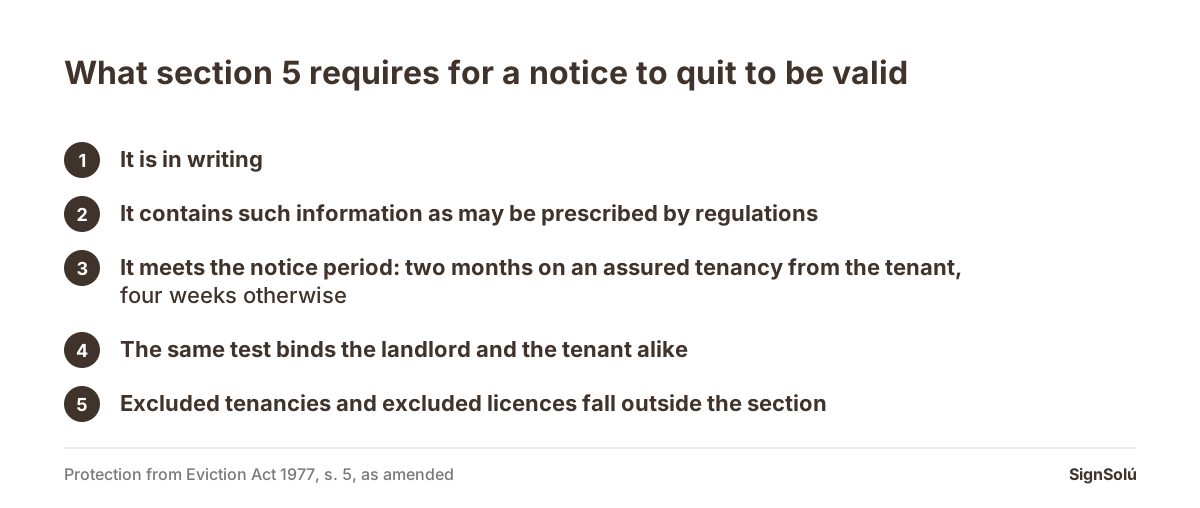
The three requirements, one at a time
In writing
This is the easy one, and it is the reason a conversation with the landlord — however amicable, however clearly both sides understood it — does not start the clock. A message that exists and can be produced later is what the section asks for. What makes a signed document provable months afterwards is covered in is an electronic signature legally binding, and where.
Containing such information as may be prescribed
Section 5(2) defines «prescribed» as prescribed by regulations made by the Secretary of State by statutory instrument, and 5(3) allows those regulations to make different provision for different descriptions of lettings and different circumstances. In practice this is the block of explanatory wording that sits at the foot of a proper notice to quit. It is not decoration: it is one of the three validity conditions, and a letter that says only «I am leaving on the 30th» does not contain it.
The notice period, which is where the change is
Section 5(1)(b) now sends you to subsection (1ZA). For a notice given by a tenant in relation to premises let under an assured tenancy, the notice must be given not less than any length of time the landlord has agreed to in writing, up to a maximum of two months, and in the absence of such an agreement, not less than two months. For everything else section 5 covers, it is not less than four weeks before the date on which it is to take effect.
Two details that decide real cases. On a joint assured tenancy, subsection (1ZB) says an agreement to shorten the period is not valid unless it is made between the landlord and all of the tenants — but (1ZC) preserves the validity of a notice to quit given by only one or some of them. And for landlords under assured tenancies the section points to section 5(1) of the Housing Act 1988: a landlord’s notice to quit is of no effect at all, which is why the route out for a landlord is a different document entirely.
| Who gives the notice | Kind of letting | Minimum period | Where it comes from |
|---|---|---|---|
| Tenant | Assured tenancy, no written agreement to shorten | Two months | s. 5(1ZA)(a)(ii) |
| Tenant | Assured tenancy, landlord agreed in writing to less | The agreed period, up to two months | s. 5(1ZA)(a)(i) |
| Tenant | Any other letting within s. 5 | Four weeks | s. 5(1ZA)(b) |
| Tenant or landlord | Periodic licence to occupy as a dwelling | Four weeks, in writing, with prescribed information | s. 5(1A) |
| Landlord | Assured tenancy | A notice to quit is of no effect | s. 5(1) Housing Act 1988 |
| Either | Excluded tenancy or excluded licence after the Housing Act 1988 came into force | Section 5 does not apply | s. 5(1B) |
| Either | A dwelling in Wales subject to an occupation contract | Section 5 does not apply | s. 5(1C) |
Why the old templates are wrong rather than out of date
A free «lease termination letter» template written before May 2026 will carry a four-week period, because for decades that was the only number in section 5. A tenant on an assured tenancy who uses it gives a notice that is short by a month, and a short notice is not a notice that takes effect late: under section 5 it is not valid. The tenancy continues, and so does the liability for rent, until a good notice is given and runs its course.
The practical reading for a tenant: check the kind of tenancy first, then count backwards from the date you want to leave, then write the notice. The practical reading for a landlord receiving one: a notice that is short does not have to be accepted as ending the tenancy, and accepting it anyway is a decision with money attached. What a deposit scheme adds on top of all this is in tenancy deposit protection: the thirty-day clock.
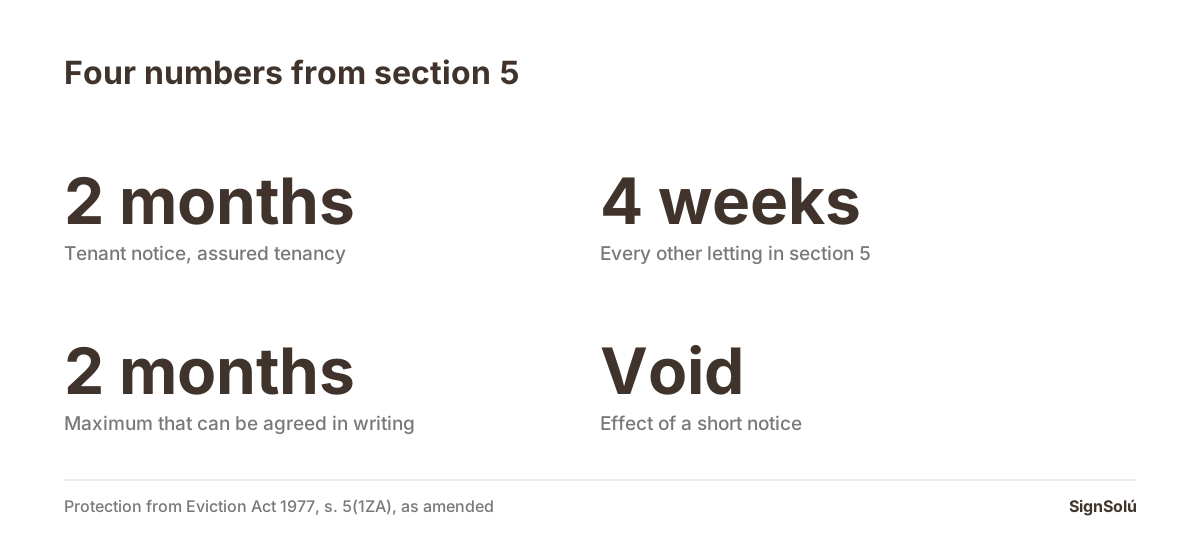
What the tenancy agreement’s own notice clause can and cannot do
Most tenancy agreements contain a clause about notice, and tenants reasonably assume it governs. It governs the parts section 5 leaves open — how notices are served, to what address, whether email is accepted — and it cannot shorten the statutory minimum. A clause saying «the tenant may end this agreement on one month’s written notice» does not make a one-month notice valid on an assured tenancy; the only route to a shorter period is the written agreement contemplated by subsection (1ZA)(a)(i), and even that stops at two months.
It also cannot convert a fixed term into something a notice to quit will end. During a fixed term there is usually nothing for a notice to quit to operate on, which is why a tenant who wants out early is in the territory of a break clause or a surrender instead: that is covered in breaking a lease and, for the costs side, in what happens if you break a lease. A deed of surrender agreed between the parties is a different document with a different effect.
And it cannot cure the prescribed information. That requirement attaches to the notice itself, not to the agreement: a tenancy that recites the information in clause 14 does not put it in a letter sent two years later. When a document has to carry specific wording to work, the safer practice is to start from a template built for that document rather than from a letter, which is the same lesson as in a commercial lease in England and Wales, where a clause without its prescribed notice is simply void.
What belongs in the letter
- 1The address of the premises, in full, as it appears in the tenancy agreement.
- 2The names of all the tenants and of the landlord, since on a joint tenancy who signs changes the effect of the notice.
- 3A clear statement that this is a notice to quit, not a request, an enquiry or a proposal.
- 4The date on which the notice is to take effect, counted so that the gap from service meets the statutory minimum.
- 5The prescribed information, in the form the regulations require.
- 6The date of service and how it was served, because the period runs from service and that is what will be argued about.
- 7A forwarding address for the deposit and for correspondence after the tenancy ends.
The lease termination letter template sets those fields out; the tenancy itself is in tenancy agreement template and lease agreement, and a lodger arrangement, which section 5 may not reach at all, is in lodger agreement template. For a month-to-month arrangement the starting document is month-to-month lease agreement, and for a short let, short-term rental agreement; an extension rather than an ending is lease extension agreement. Whether what you have is a tenancy or a licence — the question that decides whether any of this applies — is worked through in lodger agreement or tenancy: the line that decides eviction and in licence or lease: the test that decides security of tenure.
Two neighbouring situations. Leaving before a fixed term ends is not a notice to quit at all and is covered in what happens if you break a lease. A business tenancy follows a different statute altogether: a commercial lease in England and Wales.
Serving it so the date can be proved
Everything above turns on one evidential question: when was the notice served. A letter posted without a record, or an email in an account that later gets migrated, is the usual reason a notice period is disputed two months later. What matters is a document the sender can still produce, with a timestamp that does not depend on either party’s word.
SignSolú sends the notice by WhatsApp or by email and the other side opens and signs it from a phone, with no account and no payment. Every document carries an audit receipt with time, IP, device and a SHA-256 hash, and anyone can check it at /verificar without an account. The interface is in Spanish; what the sender controls is the language of each signer, so a landlord or tenant you add in English receives the email, the WhatsApp message and the signing page in English. SignSolú is a Mexican platform; for documents that need it in Mexico, it issues NOM-151 conservation certificates on the signed document through a certification service provider accredited by Mexico’s Ministry of Economy, switched on for your team on request. For a short notice period, a signed document with a provable date is usually the point: start here — the free plan is 10 documents, no expiry and no card.
Frequently asked questions
How much notice does a tenant have to give in England?
On an assured tenancy, not less than two months, unless the landlord has agreed in writing to a shorter period, and that agreed period cannot be longer than two months either. For the other lettings section 5 of the Protection from Eviction Act 1977 covers, the minimum is four weeks before the date the notice is to take effect.
What happens if my notice is one week short?
It is not valid. Section 5(1) says no notice by a landlord or a tenant to quit premises let as a dwelling shall be valid unless it meets all three conditions, and the notice period is one of them. A short notice does not simply take effect later: the tenancy continues until a valid notice is given and runs its course, and so does the rent.
Does an email count as a notice to quit?
Section 5 requires the notice to be in writing and to contain the prescribed information; it does not prescribe a method of delivery. The practical risks with email are different ones: proving the date of service, and proving the content that was sent. The tenancy agreement itself often sets out how notices are to be served, and that clause should be read first.
We are two tenants on one tenancy. Can one of us give notice?
Subsection (1ZC) preserves the validity of a notice to quit premises let under a joint assured tenancy that is given by only one or some of the tenants. What needs everyone is an agreement to shorten the notice period: subsection (1ZB) says such an agreement is not valid unless it is made between the landlord and all of the tenants.
Can my landlord end an assured tenancy by serving a notice to quit on me?
No. Section 5 itself points to section 5(1) of the Housing Act 1988, under which a landlord’s notice to quit is of no effect in relation to an assured tenancy. A landlord who wants possession has to use the statutory route instead, which is a different document with its own grounds and timetable.
When did the two-month rule start?
Section 5(1)(b) was substituted and subsections (1ZA) to (1ZD) inserted by sections 20(2) and 20(3) of the Renters’ Rights Act 2025, commenced for specified purposes on 1 May 2026 by S.I. 2026/421, regulation 2(a). Templates written before that date carry the old four-week figure for every case, which is why they are a trap on an assured tenancy.
Send your next contract to Mexico for signature
Create a free account and send 10 documents with no card. Your dashboard works in English. You set the language per signer, and their email, WhatsApp message and signing page arrive in that language.