In-house separation agreement: when living under one roof still counts as living apart
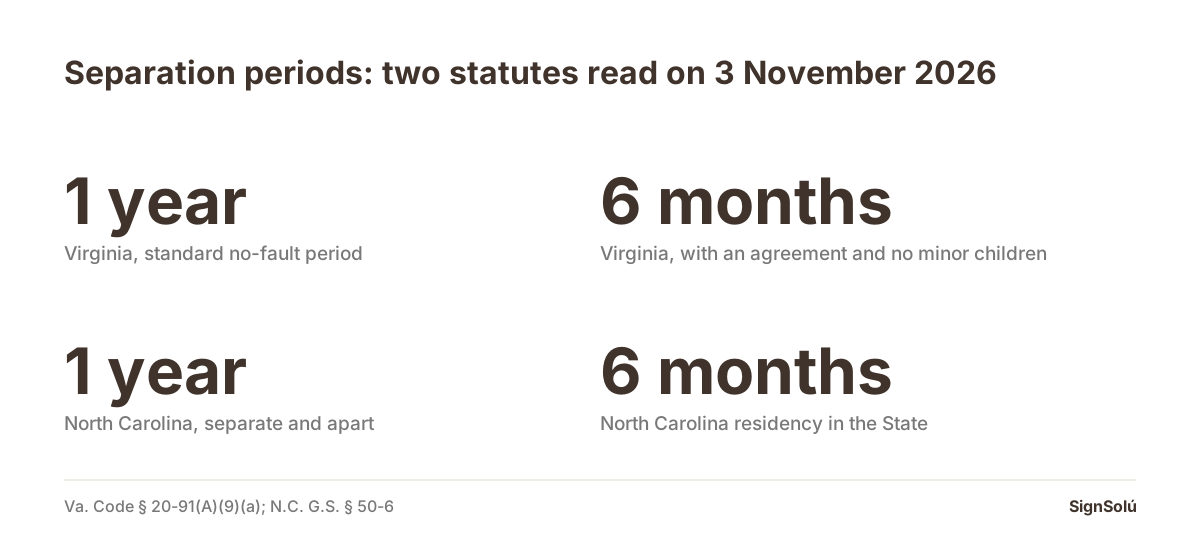
An in-house separation is a couple who have ended the marriage but still live in the same home, usually for the children or the mortgage. Whether that time counts toward a divorce depends on the state's words. Virginia Code § 20-91(A)(9)(a) requires that the parties have lived separate and apart without any cohabitation and without interruption for one year — reduced to six months where the parties have entered into a separation agreement and there are no minor children. North Carolina G.S. § 50-6 requires one year lived separate and apart, and G.S. § 52-10.2 defines resumption of marital relations as the voluntary renewal of the relationship shown by the totality of the circumstances. Which is why an in-house separation needs the agreement and the dates in writing.
Why people stay, and what it costs them
An in-house separation is almost never about the relationship. It is about one mortgage that two rents cannot replace, a school district nobody wants to leave, or a year of saving before anyone can afford to move. The decision is practical. The risk is that the practical decision quietly resets a legal clock.
The phrase to look for in your own state's statute is separate and apart. It is not defined by addresses, and courts in several states have accepted that a couple can live separate and apart under one roof. But the burden lands on the person asserting it, and what discharges that burden is evidence — which is exactly what a written agreement with dates produces.
| Virginia | North Carolina | |
|---|---|---|
| Statute | Code § 20-91(A)(9)(a) | G.S. § 50-6 |
| Standard period | One year | One year |
| Wording | Lived separate and apart without any cohabitation and without interruption | Lived separate and apart |
| Shortened by an agreement | Six months, if there are no minor children of the parties | No reduction in the statute |
| Residency requirement in the statute | Not in this subsection | Six months in the State |
| Isolated intimacy | Not addressed in this subsection | Does not toll the one-year period (G.S. § 50-6) |
Virginia: the agreement is part of the test
Code of Virginia § 20-91 lists the grounds for divorce from the bond of matrimony. Subsection A(9)(a) is the no-fault ground, and it reads, on the application of either party, if and when they have lived separate and apart without any cohabitation and without interruption for one year. Then comes the sentence that most people have never read: in any case where the parties have entered into a separation agreement and there are no minor children either born of the parties, born of either party and adopted by the other, or adopted by both parties, a divorce may be decreed on application if and when they have lived separately and apart without cohabitation and without interruption for six months.
So in Virginia the written agreement is not paperwork around the separation; it is one of the two conditions that cut the waiting period in half. The other is the absence of minor children, defined broadly enough to include children of either party adopted by the other. The statute also says that at the expiration of one year or six months, whichever applies, from the commencement of such separation, the grounds for divorce shall be deemed to be complete.
Note what the statute does not say: it does not say the parties must live at different addresses. It says separate and apart, without any cohabitation and without interruption. Those are three separate requirements, and «without interruption» is the one an in-house separation most often fails — not because of the roof, but because of a reconciliation nobody documented.
North Carolina: the definition that matters is in another statute
G.S. § 50-6 is shorter. Marriages may be dissolved on the application of either party if and when the husband and wife have lived separate and apart for one year, and the plaintiff or defendant has resided in the State for a period of six months. It adds that whether there has been a resumption of marital relations during the period of separation is determined under G.S. § 52-10.2, and that isolated incidents of sexual intercourse between the parties shall not toll the statutory period.
G.S. § 52-10.2 supplies the definition in one sentence: resumption of marital relations is the voluntary renewal of the husband and wife relationship, as shown by the totality of the circumstances, and isolated incidents of sexual intercourse do not constitute resumption.
«Totality of the circumstances» is the whole reason an in-house separation needs documentation. If the test is everything taken together, then everything taken together is the evidence: separate bedrooms, separate finances, who buys and cooks food, whether you attend events as a couple, how the household bills are split. None of that is decisive alone, and all of it is easier to establish from a dated agreement than from memory two years later.
What an in-house separation agreement has to add
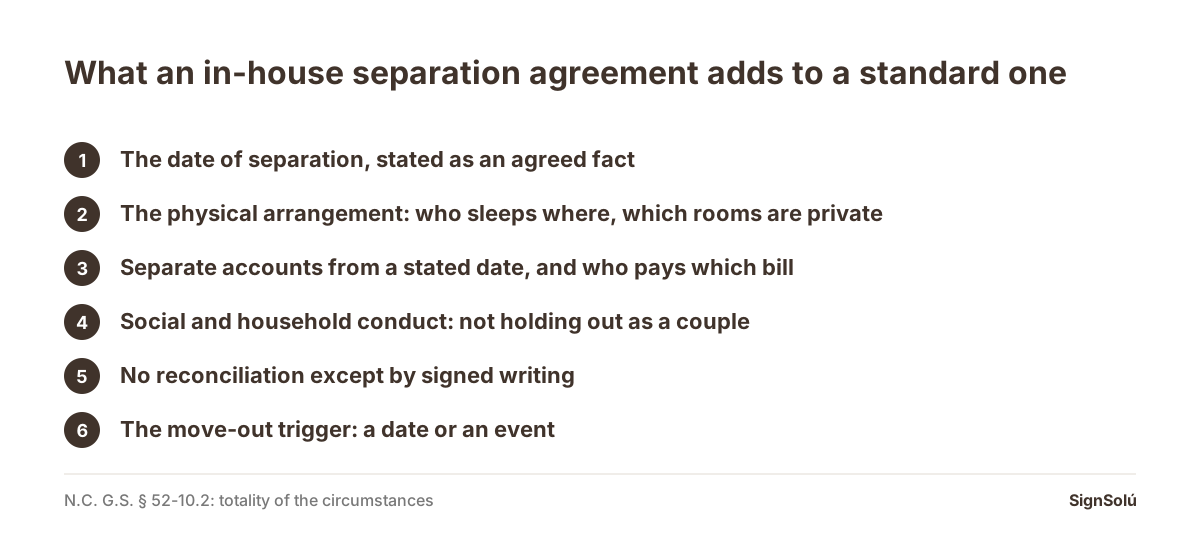
A standard separation agreement assumes two households. The fill-in version is the separation agreement template, and it covers what every one of them must: the date of separation, property and debts, support and a parenting plan. An in-house arrangement needs a handful of clauses on top, and they are all about the one thing that will be questioned later — that this was a separation and not a rough patch.
- 1The date of separation, stated as a fact. One date, in one sentence, agreed by both. Everything else counts from it.
- 2The physical arrangement. Who sleeps where, which rooms are private, and that neither party has access to the other's space. This is the clause that does the work in an in-house separation.
- 3Money, kept apart. Separate accounts from a stated date, who pays which household bill, and that neither incurs debt in the other's name.
- 4Social and household conduct. That the parties do not hold themselves out as a couple, do not share meals as a household matter, and each handles their own laundry, food and errands. It reads petty on paper and it is precisely the «totality of the circumstances».
- 5No reconciliation by conduct. That any resumption of the relationship must be agreed in a signed writing. It cannot override a statute, but it makes the parties' intention explicit, which is what the test asks about.
- 6The move-out trigger. The date or the event — the house sells, the youngest finishes the school year, a refinance closes — on which the arrangement ends.
- 7The house itself. Kept and refinanced by one party by a stated date, or sold with the net proceeds split in stated shares.
- 8Children, if any. A parenting plan that works inside one house is harder than one across two, and worth writing down: the custody agreement template has the structure. Remember that in Virginia the six-month route requires there be no minor children.
Two documents that are adjacent and often confused with this one: the cohabitation agreement, which is for unmarried partners sharing a home, and the prenuptial agreement, which is signed before a marriage rather than at the end of one. If the whole matter is being resolved in one transaction, the general form is the settlement agreement template.
The three mistakes that restart the clock
Nobody wrote down the date
When both people still live in the house, there is no lease, no change of address and no moving truck to date the separation. If the agreement does not state the date, the only evidence is two recollections that will not match, and in Virginia the grounds are deemed complete only at the expiration of the period «from the commencement of such separation».
An undocumented reconciliation
A few weeks of trying again, no paperwork, and now the period may not be «without interruption». North Carolina is explicit that isolated incidents of intimacy do not toll the period and that resumption is judged on the totality of the circumstances, but a genuine attempt at reconciliation is a different thing from an isolated incident. If it happens, write down when it started and when it ended.
Finances that never actually separated
One joint account paying for everything, one card both people use, one grocery bill. It is the easiest arrangement and the hardest to defend as a separation. Separate accounts from a stated date are worth the afternoon it takes to open them. If one party is going to pay the other on a schedule, the schedule belongs in the document with the same precision a settlement uses.
Signing it, when you both live there and nothing is comfortable
Printing a separation agreement, finding a time when you are both calm in the same kitchen and getting four pages initialled is not a small ask. It is the reason these agreements get discussed for months and signed never, which leaves the date of separation as an argument instead of a fact. Signing a PDF from a phone is covered step by step in sign a PDF on iPhone, and the mechanics of a digital signature in digital signature in a PDF.
Sending it to sign solves the logistics and, more usefully, produces the dated record the statute will eventually ask about. With SignSolú the agreement goes out over WhatsApp from your own number or by email, each party signs from their own phone without creating an account or paying anything, and the audit receipt records the time, the IP address, the device and the SHA-256 hash of the file for each signature separately. Anyone can check later that the file did not change at the verification page, with no account. The sender picks each signer's language, so a party who reads English gets the email, the WhatsApp message and the signing page in English. The free plan is 10 documents with no expiry and no card; you can start at register.
There is a second step that signing does not cover: several states require a separation agreement, or parts of it, to be notarized or acknowledged before it can be filed with a court, and a few family-law documents need more than a signature. What a consent document has to say for a third party to rely on it is a related problem: letter of consent meaning. Signing electronically and getting the required acknowledgement are two separate steps, and the second one is state law. The equivalent question for a document that has to travel between countries is in apostille in Mexico, and how a power of attorney signed in the US works abroad is in power of attorney from the US for Mexico.
Frequently asked questions
Does living in the same house count as being separated?
It depends on the state's wording and on the evidence. Virginia Code § 20-91(A)(9)(a) requires living separate and apart without any cohabitation and without interruption; North Carolina G.S. § 50-6 requires living separate and apart. Neither subsection requires different addresses, but the party asserting the separation has to establish it, which is what a dated agreement helps with.
How long is the separation period in Virginia?
One year of living separate and apart without any cohabitation and without interruption, reduced to six months where the parties have entered into a separation agreement and there are no minor children born of the parties, born of either and adopted by the other, or adopted by both.
Does a separation agreement shorten the wait in North Carolina?
G.S. § 50-6 does not provide a reduction for having an agreement. It requires one year of living separate and apart and six months of residence in the State by the plaintiff or the defendant.
Does one night together restart the clock?
In North Carolina, G.S. § 50-6 says isolated incidents of sexual intercourse between the parties shall not toll the statutory period, and G.S. § 52-10.2 says such incidents do not constitute resumption of marital relations, which is judged by the totality of the circumstances. A genuine reconciliation is a different matter, and worth dating in writing if it happens.
What should an in-house separation agreement say that a normal one does not?
The date of separation as an agreed fact, the physical arrangement inside the house, separate finances from a stated date, how the parties conduct themselves socially and as a household, that any reconciliation requires a signed writing, and the event or date on which one party moves out.
Can a separation agreement be signed electronically?
The signature itself can usually be electronic, and doing so produces a dated record of who signed and when. Separately, some states require the agreement or parts of it to be notarized or acknowledged before a court will accept it, and that requirement is state law. Check it before you file.
Send your next contract to Mexico for signature
Create a free account and send 10 documents with no card. Your dashboard works in English. You set the language per signer, and their email, WhatsApp message and signing page arrive in that language.