A business partnership agreement in the UK: the rules that already apply if you never signed one
You already have a partnership agreement; it was written in 1890. Section 1 of the Partnership Act 1890 says partnership is the relation which subsists between persons carrying on a business in common with a view of profit, so it exists without a signature. Section 24 then supplies the terms, subject to any agreement express or implied: equal shares in capital and profits however much each partner contributed, no interest on capital, no pay for working in the business, and no new partner without everyone’s consent. Section 26 lets any partner end a partnership at will at any time on notice.
The agreement exists whether or not anyone signed it
Two people start trading together. One puts in £80,000 and keeps a day job; the other puts in £5,000 and runs the business full time. Nobody signs anything, because they are friends and the lawyer quoted too much. They assume that, with no document, there are no rules. The opposite is true: there is a complete set of rules, and it was written in 1890.
Section 1(1) of the Partnership Act 1890 defines partnership as the relation which subsists between persons carrying on a business in common with a view of profit. That is a description of conduct, not of paperwork. If the description fits, the partnership exists from the day the trading started, with no registration, no deed and no signature. Section 1(2) carves out companies registered under the Companies Act 2006 and bodies incorporated by Act, letters patent or Royal Charter, which are a different thing altogether.
Section 24 writes the terms you did not
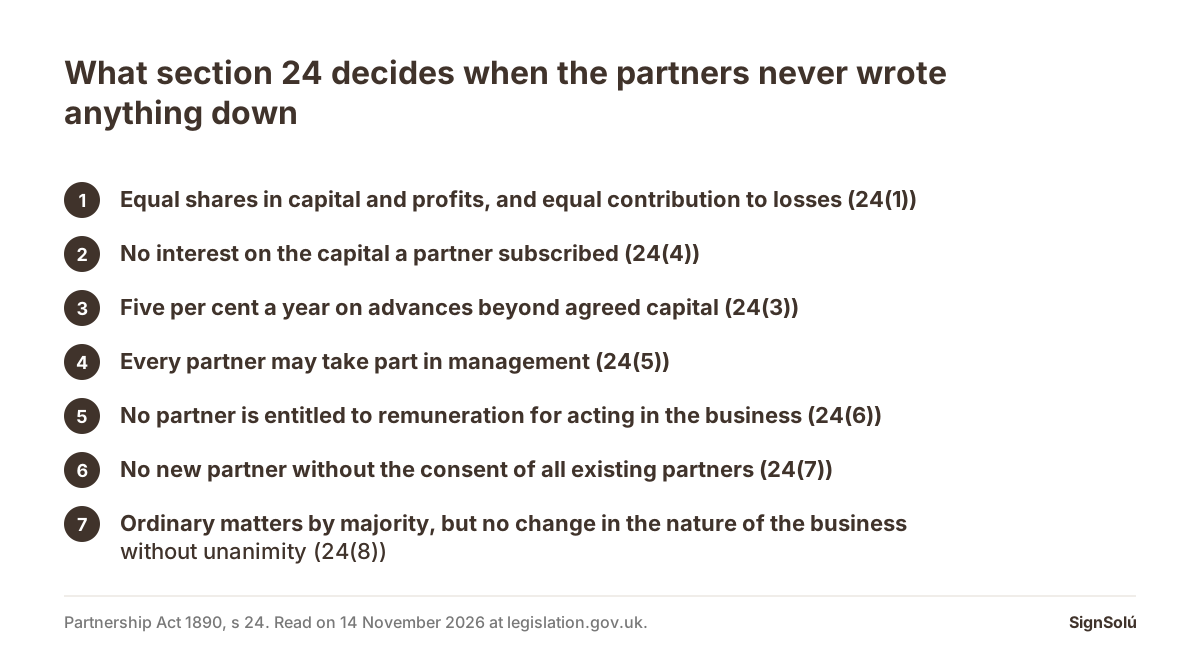
Section 24 opens with the words that matter most: the interests of partners and their rights and duties shall be determined, subject to any agreement express or implied between the partners, by the rules that follow. Those nine rules are defaults. A written agreement displaces them. Silence adopts them.
The one that causes the argument: equal shares
Section 24(1) says all the partners are entitled to share equally in the capital and profits of the business, and must contribute equally towards the losses, whether of capital or otherwise. It does not say «in proportion to what each contributed». In the example above, the partner who put in £80,000 and the partner who put in £5,000 share the capital and the profits equally, and carry the losses equally, unless they agreed otherwise.
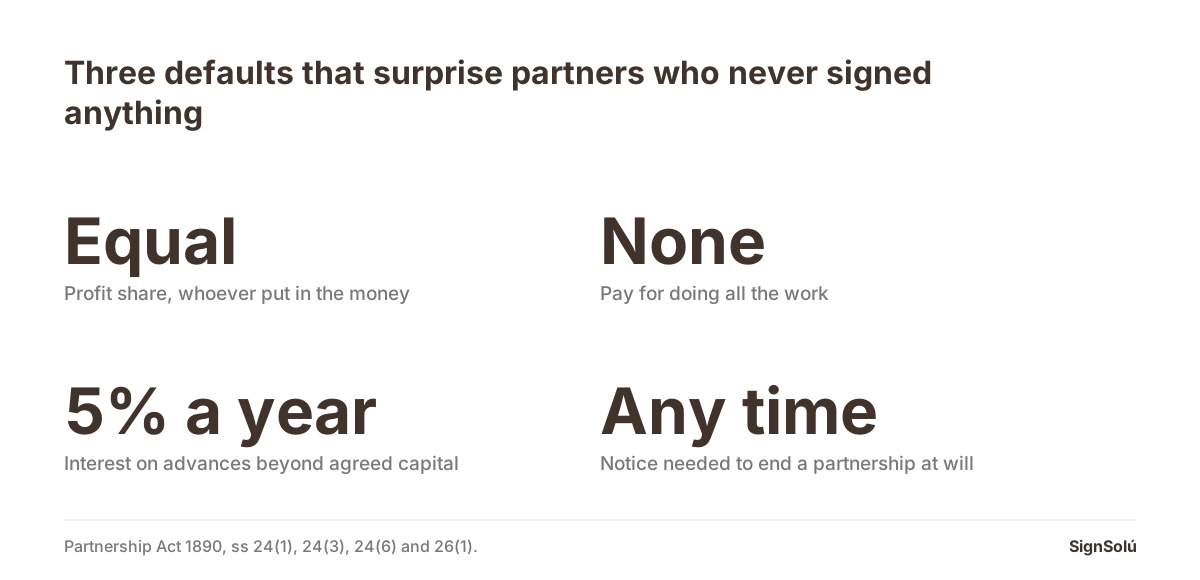
Two more defaults push in the same direction. Section 24(4) says a partner is not entitled, before the ascertainment of profits, to interest on the capital subscribed. And section 24(6) says no partner shall be entitled to remuneration for acting in the partnership business — so the one working full time is not paid a salary for it, and takes the same share as the one who does not. The only interest the Act grants is in section 24(3): five per cent a year on any actual payment or advance beyond the capital a partner agreed to subscribe, from the date of the advance.
| What partners usually assume | What the Act says without an agreement | Section |
|---|---|---|
| Profits follow the money each put in | Equal shares in capital and profits; equal contribution to losses | 24(1) |
| Capital earns interest | No interest on subscribed capital before profits are ascertained | 24(4) |
| The one who works gets a salary | No partner is entitled to remuneration for acting in the business | 24(6) |
| A majority can bring in a new partner | No person may be introduced as a partner without the consent of all | 24(7) |
| A majority can remove a bad partner | No majority can expel any partner unless an express power was agreed | 25 |
| Leaving needs agreement or a long notice period | Any partner may determine a partnership at will at any time on notice | 26(1) |
The two sections that decide how it ends
Section 25 is one sentence long and it is the one people discover too late: no majority of the partners can expel any partner unless a power to do so has been conferred by express agreement between the partners. Without that clause, a partner who has stopped working, or who is actively damaging the business, cannot be voted out by the others.
Section 26(1) points the other way and is just as blunt. Where no fixed term has been agreed for the duration of the partnership — a partnership at will, which is what you have if you never wrote anything — any partner may determine the partnership at any time on giving notice to all the others. No minimum notice, no reason required. Section 26(2) adds that where the partnership was constituted by deed, a signed written notice is sufficient. One partner can therefore dissolve the whole firm on a bad Tuesday.
And every partner can commit the firm
Section 5 makes every partner an agent of the firm and of the other partners for the purpose of the business. Acts done in carrying on, in the usual way, business of the kind the firm carries on bind the firm and the partners — unless the partner had no authority and the other side either knew that or did not believe them to be a partner. In practice, a supplier dealing normally with one partner binds all of them. That is the exposure a written agreement manages internally; it does not change what the supplier can rely on.
Who is liable, and for how much
This is the part that makes the defaults worth reading twice. A general partnership under the 1890 Act gives the partners no limited liability: section 24(1) makes them contribute equally towards the losses whether of capital or otherwise, and section 24(2) obliges the firm to indemnify every partner for payments made and personal liabilities incurred in the ordinary and proper conduct of the business, or in anything necessarily done to preserve the business or its property. Those two rules face in opposite directions, and between them sits every argument about who pays for a decision one partner took alone.
Section 24(5) gives every partner the right to take part in the management of the business, and 24(9) puts the partnership books at the principal place of business, where every partner may, when he thinks fit, have access to and inspect and copy any of them. A partner who is being kept away from the records does not need a court order to ask for them; the Act already gives the right. If the firm will be signing with counterparties abroad, the practical questions about signing across borders are the same ones covered in what a letter of intent with a company in another country commits you to.
What to put in writing, then
- 1Profit and loss shares, in figures, and whether they track capital. This displaces section 24(1).
- 2Salaries or drawings for partners who work in the business, which section 24(6) otherwise denies.
- 3Interest on capital, if any, since section 24(4) gives none.
- 4An expulsion power, because section 25 gives the majority none without an express clause.
- 5A fixed term or a notice period, so that section 26(1) does not let any partner dissolve the firm overnight.
- 6Decision thresholds, remembering that section 24(8) already allows ordinary matters by majority but requires unanimity to change the nature of the business.
Getting it signed by people in three places
Partnership agreements stall at signature more often than at drafting, because partners are rarely in the same room. A partnership agreement is an ordinary contract and does not need a deed unless you choose to constitute it by one, so it can be signed electronically and at a distance. With SignSolú the signing link goes out by WhatsApp or email, each partner signs from a phone, nobody has to open an account or pay, and the audit receipt records time, IP, device and the SHA-256 hash of the file. Anyone can check afterwards at /verificar that the document has not changed, without an account. The free plan is 10 documents with no expiry and no card.
The starting point is the business partnership agreement template, and the rest of the English catalogue is at /en/templates. The guides index is at /en/blog, and if you want the Mexican side of signing — because many partnerships trade with suppliers there — start with whether an electronic signature is valid in Mexico. If what you are signing is a preliminary document rather than the partnership itself, see a letter of intent; and for the document that ends a working relationship cleanly, the six conditions of a settlement agreement. If a partner will be signing through someone else, what POA means at the office, the bank and a company covers that.
Frequently asked questions
Do we have a partnership if we never signed anything?
Probably yes. Section 1(1) of the Partnership Act 1890 defines partnership as the relation which subsists between persons carrying on a business in common with a view of profit. That is a test of what you do, not of what you signed, so the partnership can exist from the day trading began.
I put in most of the money. Do I get most of the profits?
Not by default. Section 24(1) entitles all the partners to share equally in the capital and profits and requires equal contribution to losses, subject to any agreement express or implied between the partners. Unequal shares have to be agreed.
I do all the work. Can I pay myself a salary?
Not unless the partners agreed it. Section 24(6) says no partner shall be entitled to remuneration for acting in the partnership business, so a working partner takes the same share as a passive one until a written agreement says otherwise.
Can the rest of us expel a partner who has stopped contributing?
Not without an express clause. Section 25 says no majority of the partners can expel any partner unless a power to do so has been conferred by express agreement between the partners.
How easily can a partner walk away?
Very easily if there is no fixed term. Section 26(1) says that where no fixed term has been agreed, any partner may determine the partnership at any time on giving notice to all the other partners. Where the partnership was constituted by deed, section 26(2) says a signed written notice is sufficient.
Can a partnership agreement be signed electronically?
Yes. A partnership agreement is an ordinary contract unless the partners choose to constitute it by deed, so it can be signed electronically and at a distance. Each partner signs from a phone and the audit receipt records time, IP, device and the SHA-256 hash of the file.
Send your next contract to Mexico for signature
Create a free account and send 10 documents with no card. Your dashboard works in English. You set the language per signer, and their email, WhatsApp message and signing page arrive in that language.