POA full form: power of attorney, and what it actually does at the office, the bank and a company
POA stands for power of attorney: a document by which one person or company authorises another to act on their behalf. Everything else depends on three answers the abbreviation hides. Whose authority is it — an individual’s, or a company’s? How wide is it — one errand, or every act of disposition? And how long does it last? In an office the POA usually authorises one transaction or one filing; at a bank it names someone who can operate an account; in a company it lets an officer or agent sign for the entity. The form requirements, and whether it crosses a border, change in each case.
The abbreviation, and the three questions it hides
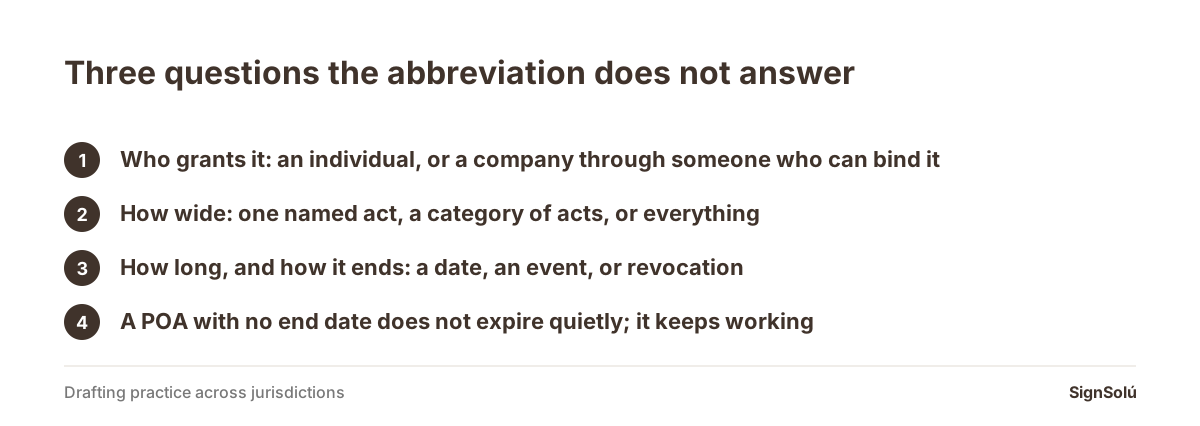
POA is power of attorney. The expansion is the part people search for and the part that helps least, because the same three letters sit on documents that have almost nothing in common. A one-page letter letting your brother collect a parcel is a POA. So is a notarised instrument letting a lawyer sell your flat. Reading a POA, or drafting one, means answering three questions before anything else. If you only need the short definition and the common uses, that is what the POA full form guide is for; this page is about what changes between settings.
- 1Who is granting it? An individual acting for themselves, or a company acting through someone who already has authority to bind it. Those start in different places.
- 2How wide is the authority? One named act, a category of acts, or everything. The widest versions are usually a separate legal category with heavier formalities.
- 3How long does it last, and how does it end? A date, an event, or revocation. A POA with no end does not expire quietly; it keeps working. Revocation is a separate step, and it only works once the agent and the people relying on the document have actually been told.
| Setting | What the POA usually authorises | What people get wrong |
|---|---|---|
| Office or agency | One filing, one collection, one appointment | Writing it so broadly that the counter asks for a notary |
| Bank | Operating a named account within stated limits | Assuming the bank will accept a generic letter instead of its own form |
| Company | Signing specified contracts for the entity | Not checking the grantor’s own authority to delegate |
| Property | Selling, mortgaging or managing real estate | Treating it as an ordinary letter; this is the heaviest category |
| Health | Decisions about medical care | Mixing it into a financial document; it is a separate instrument |
| Cross-border | The same acts, in another country | Skipping the apostille and the translation |
Where the form requirements bite
Mexico is a useful worked example, because its code writes the thresholds down in numbers instead of leaving them to practice. Article 2551 of the Código Civil Federal recognises three written forms: a public deed; a private document signed by the grantor and two witnesses with the signatures ratified before a notary, a judge or the corresponding administrative official; and a «carta poder sin ratificación de firmas», a simple letter with no ratification at all.
Article 2556 sets the ceiling on that simple form: a mandate may be granted in a private document before two witnesses, with no prior ratification, where the interest of the business it is granted for does not exceed a thousand times the minimum wage; and it may be verbal only where that interest does not exceed fifty times. Article 2555 then requires a deed, or ratified signatures, in three cases: a general mandate; a business interest above that thousand-times threshold; or an act that by law must be recorded in a public instrument. Article 2553 limits «general» to the three mandates in article 2554 — litigation and collections, administration of property, and acts of disposition — so everything else is special.
And the consequence of guessing wrong is not a weak document. Article 2557 says the omission of those requirements annuls the mandate, leaving subsisting only the obligations contracted between a good-faith third party and the agent, as if the agent had acted on their own account. The Spanish-language walkthrough is in carta poder en inglés: qué forma pide la ley (in Spanish), and the terminology problem is in «carta de poder» in English: what to call it.
England: a different regime with its own forms
Where an English reader says POA they often mean a lasting power of attorney, which is not an ordinary document at all: it has statutory signing and witnessing requirements, it is made in one of two types, and it must be registered with the Office of the Public Guardian for a fee, with a wait measured in weeks. The forms, the numbers and what replaced the old form codes are in the LP1F form to print, and what replaced it. An ordinary commercial authority to sign is a separate thing, and a power of attorney, in general, a general power of attorney and a financial power of attorney cover that ground. For health decisions the instrument changes again: a power of attorney for medical decisions, a health care proxy and a medical power of attorney form. For a vehicle, a vehicle power of attorney; for a child, a power of attorney for a minor.
Taking a POA across a border
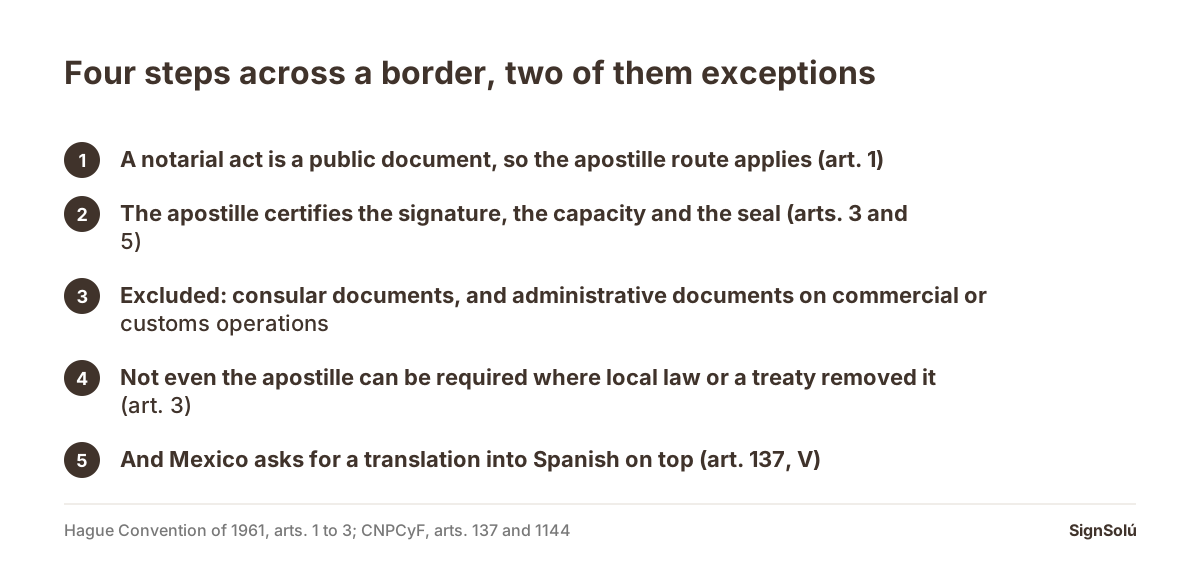
This is where most POAs fail, and the failure is procedural rather than substantive. A POA signed before a notary in one country is a foreign public document in the next, and the Hague Convention of 5 October 1961 abolishing the requirement of legalisation for foreign public documents is the instrument that governs. Its article 1 treats notarial acts as public documents, alongside documents emanating from an authority or official connected with the courts, administrative documents, and official certificates placed on documents signed by persons in their private capacity. Its article 2 abolishes legalisation for those documents, and article 3 makes the apostille the only formality that may be required to certify the signature, the capacity of the signatory and the seal or stamp.
Two limits worth knowing. Article 1 excludes documents executed by diplomatic or consular agents and «administrative documents dealing directly with commercial or customs operations». And article 3 itself says the apostille cannot be required where the law, regulations or practice of the receiving state have abolished or simplified it, where a treaty between contracting states has done so, or where the document is exempt from legalisation. So it is worth asking before paying and waiting. The Spanish-language version of this, with the Mexican recognition rule, is in apostilla: cuándo la necesita un documento (in Spanish), and the practical US-to-Mexico route is in a power of attorney from the US for Mexico.
The second border requirement is language. For Mexico, article 137, section V, of the Código Nacional de Procedimientos Civiles y Familiares requires documents drafted in a foreign language to be accompanied by their translation into Spanish, with a translator appointed to check it if the other side objects or the court thinks it necessary. Article 1144 of the same code requires foreign public documents to be presented duly apostilled or legalised, and provides that where legalisation is impossible it is replaced by any adequate evidence to guarantee authenticity.
Drafting one that a counter will accept
- Ask the receiving office for its format first. Banks and agencies very often have one, and a generic letter loses to a form. Where there is no form, a power of attorney letter template is the plain starting point.
- Name the act, not the category. «To sign the lease of the premises at [address] for a term of twelve months» rather than «to deal with property matters».
- Name the limits in numbers. An amount, an account, a single transaction. A bank POA without a limit is the version a bank is most reluctant to accept.
- Date it and end it. A start date, an end date, and how revocation is notified.
- Check the grantor’s own authority when a company is granting it. A manager who cannot bind the company cannot delegate what they do not have.
- Decide the form before drafting. If the underlying act needs a deed, start at the notary; the rest of the drafting is wasted otherwise.
- If it is crossing a border, plan the apostille and the translation into the timeline, not after it.
Signing it, and the version that holds up
Where the admissible form is a simple private document, nothing requires ink. In England, section 7 of the Electronic Communications Act 2000 makes an electronic signature «incorporated into or logically associated with a particular electronic communication» admissible in evidence on any question as to the authenticity or the integrity of the communication or data. In Mexico, article 1298-A of the Código de Comercio weighs a data message primarily by the reliability of the method by which the information was generated, stored, communicated and preserved. Both reward the same thing: a record around the signature, not a photograph of one.
SignSolú, an e-signature platform that works over WhatsApp, is built for the case where the grantor, the agent and the witnesses are in different places: the link goes out from your own number or by email, each person signs on their phone without creating an account or paying anything, and the sender chooses each signer’s language, so whoever signs in English gets the email, the WhatsApp message and the signing page in English. The audit receipt records time, IP address, device and a SHA-256 fingerprint of the file, and anyone can confirm later at the verification page that the document was not altered, with no account. The free plan is 10 documents with no expiry and no card; you can start at create an account. The background on signing with a Mexican counterparty is in how to sign a contract remotely with someone in Mexico and is an electronic signature valid in Mexico, and the mechanics without a printer are in how to sign a PDF and signing a PDF on an iPhone.
Frequently asked questions
What is the full form of POA?
Power of attorney: a document by which one person or company authorises another to act on their behalf. The abbreviation says nothing about how wide the authority is, who granted it or how long it lasts, and those are the three things that decide what the document can do.
What does POA mean at a bank?
Usually a document naming someone who may operate a specified account within stated limits. Banks almost always have their own form and their own verification process, so the first step is asking the bank rather than drafting a generic letter.
What does POA mean in a company?
An authority granted by the entity to an officer or agent to sign specified acts for it. The step people skip is checking that whoever grants it can bind the company in the first place: a delegate cannot pass on authority they do not hold.
Does a POA need to be notarised?
It depends on the act and the jurisdiction. In Mexico, article 2555 of the Federal Civil Code requires a public deed or ratified signatures where the mandate is general, where the business interest exceeds the equivalent of a thousand times the minimum wage, or where the act must by law be recorded in a public instrument. Below that, article 2551 allows a simple letter with no ratification.
Will a POA signed in one country work in another?
Only after the procedural steps. A POA signed before a notary is a foreign public document, and under the Hague Convention of 1961 the apostille certifies the signature, the capacity of the signatory and the seal or stamp. For Mexico, article 1144 requires it apostilled or legalised, and article 137 requires a translation into Spanish.
Can a POA be signed electronically?
Where the admissible form is a simple private document, yes. Section 7 of the Electronic Communications Act 2000 makes an electronic signature admissible on questions of authenticity and integrity, and article 1298-A of Mexico’s Commercial Code weighs the reliability of the method. What cannot be done that way is an instrument with its own statutory signing formalities, such as an English lasting power of attorney.
Send your next contract to Mexico for signature
Create a free account and send 10 documents with no card. Your dashboard works in English. You set the language per signer, and their email, WhatsApp message and signing page arrive in that language.