A cohabitation agreement in Ontario: the three words in section 55 that decide whether it is enforceable
Section 55(1) of Ontario’s Family Law Act says a domestic contract is unenforceable unless it is made in writing, signed by the parties and witnessed. All three, not two. Section 53(1) sets out what a cohabitation agreement can cover — ownership and division of property, support obligations, the right to direct the education and moral training of their children, and any other matter in the settlement of their affairs — and expressly excludes decision-making responsibility and parenting time. Section 56(4) then lets a court set the agreement aside for non-disclosure of significant assets or debts, for a party not understanding its nature or consequences, or otherwise in accordance with the law of contract.
Who the Act is talking about
Section 53(1) of the Family Law Act opens the door to two persons who are cohabiting or intend to cohabit and who are not married to each other. «Cohabit» is defined in section 1(1) as to live together in a conjugal relationship, whether within or outside marriage, so the agreement is for people who live as a couple without being married to one another — and it can be signed before the living together starts.
What it can settle is set out in the same subsection: ownership in or division of property; support obligations; the right to direct the education and moral training of their children; and any other matter in the settlement of their affairs. That is a wide canvas, and the third item is where the drafting has to be careful.
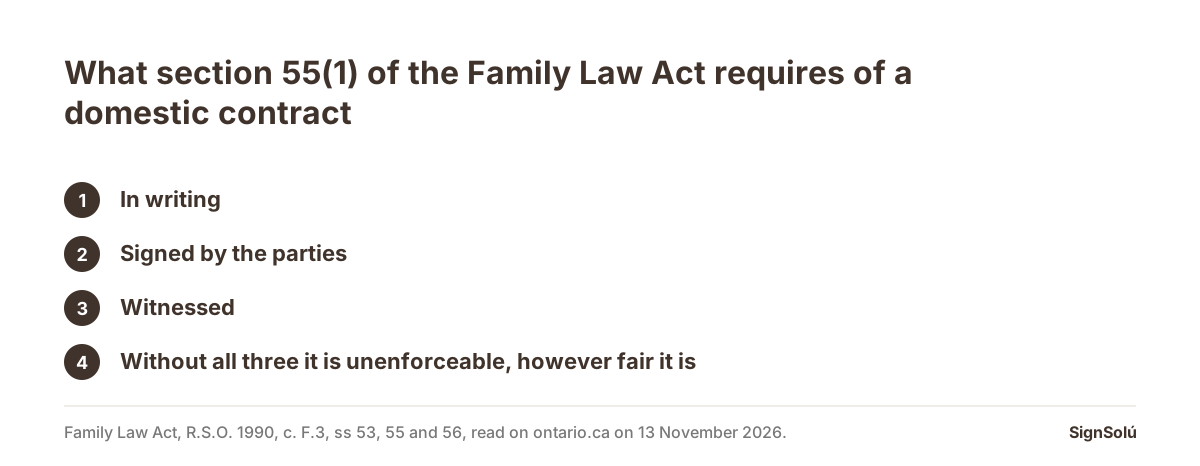
The three words of section 55(1)
Section 55(1) is the gate: «A domestic contract and an agreement to amend or rescind a domestic contract are unenforceable unless made in writing, signed by the parties and witnessed.» Three conditions joined by commas, and the one that gets skipped is the last.
Two people sitting at a kitchen table will type the agreement and sign it. Nobody watches them do it, because the document feels private. That version satisfies two of the three requirements and fails the subsection. It is not a technicality that can be cured by good intentions later: an amendment or a rescission has to meet the same test, so a handwritten note changing the agreement years later needs its own witness too.
Minors and incapacity
The rest of section 55 handles two edge cases that occasionally matter. Subsection (2): a minor has capacity to enter into a domestic contract, subject to the approval of the court, which may be given before or after. Subsection (3): where a mentally incapable person has a guardian of property or an attorney under a continuing power of attorney for property who is not their spouse, that guardian or attorney may enter into a domestic contract on their behalf, subject to the court’s prior approval.
What the agreement cannot decide
Section 53(1)(c) lets the parties agree on the right to direct the education and moral training of their children, but not the right to decision-making responsibility or parenting time. Those words were put there deliberately: parenting arrangements are not a bargaining chip between the adults.
Section 56(1) makes the point again from the other direction. In determining a matter about the education, moral training, decision-making responsibility or parenting time of a child, the court may disregard any provision of a domestic contract where in its opinion doing so is in the best interests of the child. And section 56(1.1) does the same for child support: a provision can be disregarded where it is unreasonable having regard to the child support guidelines.
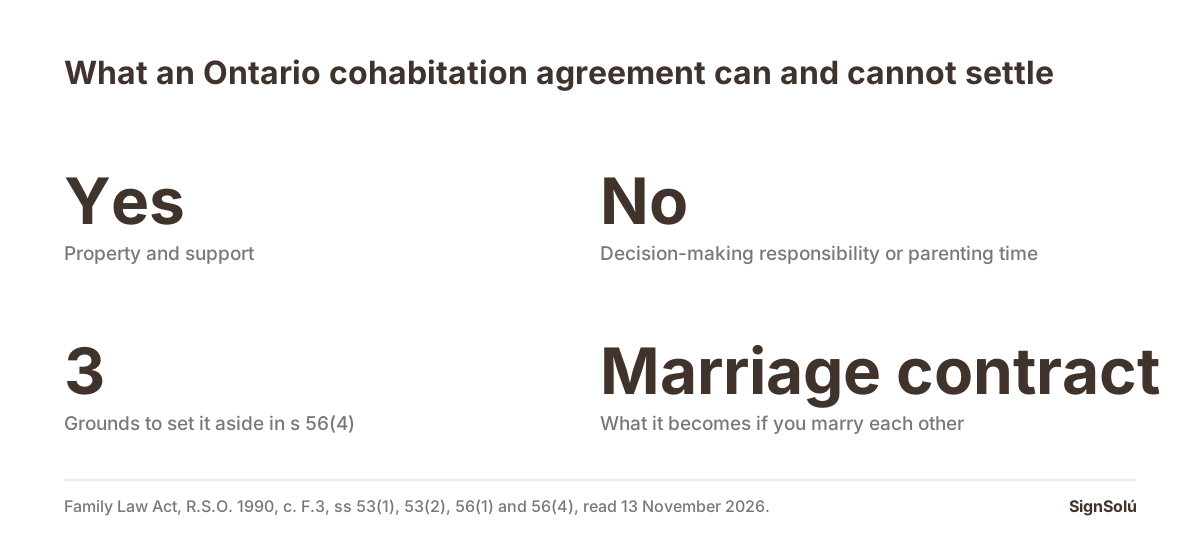
The three ways to lose it: section 56(4)
An agreement that meets section 55 can still be undone. Section 56(4) lets a court, on application, set aside a domestic contract or a provision in it on three grounds:
- 1(a) Non-disclosure. If a party failed to disclose to the other significant assets, or significant debts or other liabilities, existing when the contract was made.
- 2(b) Lack of understanding. If a party did not understand the nature or consequences of the contract.
- 3(c) Ordinary contract law. Otherwise in accordance with the law of contract — duress, undue influence, unconscionability and the rest.
A fourth exposure sits outside section 56(4) and catches homemade documents just as often: a clause that is simply silent. An agreement that divides «the house» without saying what happens to the equity built up by one party’s payments, or that fixes support without saying for how long, leaves a court to fill the gap with the statute. Silence is not neutrality; it is a decision to let someone else decide later.
Ground (a) is the one that decides most applications, and it is also the cheapest to defend against. A schedule of assets, debts and income attached to the agreement, initialled by both, converts «I didn’t know about the second mortgage» into a document someone signed. Ground (b) is why independent legal advice is worth its cost: it is evidence about understanding, not a formality.
If you marry each other, it changes shape
Section 53(2) is short and consequential: if the parties to a cohabitation agreement marry each other, the agreement shall be deemed to be a marriage contract. The document does not expire on the wedding day and it does not need to be re-signed — it converts.
That is good news for continuity and a trap for drafting. Clauses written for a couple who might separate while unmarried get read, after the wedding, against a different statutory background, including the matrimonial home rules that only apply to married spouses. A short clause saying what the parties intend to happen on marriage is cheaper than finding out later.
And one more distinction worth keeping straight: section 54 covers separation agreements, for two persons who cohabited and are living separate and apart. Same Part IV, same section 55 formalities, different document. If the relationship is already over, the agreement being drafted is usually a section 54 one.
| Question | What the Family Law Act says | Section |
|---|---|---|
| Who can sign one? | Two persons cohabiting or intending to cohabit, not married to each other | 53(1) |
| What does «cohabit» mean? | To live together in a conjugal relationship | 1(1) |
| What can it cover? | Property, support, education and moral training, and other matters | 53(1) |
| What can it not cover? | Decision-making responsibility and parenting time | 53(1)(c) |
| What form must it take? | In writing, signed by the parties and witnessed | 55(1) |
| Can a minor sign one? | Yes, subject to court approval before or after | 55(2) |
| Can a court set it aside? | Yes, on three grounds | 56(4) |
| What if the couple marries? | It is deemed to be a marriage contract | 53(2) |
A practical checklist before signing
- Write it down. Nothing in Part IV rescues an oral understanding.
- Attach a schedule of assets, debts and income for each party, dated and initialled. This is the answer to section 56(4)(a).
- Get each signature witnessed, and have the witness print their name and address on the document.
- Keep parenting arrangements out of the operative clauses, and say so.
- Add a clause dealing with what happens if you marry, knowing section 53(2) converts the document.
- Each party takes independent legal advice, and the agreement records that they did.
Signing it when you are not in the same room
The formality that trips people up is also the one that makes scheduling hard: two signatures plus witnesses, often with lawyers in two cities. The cohabitation agreement template sets out the clauses and the disclosure schedule so the document is complete before anyone sits down to sign.
SignSolú sends it by WhatsApp or email and each party signs from a phone: no account, no payment on their side, and the sender picks each signer’s language. The audit receipt records the time, IP, device and the SHA-256 hash of the file, which is the evidence of who signed and when, and anyone can check the document at /verificar without signing up. How it works is at how it works and the plans are at pricing. Where your province or country requires a witness to the signature, arrange that witness as the statute asks: an electronic signature records the act, it does not replace a formality the law imposes.
North of the border the same document does a different job, because Scotland gives cohabitants statutory defaults: a cohabitation agreement in Scotland sets them out. If one of you is moving into a place the other already rents, the tenancy side of the move is a separate document: the terms a BC tenancy agreement cannot change shows how little of that is negotiable. Related reading in English: a settlement agreement and its six conditions for the moment a relationship or a job ends on terms, what a letter of consent means for the difference between permission and contract, and a power of attorney in Scotland for how quickly these formalities change across borders. More guides are at /en/blog.
Frequently asked questions
Does a cohabitation agreement in Ontario need a witness?
Yes. Section 55(1) of the Family Law Act says a domestic contract, and an agreement to amend or rescind one, is unenforceable unless made in writing, signed by the parties and witnessed. All three conditions apply, and an amendment needs its own witness.
Can we agree on custody in a cohabitation agreement?
No. Section 53(1)(c) lets the parties agree on the right to direct the education and moral training of their children but expressly not on decision-making responsibility or parenting time, and section 56(1) lets a court disregard any provision on those matters where that is in the child’s best interests.
On what grounds can a court set the agreement aside?
Section 56(4) gives three: a party failed to disclose significant assets, or significant debts or other liabilities, existing when the contract was made; a party did not understand the nature or consequences of the contract; or otherwise in accordance with the law of contract.
What happens to the agreement if we get married?
Section 53(2) says that if the parties to a cohabitation agreement marry each other, the agreement shall be deemed to be a marriage contract. It converts rather than expires, so it is worth drafting with that conversion in mind.
Can we sign before we move in together?
Yes. Section 53(1) applies to two persons who are cohabiting or intend to cohabit and who are not married to each other, so the agreement can be made before the cohabitation starts.
What is the difference between this and a separation agreement?
A cohabitation agreement under section 53 is for people who are living together or intend to; a separation agreement under section 54 is for two persons who cohabited and are living separate and apart. Both are domestic contracts and both must meet the section 55 formalities.
Send your next contract to Mexico for signature
Create a free account and send 10 documents with no card. Your dashboard works in English. You set the language per signer, and their email, WhatsApp message and signing page arrive in that language.