Power of attorney in Scotland: it is a different document, and a downloaded template cannot make it
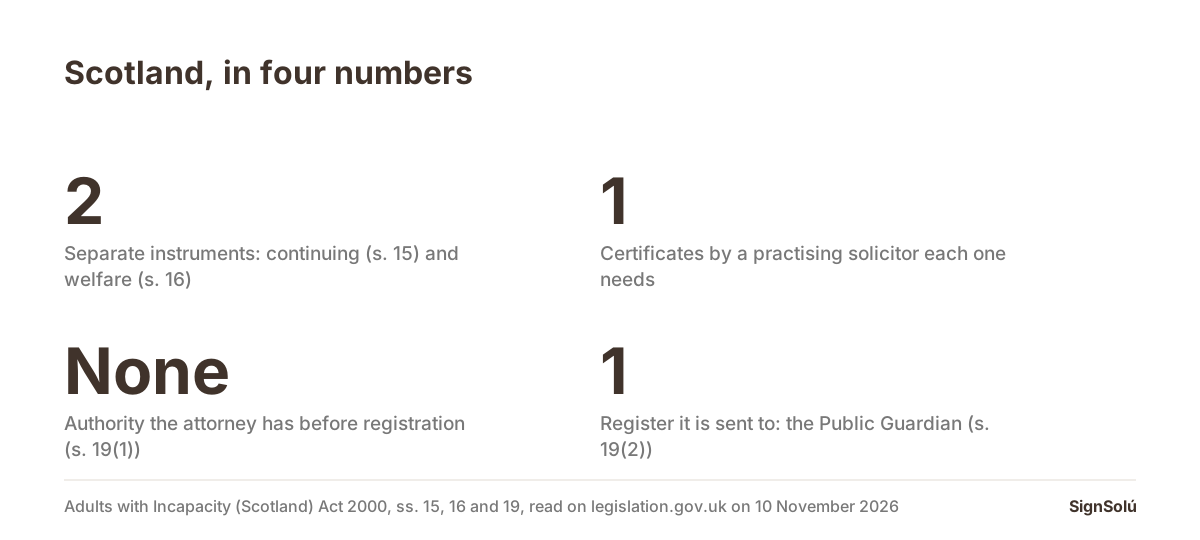
Scotland does not have a lasting power of attorney. The Adults with Incapacity (Scotland) Act 2000 creates two instruments instead: a continuing power of attorney under section 15, over property or financial affairs, which continues to have effect if the granter becomes incapable; and a welfare power of attorney under section 16, over personal welfare, which is not exercisable until the granter is incapable. Each is valid only if it is a written document subscribed by the granter, carrying a statement of intention and a certificate in the prescribed form by a practising solicitor who interviewed the granter immediately before they signed, is satisfied they understand its nature and extent, and has no reason to believe undue influence. And section 19(1) is categorical: the attorney has no authority to act until the document has been registered with the Public Guardian.
The search is for a template. The answer is a certificate
People look for «power of attorney Scotland template» for the same reason they look for any template: to avoid a solicitor’s bill. In Scotland that particular saving is not available, and the reason is written into the statute rather than hidden in practice.
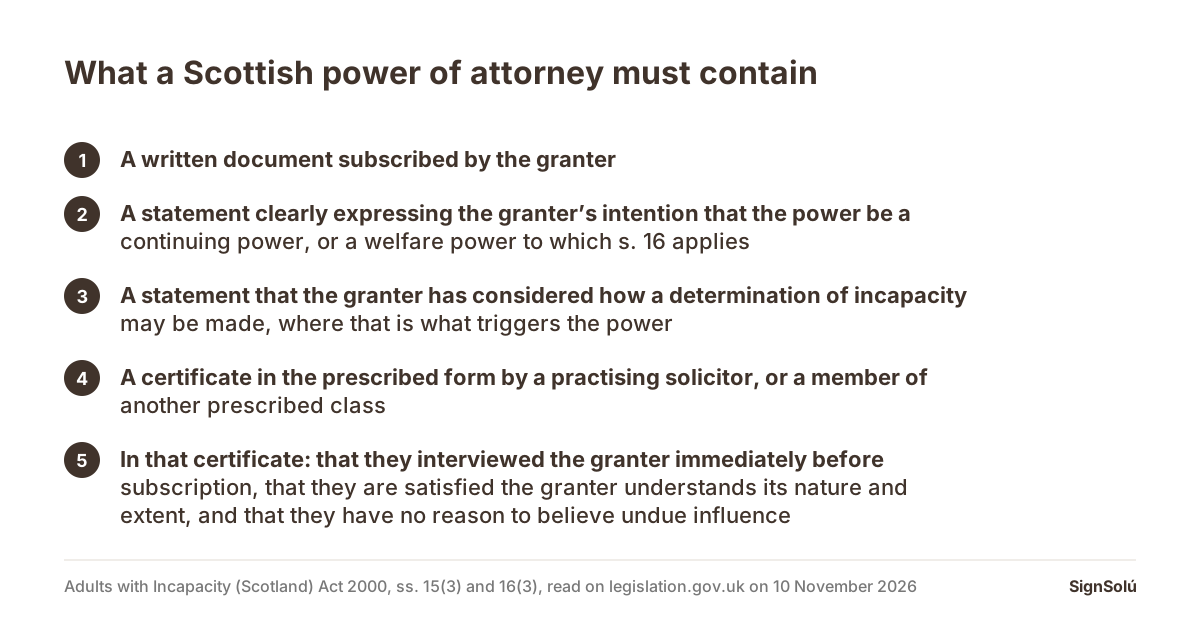
Section 15(3) of the Adults with Incapacity (Scotland) Act 2000 makes a continuing power of attorney valid only if it is expressed in a written document which is subscribed by the granter, incorporates a statement clearly expressing the granter’s intention that the power be a continuing power, and incorporates a certificate in the prescribed form by a practising solicitor or by a member of another prescribed class. A document without that certificate is not a continuing power of attorney; it is paper.
Two instruments, not one
The first thing the English form gets wrong at the border is the count. Section 15(1) deals with property or financial affairs: where an individual grants a power of attorney relating to those in accordance with the section, that power shall, notwithstanding any rule of law, continue to have effect in the event of the granter becoming incapable in relation to decisions about the matter to which it relates. That is the point of the section: an ordinary agency would end there.
Section 16 deals with personal welfare, and its subsection (5) adds two restrictions the financial one does not have: a welfare power of attorney may be granted only to an individual — which does not include a person acting in their capacity as an officer of a local authority or other statutory body — and shall not be exercisable unless the granter is incapable in relation to decisions about the matter to which it relates. England and Wales reach the same place through section 11(7) of the Mental Capacity Act 2005, described in health and welfare LPA: when it starts, but by a different route and with different paperwork.
What the certificate actually says, and who cannot sign it
Both sections use the same formula. The certificate must state that the certifier has interviewed the granter immediately before the granter subscribed the document; that they are satisfied, either because of their own knowledge of the granter or because they have consulted another person whom they name in the certificate who has knowledge of the granter, that at the time the power is granted the granter understands its nature and extent; and that they have no reason to believe that the granter is acting under undue influence or that any other factor vitiates the granting of the power.
Then the disqualification, in subsection (4) of each section: a practising solicitor or member of another prescribed class may not grant the certificate if they are the person to whom the power of attorney has been granted. The attorney cannot certify their own appointment, which rules out the tidy arrangement where the family solicitor is also the attorney and signs both halves.
And a statement about how incapacity will be judged
A later amendment added a paragraph (ba) to both sections. Where the continuing power is exercisable only if the granter is determined to be incapable in relation to the matter, the document must state that the granter has considered how such a determination may be made; section 16(3)(ba) says the same for the welfare power, by reference to its own subsection (5)(b). It is a short sentence with a real consequence: the question «who decides that I have lost capacity, and how» has to be answered in the document rather than left to a crisis.
Section 19: no authority until it is registered
Section 19(1) is the sentence to read before anything else: a continuing or welfare attorney shall have no authority to act until the document conferring the power of attorney has been registered under this section. Not «should», not «may be challenged»: no authority.
Subsection (2) sets out the mechanics. The document is sent to the Public Guardian, who, if satisfied that a person appointed to act is prepared to act, enters prescribed particulars in the register, sends a copy with a certificate of registration back to the sender, and, if it confers a welfare power of attorney, gives notice of the registration to both the local authority and the Mental Welfare Commission. Subsection (5) requires a copy to go to the granter, and, where the document so requires, to not more than two specified individuals or holders of specified offices. Subsection (4) is the practical one: an authenticated copy shall be accepted for all purposes as sufficient evidence of the contents of the original.
Subsection (3) allows something that is easy to miss and often wanted: the document may contain a condition that the Public Guardian shall not register it until the occurrence of a specified event, in which case registration waits until the Public Guardian is satisfied the event has occurred. That is how a granter keeps a financial power on the shelf rather than live from the day it is signed.
Section 20: what a sheriff can do afterwards
The oversight does not stop at registration. Under section 20, any person claiming an interest in the property, financial affairs or personal welfare of the granter may apply to the sheriff, and where the sheriff is satisfied that the granter is incapable in relation to those matters and that an order is necessary to safeguard or promote their interests, the sheriff may order that the continuing attorney be subject to supervision by the Public Guardian, that they submit accounts for audit, that a welfare attorney be subject to supervision by the local authority, that a welfare attorney report on how they exercised their powers, or revoke any of the powers granted or the appointment of the attorney.
For a family choosing an attorney, that is the reassurance; for an attorney, it is the reason to keep records from the first transaction rather than from the first complaint.
| The question | Scotland | England and Wales |
|---|---|---|
| Name of the instrument | Continuing or welfare power of attorney | Lasting power of attorney |
| Governing statute | Adults with Incapacity (Scotland) Act 2000 | Mental Capacity Act 2005 |
| Certificate by a practising solicitor | Required: ss. 15(3)(c) and 16(3)(c) | Not the same mechanism |
| Who may not certify | The attorney: ss. 15(4) and 16(4) | Not applicable |
| Authority before registration | None: s. 19(1) | None: s. 9(2)(b) and Sch. 1 |
| Where it is registered | The Public Guardian: s. 19(2) | The Public Guardian for England and Wales |
| Welfare power usable while capable | No: s. 16(5)(b) | No: s. 11(7)(a) |
| Delay registration until an event | Yes, by a condition in the document: s. 19(3) | Not by that mechanism |
| Later supervision or revocation | The sheriff, on application: s. 20 | The Court of Protection |
What a template is still good for
Not nothing. The certificate and the registration are the parts a solicitor does, but the decisions are the granter’s, and arriving with them written down is what makes a short appointment enough.
- 1Which powers, in which instrument. Property and financial affairs in the continuing power; health, care and residence in the welfare power. Write the list rather than ticking «everything».
- 2Who the attorneys are, and whether they act jointly or on their own. Two attorneys who must agree on every payment is a decision, not an oversight.
- 3How incapacity will be judged, because paragraph (ba) of both sections requires the document to state that the granter has considered it.
- 4Whether the financial power starts now or later, using the condition section 19(3) allows.
- 5Who gets a copy on registration, which section 19(5) lets the document name, up to two individuals or office-holders.
- 6Any limits you want to be binding, from gifts to selling the house, written as conditions in the instrument rather than as a letter of wishes.
For the general shape of the document, the enduring power of attorney form page sets out those blocks, and the neighbouring instruments are a general power of attorney for a time-limited financial job, a durable power of attorney and a medical power of attorney in the US framing, and the lasting power of attorney forms for England and Wales. What the abbreviation means in different settings is in POA full form, and which English form replaced the old paper one is in LP1F form to print.
Scotland diverges from England in more than this. A lodger arrangement is governed by a different Act and a different test, set out in lodger agreement Scotland, and a separation agreement is a different animal again across the devolved nations: separation agreement Ontario and in-house separation agreement. And if the person has property or family in Mexico, none of these instruments travels there on its own: the Mexican equivalent and its formalities are in Mexican power of attorney: the carta poder, what the term is really called in carta de poder in English, and what needs a notary there in Mexican notary.
The part that is admin, and where it goes wrong
Once the certificate exists and the registration is through, what remains is distribution: the bank, the care home, the GP surgery, the second attorney, the two people section 19(5) lets the document name. Section 19(4) makes an authenticated copy sufficient evidence of the contents, which only helps if someone can produce it.
SignSolú is an e-signature platform that works over WhatsApp, and that is the narrow job it does here. Each document you send keeps an audit receipt with the time, the IP, the device and a SHA-256 hash of the file, and the recipient acknowledges it by signing rather than by replying, so «we sent the registered copy in March» becomes a dated, hashed, acknowledged record that anyone can check at /verificar without an account. Signers need no account and pay nothing. The interface is in Spanish; what the sender chooses per signer is the language, so a signer set to English gets the email, the WhatsApp message and the signing page in English. Whether an electronic signature binds, and where, is in is an electronic signature legally binding. The free plan is 10 documents with no expiry and no card: start here.
Frequently asked questions
Can I use an English lasting power of attorney form in Scotland?
No. Scotland has no lasting power of attorney. The Adults with Incapacity (Scotland) Act 2000 creates a continuing power of attorney under section 15 for property or financial affairs and a welfare power of attorney under section 16 for personal welfare, each with its own validity requirements, its own certificate and its own register.
Why can’t I just download a template and sign it?
Because sections 15(3)(c) and 16(3)(c) require the document to incorporate a certificate in the prescribed form by a practising solicitor, or a member of another prescribed class, stating that they interviewed the granter immediately before subscription, that they are satisfied the granter understands the power’s nature and extent, and that they have no reason to believe undue influence. A template cannot produce that certificate.
Can my solicitor be my attorney and also sign the certificate?
Not both. Sections 15(4) and 16(4) say a practising solicitor or member of another prescribed class may not grant the certificate if they are the person to whom the power of attorney has been granted. One of the two roles has to go to someone else.
When can the attorney start acting?
After registration, and for a welfare power only once the granter is incapable. Section 19(1) says a continuing or welfare attorney shall have no authority to act until the document has been registered under that section, and section 16(5)(b) says a welfare power of attorney shall not be exercisable unless the granter is incapable in relation to decisions about the matter to which it relates.
Can I sign it now but keep it dormant?
Yes, through section 19(3). The document may contain a condition that the Public Guardian shall not register it until the occurrence of a specified event, and in that case the Public Guardian shall not register it until satisfied that the event has occurred. That is the mechanism for a financial power that exists but is not live.
What if the attorney starts making bad decisions?
Section 20 lets any person claiming an interest in the granter’s property, financial affairs or personal welfare apply to the sheriff. Where satisfied that the granter is incapable and that an order is necessary, the sheriff may put the continuing attorney under the supervision of the Public Guardian, require accounts for audit, put a welfare attorney under the supervision of the local authority, require a report, or revoke powers or the appointment itself.
Send your next contract to Mexico for signature
Create a free account and send 10 documents with no card. Your dashboard works in English. You set the language per signer, and their email, WhatsApp message and signing page arrive in that language.