Health and welfare lasting power of attorney: it only starts when capacity goes, and one box decides the rest
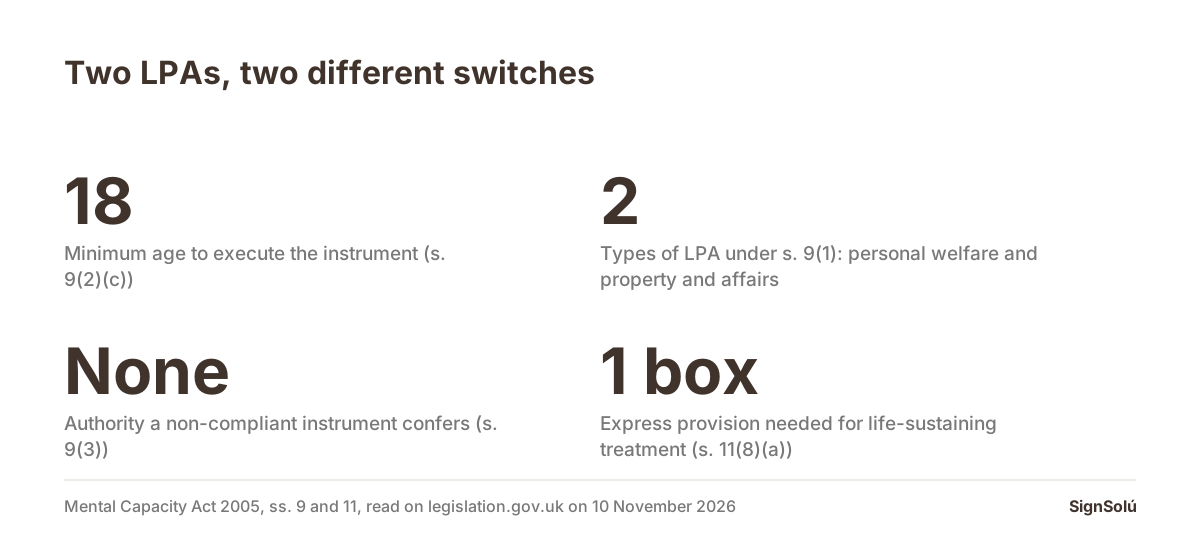
Only once capacity has gone. Section 11(7)(a) of the Mental Capacity Act 2005 says that where an LPA authorises the donee to make decisions about the donor’s personal welfare, the authority does not extend to making such decisions in circumstances other than those where P lacks, or the donee reasonably believes that P lacks, capacity. That is the difference from a property and financial affairs LPA, which can be used while the donor still has capacity if the instrument allows it. And section 11(8)(a) adds the clause people miss: the authority to consent to treatment does not authorise giving or refusing consent to the carrying out or continuation of life-sustaining treatment unless the instrument contains express provision to that effect. One box on the form, and without it the attorney cannot make that decision at all.
Two documents that look like one
Section 9(1) of the Mental Capacity Act 2005 describes a lasting power of attorney as conferring authority over all or any of two things: the donor’s personal welfare, or specified matters concerning it, and the donor’s property and affairs, or specified matters concerning those. In practice they are filled in, registered and used as two separate instruments, and the reason is in section 11.
A property and financial affairs LPA can be used as soon as it is registered, if the donor says so in the instrument. A health and welfare LPA cannot be used at all while the donor still has capacity. Nothing on the front page says that, and it is the single most common surprise for a family who registered one and then found the hospital would not take instructions from them.
Section 11(7): the switch is capacity, not registration
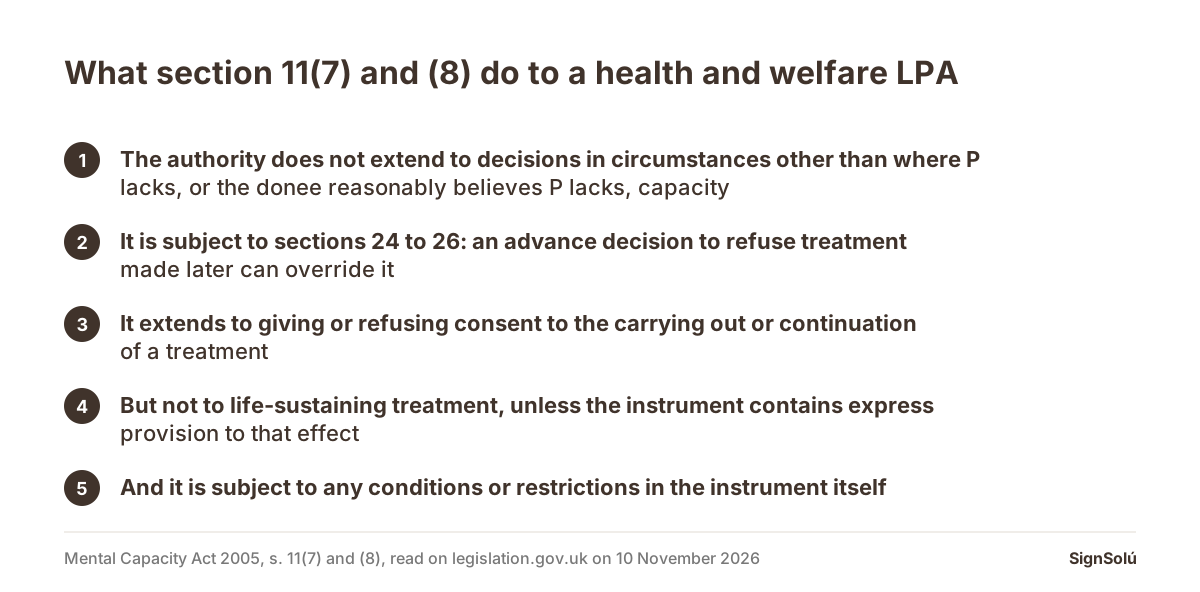
Section 11(7) is short and does three things. Where an LPA authorises the donee to make decisions about P’s personal welfare, the authority (a) does not extend to making such decisions in circumstances other than those where P lacks, or the donee reasonably believes that P lacks, capacity; (b) is subject to sections 24 to 26, which deal with advance decisions to refuse treatment; and (c) extends to giving or refusing consent to the carrying out or continuation of a treatment by a person providing health care for P.
Read (a) and (c) together and the shape of the instrument appears: the attorney can consent to treatment and can refuse it, but only in the window where the donor cannot decide. Outside that window the attorney has no authority at all, however well intentioned, and a clinician who follows them is not following a valid instruction.
And section 11(7)(b) means a later decision can beat the LPA
The reference to sections 24 to 26 is the part nobody plans for. A valid and applicable advance decision to refuse treatment, made after the LPA, can take the refusal of that treatment out of the attorney’s hands. Families who want one person to decide everything sometimes end up with two instruments pointing in different directions, and the order in which they were made matters. If that is the risk you are managing, say so in the instrument rather than in a letter nobody will find.
Section 11(8): the box that decides life-sustaining treatment
Subsection (8) is where a generic template does real damage. It says that subsection (7)(c) does not authorise the giving or refusing of consent to the carrying out or continuation of life-sustaining treatment, unless the instrument contains express provision to that effect, and that it is subject to any conditions or restrictions in the instrument.
So the authority over the hardest decision there is exists only if the donor wrote it in. Left blank — or left out of a home-made document — the attorney is consulted but cannot consent or refuse, and the decision goes back to the clinical team acting in the donor’s best interests under section 4. That is a legitimate choice. What is not legitimate is making it by accident.
Section 9: what has to be true before any of this applies
None of section 11 matters if the instrument never became an LPA. Section 9(2) says an LPA is not created unless section 10 is complied with, an instrument conferring authority of the kind mentioned in subsection (1) is made and registered in accordance with Schedule 1, and at the time the donor executes the instrument they have reached 18 and have capacity to execute it. Section 9(3) is blunt about the consequence: an instrument that purports to create an LPA but does not comply with section 9, section 10 or Schedule 1 confers no authority.
Section 9(4) adds that the authority is subject to the Act and in particular to section 1, the principles, and section 4, best interests, and to any conditions or restrictions specified in the instrument. In other words the attorney is not a proxy with free rein: every decision has to be the donor’s best interests decision, and the instrument can narrow it further. Which forms replaced the old paper ones, and what can still be printed, is in LP1F form to print.
Restraint has its own three conditions
Subsections (1) to (5) of section 11 cover something families rarely think about until it happens: an act intended to restrain the donor. An LPA does not authorise it unless three conditions are satisfied — P lacks, or the donee reasonably believes P lacks, capacity in relation to the matter; the donee reasonably believes the act is necessary to prevent harm to P; and the act is a proportionate response to the likelihood of P suffering harm and to the seriousness of that harm.
Subsection (5) defines restraint widely: the donee restrains P if they use, or threaten to use, force to secure the doing of an act which P resists, or restrict P’s liberty of movement, whether or not P resists, or authorise another person to do either. Locking a door, or asking a care home to, is inside that definition. The three conditions are not advice; they are the limit of the authority.
| The question | Health and welfare LPA | Property and affairs LPA |
|---|---|---|
| Can it be used while the donor has capacity? | No: s. 11(7)(a) | Yes, if the instrument allows it |
| Does it need registration to confer authority? | Yes: s. 9(2)(b) and Sch. 1 | Yes: s. 9(2)(b) and Sch. 1 |
| Consent to treatment | Yes: s. 11(7)(c) | Not covered |
| Refusing life-sustaining treatment | Only with express provision: s. 11(8)(a) | Not covered |
| Beaten by a later advance decision | Possible: s. 11(7)(b), ss. 24 to 26 | Not applicable |
| Restraint of the donor | Only on the three conditions of s. 11(1) to (4) | Only on the same three conditions |
| Bound by best interests | Yes: s. 9(4)(a), ss. 1 and 4 | Yes: s. 9(4)(a), ss. 1 and 4 |
What to do with the document, in order
- 1Decide the two instruments separately. The same attorney can hold both, but the switches are different and the wording is different.
- 2Answer the life-sustaining treatment question explicitly, either way. A blank is the narrow answer by default, and nobody will remember that it was a default.
- 3Write the conditions and restrictions you actually mean. Section 9(4)(b) and section 11(8)(b) both make them binding, so a sentence here does more than a conversation.
- 4Register it, and keep the certificate where it will be found. Until the instrument is made and registered in accordance with Schedule 1 it confers no authority at all.
- 5Give a copy to the people who will be asked: the GP surgery, the hospital, the care home, the second attorney. A document nobody can produce at 2am is a document that does not work.
- 6Keep a dated record of when and to whom you sent it. That is the part this platform does, and it is the only part of this that is not a solicitor’s job.
For the structure of the document itself, the lasting power of attorney forms page sets out what each section is for, and the neighbouring instruments are the general power of attorney for a time-limited financial job, the enduring power of attorney for the older regime, the medical power of attorney and, for a child while the parents are away, the power of attorney for a minor and a medical consent form. What the words themselves mean in different settings is in POA full form, and the travel case for a child is in medical consent for a minor while parents are away.
If the person whose affairs you are arranging has assets or family in Mexico, none of the above crosses the border on its own: a Mexican power of attorney is a different instrument with its own formalities, set out in Mexican power of attorney: the carta poder and, for a document signed in the United States to be used in Mexico, in power of attorney from the US for Mexico. What the Spanish term is actually called, and what it is not, is in carta de poder in English, and when a Mexican notary is unavoidable, in Mexican notary: what needs one. A general letter of consent is a far weaker thing than any of these; what the term means is explained in letter of consent meaning.
Proving who was told, and when
The legal work here belongs to a solicitor. The administrative half — getting the registered copy to the surgery, the hospital, the care home and the second attorney, and being able to show months later that it arrived — is the part that fails quietly, usually inside an email thread.
SignSolú is an e-signature platform that works over WhatsApp, and that is the narrow job it does here. Each document you send keeps an audit receipt with the time, the IP, the device and a SHA-256 hash of the file, and the recipient acknowledges it by signing rather than by replying, so «we sent it in March» becomes a dated, hashed, acknowledged record that anyone can check at /verificar without an account. Signers need no account and pay nothing. The interface is in Spanish; what the sender chooses per signer is the language, so a signer set to English gets the email, the WhatsApp message and the signing page in English. Whether an electronic signature binds, and where, is in is an electronic signature legally binding. The free plan is 10 documents with no expiry and no card: start here.
Frequently asked questions
Can my attorney use the health and welfare LPA while I still have capacity?
No. Section 11(7)(a) of the Mental Capacity Act 2005 says the authority does not extend to making such decisions in circumstances other than those where P lacks, or the donee reasonably believes that P lacks, capacity. That is the difference from a property and financial affairs LPA, which can be used while the donor still has capacity if the instrument says so.
Does registering it make it usable?
Registration makes it exist; capacity makes it usable. Section 9(2)(b) requires the instrument to be made and registered in accordance with Schedule 1 before it is an LPA at all, and section 9(3) says an instrument that does not comply with section 9, section 10 or Schedule 1 confers no authority. But even a properly registered welfare LPA still waits for section 11(7)(a).
Can my attorney refuse life-sustaining treatment for me?
Only if the instrument says so. Section 11(8)(a) provides that the authority to consent to treatment does not authorise giving or refusing consent to the carrying out or continuation of life-sustaining treatment unless the instrument contains express provision to that effect, and 11(8)(b) makes it subject to any conditions or restrictions in the instrument.
I made an advance decision after the LPA. Which one wins?
Section 11(7)(b) makes the welfare authority subject to sections 24 to 26, which govern advance decisions to refuse treatment. A valid and applicable advance decision can therefore take the refusal of that treatment out of the attorney’s hands. If you want one person to decide, the instrument and the advance decision need to be read together rather than written separately.
Can an attorney stop me leaving the house?
Only on three conditions. Section 11(1) to (4) says an LPA does not authorise an act intended to restrain P unless P lacks, or the donee reasonably believes P lacks, capacity in relation to the matter; the donee reasonably believes the act is necessary to prevent harm to P; and the act is a proportionate response to the likelihood of harm and its seriousness. Section 11(5) counts restricting P’s liberty of movement as restraint, whether or not P resists.
Does an LPA cover my property in Mexico?
Not by itself. A Mexican power of attorney is a different instrument with its own formalities, and for acts over Mexican real estate a Mexican notary is usually involved. A document signed abroad generally needs to be put into the form Mexican law expects before it is used there, which is a separate step from registering an LPA in England and Wales.
Send your next contract to Mexico for signature
Create a free account and send 10 documents with no card. Your dashboard works in English. You set the language per signer, and their email, WhatsApp message and signing page arrive in that language.