A cohabitation agreement in Scotland: the defaults you already live under, and the one-year deadline
Scottish cohabitants are not in the legal vacuum people assume. Sections 26 and 27 of the Family Law (Scotland) Act 2006 presume equal shares in household goods bought during the cohabitation and in money derived from a joint housekeeping allowance, and section 28 lets a cohabitant apply to the court for a capital sum when the relationship ends. Section 27 is expressly «subject to any agreement between the cohabitants to the contrary», which is what a cohabitation agreement is for. And section 28(8) sets a hard deadline: the application must be made not later than one year after the day the cohabitants cease to cohabit.
Who counts as a cohabitant
Section 25 of the Family Law (Scotland) Act 2006 defines a cohabitant, for sections 26 to 29, as either member of a couple who are or were living together as if they were husband and wife, or two persons of the same sex living together as if they were civil partners. There is no minimum period written into the definition.
Instead, subsection (2) tells the court what to weigh: the length of the period during which the parties lived together, the nature of their relationship during that period, and the nature and extent of any financial arrangements subsisting during it. The third factor is the one a written agreement speaks to directly, because a signed document is a financial arrangement with a date on it.
Section 26: the sofa is half yours
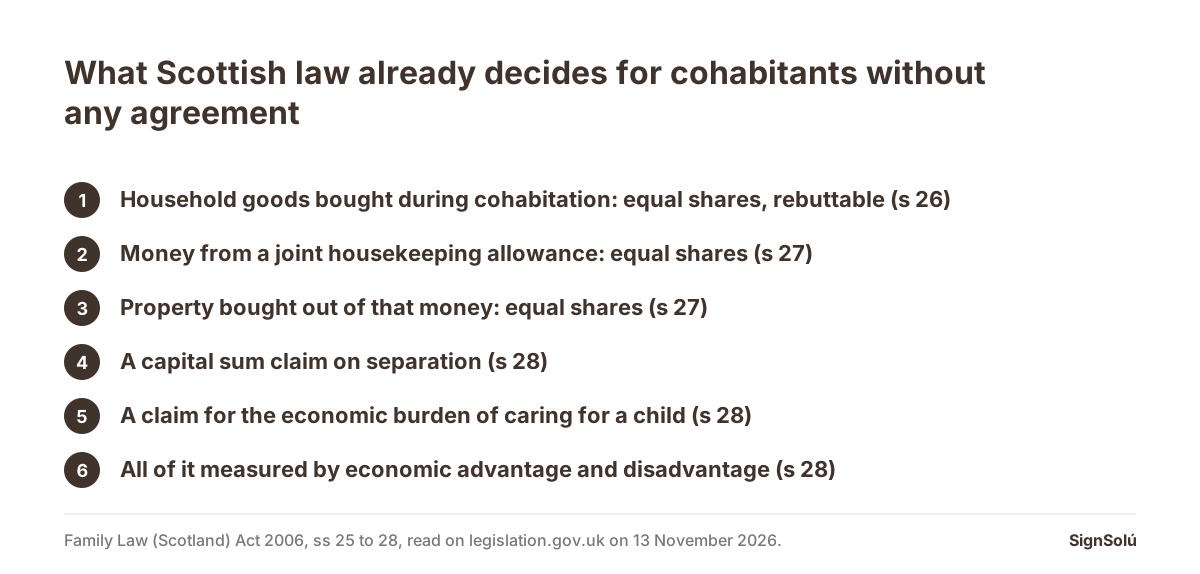
Where a question arises about the respective rights of ownership of cohabitants in any household goods, section 26(2) presumes that each cohabitant has a right to an equal share in goods acquired during the period of cohabitation, other than by gift or succession from a third party. Subsection (3) makes the presumption rebuttable, which means receipts matter.
The definition in subsection (4) is broader and narrower than people expect. «Household goods» means any goods, including decorative or ornamental goods, kept or used at any time during the cohabitation in a residence where the couple cohabited for their joint domestic purposes. But it expressly does not include four things: money, securities, any motor car, caravan or other road vehicle, and any domestic animal. The car and the dog are outside the presumption entirely.
Section 27: the clause an agreement can switch off
Section 27 deals with money derived from any allowance made by either cohabitant for their joint household expenses or for similar purposes, and with any property acquired out of that money. Subsection (2) treats it as belonging to each cohabitant in equal shares — and it begins with the words that make this article worth writing: «Subject to any agreement between the cohabitants to the contrary».
That is a statutory default the parties may displace by agreeing otherwise. It is not a rule you have to litigate around: it is a rule you can contract out of, in advance, in one clause. Subsection (3) also carves out the home itself — «property» in section 27 does not include the residence used as the sole or main residence in which the couple live or lived together.
Section 28: the claim, and the clock
Where cohabitants cease to cohabit otherwise than by death, section 28(2) lets one of them apply to the appropriate court for an order requiring the other to pay a capital sum, or to pay an amount in respect of any economic burden of caring, after the end of the cohabitation, for a child of whom the cohabitants are the parents. The court may also make such interim order as it thinks fit.
The test in subsection (3) is not need and it is not a share of assets. It is whether the defender derived economic advantage from contributions made by the applicant, and whether the applicant suffered economic disadvantage in the interests of the defender or of any relevant child — with subsections (5) and (6) then offsetting each against the other. Subsection (9) defines the terms generously: «contributions» includes indirect and non-financial contributions, and in particular looking after a relevant child or the house; «economic advantage» includes gains in capital, income and earning capacity.
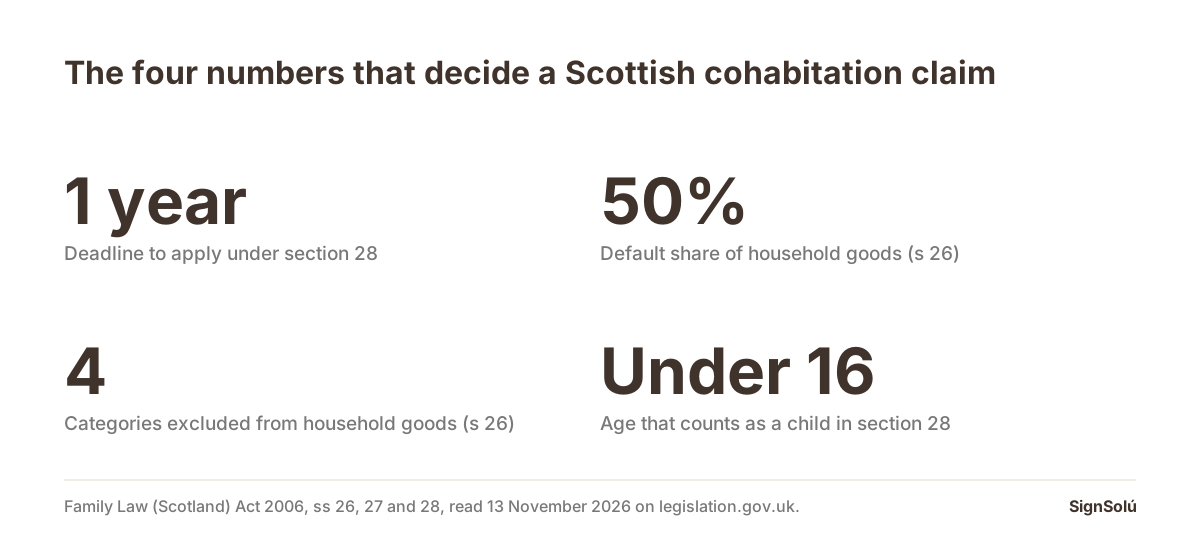
And then subsection (8): any application under section 28 shall be made not later than one year after the day on which the cohabitants cease to cohabit. One year, from the day they stopped living together — a date that is itself often disputed, which is another reason to have something written and dated.
Why the date of separation matters twice
It starts the one-year clock, and it closes the period over which the section 26 and 27 presumptions operate. Couples rarely stop cohabiting on a tidy date: one person moves out gradually, or stays in the spare room for months. A dated written acknowledgement of when the cohabitation ended costs nothing at the time and settles an argument that is otherwise reconstructed from text messages.
| Question | What the 2006 Act says | Section |
|---|---|---|
| Is there a minimum time to be a cohabitant? | No fixed period; the court weighs three factors | 25(2) |
| Who owns the furniture bought together? | Equal shares presumed, rebuttable | 26(2) and 26(3) |
| Does that cover the car or the dog? | No; both are excluded, with money and securities | 26(4) |
| Housekeeping money and what was bought with it? | Equal shares, subject to any agreement to the contrary | 27(2) |
| Does section 27 cover the home? | No, the sole or main residence is excluded | 27(3) |
| Can I claim a capital sum when we split? | Yes, on the economic advantage and disadvantage test | 28(2) and 28(3) |
| Do unpaid contributions count? | Yes, indirect and non-financial ones included | 28(9) |
| How long do I have to claim? | One year from the day you cease to cohabit | 28(8) |
What to put in the agreement
- 1What each of you brought in, with dates and values. Section 26 presumes equality only for goods acquired during the cohabitation.
- 2How household expenses are met, and what happens to money and property derived from that arrangement — the clause that engages the opening words of section 27(2).
- 3The home: who owns it, who pays the mortgage, and what a contribution to payments is intended to buy, if anything. Section 27 does not cover it.
- 4Anything already outside section 26: the car, the savings, the pets.
- 5What the parties intend about a section 28 claim, bearing in mind that a court order under that section is a statutory remedy and an agreement is evidence rather than a bar.
- 6A mechanism for recording the date you cease to cohabit, because of subsection (8).
The deadline also changes what the agreement is for. In Ontario the document mostly allocates property; in Scotland it also protects both people from a claim that has to be brought within twelve months, which means it is read quickly and under pressure. A short, legible agreement with a disclosure schedule attached does more work in that setting than a long one full of recitals.
One limit worth stating: section 28 is a claim to a court, and the statute does not say an agreement extinguishes it. What a clear, fairly negotiated, fully disclosed agreement does is shape the advantage-and-disadvantage picture the court is asked to assess, and remove most of the factual disputes. That is worth a great deal before anyone has instructed a solicitor.
Signing it without a weekend of logistics
These agreements fail to exist for ordinary reasons: both people work, one is away, and the conversation is uncomfortable enough that nobody chases the signature. The same thing happens with the paperwork of a tenancy a couple takes on together, which is why the terms a BC tenancy agreement cannot change is worth reading before anyone signs a lease as a couple. The cohabitation agreement template lays out the clauses and the disclosure schedule so the only thing left is to sign.
SignSolú sends it by WhatsApp or email and each party signs from a phone: no account and no payment on their side, and the sender picks each signer’s language. The audit receipt records the time, IP, device and the SHA-256 hash of the file — which is exactly the evidence that fixes when the agreement was made, and anyone can check the document at /verificar without signing up. How it works is at how it works, the plans are at pricing. Where Scottish practice or your solicitor asks for a witness or for independent advice, arrange that as well: an electronic signature records the act, it does not replace a formality someone else requires.
For the same document under a different statute, a cohabitation agreement in Ontario shows how much the formalities change across jurisdictions, and a power of attorney in Scotland makes the same point for a different instrument. A settlement agreement and its six conditions covers the moment things end on agreed terms. More guides are at /en/blog.
Frequently asked questions
How long do I have to make a claim after we separate in Scotland?
One year. Section 28(8) of the Family Law (Scotland) Act 2006 says any application under that section shall be made not later than one year after the day on which the cohabitants cease to cohabit.
Do Scottish cohabitants own the furniture equally?
Section 26(2) presumes an equal share in household goods acquired during the cohabitation, other than by gift or succession from a third party, and subsection (3) makes that presumption rebuttable. Money, securities, any motor car, caravan or other road vehicle and any domestic animal are excluded by subsection (4).
Can an agreement change what the Act says?
Section 27(2) expressly operates «subject to any agreement between the cohabitants to the contrary», so the equal-shares rule for housekeeping money and property bought with it can be displaced by agreement. Section 28 is a statutory claim to a court, and an agreement shapes the evidence rather than removing the remedy.
Is there a minimum number of years before I count as a cohabitant?
No fixed period appears in section 25. The court has regard to the length of the period of living together, the nature of the relationship during it, and the nature and extent of any financial arrangements subsisting during that period.
Does section 28 cover unpaid work at home?
Yes. Section 28(9) says «contributions» includes indirect and non-financial contributions, and in particular any contribution made by looking after any relevant child or any house in which the couple cohabited.
Does the 2006 Act apply in England and Wales?
No. It is an Act of the Scottish Parliament and these sections apply in Scotland. England and Wales have no equivalent statutory scheme for cohabitants, which is why an agreement does different work on each side of the border.
Send your next contract to Mexico for signature
Create a free account and send 10 documents with no card. Your dashboard works in English. You set the language per signer, and their email, WhatsApp message and signing page arrive in that language.