Research consent form template: free in Word, or sign it online
Reviewed in October 2026
A research consent form explains a study to a possible participant and records their decision to join. Under the federal Common Rule it starts with key information and covers the purpose, procedures, risks, benefits, confidentiality and the right to quit. Your ethics board approves the final text.
Ten documents free, no card. Signed by the participant and the person obtaining consent.
Example filled in with sample data
The full research consent form
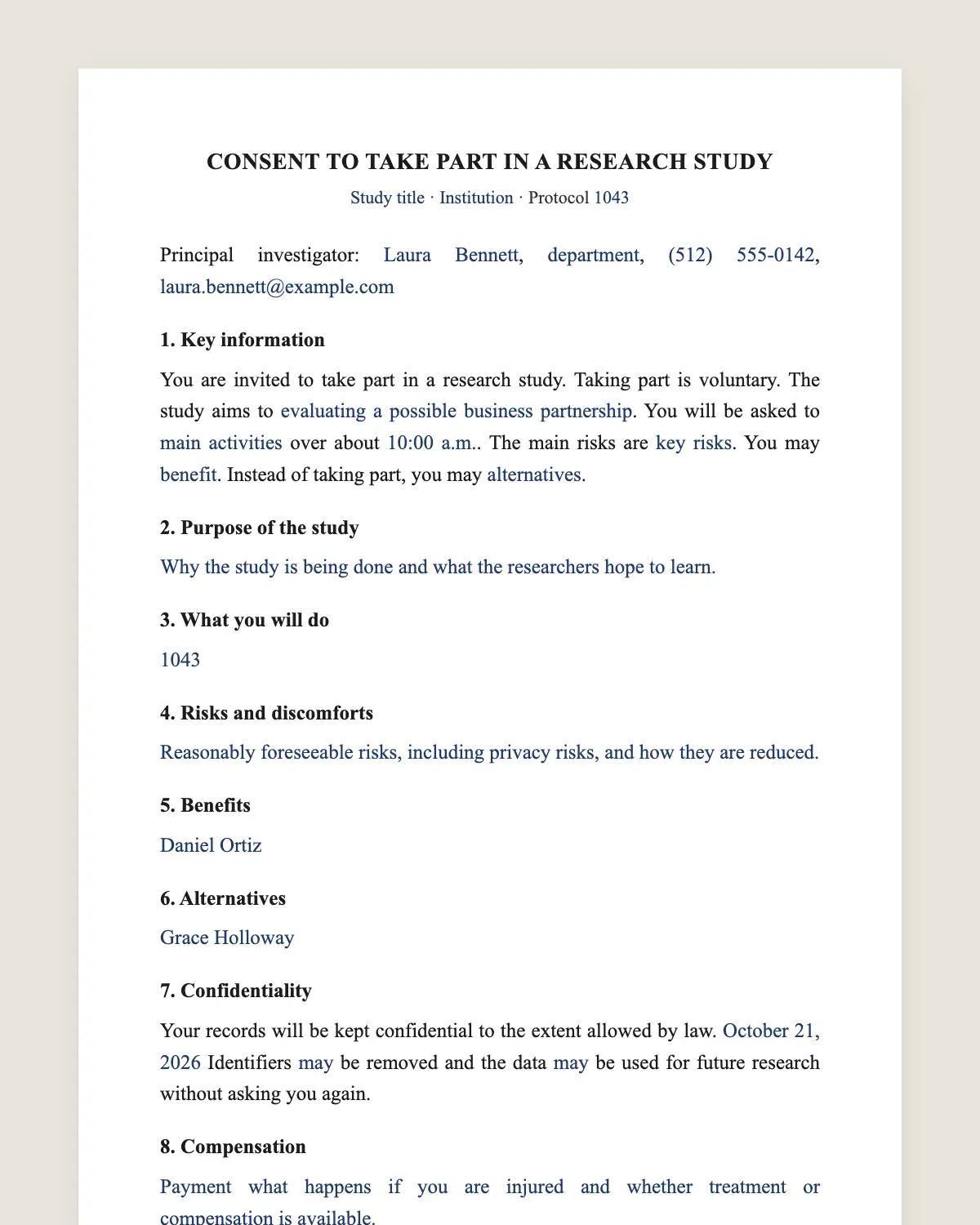
CONSENT TO TAKE PART IN A RESEARCH STUDY
[Study title] · [Institution] · Protocol [number]
Principal investigator: [name], [department], [phone], [email]
1. Key information
You are invited to take part in a research study. Taking part is voluntary. The study aims to [purpose in one sentence]. You will be asked to [main activities] over about [time]. The main risks are [key risks]. You may [benefit / not benefit directly]. Instead of taking part, you may [alternatives, or decline].
2. Purpose of the study
[Why the study is being done and what the researchers hope to learn.]
3. What you will do
[Procedures, number of visits, length of each, and which procedures are experimental.]
4. Risks and discomforts
[Reasonably foreseeable risks, including privacy risks, and how they are reduced.]
5. Benefits
[Benefits to you or to others, or a statement that there may be none.]
6. Alternatives
[Other options, if any, that might be helpful to you.]
7. Confidentiality
Your records will be kept confidential to the extent allowed by law. [How data are stored, who can see them, how long they are kept.] Identifiers [may / will not] be removed and the data [may / will not] be used for future research without asking you again.
8. Compensation
[Payment or reimbursement, if any, and when it is paid.] [For studies with more than minimal risk: what happens if you are injured and whether treatment or compensation is available.]
9. Voluntary participation
You can choose not to take part or stop at any time. You will not lose any benefits you are otherwise entitled to.
10. Contacts
For questions about the study, contact [investigator]. For questions about your rights as a participant, contact the [IRB or ethics committee name] at [phone or email].
By signing, you agree to take part in this study. You will receive a copy of this form.
PARTICIPANT
Signature: ______________________
Name: [full name]
Date: [date]
PERSON OBTAINING CONSENT
Signature: ______________________
Name: [full name]
Role: [role]
Date: [date]
What the template includes
A key information section first, as the Common Rule asks
Purpose, procedures and which ones are experimental
Foreseeable risks and how they are reduced
Benefits or that there may be none
Alternatives to taking part
Confidentiality and future use of identifiable data
Compensation and injury information
Voluntary participation and the right to stop
Contacts for the study and for participant rights
Signature of the participant and the person obtaining consent
What you fill in
Field
Example
Study
Sleep habits of night-shift nurses
Institution
Lakeview University, IRB protocol 2026-117
Investigator
Dr. Nina Patel
Procedures
Two online surveys and a sleep tracker for 14 days
Risks
Mild inconvenience and a small privacy risk
Compensation
50 USD gift card after the second survey
How it gets signed
1Choose “Use this template”, fill in the fields and read the full research consent form once more.
2Send it by WhatsApp or email. The other party opens the link on their phone without an account.
3They tap the brown bar at the bottom that says “Sign as …” and draw their signature with a finger.
4Everyone gets the signed PDF with its signature certificate. Anyone can check it at signsolu.com/verificar.
Before signing, each signer agrees to sign electronically. The screen links to the electronic signature disclosure the ESIGN Act asks for.
Federal rules allow written consent to be signed in electronic format. Use the version your ethics board approved, and give every participant a copy.
Your first ten documents are free and need no card.
Research funded or regulated by many US federal agencies follows the Common Rule. Its section 45 CFR 46.116 lists the basic elements of informed consent and asks that the form begin with a concise key information section.
An institutional review board (IRB) or ethics committee must approve the consent form before use. This template is a starting point for that approval, not a replacement for it.
The Common Rule allows the written consent form to be signed in electronic format. The ESIGN Act gives electronic signatures the same effect as ink.
Key information comes first
Participants should understand the study in the first page. Write the key information in short sentences. The details follow in the rest of the form.
Test it with someone outside your field. If they cannot explain the study back to you, simplify.
Remote studies and online consent
Online studies can send the form by email or text. Participants read it on their phones, ask questions by message or call, and sign. Each signature carries a certificate with date and time.
Your ethics board may ask how you confirm identity and how participants get their copy. SignSolú sends the signed PDF to everyone automatically.
A worked example
A nursing researcher studies sleep in night-shift nurses. The ethics board approves the form, with key information on the first page.
Nurses get the link by email, read the form and call the study line with questions. They sign on their phones and start the first survey the same day.
Mistakes that delay approval
Key information buried. Put it first and keep it short.
Technical language. Write for a reader with no science background.
Missing contacts. Include the investigator and the IRB.
No statement on future use of data. The rule asks for it.
Assent for children
Children who join a study give assent, a simple agreement in words they understand. Their parents give permission with a form like this one. Your IRB decides the age and the wording for assent.
Re-consent when the study changes
If procedures, risks or data use change, participants may need to sign a new version. Send the updated form with the changes marked and collect new signatures.
Checklist before you submit to the IRB
1Key information is on the first page.
2Each basic element of the Common Rule is covered.
3Contacts for the study and the IRB are included.
4Future use of data is stated.
5Language is plain and tested with a lay reader.
Once approved, upload the approved version and send it for signature. Keep the signed forms for the retention period your IRB sets.
A sample key information paragraph
“You are invited to join a study about sleep in nurses who work night shifts. It is voluntary. You will answer two online surveys and wear a sleep tracker for 14 days. The main risks are inconvenience and a small chance that your data could be seen by someone outside the study. You will not benefit directly, but the results may help hospitals plan shifts.”
Storing signed forms
Keep signed consent forms for the period your IRB and sponsor require, often several years after the study ends. SignSolú keeps them with their certificates, and you can export them for audits.
Is a research consent form signed online legally binding?
Yes. The ESIGN Act gives an electronic signature the same legal effect as a handwritten one. The signed PDF and its certificate show who signed the research consent form, when and from which device.
Does a participant need a SignSolú account to sign?
No. They open the link on their phone and sign with the brown bar at the bottom of the screen.
Can I download the research consent form in Word?
Yes. “Download in Word” gives you the full research consent form with no email and no account. You can print it or edit it and sign it here later.
Does an IRB have to approve the form?
Yes, for studies under the Common Rule. Submit this template with your protocol and use only the approved version.
Can minors take part?
Yes, with a parent’s permission and the child’s assent, under extra rules. Your IRB will tell you what it needs.
Do participants get a copy?
Yes. Everyone who signs receives the signed PDF.
Can participants sign on a phone?
Yes. The Common Rule allows electronic signatures. Your IRB may ask how you confirm identity.
Can I use this form outside the US?
Many countries have their own research ethics rules. Use it as a draft and follow your local ethics committee.