An employee loan agreement in Australia: the written authorisation your employee can withdraw at any time
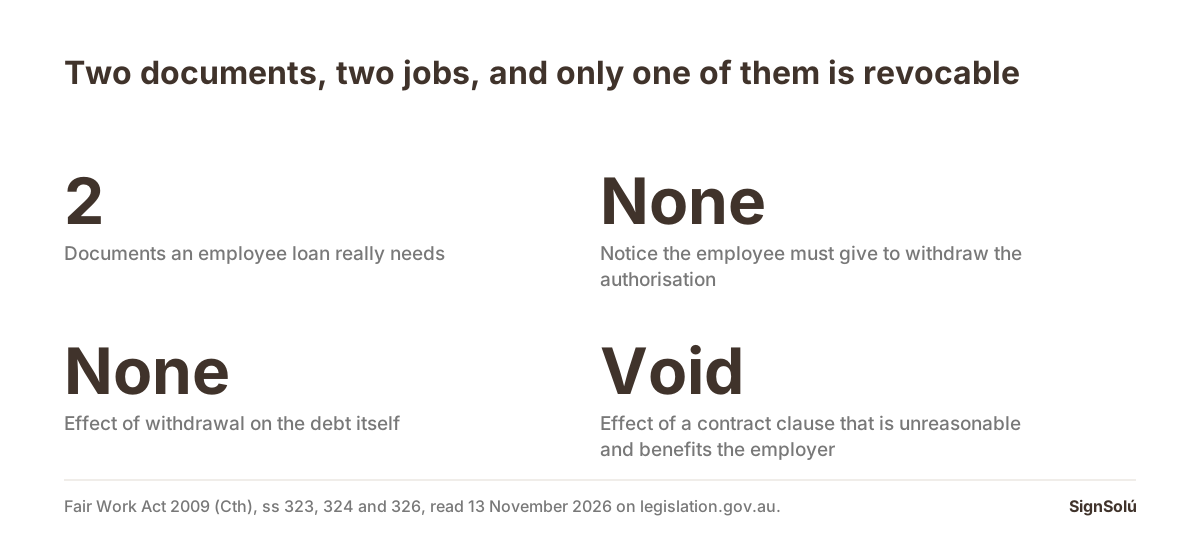
A deduction from wages to repay a staff loan is lawful in Australia only if it meets section 324 of the Fair Work Act 2009: authorised in writing by the employee and principally for the employee’s benefit. The part most templates miss is subsection 324(2)(b): that authorisation may be withdrawn in writing by the employee at any time. Withdrawal stops the deduction, not the debt. So the loan has to stand on its own as a written loan agreement, with its amount, instalments and a repayment date on termination, because the deduction clause is not security.
The default rule is that you pay wages in full
Section 323(1)(a) of the Fair Work Act 2009 says an employer must pay an employee the amounts payable for the performance of work in full, and adds four words that carry the rest of this article: «except as provided by section 324». Everything a staff loan does to a pay run has to fit through that one door.
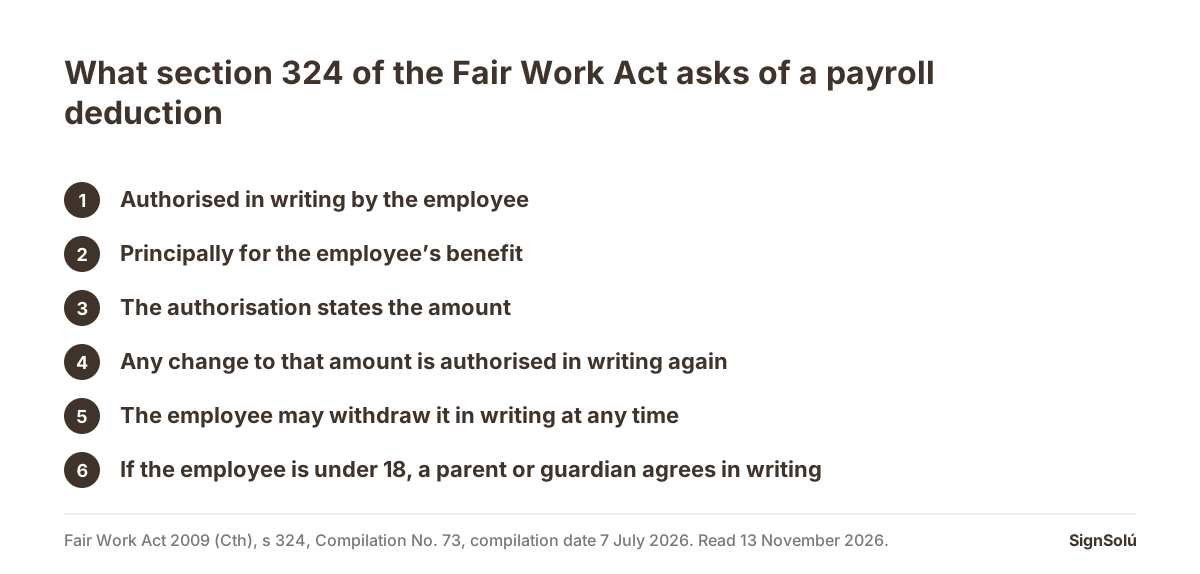
Section 324(1) opens it on four grounds. The one that applies to a loan is paragraph (a): the deduction is authorised in writing by the employee and is principally for the employee’s benefit. The other three — an enterprise agreement, a modern award or an FWC order, or a law or court order — are not what a private arrangement between you and one employee runs on.
The authorisation can be withdrawn at any time
Subsection 324(2) sets out what the authorisation must contain and then, in paragraph (b), what the employee can do with it: it may be withdrawn in writing by the employee at any time. No notice period. No cause. No carve-out for an authorisation given as part of a loan.
That single line undoes the way most employee loan templates are built. They put the repayment clause inside the loan agreement and treat it as the security — the reason the employer feels safe lending. In Australia it is the opposite: the deduction is the revocable part. What survives a withdrawal is the debt, and the debt is only as good as the document that records it, which is why a staff loan is drafted like any other loan agreement and not like a payroll instruction.
What that means for drafting
- Write the loan and the deduction authorisation as two things, even if they live on the same page. One creates a debt; the other is a payment method the employee can switch off.
- State the amount lent, the instalment and the number of instalments. Section 324(2)(a) requires the authorisation to specify the amount for a single deduction, or whether ongoing deductions are for a specified amount or for amounts that vary.
- Say what happens if the authorisation is withdrawn: the outstanding balance stays owing, on terms you have already written down.
- Say what happens on termination. A final pay is still wages, and section 324 still applies to it; the surrounding paperwork is in terminating an employee.
The «principally for the employee’s benefit» test
Paragraph 324(1)(a) has two limbs and the second one is where people argue. The deduction must be principally for the employee’s benefit, and a repayment of money the employee borrowed and spent is, on its face, a benefit to the lender. The way to read it is to look at what the deduction is for rather than who receives the cash: the arrangement the employee asked for is the loan, and the instalment is how the employee discharges it on terms that suit them, which is why the authorisation has to come from the employee and name the amount.
That reading only holds while the document matches it. An instalment the employee chose, written down, with a right to withdraw that is honoured, looks like the employee’s arrangement. A deduction the employer sets, varies and refuses to stop looks like the employer’s, and subsections 324(1A) and 326(1) are drafted for exactly that case. The distinction is not decorative: it is the difference between a lawful deduction and an underpayment of wages.
Why a fixed amount matters so much
Subsection 324(1A) adds a prohibition that catches sloppy drafting. An employer must not deduct under paragraph (1)(a) if the deduction is directly or indirectly for the benefit of the employer or a related party and is for an amount that may be varied from time to time — unless it would be reasonable in circumstances prescribed under subsection 326(2).
Read that against an open-ended clause like «the Company may deduct such amounts as are outstanding from time to time». It is for the employer’s benefit and the amount varies: exactly the combination the subsection prohibits. A fixed instalment, written down, with any change re-authorised in writing under subsection 324(3), keeps the arrangement inside the rule.
A clause in the employment contract is not the authorisation
Section 326(1) says a term of a modern award, an enterprise agreement or a contract of employment has no effect to the extent that it permits, or has the effect of permitting, a deduction that is directly or indirectly for the benefit of the employer or a related party and unreasonable in the circumstances. Subsection (2) lets the regulations prescribe when such a deduction is or is not reasonable.
So a standing deduction clause buried in the employment contract does two things at once: it does not supply the written authorisation that section 324(1)(a) wants, and if it is unreasonable and benefits the employer it has no effect at all. The authorisation has to be the employee’s own, specific, and given for this loan — the same logic that keeps pay terms out of a handshake in independent contractor payment terms. The hiring paperwork itself is a separate document, such as a letter of offer of employment.
Employees under 18
Subsection 326(4) is short and absolute: where the employee is under 18, a term permitting a deduction, or requiring a payment to the employer, has no effect unless the deduction or payment is agreed to in writing by a parent or guardian of the employee. If you lend to an apprentice or a casual who is seventeen, the parent or guardian signs too, or the deduction term is dead on the page.
| Question | What the Fair Work Act says | Section |
|---|---|---|
| Can I deduct repayments from wages? | Only through section 324; wages are otherwise payable in full | 323(1)(a) |
| What makes the deduction lawful? | Written authorisation, principally for the employee’s benefit | 324(1)(a) |
| Can the authorisation be open-ended? | Not if it benefits the employer and the amount varies | 324(1A) |
| What must the authorisation say? | The amount, or whether ongoing amounts are fixed or varying | 324(2)(a) |
| Can the employee cancel it? | In writing, at any time | 324(2)(b) |
| Can I change the instalment? | Only with a new written authorisation | 324(3) |
| Is a clause in the employment contract enough? | No, and it is void if unreasonable and for your benefit | 326(1) |
| Employee under 18? | A parent or guardian must agree in writing | 326(4) |
What a usable document looks like
- 1The loan: amount, purpose, whether interest is charged, and the repayment schedule.
- 2The deduction authorisation, signed by the employee, with the instalment amount in figures.
- 3A clause saying the debt remains payable if the authorisation is withdrawn, and how.
- 4A clause for termination: how the balance is dealt with in and after the final pay.
- 5For an employee under 18, the written agreement of a parent or guardian.
- 6The date each signature was given — because the authorisation operates from then, not from the first pay cycle.
Getting it signed before the money moves
The practical failure is not legal, it is sequencing. The money goes out on a Thursday and the paperwork follows «next week», by which time the first deduction has already been made without an authorisation in place. The employee loan agreement template is laid out to be signed the same day the loan is approved, with the repayment figures on the face of it.
SignSolú sends it by WhatsApp or email and the employee signs from a phone: no account, no payment on their side. The audit receipt records the time, IP, device and the SHA-256 hash of the file, which is what later shows the authorisation existed before the first deduction, and anyone can check the document at /verificar without signing up. The sender chooses each signer’s language, so the email, the WhatsApp message and the signing page arrive in English. How it works is at how it works, and the plans are at pricing.
If the employee is in another country from the payroll that lends the money, how to sign a contract remotely covers the mechanics. Two other jurisdictions resolve the same problem differently, and both are worth reading if you employ across borders: the two dates that decide an employee loan in the UK and the free-and-clear rule that stops a US deduction at the minimum wage. More English guides are at /en/blog.
Frequently asked questions
Can an Australian employer deduct a staff loan repayment from wages?
Yes, if it meets section 324 of the Fair Work Act 2009: the deduction is authorised in writing by the employee and is principally for the employee’s benefit. Without that authorisation, section 323 requires wages to be paid in full.
Can the employee cancel the deduction authorisation?
Yes. Subsection 324(2)(b) says the authorisation may be withdrawn in writing by the employee at any time. There is no notice period and no requirement to give a reason.
If the authorisation is withdrawn, does the employee still owe the money?
Yes. Withdrawal stops the deduction, not the debt. That is why the loan has to be recorded as a loan — amount, instalments and repayment on termination — rather than relying on the deduction clause as security.
Is a deduction clause in the employment contract enough?
No. Section 326(1) says a term of a contract of employment has no effect to the extent it permits a deduction that is directly or indirectly for the employer’s benefit and unreasonable in the circumstances, and a standing clause is not the specific written authorisation section 324(1)(a) asks for.
Can the deduction be «whatever is outstanding from time to time»?
Subsection 324(1A) prohibits a deduction under paragraph (1)(a) that is directly or indirectly for the employer’s benefit and is for an amount that may be varied from time to time, unless it would be reasonable in circumstances prescribed under subsection 326(2). A fixed instalment, with any change re-authorised in writing under subsection 324(3), avoids the problem.
What if the employee is under 18?
Subsection 326(4) makes a deduction term ineffective where the employee is under 18 unless the deduction is agreed to in writing by a parent or guardian of the employee. The parent or guardian signs alongside the employee.
Send your next contract to Mexico for signature
Create a free account and send 10 documents with no card. Your dashboard works in English. You set the language per signer, and their email, WhatsApp message and signing page arrive in that language.