An employee loan agreement in the UK: the two dates that decide whether it works
Two dates. The first is when the worker agreed in writing: section 13(1)(b) of the Employment Rights Act 1996 allows a deduction from wages only where the deduction is required or authorised by a statutory provision or a relevant provision of the contract, or where the worker has previously signified in writing their agreement to it. Subsections (5) and (6) add that a varied contract term, or a consent, does not authorise a deduction on account of any conduct or event occurring before it took effect, so a loan agreement signed after the money has gone out cannot reach back. The second date is the tax year: under section 180 of the Income Tax (Earnings and Pensions) Act 2003, section 175 does not apply if the amount outstanding never exceeds £10,000 at any time in the year.
Why the template is really a deductions document
Most employee loans are small and friendly: a season ticket, a deposit for a flat, a car repair, a training course the employer fronts. The paperwork people look for is called a loan agreement, but almost everything that can go wrong with it sits in one clause — the one that says the employer will take the repayments out of the worker’s pay.
In England, Wales and Scotland that clause is governed by Part II of the Employment Rights Act 1996, headed Protection of wages. It is short, and it is strict about sequence.
Section 13, read in order
Section 13(1) says an employer shall not make a deduction from the wages of a worker unless the deduction is required or authorised by virtue of a statutory provision or a relevant provision of the worker’s contract, or the worker has previously signified in writing their agreement or consent to the making of the deduction.
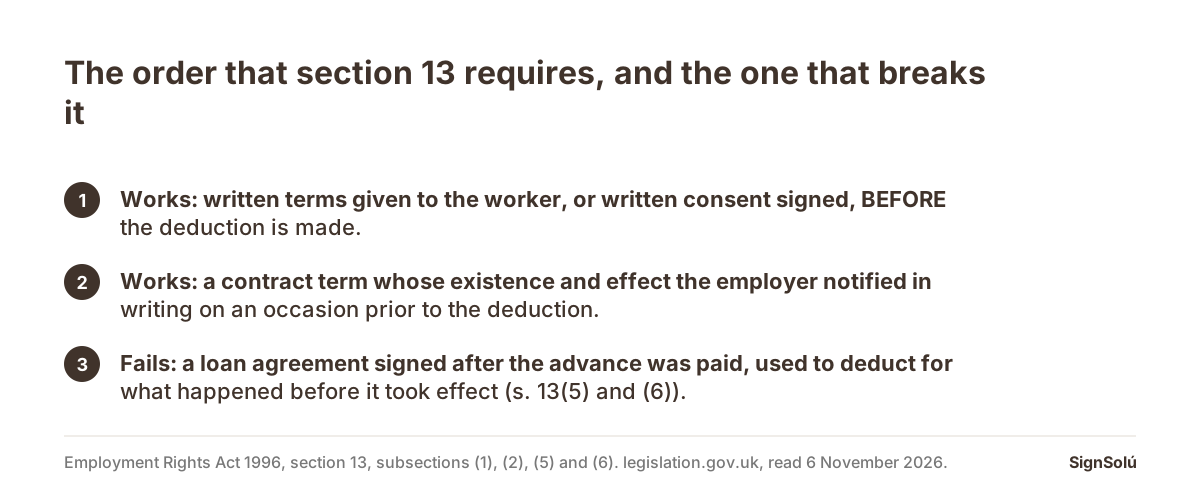
Section 13(2) defines that “relevant provision”. It has to be a provision comprised in one or more written terms of which the employer has given the worker a copy on an occasion prior to the employer making the deduction, or in one or more terms, express or implied, whose existence and effect the employer has notified to the worker in writing on such an occasion.
Read those two together and the rule is not “get it in writing”. It is “get it in writing, and hand it over, before the first deduction”. A policy that lives on an intranet nobody was pointed to does not satisfy subsection (2). A verbal agreement does not satisfy subsection (1)(b), which says in writing.
The subsections that stop you fixing it afterwards
This is the part that catches employers who did the loan on trust and papered it later. Section 13(5) says that a relevant provision of a contract having effect by virtue of a variation of the contract does not operate to authorise the making of a deduction on account of any conduct of the worker, or any other event occurring, before the variation took effect. Section 13(6) says the same about an agreement or consent signified by a worker.
So the advance paid in March cannot be recovered from wages by a document signed in June. The money is still owed — that is a civil debt — but the route of taking it out of pay has closed for that sum. And section 13(3) treats any shortfall in wages properly payable as a deduction, so paying someone short and calling it a repayment lands in the same place.
One narrow exception is worth knowing: section 13(4) carves out a shortfall attributable to an error by the employer affecting the computation of the gross amount of wages properly payable. An arithmetic error in the payroll run is not the same thing as a planned recovery.
The second date: £10,000 and the tax year
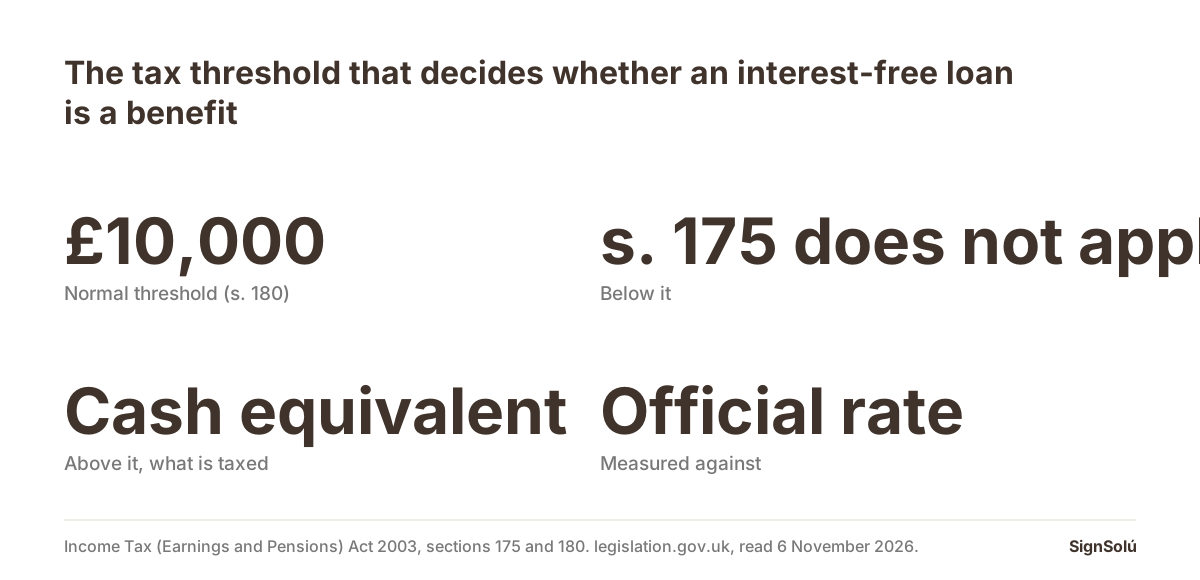
An interest-free loan to an employee is a benefit, and the benefit is taxable unless it stays small. Section 175 of the Income Tax (Earnings and Pensions) Act 2003 treats the cash equivalent of the benefit of a taxable cheap loan as earnings from the employment for the tax year. A loan is a taxable cheap loan for a year if it is outstanding for the whole or part of that year while the employee holds the employment, and no interest is paid on it, or less than would have been payable at the official rate.
The cash equivalent, under section 175(3), is the difference between the interest that would have been payable at the official rate and the interest actually paid, if any. And section 180 sets the escape: section 175 does not have effect for an employee and a tax year if the normal £10,000 threshold is not exceeded, which happens when at all times in the year the amount outstanding — aggregated across employment-related cheap loans — does not exceed £10,000.
Three practical consequences. One: the test is at all times in the year, not the balance on a particular date, so a loan that dips below the line in March does not help if it was above it in January. Two: loans aggregate, so a £7,000 season ticket loan plus a £4,000 relocation advance crosses the threshold even though neither does alone. Three: charging interest at the official rate removes the benefit altogether, which is sometimes simpler than tracking the threshold.
What belongs in the document
| Clause | What it has to say | Why |
|---|---|---|
| Amount and date paid | The sum and the day it reached the worker | Fixes which events fall before and after the consent |
| Written consent to deduct | Express authority to deduct repayments from wages, signed before the first deduction | ERA 1996, s. 13(1)(b) |
| Copy given | That the worker received a copy of the terms on a date before the first deduction | ERA 1996, s. 13(2)(a) |
| Instalments | How much, how often, and from which pay run | Makes the deduction identifiable rather than a shortfall |
| Interest | None, or a stated rate, and whether it matches the official rate | ITEPA 2003, s. 175: the official rate sets the benefit |
| Early repayment | What happens if the worker pays it off sooner | Keeps the balance and the threshold calculation clean |
| Leaving | What falls due on termination and how the balance is handled | A final-pay deduction still needs the same prior written consent |
| Statutory minimums | That the deduction will not take net pay below the lawful minimum | Deductions interact with national minimum wage rules |
The form itself is at the employee loan agreement. If what you are documenting is pay rather than a loan, the terms of engagement belong in the employment letter or in the letter of offer of employment, and for a contractor in the independent contractor agreement or the freelance contract, with the payment side set out in independent contractor payment terms, the US paperwork in the 1099 contractor agreement and the W-9 form, and the no-guaranteed-hours case in the zero hours contract template.
The order of operations, in six steps
- 1Agree the amount, the instalments and whether interest is charged, and decide that against the official rate rather than against nothing.
- 2Draft the agreement with the express authority to deduct repayments from wages.
- 3Give the worker a copy, and record the date they received it. That date is what section 13(2)(a) asks for.
- 4Get the signature, and keep the signed copy with its date.
- 5Only then pay the money out.
- 6Run the first deduction on the pay date the agreement names, and show it as a named deduction on the payslip rather than as a lower gross.
Steps three and five are the ones that get swapped under pressure, and swapping them is what sections 13(5) and 13(6) will not forgive. If the money genuinely has to move first — an emergency, a repair, a deposit that will otherwise be lost — then accept that recovery is a debt to be collected rather than a deduction to be run, and say so in the document. The general form for that is the loan agreement, and a later change of terms goes in the contract amendment.
Leaving before the loan is repaid
The final payslip is where most of these documents are tested, because it is the one deduction the worker notices. The same rule applies: the authority has to be in writing and to have existed before the deduction. A clause in the loan agreement that says the outstanding balance becomes payable on the last day of employment and may be deducted from final pay does that work, provided it was given to the worker at the start.
If employment is ending by agreement rather than by resignation, the loan usually gets folded into the settlement, and that document has its own six conditions: the settlement agreement and the six conditions. A separation that is not an employment matter at all is a different document again: the in-house separation agreement.
If the employee is in Mexico
UK employers with staff in Mexico sometimes reuse the same loan template, and the deduction rules there are tighter in a different way. Article 110, fraction I, of the Mexican Federal Labour Law allows deductions for debts owed to the employer, but caps the amount owed at one month of salary and the deduction at thirty per cent of the excess over the minimum wage, and the amount has to be agreed between worker and employer. A UK-style repayment schedule for a large advance does not fit inside those limits. What the Mexican employment contract has to carry is in hiring employees in Mexico, and the alternative route, in employer of record or your own contract.
Getting it signed before the money moves
Everything above turns on one operational habit: the document is signed before the transfer, not after. That is easy to say and hard to do when the request arrives on a Friday afternoon and the person who approves it is travelling. An electronic signature solves the sequencing problem rather than the legal one, and the legal one is already settled: is an electronic signature legally binding, and where, with the Mexican answer in is an electronic signature valid in Mexico and the cross-border one in is a Mexican e-signature valid in the US.
With SignSolú the agreement goes out over WhatsApp from your own number or by email, the employee signs from their phone without creating an account and without paying, and the audit receipt records the time, the IP address, the device and the SHA-256 hash of the file. Anyone can later check that the document did not change at the verification page, with no account. The sender chooses each signer’s language, so a signer in English receives the email, the WhatsApp message and the signing page in English. The free plan is 10 documents, with no expiry date and no card. If your Mexican counterpart is the one signing, how to sign a contract remotely with someone in Mexico walks through it, and the Spanish-language catalogue of Mexican forms is at las plantillas.
Frequently asked questions
Can I deduct loan repayments from an employee’s wages?
Only if section 13(1) of the Employment Rights Act 1996 is satisfied: the deduction is required or authorised by a statutory provision or a relevant provision of the contract, or the worker has previously signified in writing their agreement to it. For a contract provision, section 13(2) requires that the written terms were given to the worker, or their existence and effect notified in writing, on an occasion before the deduction.
The loan was paid out months ago and nothing was signed. Can I paper it now?
You can document the debt, but not the wage deduction for what has already happened. Sections 13(5) and 13(6) say a varied contract term or a consent does not authorise a deduction on account of any conduct or event occurring before it took effect.
Is an interest-free loan to an employee taxable?
It can be. Section 175 of ITEPA 2003 treats the cash equivalent of a taxable cheap loan as earnings, measured as the difference between interest at the official rate and interest actually paid. Section 180 disapplies it where the amount outstanding never exceeds £10,000 at any time in the tax year.
Do two small loans count separately for the threshold?
No. Section 180(2) aggregates the amounts outstanding on employment-related loans that are taxable cheap loans in the year, so two loans of £7,000 and £4,000 cross the £10,000 threshold even though neither does alone.
What if I just pay the person short instead of calling it a deduction?
Section 13(3) treats any shortfall between the wages paid and the wages properly payable as a deduction for the purposes of Part II. The only carve-out is section 13(4), for a shortfall attributable to an error by the employer in computing the gross amount properly payable.
Can I take the outstanding balance out of final pay?
Yes, if the authority to do so was in writing and existed before the deduction, as section 13 requires. A clause saying the balance falls due on termination and may be deducted from final pay does that, as long as the worker was given the terms at the outset.
Send your next contract to Mexico for signature
Create a free account and send 10 documents with no card. Your dashboard works in English. You set the language per signer, and their email, WhatsApp message and signing page arrive in that language.