A 1099 contractor agreement template: what the form does not decide for you
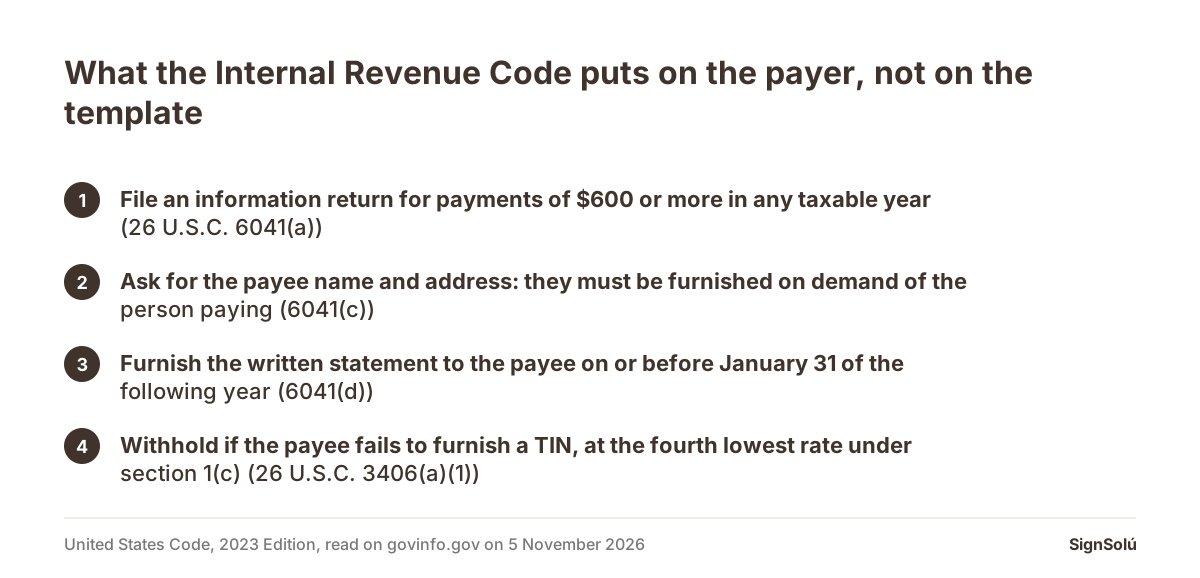
A 1099 is an information return, not a status. Section 6041(a) of the Internal Revenue Code requires every person engaged in a trade or business to report payments of $600 or more made in the course of that business to another person in any taxable year. Section 6041(c) says the payee name and address must be furnished on demand of the person paying. Section 6041(d) requires the payer to furnish the payee a written statement on or before January 31 of the following year. And section 3406(a)(1) requires the payer to withhold if the payee fails to furnish a taxpayer identification number, at the fourth lowest rate of tax under section 1(c). None of that is decided by the template, and none of it makes the worker a contractor: the agreement has to carry the facts that do.
What a 1099 is, and what it is not
People say "I hired a 1099" the way they would say "I hired a plumber". The number is not a kind of worker. It is a family of information returns that a business files to tell the Internal Revenue Service what it paid, and it exists because of one sentence in the tax code.
That sentence is section 6041(a) of the Internal Revenue Code: all persons engaged in a trade or business and making payment in the course of such trade or business to another person, of rent, salaries, wages, compensations, remunerations, emoluments, or other fixed or determinable gains, profits, and income, of $600 or more in any taxable year, must render a true and accurate return to the Secretary setting forth the amount and the name and address of the recipient.
Read it again and notice what is missing: nothing in it says the recipient is an independent contractor. The return reports a payment. Whether the person was a contractor or an employee is decided by the facts of the working relationship, and a template cannot change those facts — it can only record them accurately or inaccurately.
The $600 threshold is per payee, per year
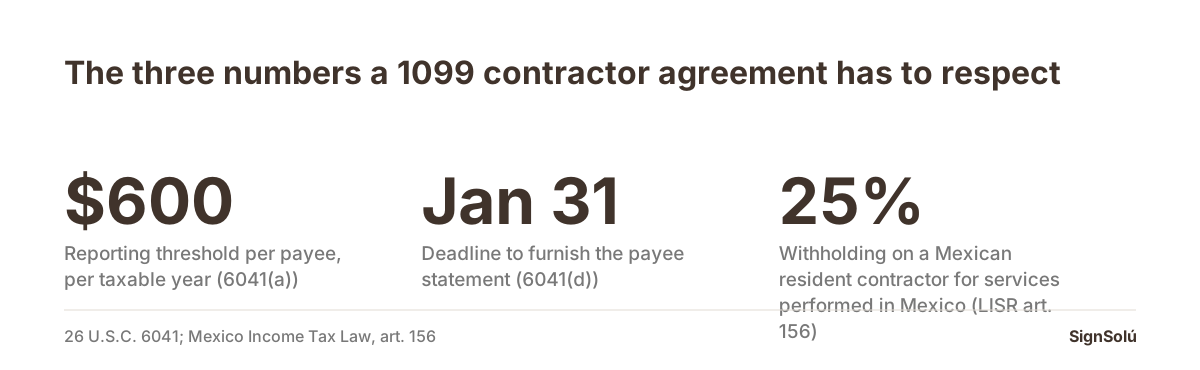
It is not per invoice and not per project. Section 6041(a) says $600 or more in any taxable year, so three invoices of $250 to the same designer in the same year cross the line even though no single invoice does.
Two practical consequences for the agreement. First, the contract should say who tracks the running total, because in small companies nobody does and the January scramble is the result. Second, if the engagement is one of several with the same person, the agreement should reference the others or be written as a master agreement with work orders, so the total is visible in one place.
Payment terms are the other half of the same problem, and they are treated on their own in independent contractor payment terms.
The TIN clause, and why it is not boilerplate
Section 6041(c) is one line: when necessary to make effective the provisions of that section, the name and address of the recipient of income shall be furnished upon demand of the person paying the income. The payer is entitled to ask, and the payee is required to answer.
Section 3406(a)(1) of the Code is what happens if they do not. If the payee fails to furnish his taxpayer identification number to the payor in the manner required, or the Secretary notifies the payor that the number furnished is incorrect, the payor shall deduct and withhold from such payment a tax equal to the product of the fourth lowest rate of tax applicable under section 1(c) and such payment. That is backup withholding, and the rate is whatever that bracket is for the year — the statute states a formula, not a percentage.
So the clause that matters is not a recital that the contractor is independent. It is the one that says the contractor will provide a completed taxpayer identification form before the first payment, that payment is conditioned on it, and that the payer will withhold as required by section 3406 if it is missing. That single clause is the difference between a clean file and a withholding problem discovered in February.
The January 31 statement
Section 6041(d) requires the payer to furnish each person about whom a return is required a written statement showing the name, address and phone number of the information contact of the payer, and the aggregate amount of payments. The statute sets the date: on or before January 31 of the year following the calendar year for which the return was required.
That date is the reason the agreement should carry a current address and a current email for the contractor, and a clause that puts the duty to update them on the contractor. A statement that cannot be delivered is still a statement that was required.
What actually belongs in the agreement
| Clause | Why it is there | What templates get wrong |
|---|---|---|
| Scope of work and deliverables | It is the evidence of what was bought: a result, not hours | Describing a role instead of a deliverable |
| Control over how the work is done | The facts of control are what classification turns on | Setting hours and supervision while calling the person a contractor |
| Tools, workspace and expenses | Who provides them is part of the same picture | Silence, which in practice means the payer provides everything |
| Taxpayer identification form before first payment | Section 6041(c) and section 3406(a)(1) | A recital that the contractor "is responsible for their own taxes" and nothing else |
| Notice address and duty to keep it current | Section 6041(d) sets a January 31 deadline | An address that was true on the day of signature |
| Right to work for others | Exclusivity cuts against contractor status | A non-compete copied from an employment template |
| Intellectual property assignment | Work made for hire does not cover everything by default | Assuming the payer owns the output because it paid for it |
| Term and termination for convenience | A fixed indefinite engagement looks like employment | No end date at all |
If what the business actually needs is an employee, the right document is an employment contract. In Mexico that choice has its own consequences, set out in hiring employees in Mexico and in employer of record or your own contract. The template itself is in the independent contractor agreement.
- 1Get the taxpayer identification form before the first payment, and say in the agreement that payment is conditioned on it. That is sections 6041(c) and 3406(a)(1) in one clause.
- 2Name one person who tracks the running total per payee, because the $600 threshold is annual and nobody notices it crossing.
- 3Put a current notice address and email in the agreement, with a duty to keep them updated, so the January 31 statement can actually be delivered.
- 4Describe a deliverable, not a role, and leave the method of work to the contractor. That is the part a label cannot fix.
- 5Keep the signed agreement with its date, because the date is what ties the payments to the engagement when someone asks a year later.
When the contractor is in Mexico
This is where a US-shaped template starts missing things, and it is common: a US company engages a developer, a designer or a plant supervisor who lives in Mexico and works there.
Article 156 of the Mexican Income Tax Law says that for income from fees and, in general, from the rendering of an independent personal service, the source of wealth is in Mexican territory when the service is performed in the country. It presumes the service is performed entirely in Mexico if any part of it is, unless the taxpayer proves the share performed abroad. The tax is 25% of the total income with no deductions, and the person making the payments withholds it if they are resident in Mexico or a foreign resident with a permanent establishment in Mexico to which the service relates. In other cases the contractor files and pays within fifteen days of receiving the income.
Article 156 also carries an exemption worth reading before you assume a withholding applies: fees paid by foreign residents with no permanent establishment in the country are excepted, subject to conditions on the length of the provider's stay. Article 153 is the one that frames the whole title, for foreign residents with income from a source in Mexico.
The practical version: the agreement should say where the service will be performed, who withholds what, and whether the fee is gross or net of withholding. Getting that wrong is how a fixed fee turns into a 25% argument. The Mexican-side contract is described in the independent contractor in Mexico, the development case in software developers in Mexico, and the first documents of a nearshoring move in nearshoring in Mexico. If the person will in fact be an employee of a Mexican entity, the work permit side is in what your employer signs; if a maquila is involved, the maquila contract in Mexico; and if the engagement starts with a letter rather than a contract, a letter of intent with a Mexican company.
The confidentiality agreement is a separate document
Bundling it into the services agreement is tempting and usually wrong, because the two have different lifespans: confidentiality should survive termination. The standalone document is in the non-disclosure agreement, the clause most Word templates leave out is in the notice most of them skip, and the Mexican supplier case is in an NDA with a Mexican supplier.
Getting it signed across the border
Article 89 of Mexico's Commercial Code subjects commercial acts to the principles of technological neutrality and functional equivalence, and defines an electronic signature as one that produces the same legal effects as a handwritten signature and is admissible as evidence. Article 93 treats the written form as met by a data message as long as the information stays complete and accessible for later consultation. What a Mexican signature is worth on the US side is in is a Mexican e-signature valid in the US, and the other direction in is an electronic signature valid in Mexico and the validity notes for the United States and for Mexico.
SignSolú is a Mexican e-signature platform that works over WhatsApp. You send the agreement by WhatsApp from your own number or by email, the contractor signs from a phone without opening an account or paying anything, and the audit receipt records time, IP address, device and the SHA-256 hash of the file. Anyone can check the document at the verification page with no account. The sender picks the language for each signer, so a signer who reads English gets the email, the WhatsApp message and the signing page in English. How a remote signature works end to end is in how to sign a contract remotely with someone in Mexico; what the platform stores is in trust; plans are in pricing, and the free plan is 10 documents with no expiry and no card. You can create an account and send the first one today.
Frequently asked questions
Does filing a 1099 make someone an independent contractor?
No. Section 6041(a) of the Internal Revenue Code requires a business to report payments of $600 or more made in the course of its trade or business. It reports a payment; it does not decide the status of the person paid. Classification depends on the facts of the working relationship.
Is the $600 threshold per invoice or per year?
Per payee, per taxable year. Section 6041(a) says $600 or more in any taxable year, so several smaller payments to the same person in the same year are added together: three invoices of $250 to the same designer cross the line even though no single invoice does. That is why someone has to own the running total per payee rather than looking at invoices one at a time.
What happens if the contractor will not give a taxpayer identification number?
Section 3406(a)(1) requires the payer to deduct and withhold a tax equal to the product of the fourth lowest rate of tax under section 1(c) and the payment. That is why the agreement should make the first payment conditional on receiving the completed form.
When does the payer have to send the statement to the contractor?
Section 6041(d) requires it on or before January 31 of the year following the calendar year covered by the return, and it must show the payer's information contact and the aggregate amount of payments.
Do I withhold Mexican tax if my contractor lives in Mexico?
It depends on who pays and where the service is performed. Article 156 of the Mexican Income Tax Law puts the source of wealth in Mexico when the service is performed there, sets the tax at 25% of total income with no deductions, and makes the payer withhold when the payer is resident in Mexico or a foreign resident with a permanent establishment there. The same article carries an exemption for fees paid by foreign residents without a permanent establishment, subject to conditions.
Can the contractor sign electronically?
Yes on the Mexican side: article 89 of the Commercial Code gives an electronic signature the same legal effects as a handwritten one and makes it admissible as evidence, and article 93 treats the written form as met by a data message that stays complete and accessible. Whether a particular US filing needs an ink signature is a separate question for your accountant.
Send your next contract to Mexico for signature
Create a free account and send 10 documents with no card. Your dashboard works in English. You set the language per signer, and their email, WhatsApp message and signing page arrive in that language.