An employee loan repayment agreement in the United States: the payroll deduction that stops at the minimum wage
Write the loan, the instalments and the authorisation, and then size the instalment so it never reaches the floor. Under 29 C.F.R. § 531.35, wages cannot be considered paid unless they are paid finally and unconditionally, or «free and clear», and the wage requirements of the Fair Labor Standards Act are not met where the employee kicks back to the employer, directly or indirectly, the whole or part of the wage delivered. A repayment deduction that cuts into the minimum wage required for that workweek is the textbook example, and the employee’s signature on the agreement does not cure it. Section 531.36 applies the same test in non-overtime weeks and § 531.37 in overtime weeks.
Two questions that get answered as one
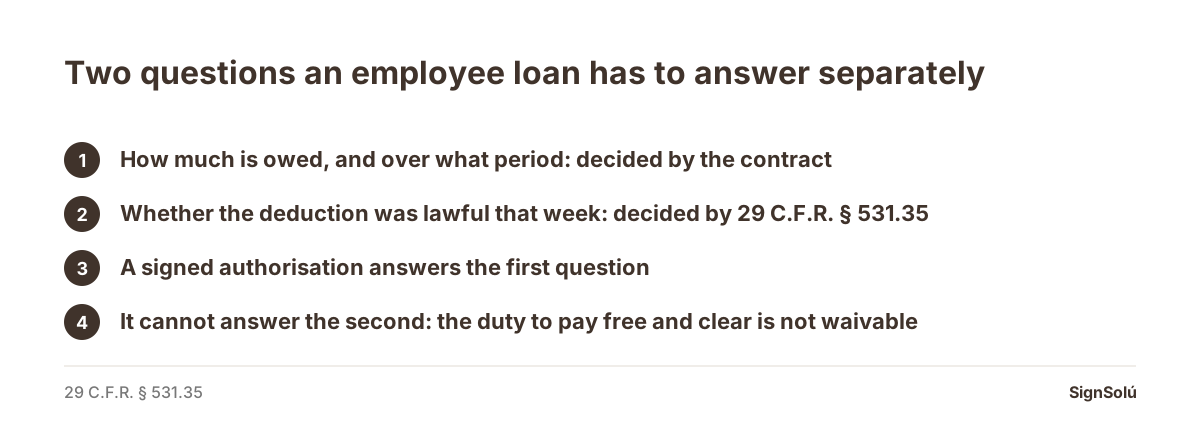
An employer lends an employee money — for a car repair, a deposit on an apartment, a relocation — and the repayment comes out of payroll. Everyone signs something. The document usually answers one question well: how much is owed and over what period. It rarely answers the second: whether that particular deduction, in that particular workweek, was lawful.
Those are separate questions, and they are decided by different things. The first is contract. The second is wage law, and the employee’s consent is not the test.
What «free and clear» means
Section 531.35 of title 29 of the Code of Federal Regulations is short and blunt. Whether in cash or in facilities, wages cannot be considered to have been paid by the employer and received by the employee unless they are paid finally and unconditionally or «free and clear». And the wage requirements of the Act are not met where the employee «kicks-back» directly or indirectly to the employer or to another person for the employer’s benefit the whole or part of the wage delivered — whether the kick-back is made in cash or in other than cash.
The regulation’s own example is about tools: if the employer requires the employee to provide tools of the trade used in or specifically required for the employer’s particular work, there is a violation in any workweek when the cost of those tools cuts into the minimum or overtime wages required to be paid. The structure of the rule is what matters for a loan: it is not a cap expressed as a percentage, and it is not waivable by agreement. It is a floor measured workweek by workweek.
Why a signature does not fix it
The authorisation is doing real work — it is what makes the deduction something other than an unexplained shortfall, and it is the document the bookkeeping rests on. What it cannot do is convert an unlawful deduction into a lawful one, because the obligation it would be waiving is the employer’s statutory duty to pay the minimum wage free and clear, not a private debt owed to the employee.
The practical consequence is in the arithmetic, not the drafting. An instalment sized as a fixed dollar amount will eventually land in a week with fewer hours — a short week, a leave week, a final week — and that is the week in which it breaches the floor. An instalment sized so that pay after deduction never falls below the applicable minimum for the hours actually worked does not.
| The question | What decides it | Where it is written |
|---|---|---|
| How much is owed | The loan agreement | Contract |
| Is the deduction authorised | The written authorisation signed by the employee | Contract |
| Was the wage paid free and clear | Whether the deduction cut into the minimum wage that week | 29 C.F.R. § 531.35 |
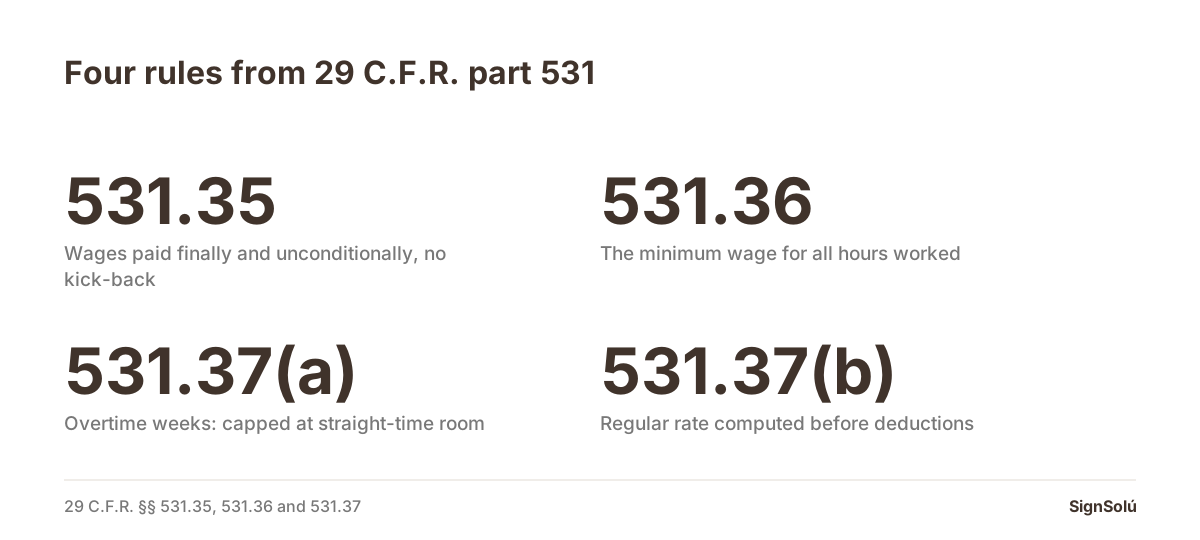
| Non-overtime workweeks | Section 3(m) and part 531 apply to the applicable minimum wage for all hours worked | 29 C.F.R. § 531.36(a) |
| Overtime workweeks | Deductions may be made on the same basis, capped at what could be deducted on straight time | 29 C.F.R. § 531.37(a) |
| The regular rate for overtime | Computed on the stipulated wage before any deductions | 29 C.F.R. § 531.37(b) |
The overtime week is the one people get wrong
Section 531.37(a) allows deductions to be made on the same basis in an overtime workweek as in non-overtime workweeks, if their purpose and effect are not to evade the overtime requirements of the Act or other law, and provided the amount deducted does not exceed the amount which could be deducted if the employee had only worked the maximum number of straight-time hours during the workweek. In other words, overtime hours do not create extra room for repayment.
The same section adds a warning worth reading twice: deductions made only in overtime workweeks, or increases in the prices charged for articles or services during overtime workweeks, will be scrutinised to determine whether they are manipulations to evade the overtime requirements. A repayment schedule that quietly accelerates in busy weeks is exactly the pattern that invites that scrutiny. And § 531.37(b) settles a question payroll teams ask: where deductions are made from a stipulated wage, the regular rate of pay is arrived at on the basis of the stipulated wage before any deductions.
The final paycheck
This is where most loan agreements end up being tested, because an employee who leaves with a balance outstanding is the whole reason the document exists. Two things to keep apart. Recovering the balance as a debt is an ordinary contractual claim and the agreement supports it. Recovering it by deducting from the last paycheck is a wage question, and the free-and-clear rule applies to that paycheck like any other.
A final week is often a short week, which is precisely when a fixed instalment is most likely to breach the floor. Drafting that acknowledges this — a balloon clause that converts the balance into a debt payable on a stated date rather than a deduction without limit — gets the employer further than a clause that purports to authorise deducting «any outstanding amount» from the final payment. The ending of the employment relationship itself is a separate document: contract termination letter for an employee covers how notice works in the United Kingdom, and terminating an employee is the general guide; the Fair Labor Standards Act itself is published by the Department of Labor at dol.gov.
And a reminder that this is federal floor, not ceiling: state wage laws frequently add their own requirements for payroll deductions — written authorisation in a prescribed form, caps on the percentage, outright bans on deducting certain items. The federal rule is the one that cannot be contracted around; the state rule is the one that most often decides the case.
What the agreement should actually say
- 1The principal, the date advanced and how it was paid, so the loan is identifiable as a loan rather than an advance on wages.
- 2Interest, or its absence, stated expressly, along with any tax treatment the parties have agreed to document.
- 3The instalment, expressed so it cannot breach the floor: a stated amount together with a cap tied to the minimum wage for hours actually worked in the pay period.
- 4A written authorisation to deduct, signed and dated, and revocable or not on stated terms.
- 5What happens in a short week: the instalment is reduced or skipped and the balance carries, rather than being made up by a larger deduction later.
- 6What happens on termination: the balance becomes a debt payable on a stated date, kept separate from any deduction from the final paycheck.
- 7Early repayment, whether it is allowed and whether anything is rebated.
- 8Governing law, because the state rules are the ones that will add requirements.
The employee loan agreement template sets out those fields; a plain loan between parties who are not employer and employee is loan agreement template. The UK version of the same document, where the two dates on the agreement decide the case, is in employee loan agreement template UK. The employment relationship around it is in letter of offer of employment and employment letter. If the person being paid is not an employee at all, the document and the tests are different: independent contractor agreement template and independent contractor payment terms. A settlement that wraps up a disputed balance is settlement agreement template, explained in the six conditions.
Getting it signed, and keeping the date
Two dates matter later: when the authorisation was signed, and when each change to it was agreed. A loan that is varied by a conversation and confirmed by nothing is the version that cannot be reconstructed two years afterwards, which is when it tends to be needed. Whether an electronic signature binds, and where, is in is an electronic signature legally binding, and where.
SignSolú sends the agreement by WhatsApp or by email and the employee signs it from a phone, with no account and no payment on their side. Every document carries an audit receipt with time, IP, device and a SHA-256 hash, and anyone can check it at /verificar without an account. The interface is in Spanish; the sender chooses each signer’s language, so an employee added in English receives the email, the WhatsApp message and the signing page in English. SignSolú is a Mexican platform; for documents that need it in Mexico, it issues NOM-151 conservation certificates on the signed document through a certification service provider accredited by Mexico’s Ministry of Economy, switched on for your team on request. For a document that has to be produced years later with its date intact, that receipt is the point: start here — the free plan is 10 documents, no expiry and no card.
Frequently asked questions
Can I deduct a loan repayment from an employee’s wages if they signed an authorisation?
The authorisation is necessary but not sufficient. Under 29 C.F.R. § 531.35 wages cannot be considered paid unless they are paid finally and unconditionally, or free and clear, and the Act’s wage requirements are not met where the employee kicks back to the employer, directly or indirectly, the whole or part of the wage delivered. A deduction that cuts into the minimum wage for that workweek is not cured by consent.
Is there a percentage cap on the deduction?
The federal rule is not expressed as a percentage. It is a floor measured workweek by workweek: the deduction may not cut into the minimum or overtime wages required to be paid for that week. Several states do impose percentage caps and additional formalities, which is why the governing law clause matters.
Can I take a bigger instalment in a week with overtime?
No. Section 531.37(a) allows deductions on the same basis in an overtime workweek as in non-overtime workweeks, provided the amount deducted does not exceed what could be deducted if the employee had only worked the maximum number of straight-time hours. It also warns that deductions made only in overtime workweeks will be scrutinised as possible manipulations to evade the overtime requirements.
Do deductions change the overtime rate?
Section 531.37(b) says that where deductions are made from the stipulated wage of an employee, the regular rate of pay is arrived at on the basis of the stipulated wage before any deductions have been made. The deduction comes after the rate is computed, not before.
Can I take the whole balance out of the final paycheck?
Treat the balance and the deduction as two different things. The balance is a contractual debt and the agreement supports recovering it. Deducting it from the final payment is a wage question, and the free-and-clear rule applies to that payment as to any other — in a final week, which is often a short week, a full-balance deduction is the most likely to breach the floor.
What if the employee works fewer hours one week?
That is the week the agreement should plan for. Because the test is applied to the wages due for the hours actually worked in that workweek, a fixed instalment can breach the floor in a short week even though it was comfortable in a full one. A clause that reduces or skips the instalment and carries the balance forward is safer than one that makes it up with a larger deduction later.
Send your next contract to Mexico for signature
Create a free account and send 10 documents with no card. Your dashboard works in English. You set the language per signer, and their email, WhatsApp message and signing page arrive in that language.