Contract termination letter for an employee: the notice the law sets, and the date the law moves
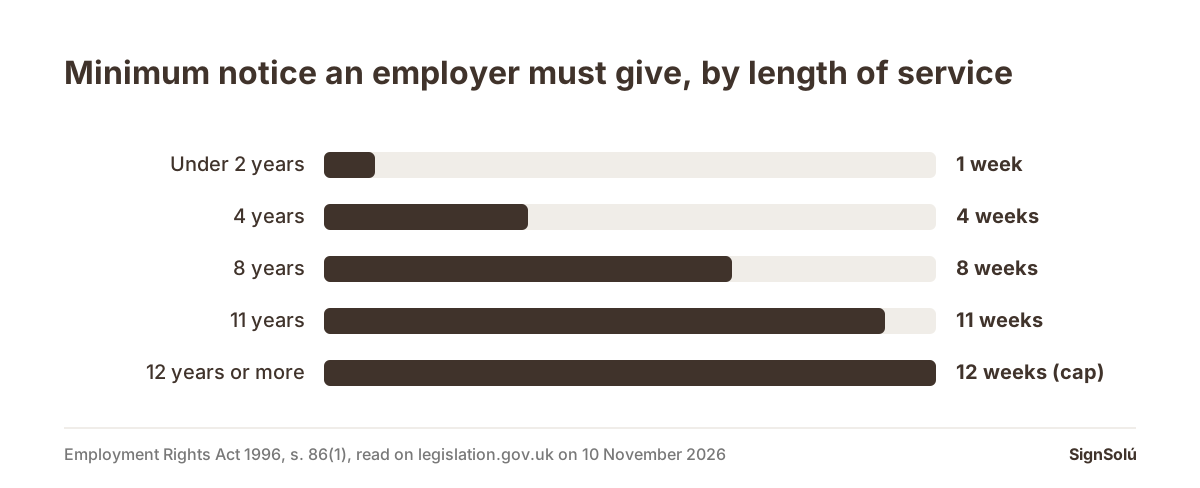
Two sections decide what the letter has to say. Section 86(1) of the Employment Rights Act 1996 sets the minimum notice an employer must give someone continuously employed for one month or more: not less than one week if service is under two years, not less than one week for each year of service between two and twelve years, and not less than twelve weeks at twelve years or more. Section 86(3) makes any shorter contractual notice take effect subject to that, although either party may waive notice or accept a payment in lieu. And section 92(7) is the one that bites: where the employer terminates and the section 86 notice would, if duly given on the material date, expire later than the stated date, the later date is the effective date of termination. A letter that gives too little notice moves the date everything else is counted from.
The letter is short. The two numbers in it are not optional
A termination letter is three paragraphs: that the contract is ending, when it ends, and what happens to pay and property. The second paragraph is where the templates go wrong, because the date is not a management decision. It is the output of a statutory formula.
Section 86(1) of the Employment Rights Act 1996 sets the notice required to be given by an employer to terminate the contract of employment of a person continuously employed for one month or more: (a) not less than one week if the period of continuous employment is less than two years, (b) not less than one week for each year of continuous employment where it is two years or more but less than twelve, and (c) not less than twelve weeks at twelve years or more. Twelve is the ceiling: a thirty-year employee is still entitled to twelve weeks under the statute, whatever more the contract may give.
Section 86(3): a shorter contractual notice does not survive
Subsection (3) does two things in one sentence. Any provision for shorter notice in a contract of employment with a person continuously employed for one month or more has effect subject to subsections (1) and (2); but the section does not prevent either party from waiving their right to notice on any occasion, or from accepting a payment in lieu of notice.
So a contract that says «one week» for a six-year employee is not void — it simply reads as six weeks. And payment in lieu is available, but as something accepted, not something imposed by the letter. If the contract has no PILON clause, paying instead of giving notice is a breach the employee may choose to accept; with a clause, it is a contractual option. That distinction is worth getting right before the letter goes out, not after.
Two edges of section 86 that catch people out
Subsection (4) says a contract of employment of a person continuously employed for three months or more which is a contract for a term certain of one month or less shall have effect as if it were for an indefinite period, and so subsections (1) and (2) apply to it. A series of short fixed-term engagements does not keep someone outside the notice regime. And subsection (6) preserves the other direction: the section does not affect any right of either party to treat the contract as terminable without notice by reason of the conduct of the other party. Gross misconduct is still gross misconduct; it is just not something a template decides.
Section 92(7): the date moves, and that is the expensive part
Here is the provision that turns a drafting slip into a legal problem. Section 92 defines «the effective date of termination» for its own purposes — the date the notice expires where notice was given, or the date termination takes effect where it was not — and then subsection (7) says that where the contract is terminated by the employer and the notice required by section 86, if duly given on the material date, would expire on a date later than that effective date, the later date is the effective date of termination. Subsection (8) defines the material date as the date notice of termination was given or, where none was given, the date the contract was terminated.
Read that with a calendar in hand. An employee with one year and eleven months of service, dismissed with no notice, is treated as terminating a week later — and a week later she has two years of service. Length of service is what unlocks a written statement of reasons under subsection (3), and it is what unlocks a great deal else in the Act. The cheapest mistake in a termination letter is an arithmetic one.
The written statement of reasons, and who gets it without asking
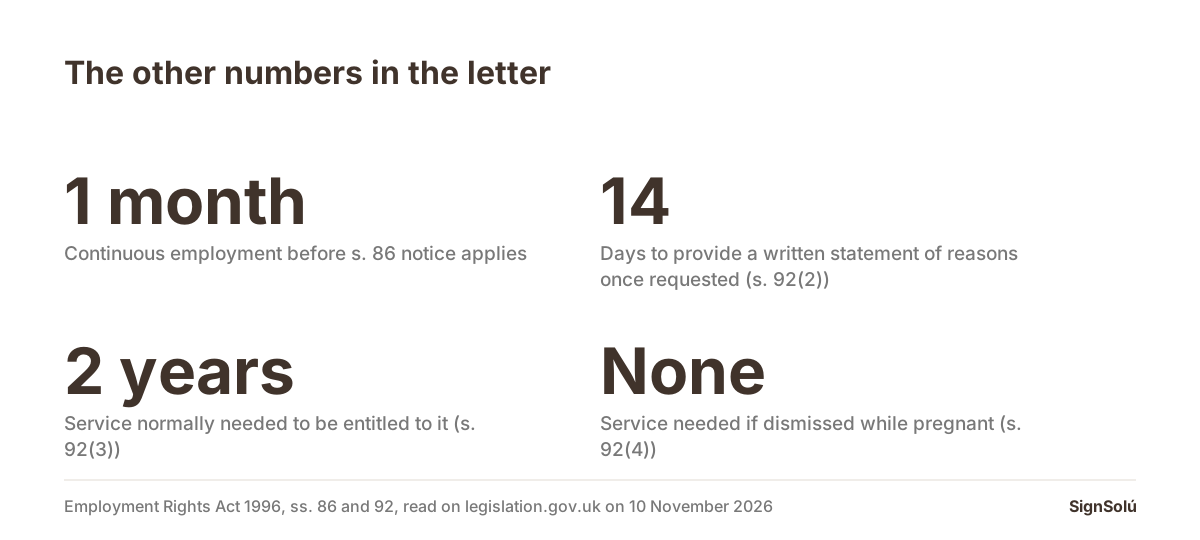
Section 92(1) entitles an employee to be provided with a written statement giving particulars of the reasons for their dismissal where they are given notice of termination, where the contract is terminated without notice, or where a limited-term contract terminates by virtue of the limiting event without being renewed. Subsection (2) makes it a request-based right and sets the deadline: a statement shall be provided within fourteen days of such a request. Subsection (3) normally requires two years of continuous employment ending with the effective date of termination.
Then the exceptions, which are the reason this cannot be delegated to a template. Subsection (4) entitles an employee to the statement without having to request it and irrespective of any qualifying period if she is dismissed at any time while she is pregnant, or after childbirth in circumstances where her ordinary or additional maternity leave period ends by reason of the dismissal. Subsection (4A) does the same for an employee dismissed while absent during an ordinary or additional adoption leave period, where that period ends by reason of the dismissal. And subsection (5) is the sting in the tail: a written statement under this section is admissible in evidence in any proceedings. Whatever the letter says about why, that is the employer’s case.
| What the letter does | Section | What follows |
|---|---|---|
| Gives less notice than the formula | 86(1) and 86(3) | The contractual term reads up to the statutory minimum |
| Gives no notice at all | 92(7) and 92(8) | Effective date of termination moves to when notice would have expired |
| Pays in lieu without a PILON clause | 86(3) | A breach the employee may accept, not an entitlement |
| Ends a one-month fixed term after 3 months service | 86(4) | Treated as indefinite; notice rules apply |
| Dismisses for gross misconduct | 86(6) | Notice rules unaffected by the section |
| States the reasons in writing | 92(5) | Admissible in evidence in any proceedings |
| Omits reasons for a pregnant employee | 92(4) | She is entitled to them with no request and no qualifying period |
| Answers a request for reasons late | 92(2) | The statement is due within fourteen days of the request |
What belongs in the letter
- 1The length of continuous employment, in years, because that is the input to section 86(1). Write it down; do not compute it in your head.
- 2The notice given and the date it expires, with the statutory minimum named. If the contract gives more, the contract wins; if it gives less, section 86(3) reads it up.
- 3Whether notice is being worked, waived or paid in lieu, and under which clause. «Payment in lieu» with no clause behind it is a different legal event.
- 4The effective date of termination, stated as such, after checking it against section 92(7).
- 5The reasons, if they are being given, knowing section 92(5) makes the statement admissible in evidence.
- 6Accrued holiday, final pay date, property and access, and what the employee has to return.
- 7Who to contact and how to appeal, where a procedure exists. A letter that closes the door invites the claim.
For the shape of the document, the termination letter page sets out those blocks, and the matching instruments are the letter of offer of employment at the other end of the relationship, an employment letter for confirming terms, a contract amendment when the change is mid-term rather than final, and a settlement agreement when the exit is negotiated instead of notified. The six statutory conditions a settlement agreement has to meet before it binds are in settlement agreement template: the six conditions.
Two neighbouring cases are worth naming because the notice analysis is different. Where the worker has irregular hours, the clause that most zero-hours templates still carry is already unenforceable: zero hours contract template. And where the person was never an employee, none of section 86 applies: the terms are whatever the contract says, which is why the payment clause matters so much in independent contractor payment terms and 1099 contractor agreement template. The documents for that relationship are a freelance contract or an independent contractor agreement, and confidentiality usually travels separately, in a mutual NDA or an employee confidentiality agreement.
If the person being dismissed is employed in Mexico, stop and start again: none of the above applies there. Mexican employment is governed by the Federal Labour Law, dismissal needs a cause and a written notice of its own, and the paperwork is set out in hiring employees in Mexico, employer of record or your own contract and work permit Mexico: what your employer signs. The offer stage is in job offer letter for a job in Mexico.
Proving the date it was served
Everything above turns on dates: when notice was given, when it expires, when a request for reasons arrived, when the statement went back. A year later those dates are either documentary or they are a disagreement. And the statute itself is moving: legislation.gov.uk lists provisions of the Employment Rights Act 2025 not yet applied to the 1996 Act, so the version to read is the one on the day you write the letter.
SignSolú is an e-signature platform that works over WhatsApp, and that is the narrow job it does here. Each document you send keeps an audit receipt with the time, the IP, the device and a SHA-256 hash of the file, and the recipient acknowledges it by signing rather than by replying — so the letter becomes a dated, hashed, acknowledged document instead of an email with a read receipt nobody kept. Anyone can check it later at /verificar without an account, and signers need no account and pay nothing. The interface is in Spanish; what the sender chooses per signer is the language, so a signer set to English gets the email, the WhatsApp message and the signing page in English. Whether that signature binds, and where, is in is an electronic signature legally binding. The free plan is 10 documents with no expiry and no card: start here.
Frequently asked questions
How much notice do I have to give?
Section 86(1) of the Employment Rights Act 1996 sets the minimum for someone continuously employed for one month or more: not less than one week if service is under two years; not less than one week for each year of continuous employment where it is two years or more but less than twelve; and not less than twelve weeks at twelve years or more. Twelve weeks is the statutory ceiling, whatever the length of service beyond that.
The contract says one week. Can I rely on that?
Not where the statutory minimum is longer. Section 86(3) says any provision for shorter notice in a contract with a person continuously employed for one month or more has effect subject to subsections (1) and (2). The clause is not void; it simply reads up to the statutory minimum. The same subsection does allow either party to waive notice on an occasion or to accept a payment in lieu.
What happens if the letter gives too little notice?
The date moves. Section 92(7) provides that where the employer terminates and the notice required by section 86, if duly given on the material date, would expire later than the effective date of termination as otherwise defined, the later date is the effective date of termination. Since length of service is counted to that date, a short notice period can push an employee past a qualifying threshold.
Do I have to put the reasons in the letter?
Not always, but be careful what you write. Section 92(1) and (2) make the written statement of reasons a right the employee requests, to be provided within fourteen days, and subsection (3) normally requires two years of continuous employment. Subsection (5) makes any such statement admissible in evidence in any proceedings, so the reasons given become the employer’s case.
Is there anyone who gets the reasons automatically?
Yes. Under section 92(4) an employee is entitled to a written statement without having to request it and irrespective of any qualifying period if she is dismissed while pregnant, or after childbirth where her ordinary or additional maternity leave period ends by reason of the dismissal. Section 92(4A) applies the same rule to dismissal during an ordinary or additional adoption leave period that ends by reason of the dismissal.
Can I dismiss without notice for misconduct?
Section 86(6) says the section does not affect any right of either party to a contract of employment to treat the contract as terminable without notice by reason of the conduct of the other party. So the notice rules do not stand in the way. Whether the conduct justifies it, and what procedure was followed, are different questions that section 86 does not answer.
Send your next contract to Mexico for signature
Create a free account and send 10 documents with no card. Your dashboard works in English. You set the language per signer, and their email, WhatsApp message and signing page arrive in that language.