«HIPAA compliance form»: there is no single one, and the authorization has six required elements
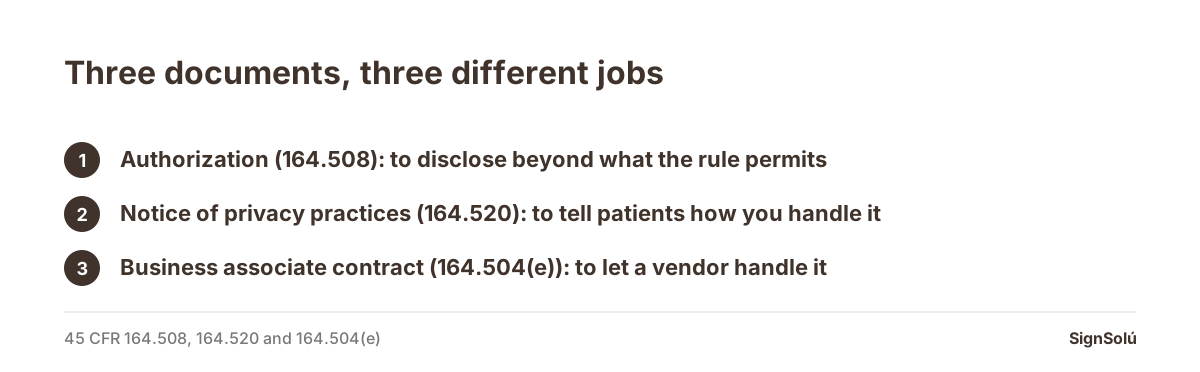
There is no document called a «HIPAA compliance form». The Privacy Rule describes three different ones, and which you need depends on what you are doing. To use or disclose protected health information beyond what the rule already permits, you need an **authorization**, and 45 CFR 164.508(c)(1) lists six core elements it must contain, plus three statements required by (c)(2). To tell patients how you handle their information, you need the **notice of privacy practices** of § 164.520. And to let a vendor handle that information for you, you need the **business associate contract** described in § 164.504(e). Missing one element makes an authorization invalid under (b)(2)(ii).
Three documents, three different jobs
The phrase «HIPAA compliance form» comes from the front desk, not from the rule. What a clinic, a dental practice, a therapist or a small lab actually signs is one of three documents, and they are not interchangeable. Confusing them is the most common cause of a disclosure that should not have happened, or of a release that a records department refuses to honour.
| What you are doing | The document | Where it is described |
|---|---|---|
| Disclosing records beyond what the rule already permits | Authorization | 45 CFR 164.508 |
| Telling patients how you handle their information | Notice of privacy practices | 45 CFR 164.520 |
| Letting a vendor handle that information for you | Business associate contract | 45 CFR 164.504(e) |
| Treatment, payment and health care operations | Usually none of the above | Permitted without authorization, subject to the rule |
| Psychotherapy notes | Authorization, with narrow exceptions | 164.508(a)(2) |
| Marketing, or a sale of information | Authorization with an extra statement | 164.508(a)(3) and (a)(4) |
The six core elements of an authorization
Paragraph (c)(1) of 45 CFR 164.508 says a valid authorization must contain at least the following elements. Six, and each one has a detail that templates get wrong.
- 1A description of the information to be used or disclosed that identifies it in a specific and meaningful fashion. «All medical records» is the line that gets a release rejected; a date range and a record type do not.
- 2The name or other specific identification of the person or class of persons authorized to make the requested use or disclosure. Who is releasing it.
- 3The name or other specific identification of the person or class of persons to whom the disclosure may be made. Who is receiving it.
- 4A description of each purpose of the requested use or disclosure. The rule adds that «at the request of the individual» is a sufficient description when the individual initiates the authorization and does not, or elects not to, state a purpose.
- 5An expiration date or an expiration event that relates to the individual or the purpose. For research, the rule accepts «end of the research study», «none» or similar language.
- 6Signature of the individual and date. If a personal representative signs, the authorization must also describe that representative’s authority to act for the individual.
The sixth is where an electronic signature has to carry its weight: a signature with no reliable date, or with a date typed by hand, leaves the element technically present and practically unprovable.
The three statements most templates skip
Paragraph (c)(2) adds that, in addition to the core elements, the authorization must contain statements adequate to place the individual on notice of three things. They are not optional and they are not boilerplate: each one answers a question the individual is entitled to have answered before signing.
- The right to revoke in writing, together with either the exceptions to that right and how to revoke, or a reference to the covered entity’s notice where § 164.520 already contains that information.
- The ability or inability to condition treatment, payment, enrolment or eligibility on signing — stating either that the covered entity may not condition it, where the prohibition in (b)(4) applies, or the consequences of refusing where it may.
- The potential for redisclosure: that information disclosed under the authorization may be redisclosed by the recipient and no longer be protected by the Privacy Rule. This is the one patients most often have not understood.
And three more requirements sit nearby. Paragraph (c)(3) says the authorization must be written in plain language. Paragraph (c)(4) says that if the covered entity seeks the authorization, it must give the individual a copy. And paragraph (b)(6) requires the covered entity to document and retain any signed authorization as required by § 164.530(j).
Five ways an authorization is invalid
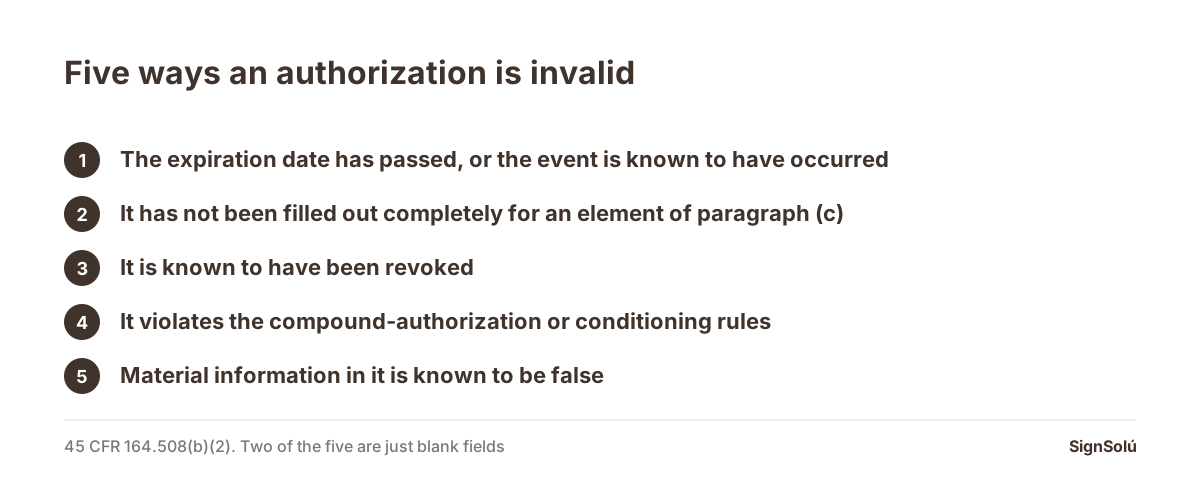
Paragraph (b)(2) is the most useful paragraph in the section for anyone handling records, because it lists the defects that make an authorization not valid. A records clerk who knows these five reads a release in ten seconds.
- 1The expiration date has passed, or the expiration event is known by the covered entity to have occurred.
- 2The authorization has not been filled out completely with respect to an element described by paragraph (c), if applicable. This is the one that catches a missing date range or a blank purpose.
- 3The authorization is known by the covered entity to have been revoked.
- 4It violates the compound-authorization rule of (b)(3) or the conditioning rule of (b)(4), if applicable.
- 5Any material information in it is known by the covered entity to be false.
Two of those five are about completeness, which is why the practical fix is a form that cannot be submitted half-empty rather than a longer form. And (b)(3) deserves a line of its own: an authorization for use or disclosure of protected health information may not be combined with any other document to create a compound authorization, except in the cases the rule allows. Stapling the release to the intake packet is exactly the habit that paragraph is about.
Revocation, and what it does not undo
Paragraph (b)(5) says an individual may revoke an authorization at any time, provided that the revocation is in writing, except to the extent that the covered entity has taken action in reliance on it, or that the authorization was obtained as a condition of obtaining insurance coverage and other law gives the insurer the right to contest a claim or the policy itself.
The practical consequence: a revocation stops future disclosures, not past ones. Which makes the date on both documents — the authorization and the revocation — the fact that decides whether a particular disclosure was covered. Keeping that pair with reliable timestamps is most of the compliance work.
The two documents people reach for by mistake
The notice of privacy practices
It is not a permission slip. Section 164.520 is about telling individuals how their information is used, and the acknowledgement a front desk collects is not an authorization: it does not let you disclose anything that the rule did not already permit. A practice that has only this on file, and believes it has consent, has a gap.
The business associate contract
Section 164.504(e) covers the contract between a covered entity and a vendor that handles protected health information on its behalf. Its paragraph (e)(1)(ii) adds a duty that is easy to miss: a covered entity is not in compliance if it knew of a pattern of activity or practice of the business associate that constituted a material breach or violation of the contract, unless it took reasonable steps to cure or end it and, if those failed, terminated the contract where feasible. Knowing and doing nothing is itself the violation.
The form for the first of the three documents is the HIPAA release form. A consent to treatment is a different document again: the medical consent form, and for research, the consent form for research. Where the information is personal data rather than health records, the document is the data privacy consent form — the case is set out in a medical consent form for a minor while parents are away. For a dental practice, the consent that matters is described in dental work in Mexico: the consent form.
Signing it, and proving it later
Two of the rule’s requirements are really evidence requirements. The signature and date of element six, and the retention duty of paragraph (b)(6) read with § 164.530(j). A paper release signed at the counter satisfies both only if the practice can find it years later and show it has not been altered.
With SignSolú the authorization goes out over WhatsApp from your own number or by email, the patient or the personal representative signs from a phone without creating an account or paying anything, and the audit receipt records the time, the IP address, the device and the SHA-256 hash of the file, with each signature timed separately. Anyone can check later that the document did not change at the verification page, with no account — which is the practical answer to «prove this release is the one that was signed». The sender picks each signer’s language, so a patient who reads English gets the email, the WhatsApp message and the signing page in English. SignSolú is a Mexican platform and is not an accredited certification provider in Mexico; it does not issue NOM-151 conservation certificates. The free plan is 10 documents with no expiry and no card; start at register. The general question of validity is covered in is an electronic contract valid.
Frequently asked questions
Is there one official HIPAA compliance form?
No. The Privacy Rule describes an authorization in 45 CFR 164.508, a notice of privacy practices in § 164.520 and a business associate contract in § 164.504(e). Which one you need depends on whether you are disclosing information, informing patients, or letting a vendor handle it.
What must a HIPAA authorization contain?
Six core elements under paragraph (c)(1): a specific and meaningful description of the information, who may disclose it, who may receive it, each purpose, an expiration date or event, and the individual’s signature and date. Plus the three statements required by paragraph (c)(2).
Does «all medical records» work as a description?
It is the usual reason a release is rejected. Paragraph (c)(1)(i) requires a description that identifies the information in a specific and meaningful fashion, which in practice means a record type and a date range.
Can I put the HIPAA authorization inside my intake packet?
Paragraph (b)(3) says an authorization for use or disclosure of protected health information may not be combined with any other document to create a compound authorization, except in the cases the rule allows. Combining it outside those cases is one of the defects listed in (b)(2).
Can a patient revoke an authorization?
Yes, at any time, provided the revocation is in writing — except to the extent the covered entity has already taken action in reliance on it, or where the authorization was a condition of insurance coverage and other law lets the insurer contest a claim or the policy.
Does the authorization have to be on paper?
The rule asks for the individual’s signature and date and for the authorization to be documented and retained under § 164.530(j); it does not prescribe paper. What matters is that you can produce the signed document later and show which version was signed.
Send your next contract to Mexico for signature
Create a free account and send 10 documents with no card. Your dashboard works in English. You set the language per signer, and their email, WhatsApp message and signing page arrive in that language.