When do you need a model release? The trigger is the use, not the camera
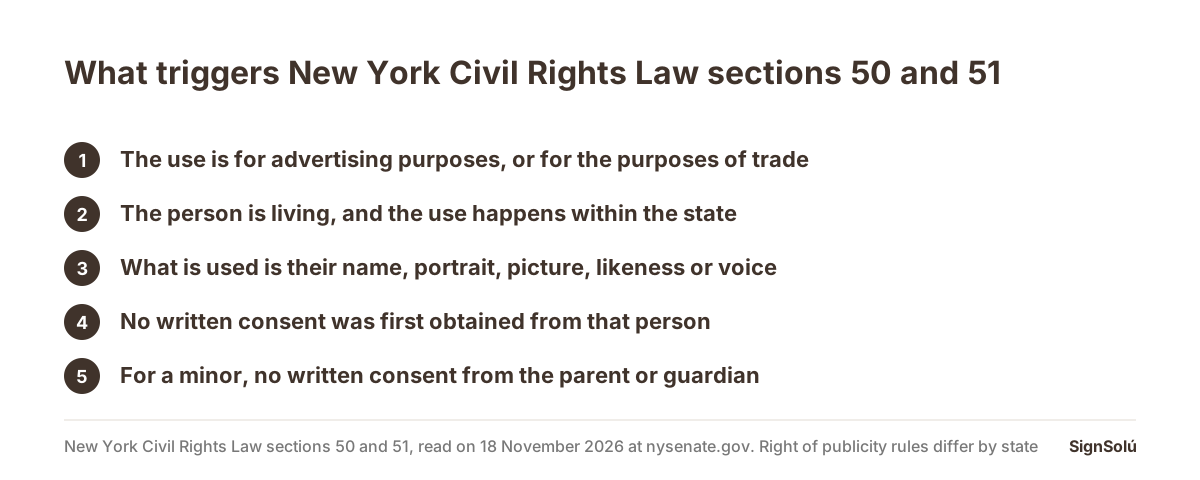
When the picture is going to be used for advertising or trade, not merely because a recognisable person is in it. New York Civil Rights Law § 50 makes it a misdemeanour for a person, firm or corporation to use, «for advertising purposes, or for the purposes of trade», the name, portrait, picture or voice of a living person without having first obtained written consent — and for a minor, the written consent of the parent or guardian. Section 51 adds the civil side: an injunction and damages, with exemplary damages available only where the defendant knowingly did what § 50 forbids. So the trigger is the use and not the shutter: taking a photograph in a public place is not what the statute addresses. Putting that face on a package, in an advertisement or in a brand campaign is. The two words that decide most arguments are «advertising» and «trade», and they are doing a lot of work.
Photographers tend to ask this question at the wrong moment: on location, with the camera up, about whether they are allowed to take the picture. The statute that most of this comes from is not about taking pictures. It is about what somebody does with one afterwards.
The statute, and the two words that matter
Section 50 of the New York Civil Rights Law — read today at nysenate.gov — makes it a misdemeanour for «a person, firm or corporation that uses for advertising purposes, or for the purposes of trade» the name, portrait, picture or voice of a living person without first obtaining that person’s written consent. Where the subject is a minor, the written consent of the parent or guardian is what the statute asks for.
Section 51 of the same law builds the civil remedy on top. A person whose «name, portrait, picture, likeness or voice is used within this state» for those purposes, without the written consent «first obtained as above provided», may sue to prevent and restrain the use and to recover damages. Exemplary damages are not automatic: they are available where the defendant knowingly used the identity in a manner § 50 forbids, and then the jury «may award exemplary damages».
Two details in that wording are worth pulling out, because they change what you should do rather than just what you should know. The consent has to be written, so a verbal yes on set is not what the statute describes. And it has to be first obtained, which means before the use — a release signed after a campaign has run is repair work, not compliance.
Why street photography is usually a different question
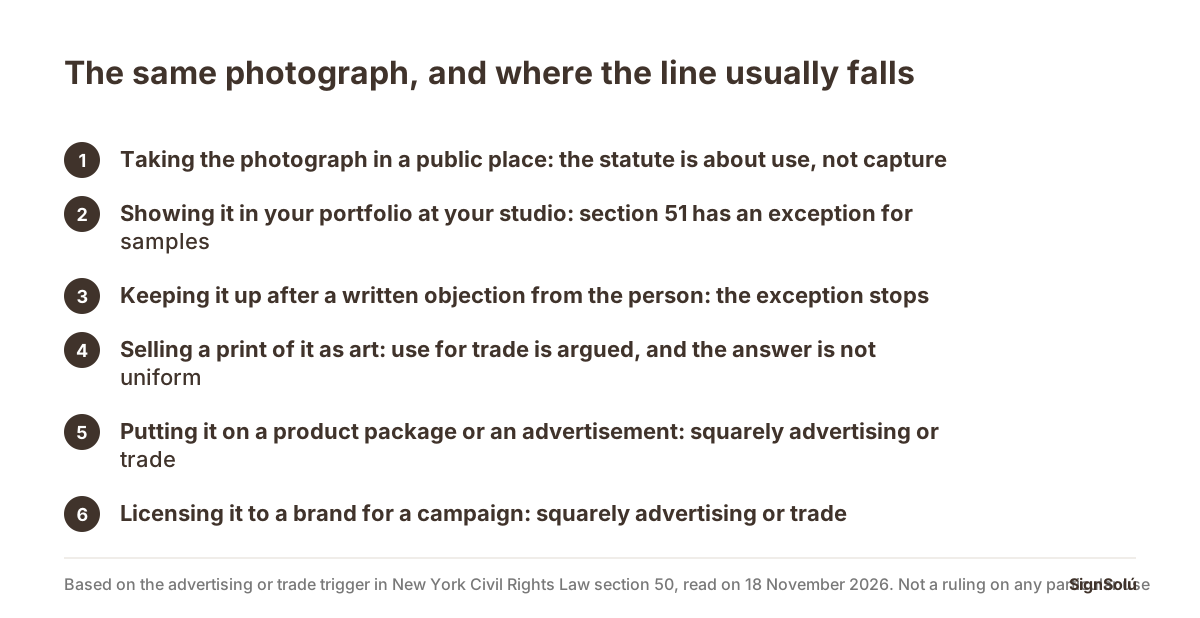
Because «advertising purposes» and «purposes of trade» are not synonyms for «any use at all». The statute does not say that photographing a stranger requires their consent, and it does not say that publishing a photograph requires it either. It attaches to a category of use. That is why the answer to «do I need a model release for street photography» is almost always «not for the photograph, possibly for what you later do with it».
The practical consequence is that the release is a function of the client, not the shoot. The same frame can sit in an archive for three years needing nothing, and then need a signed release the week a brand wants to license it. Photographers who treat the release as a shoot-day document end up chasing signatures years later from people whose last name they never wrote down.
The portfolio exception, and how it ends
Section 51 carries an exception that photographers should know verbatim, because it is narrow and it has an off switch. A photographer may display samples of their work in their own establishment — but not where the use continues «after written notice objecting thereto» from the person portrayed. So the exception is real, it is limited to your own premises, and a letter from the subject closes it.
Section 51 also carves out transfers of material to a user for lawful use, manufacturers and dealers using a name or likeness in connection with goods they have already sold bearing it, and authors, composers and artists doing the same with productions they have already sold. And it preserves other rights: nothing in the section limits rights or remedies available under other federal or state law.
What a release should actually nail down
Since the statute asks for written consent obtained first, the document’s job is to make the scope of the permitted use unambiguous enough that nobody has to argue about it later. The table is the practical checklist rather than statutory text.
| What the release states | Why it matters | What goes wrong without it |
|---|---|---|
| Who is granting the consent | Section 50 asks for the consent of that person | A release signed by an agent whose authority nobody checked |
| That the subject is an adult, or a guardian signs | For a minor the statute asks for the parent or guardian | The whole consent is open to challenge |
| The media and the territory covered | Scope is what the argument is usually about | Print was permitted, the campaign ran on billboards |
| Whether advertising and trade uses are included | Those are the uses the statute reaches | Editorial consent gets stretched to a brand campaign |
| Duration, or that it is perpetual | Archives outlive campaigns | A licence request arrives after the consent lapsed |
| Whether the name may be used, or only the image | Section 50 covers the name separately from the picture | The caption becomes the problem, not the photograph |
| Any uses excluded by agreement | Subjects often care about one specific thing | A negotiation that was settled verbally and recorded nowhere |
| The date it was signed | Consent has to be first obtained | No way to show the consent preceded the use |
The last row is the one people skip and the one the statute’s wording points at. «First obtained» is a sequence requirement, so being able to show when the release was signed is part of what makes it do its job. A template to start from is at /en/templates/model-release-form, and the related document for recorded interviews is at /en/templates/interview-consent-form.
Running releases so they exist when you need them
Because the release is a function of the eventual use, the only workable system is one that collects it early and keeps it findable. The order below is what separates a photographer who can answer a licensing request in an hour from one who spends a week on it.
- 1Collect on the day, even when the shoot is editorial. The cost of a signature on set is minutes; the cost of finding someone three years later is the licence you lose.
- 2Write down who the person is, not just that they signed. A release with a first name and an illegible signature is hard to match to a request about one specific frame.
- 3Name the frames or the session, not «the photographs». Scope arguments are almost always about which images were covered.
- 4Record the date the consent was given, since § 50 asks for consent first obtained and that is a claim about sequence.
- 5Keep the release findable from the image, so the file and the consent travel together instead of living in different systems.
- 6Re-read the scope before every new use. A release written for a print campaign is not self-evidently a release for a packaging run or a different territory.
None of that is statutory. It is just what the statute’s two requirements — written, and first obtained — imply once you are doing this at volume rather than once.
A word on where this applies
Everything above is New York’s statute. It is the one quoted most often because it is old, it is express, and a great deal of advertising work happens in the state, but it is not a national rule. Other states protect the same interest through a right of publicity that may be statutory, common-law, or both, with different triggers, different durations and different treatment after death. Outside the United States the analysis changes again, often sitting in data protection law rather than privacy law. Who owns the photograph itself is a separate question from who may be shown in it, and that one is covered in work made for hire and independent contractors.
Getting the signature, and keeping the proof of it
The administrative problem with releases is not drafting, it is collection: the signature you need belongs to someone who was in front of your camera for twenty minutes and has no further reason to deal with you. That is worse when the release is needed years later, for a licence, from a person you can only reach by phone.
SignSolú is a Mexican e-signature platform that works over WhatsApp, which is the relevant part here: a subject who will not open an emailed PDF will often answer a message, and nobody has to create an account to sign. The sender picks the language for each signer, so a signer set to English receives the email, the WhatsApp message and the signing page in English. You can send one from /en/sign-documents-online, and several people can sign on one tablet on set, which is covered in in-person signing, and how two people sign on one tablet.
Because «first obtained» is a question about timing, what you keep alongside the release matters as much as the release. Every signed document receives an RFC 3161 time stamp, the audit certificate records the time, the IP address, the device and a SHA-256 hash of the file, and the signature stroke itself is recorded point by point rather than stored as a flat image. Anyone can check the document at /en/verify without an account, and the whole set is described at /en/trust. Whether an electronic signature binds in the first place is covered in whether an electronic signature is legally binding, and where.
Frequently asked questions
Do I need a model release for street photography?
Not for taking the photograph. New York Civil Rights Law § 50 attaches to using a living person’s name, portrait, picture or voice «for advertising purposes, or for the purposes of trade» without written consent first obtained. If the picture is never put to one of those uses, the statute is not the issue. If it is later licensed to a brand, it becomes one.
Does the consent have to be in writing?
Under the New York statute, yes. Section 50 speaks of written consent, and § 51 refers to consent «first obtained as above provided». A verbal agreement on set is not what the statute describes, which is why the release exists as a document in the first place.
Can I get the release signed after the shoot?
You can get it signed later, but the statute’s wording asks for consent first obtained, meaning before the advertising or trade use. So a release signed after a campaign has already run does not retroactively satisfy the sequence, which is why the date the release was signed is worth being able to prove.
What about photographing a child?
Section 50 provides for the written consent of the parent or guardian where the subject is a minor. The practical consequence is that the signature you need is not the one of the person in the frame, and the release should record who signed and in what capacity.
Can I show the photo in my portfolio without a release?
Section 51 contains a narrow exception letting a photographer display samples of their work in their own establishment. It is limited to that, and it stops applying where the use continues after written notice objecting to it from the person portrayed. A website is not obviously «their establishment», so that is worth checking rather than assuming.
Does a release cover my use of the person’s name too?
Only if it says so. Section 50 lists the name separately from the portrait, picture and voice, so a release drafted only around the image leaves the caption, the credit and any testimonial copy outside what was consented to.
Send your next contract to Mexico for signature
Create a free account and send 10 documents with no card. Your dashboard works in English. You set the language per signer, and their email, WhatsApp message and signing page arrive in that language.