Does work made for hire apply to an independent contractor? Usually not
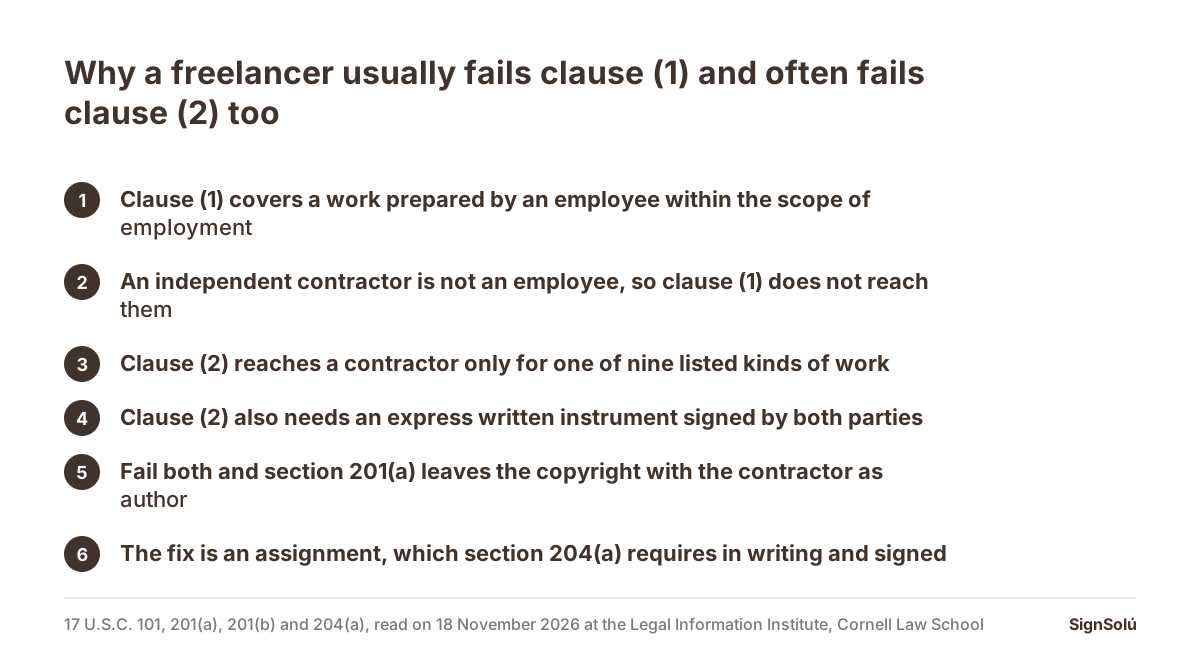
Usually not, and that surprises people who have been writing «work for hire» into freelance contracts for years. The definition in 17 U.S.C. § 101 has two clauses. Clause (1) covers «a work prepared by an employee within the scope of his or her employment» — an independent contractor is not an employee, so it does not apply. Clause (2) reaches commissioned work, but only work «specially ordered or commissioned» for use as one of nine listed things: a contribution to a collective work, part of a motion picture or other audiovisual work, a translation, a supplementary work, a compilation, an instructional text, a test, answer material for a test, or an atlas. A logo, a website, an app and a photograph are on none of that list. Fail both clauses and § 201(a) leaves the copyright with the contractor, because the author owns it. The fix is not a better work-for-hire clause: it is an assignment, in writing and signed, which is what § 204(a) requires.
The phrase «this is a work for hire» appears in a great many contracts with designers, developers, photographers and writers, and in a great many of them it does nothing. Not because it was drafted badly, but because the statute it refers to is narrower than its reputation.
The definition has two clauses, and they are not alternatives you pick
Section 101 of title 17 of the U.S. Code — read today at the Legal Information Institute of Cornell Law School — defines a work made for hire as, first, «a work prepared by an employee within the scope of his or her employment»; or, second, «a work specially ordered or commissioned for use as» one of a closed list of things, «if the parties expressly agree in a written instrument signed by them that the work shall be considered a work made for hire».
Clause (1) is about status. If the person is an employee acting within the scope of their employment, the work is a work made for hire and no clause in any contract is needed to make it one. That is also why an employer rarely has a problem here and a client hiring a freelancer often does: the whole point of engaging an independent contractor is that they are not an employee.
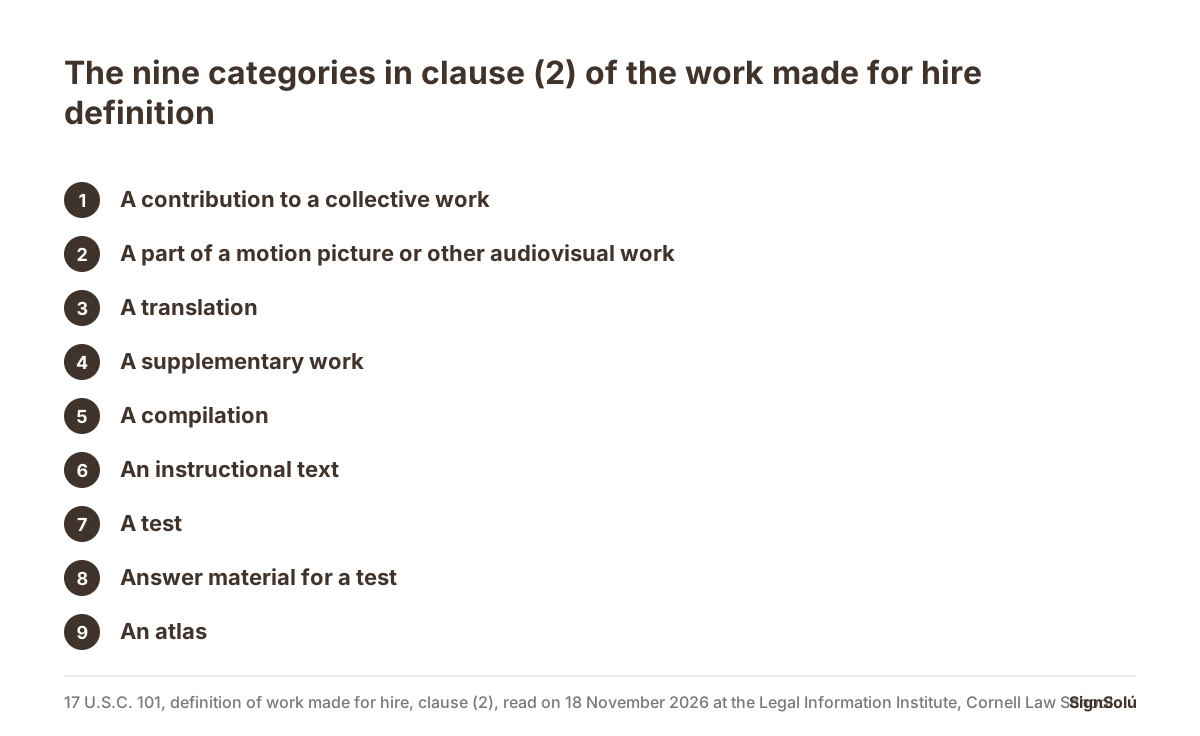
Clause (2) is the one people reach for, and it has two conditions that both have to hold. The work has to be one of nine enumerated kinds, and there has to be an express written instrument signed by both parties. Most drafters remember the second condition and forget the first.
What is conspicuously missing from the nine
Read the list and then think about what freelancers are actually commissioned to make. A brand identity. A marketing site. A mobile application. A set of product photographs. A single illustration. None of those is a contribution to a collective work, a part of an audiovisual work, a translation, a supplementary work, a compilation, an instructional text, a test, answer material for a test, or an atlas.
Software is the case that catches companies out most often, because it feels like the most obviously commissioned thing in the world. It is still not on the list. So a development agreement whose intellectual property clause says only «all deliverables are works made for hire» can leave the copyright exactly where § 201(a) puts it by default: with the author.
Who owns it when the clause misses
Section 201(a) of title 17 says copyright «vests initially in the author or authors of the work». Section 201(b) then says that «in the case of a work made for hire, the employer or other person for whom the work was prepared is considered the author», and owns all of the rights comprised in the copyright, «unless the parties have expressly agreed otherwise in a written instrument signed by them».
So 201(b) is the whole prize: it does not transfer the copyright to the client, it makes the client the author from the start. That is why the doctrine is attractive, and also why Congress fenced it in. When the work is not a work made for hire, 201(b) never engages and 201(a) governs instead. The contractor is the author and the owner, and what the client has is whatever licence can be read out of the deal.
The sentence that actually moves the copyright
An assignment. Section 204(a) of title 17 provides that a transfer of copyright ownership, other than by operation of law, is not valid unless it is «in writing and signed by the owner of the rights conveyed or such owner’s duly authorized agent». Two things follow from that wording, and both are practical.
- It has to be signed by the owner, which is the contractor, not the client. A client’s countersignature does not cure a missing contractor signature.
- It has to be in writing, so an email thread agreeing «you own everything» is a weaker thing than a signed document, and a verbal understanding is weaker still.
- It can be partial. Section 201(d)(1) says ownership «may be transferred in whole or in part by any means of conveyance or by operation of law», so an assignment can carve out, say, the contractor’s right to show the work in a portfolio.
- It works whether or not the nine categories apply, which is the point: an assignment does not care what kind of work it is.
The practical drafting answer is to keep both: say the work is a work made for hire to the extent it qualifies, and then, to the extent it does not, assign the copyright outright. That belt-and-braces pairing is why so many intellectual property clauses read the way they do, and why the short clause that only says «work for hire» is the risky one.
| What the contract says | What it achieves | What is left open |
|---|---|---|
| «Work for hire» only, freelancer, logo | Nothing under clause (2): a logo is not one of the nine | The contractor is author and owner under 201(a) |
| «Work for hire» only, freelancer, translation | Works, if signed by both parties in a written instrument | Nothing, assuming it really was commissioned as a translation |
| «Work for hire» only, employee, in scope | Works under clause (1), with or without the clause | Whether the work was within the scope of employment |
| Assignment, signed by the contractor | Transfers ownership under 204(a) | Moral-rights style concerns and any carve-outs you did not write |
| Work for hire to the extent it qualifies, plus assignment | Covers both paths | Little, which is why this is the common drafting |
| Email saying «you own it» | Not a signed writing in the 204(a) sense | Validity of the transfer itself |
The work is already delivered and nobody signed anything
This is the common situation, and it is more fixable than it feels. Nothing in § 204(a) requires the signed writing to exist before the work is made. It requires a transfer of ownership to be in writing and signed by the owner, and a contractor who is willing to sign today can transfer today what they have owned since the file was saved.
- 1Work out who the owner is first. If the person was an employee acting within the scope of their employment, clause (1) already did the job and there is nothing to transfer. If they were a contractor, start from the assumption that they own it.
- 2Check the deliverable against the nine categories before concluding the clause failed. A commissioned translation or a chapter written for an anthology may already qualify under clause (2) if there was a signed written instrument.
- 3Ask for an assignment covering the work already delivered, identified specifically rather than as «all work», so there is no argument later about which files it reached.
- 4Decide what the contractor keeps. Section 201(d)(1) allows a partial transfer, and a portfolio carve-out is usually what makes the signature easy to get rather than a negotiation.
- 5Get it signed by the contractor, since § 204(a) puts the signature on the owner of the rights conveyed. A client signature alone does not do it.
- 6Keep the proof of the signature, not just the document. The value of the clause rests entirely on being able to show a signed writing years later.
The last point is the one that gets skipped. A signed assignment that exists only as an attachment in a former employee’s mailbox is a thin thing to rely on. What has to survive for a signature to still count is covered in whether an electronic signature is legally binding, and where, and if the engagement is one of a long series with the same contractor, billed per user or per document is the cost distinction that decides how you run it.
Getting it signed by the person who has to sign it
Section 204(a) puts the signature requirement on the contractor, and that is usually the hard part of the administrative job rather than the drafting: the person whose signature the statute wants is the one who is freelancing, often in another city or another country, often without a printer. A template to start from is at /en/templates/work-for-hire-contract-template, and the broader question of when an electronic signature binds is covered in whether an electronic signature is legally binding, and where.
SignSolú is a Mexican e-signature platform that works over WhatsApp, which is relevant here for a narrow reason: a contractor who does not answer email often answers a message. The sender chooses the language for each signer, so a signer set to English receives the email, the WhatsApp message and the signing page in English, and nobody has to open an account to sign. You can send one from /en/sign-documents-online, and what the signature leaves behind is described at /en/trust.
Because the whole value of the clause depends on a signature existing, it is worth keeping the proof of it rather than just the file. Every signed document receives an RFC 3161 time stamp, the audit certificate records the time, the IP address, the device and a SHA-256 hash, and the signature stroke itself is recorded point by point rather than stored as a picture. Anyone can check the document at /en/verify without an account. If the engagement also involves confidential material, the related document is covered in supplier agreements and e-signature.
Frequently asked questions
Can a freelancer ever produce a work made for hire?
Yes, but only through clause (2) of the 17 U.S.C. § 101 definition, and only if the work was specially ordered or commissioned for use as one of nine listed things and the parties expressly agreed in a written instrument signed by them. A translation or a contribution to a collective work can qualify. A logo, a website or an app does not appear on the list.
Is software a work made for hire?
Not by virtue of being commissioned. Software is not one of the nine categories in clause (2), and a contractor writing it is not an employee for clause (1). That is why development agreements normally pair the work-for-hire language with an outright assignment of copyright.
Who owns the copyright if the work-for-hire clause does not apply?
The contractor. Section 201(a) says copyright vests initially in the author, and § 201(b) only displaces that for a work made for hire. If neither clause of the definition is satisfied, § 201(b) never engages and the person who created the work is both author and owner.
What makes a copyright assignment valid?
Section 204(a) requires that a transfer of copyright ownership, other than by operation of law, be in writing and signed by the owner of the rights conveyed or that owner’s duly authorized agent. The signature that matters is the contractor’s, since they are the owner being asked to convey.
Can an assignment be partial?
Yes. Section 201(d)(1) says ownership of a copyright may be transferred in whole or in part by any means of conveyance or by operation of law. That is what lets a contract assign the commercial rights to the client while leaving the contractor a right to display the work in a portfolio.
Does an electronic signature satisfy the writing requirement?
Under the E-SIGN Act, a signature or record may not be denied legal effect solely because it is in electronic form, which is why electronic assignments are routine. What matters practically is that you can still produce the signed document and show who signed it, so keeping the audit record alongside the file is worth more than the file alone.
Send your next contract to Mexico for signature
Create a free account and send 10 documents with no card. Your dashboard works in English. You set the language per signer, and their email, WhatsApp message and signing page arrive in that language.