Are e-signature tools billed per user or per document? How to tell before you commit
Both models exist, and the two are not interchangeable. Per user — sometimes called per seat — charges for each person in your organisation who can send documents, and usually caps how many documents each of them may send. Per document — sometimes called per envelope — charges for each document you send for signature, whatever the number of people who send them. Which one is cheaper depends on which number grows in your business: the senders or the documents. And there is a third number that decides more bills than either: whether a document with four signers counts as one document or as four.
Why the answer is not on the price page
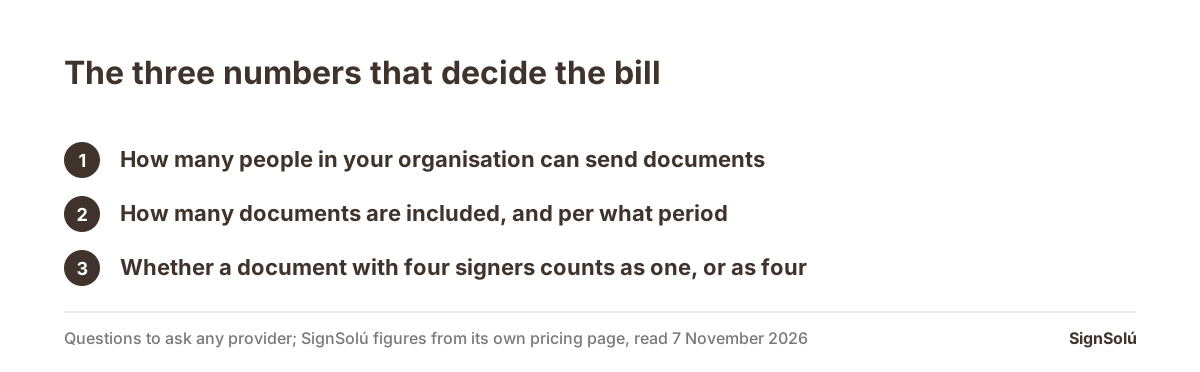
A price page shows a monthly figure and a list of features. What it rarely shows in one place is the three numbers that decide your bill: how many people can send, how many documents are included, and how a document with several signers is counted.
Those three questions are the whole comparison. Everything else — templates, branding, integrations — changes what the tool does, not what it costs you at the end of the quarter. A template library is the one feature that does change the arithmetic, because it removes the drafting time: see the service agreement template, the employee loan agreement and the annual maintenance contract for the shape of the ones that get reused most.
The two models, and what each one punishes
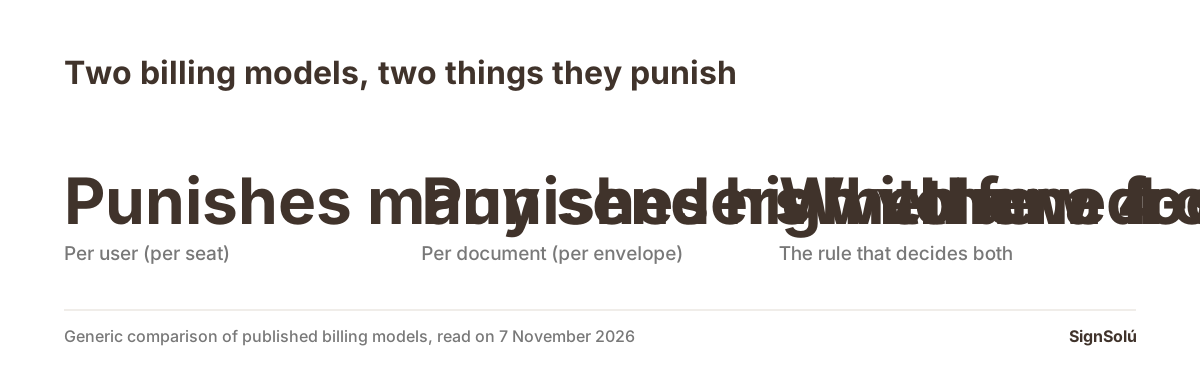
Per user. You pay for each seat: the sales manager, the two account executives, the person in HR. Usually each seat comes with an allowance of documents. It punishes a team where many people send a few documents each — a branch network, a dealer group, a firm where every lawyer sends their own.
Per document. You pay for each document sent for signature. The number of people in your organisation is irrelevant. It punishes high volume from a small team — a rental company that sends two hundred contracts a month from one back office, a clinic that sends a consent form to every patient.
Stated that plainly, the choice is arithmetic. The complication is that most real businesses are somewhere in between, and that the counting rule changes the arithmetic more than the model does.
The third number: does a signer cost money?
This is the one to ask about before anything else, because it is where a quote and a bill part company. A supply agreement signed by your director, the counterparty’s director and two witnesses is one document with four signatures. Some tools count that as one. Others count a unit per signature, or charge extra beyond a number of signers, or require the counterparty to hold an account of their own.
If the counterparty needs an account, the cost has moved off your invoice and onto your deal: the signature that does not happen because somebody would not register is more expensive than any plan. It is the single most common reason a document sits unsigned for a week.
| Question to ask | Why it changes the bill | What a good answer looks like |
|---|---|---|
| How many people in my organisation can send? | It is the per-seat axis | A number, or «unlimited» |
| How many documents are included, and per what period? | It is the per-document axis | A number per month, stated |
| Does a document with four signers count as one or as four? | Multi-signer deals are where quotes break | «Each document counts once, however many people sign» |
| Does the other side need an account? | An account requirement costs you deals, not money | No account, no payment, signs from a phone |
| Are templates limited? | A cap on templates forces copy-paste and errors | Unlimited templates with your own fields |
| Is the audit trail included or an add-on? | It is the part you need if anything is ever disputed | Included on every plan, free one too |
| What happens to documents already signed if I stop paying? | Access to history is worth more than the monthly fee | You can still download and verify them |
Work out your own number in five minutes
- 1Count the documents you sent for signature last month. Not the ones you meant to send: the ones that went out.
- 2Count how many different people in your organisation sent them.
- 3Count the average number of signers per document, including witnesses.
- 4Multiply: documents × the per-document price, against senders × the per-seat price. Two numbers.
- 5Then redo the first number using the counting rule you were quoted. If signatures are counted rather than documents, multiply by the average from step three.
Step five is where most plans turn out to cost two or three times the headline. It is also the step nobody does before signing up, which is why the second month is the surprising one.
What SignSolú charges, so the arithmetic has a reference
SignSolú is a Mexican e-signature platform that works over WhatsApp. Its published plan, on the pricing page, is USD $22.99 per month for 500 documents per month, with unlimited users in your organisation and unlimited templates with your own fields. Each document counts once, however many people sign it. The audit certificate is included. The free plan is 10 documents, with no expiry and no card.
Put against the three questions above: it is a per-document plan where the per-seat axis is removed, and the counting rule is the document and not the signature. For a rental company, a clinic or a property manager — many documents, few senders, several signers per document — that is the shape that costs least. For a large field sales organisation with a handful of documents per person, a per-seat plan with a small allowance may well come out lower, and the arithmetic in step four will say so.
The part that does not show up in either column: the person on the other side does not open an account and does not pay. The link arrives by WhatsApp or by email and they sign from their phone. Anyone can then check the signed file at the verification page, with no account. SignSolú is not an accredited certification service provider and does not issue NOM-151 conservation certificates, which are a Mexican requirement for a specific kind of evidence.
Four pricing words that mean something specific
Half of the confusion is vocabulary, and the words are not standard across providers. Reading a quote is easier once you know which axis each word sits on.
- Seat. A person in your organisation who can send. Some plans distinguish a sender from a viewer, and only the sender costs.
- Envelope. A document, or a package of documents, sent in one go. Whether a package counts as one envelope or several is worth asking, because a lease plus two annexes is the common case.
- Signature. One person signing. If the unit is the signature rather than the envelope, your multi-signer deals get expensive quietly.
- Allowance. The number included before anything extra is charged, and the period it resets on. An annual allowance and a monthly one behave very differently in a seasonal business.
The package question deserves a line of its own. A rental operation sends a contract, an inventory annex and a handover note for the same job, and whether that is one unit or three decides whether the plan fits. The practical fix is the same either way: put the annexes inside one document instead of sending three, which also means one signature event and one hash to verify later. The companion piece on the Mexican side, with the article behind it, is plataformas de firma electrónica que cobran por documento and quién paga la firma, el que manda o el que firma.
Two costs that are not on any plan
The first is the deal that does not close because the counterparty will not register, download an app or install a certificate. The second is the hour someone spends looking for a signed document from eighteen months ago. Neither appears on an invoice, and both are usually larger than the difference between two plans. What the audit receipt has to contain so the second cost never arrives is in how to sign a contract remotely with someone in Mexico, and the templates that remove the drafting cost are at the templates index and the guides index.
Before you compare price, check the evidence
A cheap signature that cannot be shown to be genuine is not cheap. What matters is what travels with the document: the time, the IP address, the device and a hash of the file, so that the version signed can be distinguished from any later one.
What makes an electronic signature binding, and where, is in is an electronic signature legally binding; for Mexico specifically, is an electronic signature valid in Mexico and NOM-151 in Mexico; across the border, is a Mexican e-signature valid in the US. Where a deed and a witness are in the way, the supplier agreement and the deed question. How the audit trail is built is on the trust page, the disclosure on the electronic signature disclosure, and validity by country on the validity pages.
If the work ahead is signing with a party in Mexico, the practical walkthrough is in how to sign a contract remotely with someone in Mexico and e-signature platforms for doing business in Mexico; which language governs, in bilingual contracts in Mexico. The documents themselves start from the service agreement template, the independent contractor agreement and the mutual NDA.
Frequently asked questions
Are e-signature tools billed per user or per document?
Both models exist. Per user charges for each person in your organisation who can send documents, usually with an allowance each. Per document charges for each document sent for signature, regardless of how many people send them.
Which one is cheaper?
It depends on which number grows in your business. Many senders with few documents each favours a per-document plan with unlimited users; a few documents per person across a large team can favour a per-seat plan with a small allowance. The arithmetic takes five minutes.
Does a document with four signers cost four times as much?
That is exactly the question to ask, because providers differ. SignSolú publishes that each document counts once, however many people sign it. Other providers count signatures or charge beyond a number of signers, and that is where a quote and a bill part company.
Does the person signing have to pay or open an account?
With SignSolú, no: the link arrives by WhatsApp or by email and they sign from their phone without creating an account or paying anything. Where a provider requires the counterparty to register, the cost shows up as deals that take a week longer.
Is there a free way to try it?
SignSolú’s free plan is 10 documents, with no expiry and no card, and the audit certificate is included on it. That is enough to run the arithmetic on real documents instead of on a spreadsheet.
What should I check besides the price?
What travels with the document: time, IP address, device and a hash of the file, so the signed version can be distinguished from any later one; whether the audit trail is included or an add-on; and whether you can still download and verify signed documents if you stop paying.
Send your next contract to Mexico for signature
Create a free account and send 10 documents with no card. Your dashboard works in English. You set the language per signer, and their email, WhatsApp message and signing page arrive in that language.