Canadian travel consent letter: free in Word, or sign it online
A Canadian travel consent letter shows that a child travelling abroad has permission from a parent who is not on the trip. The Government of Canada recommends carrying one for every international trip, even a day across the US border. It is not legally required, but officials may ask for it.
Ten documents free, no card. Signed by each parent who is not travelling.
Example filled in with sample data
The full travel consent letter
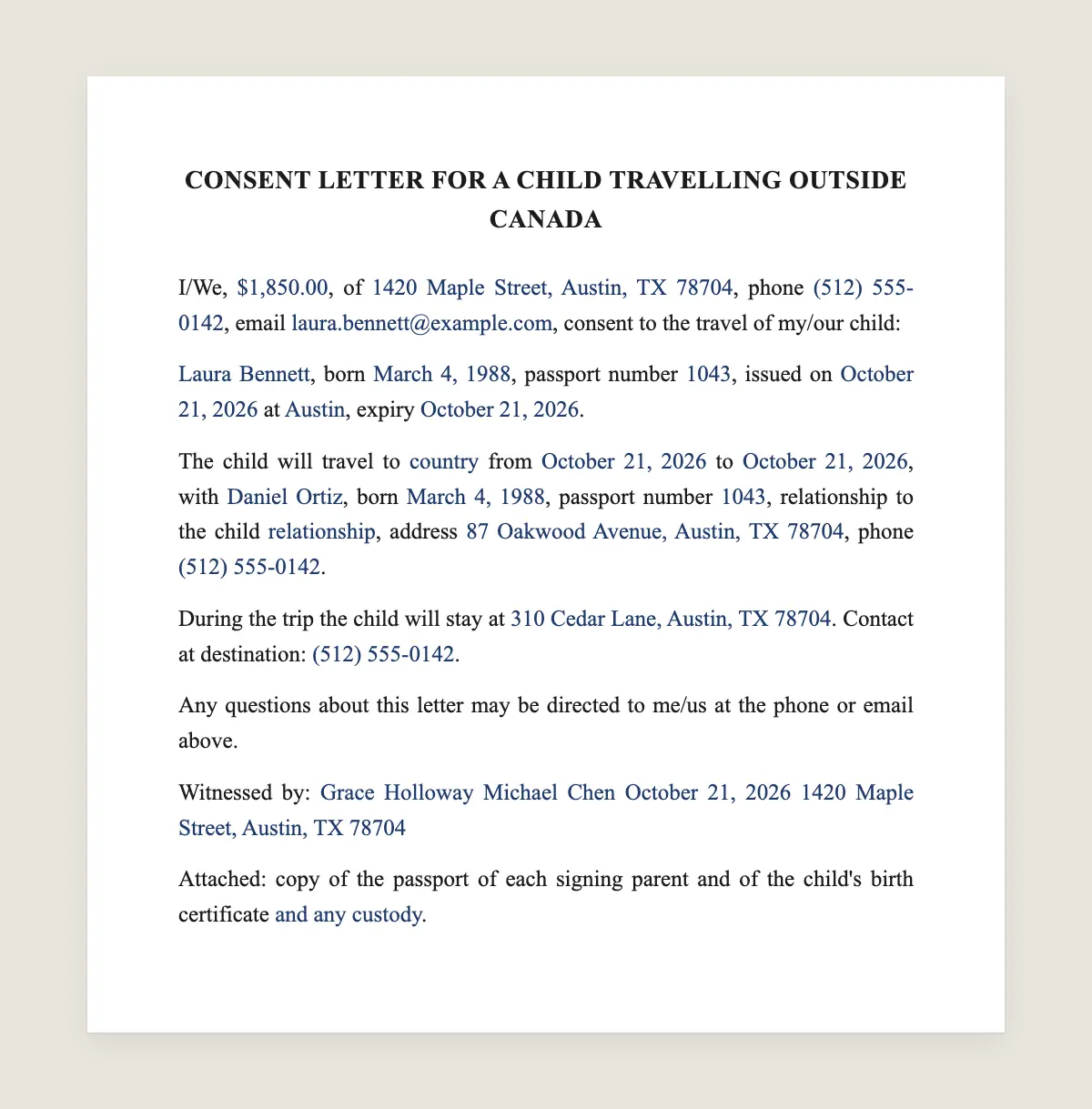
CONSENT LETTER FOR A CHILD TRAVELLING OUTSIDE CANADA
I/We, [full name of parent or person with decision-making responsibility], of [address], phone [phone], email [email], consent to the travel of my/our child:
[Child full name], born [date of birth], passport number [number], issued on [date] at [place], expiry [date].
The child will travel to [country or countries, cities] from [departure date] to [return date], with [full name of accompanying adult], born [date of birth], passport number [number], relationship to the child [relationship], address [address], phone [phone].
During the trip the child will stay at [address of accommodation]. Contact at destination: [name and phone].
Any questions about this letter may be directed to me/us at the phone or email above.
Witnessed by: [Signature of witness or notary] [Printed name] [Date] [Address or seal]
Attached: copy of the passport of each signing parent and of the child's birth certificate [and any custody or parenting order].
Signature of parent
Printed name: ______________
Date: ______________
Signature of second parent, if applicable
Printed name: ______________
Date: ______________
What the template includes
Name and contact details of each consenting parent
Child's name, date of birth and passport data
Destination, departure date and return date
Accompanying adult with passport data and relationship
Accommodation and a contact at destination
Contact line for questions from officials
Signatures of the parents who are not travelling
Witness or notary line
List of attachments
What you fill in
Field
Example
Consenting parent
Jean-Luc Tremblay, Montreal
Child
Chloé Tremblay, born May 9, 2016
Destination
Orlando, Florida, United States
Dates
December 20, 2026 to January 3, 2027
Travelling with
Marie Gagnon (mother)
Accommodation
Rosewood Suites, 8800 Vineland Ave
Witness
Notary public
How it gets signed
1Choose «Use this template», fill in the fields and review the full travel consent letter.
2Send it by WhatsApp or email. The other party opens the link on their phone without an account.
3They tap the brown bar at the bottom that says «Sign as …» and draw their signature once.
4Everyone gets the signed PDF with its signature certificate. Anyone can check it at signsolu.com/verificar.
A parent abroad signs from their phone wherever they are. The Government of Canada says digital signatures may be accepted, and recommends carrying the original signed letter. Print the signed PDF and have it witnessed, ideally by a notary, before the trip.
What you get once everyone signs
The signed PDF. The final travel consent letter with every drawn signature in place.
The signature certificate. It lists each signer and the date and time of each signature.
A record you can check. The folio on the certificate opens the document history at signsolu.com/verificar.
Reminders. Turn them on and SignSolú reminds every signer who has not signed yet.
Your first ten documents are free and need no card.
What the law says
The Government of Canada explains consent letters on travel.gc.ca. A consent letter is not legally required in Canada, but immigration authorities, airline agents and Canadian officials may ask for it.
It should be signed by any parent or person with decision-making responsibility who is not travelling with the child. That includes parents who are married, in a common-law relationship, separated or divorced.
Any adult may witness the signature, and the Government strongly recommends a notary public. There are no official rules for content and format, so the letter usually carries the data this template asks for.
Who signs the letter
One parent travels. The other parent signs.
Neither parent travels. Both parents sign one letter, or each signs their own.
A parent lives outside Canada. That parent signs, ideally with a witness such as a consular officer.
A parent has died. The surviving parent signs and the child carries a copy of the death certificate.
The Government recommends a letter even when a parenting order lets one parent decide travel alone. Officials may still ask for proof.
What to carry at the border
The original signed consent letter.
The child's passport and any visa needed.
A copy of the signing parents' passports.
The child's birth certificate, which shows the parents' names.
Any custody or parenting order that applies.
Common mistakes
Only a photocopy. Officials may question copies. Carry the original signed letter.
Missing dates or destinations. Write each country and the exact travel dates, including connections.
No witness. Any adult may witness, and a notary carries more weight at the border.
One letter or several
If neither parent travels, both can sign one letter or each can sign a separate one. The Government of Canada accepts either approach.
When a child travels with different adults on different legs of a trip, a separate letter for each part helps. Each letter names the adult in charge for that part.
School trips work the same way. Parents sign a letter that names the teacher or chaperone leading the group.
Why fill it in online
The parent who stays home often lives in another city or country. Sending a link by WhatsApp is faster than mailing a paper back and forth.
SignSolú keeps the data typed and legible, with the passport numbers written once and checked. The signed PDF arrives in minutes.
Print it, have it witnessed and carry the original. Keep the PDF on your phone as a backup in case the paper gets lost on the trip.
What the letter does not do
The Government of Canada notes that a consent letter shows permission but does not guarantee a child's return. It is a precaution, not a complete safeguard.
Destination countries may also have their own entry rules for minors. Check with the embassy or consulate of each country before you travel.
Some countries ask for the letter in their own language or with a stamp from a consulate. Ask early, since those steps can take weeks.
Example of a filled-in letter
Jean-Luc lives in Montreal and stays home. His daughter Chloé flies to Orlando with her mother, Marie, for the winter holidays.
Jean-Luc fills in the letter with Chloé's passport, the dates, the hotel and Marie's details. He signs it from his phone and prints the signed PDF.
A notary near his office witnesses the printed letter. Marie carries the original with copies of both parents' passports and Chloé's birth certificate.
At the airport, the agent asks for the letter. Marie shows it, and the family boards without extra questions.
Custody orders and the letter
If a court order sets who decides travel, carry a copy of it with the letter. Officials may compare the two documents at the border.
When the other parent cannot be reached or contacting them is unsafe, the Government of Canada suggests getting legal advice before the trip.
Keep the contact line in the letter current. Officials may call the absent parent during the trip, so a phone that rings matters more than a perfect signature.
Write the letter in English or French, and add a translation for the destination if its officials use another language.